I know the definition. It is a shift in 2 counterpropagating beams of light around a loop which is rotating.Where are your loops???
You are still comparing two OPEN SEGMENTS: defying the very definition of the Sagnac effect.
Path 1 - A>B, D>C.
Path 2 - C>D, B>ACompletely wrong!
The paths are very clear:
A > B > C > D > A is a continuous counterclockwise path, a negative sign -
A > D > C > B > A is a continuous clockwise path, a positive sign +
Yes, ignoring the sign which I don't particular care about at this timeYou CANNOT ignore the sign, since by your own admission you have light beams travelling in opposite directions.
You are literally saying it takes negative time to do something.No negative times at all.
Just two loops, continuous paths, as required by the definition of the Sagnac effect.
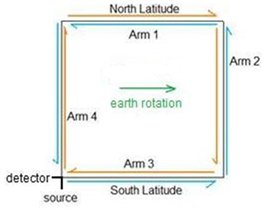
Point A is located at the detector
Point B is in the bottom right corner
Point C is in the upper right corner
Point D is in the upper left corner
Here is the most important part of the derivation of the full/global Sagnac effect for an interferometer located away from the center of rotation.
A > B > C > D > A is a continuous counterclockwise path, a negative sign -
A > D > C > B > A is a continuous clockwise path, a positive sign +
The Sagnac phase difference for the clockwise path has a positive sign.
The Sagnac phase difference for the counterclockwise has a negative sign.
Sagnac phase components for the A > D > C > B > A path (clockwise path):
l
1/(c - v
1)
-l
2/(c + v
2)
Sagnac phase components for the A > B > C > D > A path (counterclockwise path):
l
2/(c - v
2)
-l
1/(c + v
1)
For the single continuous clockwise path we add the components:
l
1/(c - v
1) - l
2/(c + v
2)
For the single continuous counterclockwise path we add the components:
l
2/(c - v
2) - l
1/(c + v
1)
The net phase difference will be (let us remember that the counterclockwise phase difference has a negative sign attached to it, that is why the substraction of the phase differences becomes an addition):
{l
1/(c - v
1) - l
2/(c + v
2)} - (-){l
2/(c - v
2) - l
1/(c + v
1)} = {l
1/(c - v
1) - l
2/(c + v
2)}
+ {l
2/(c - v
2) - l
1/(c + v
1)}
Rearranging terms:
l
1/(c - v
1) - l
1/(c + v
1)
+ {l
2/(c - v
2) - l
2/(c + v
2)} =
2(v
1l
1 + v
2l
2)/c
2BY CONTRAST, here is what you did:
Now instead of adding and subtracting based upon direction, we will add the terms of the same colour, corresponding to the one beam rotating around the interferometer and then find the difference.
dt=l1/(c - v1)+l2/(c + v2)-l1/(c + v1)-l2/(c - v2)
=l1/(c - v1)-l1/(c + v1)+l2/(c + v2)-l2/(c - v2)
=l1(c + v1-c + v1)/(c2 - v12)+l2(c - v2-c - v2)/(c2 - v22)
=2*l1v1/(c2 - v12)-2*l2v2/(c2 - v22)
We have the following terms, both have the same direction, that means one of them corresponds to the red in the inner segment and one to orange on the outer segment. I will colour code them for clarity:
l1/(c - v1)
l2/(c - v2)
Then, we have the remaining terms, in the opposite direction, likewise meaning one is for orange one is for red, noting that red travelled along l1 in the previous one so now it must travel along l2 in this one:
l1/(c + v1)
l2/(c + v2)
Then, if they ARE in opposite direction, they must have the OPPOSITE SIGN.
You used the SAME sign for opposite directions.
Moreover, you compared two open segments, and not the two loops of the Sagnac interferometer.
l1/(c - v1)
l2/(c + v2)
Again, there are 4 legs, not 2. This means you should actually have 4 components.
If you assume arm 2 and 4 to be insignificant (which is technically wrong for a rectangle, as they need to be radial to have no effect, but then again you don't even have a constant v for a rectangle either), then you end up with arm 1, where the light is propagating with the motion of the apparatus, a time of (again, just accepting the formula you provided rather than double checking it):
l1/(c - v1)
which is larger than if it is at rest.
Then for the time in arm 3 you get:
l3/(c + v3)
which is smaller than if the arm is at rest.
You need to add these 2 POSITIVE times to get a reference time for the loop (as well as 2 lots for arm 2 and 4).You seem to need medical attention jackblack.
Of course the times will be larger and smaller, since you are dealing with DIFFERENT VELOCITIES, c - v
1 - v
2 and c + v
1 + v
2.
Positive times? Everyone is laughing at you.
You used the wrong signs.
You compared two open segments, in full defiance of the definition of the Sagnac effect.
I added correctly the terms for the two loops.
His experiment was fundamentally different to get a different formula.The very same experiment: two different velocities, two different lengths.
Do not fool yourself into believing anything else.
Because amazingly enough it doesn't matter if it goes in the opposite direction, it still takes a positive time.
You don't magically go backwards in time by going against the rotation.No backward time at all.
I am obeying the very definition of the Sagnac effect: comparing two LOOPS in opposite direction.
Each sign has been assigned properly.
No error at all.
You, on the other hand, used the wrong signs and compared two open segments.
Yes, just like I did, but unlike your garbage, I had positive times, as it doesn't reach the end before it leaves like your nonsense indicates.
l1/(c - v1) + l2/(c + v2)Do you understand the definition of the Sagnac effect?
Let me remind you of it:
https://www.mathpages.com/rr/s2-07/2-07.htmTwo pulses of light are sent in opposite directions around a loop.
Loop = a structure, series, or process, the end of which is connected to the beginning.
What you, jackblack, have done, is to compare two open segments of the interferometer, and not the two loops as required by the definition of the Sagnac effect.
l1/(c - v1) + l2/(c + v2)You have the wrong sign!!!
These beams are in opposite direction: one has a positive sign l1/(c - v1), the other has a negative sign -l2/(c + v2).
But again, we don't use your nonsense negative times.There are NO negative signs.
Just TWO LOOPS: one counterclockwise, one clockwise.
Exactly as required by the defintion of the Sagnac effect.
Please read:
Here is how it's done.
Point A is located at the detector
Point B is in the bottom right corner
Point C is in the upper right corner
Point D is in the upper left corner
l
1 is the upper arm.
l
2 is the lower arm.
Here is the most important part of the derivation of the full/global Sagnac effect for an interferometer located away from the center of rotation.
A > B > C > D > A is a continuous counterclockwise path, a negative sign -
A > D > C > B > A is a continuous clockwise path, a positive sign +
The Sagnac phase difference for the clockwise path has a positive sign.
The Sagnac phase difference for the counterclockwise has a negative sign.
Sagnac phase components for the A > D > C > B > A path (clockwise path):
l
1/(c - v
1)
-l
2/(c + v
2)
Sagnac phase components for the A > B > C > D > A path (counterclockwise path):
l
2/(c - v
2)
-l
1/(c + v
1)
For the single continuous clockwise path we add the components:
l
1/(c - v
1) - l
2/(c + v
2)
For the single continuous counterclockwise path we add the components:
l
2/(c - v
2) - l
1/(c + v
1)
The net phase difference will be (let us remember that the counterclockwise phase difference has a negative sign attached to it, that is why the substraction of the phase differences becomes an addition):
{l
1/(c - v
1) - l
2/(c + v
2)} - (-){l
2/(c - v
2) - l
1/(c + v
1)} = {l
1/(c - v
1) - l
2/(c + v
2)}
+ {l
2/(c - v
2) - l
1/(c + v
1)}
Rearranging terms:
l
1/(c - v
1) - l
1/(c + v
1)
+ {l
2/(c - v
2) - l
2/(c + v
2)} =
2(v
1l
1 + v
2l
2)/c
2You, on the other hand, COMPARED TWO OPEN SEGMENTS, and used the WRONG SIGNS.
tell us simply how long it takes for the orange beam in arm 3 below to travel from the right side of it to the left side of it, assuming the arm has a length of l3, and is traveling at a velocity of v3.Again, you are comparing SIDES/ARMS, not the two LOOPS as required by the definition of the Sagnac effect.
Your full ignorance of the Sagnac effect is incredible.
HERE IS THE DEFINITION OF THE SAGNAC EFFECT:
Two pulses of light sent in opposite direction around a closed loop (either circular or a single uniform path), while the interferometer is being rotated.
Loop = a structure, series, or process, the end of which is connected to the beginning.
A single continuous pulse A > B > C > D > A, while the other one, A > D > C > B > A is in the opposite direction, and has the negative sign.