@Jack, don't make me laugh!
1. I don't know what causes stellar aberration, and i don't have to know the real reason which lies behind that phenomena. Why i don't have to know it? Because Airy's failure experiment was designed to determine whether the real reason which causes this phenomena should be assigned to the earth's orbital motion or not!
Who designed this method of verification? One of the greatest physicist of all time.
Who was
Ruđer Bošković :
http://www.croatia.org/crown/articles/10055/1/Rudjer-Boskovic-a-famous-Croatian-scientist-born-300-years-ago-in-1711.html>>>With his theory of forces R. Bošković was a forerunner of modern physics
for almost two centuries. It was described in his most important book
Theoria Philosophiae naturalis (Vienna 1758, Venice 1763, London 1922, American edition in 1966).
Werner Heisenberg (Nobel prize for physics in 1932) wrote the following:
"Among scientists from the 18th century Boskovic occupies outstanding place as a theologian, philosopher, mathematician, and astronomer. His "
Theoria philosophiae naturalis" announced hypotheses which were confirmed
only in the course of last fifty years. "<<<
James Bradley was the guy to whom my countryman Ruder Bošković (forgotten croatian genius) - during his visitation to London - proposed to conduct a decisive experiment in order to determine if the earth orbits the sun!!! Almost 100 years later (In 1871) G. B. Airy (1802-1892) implemented the verification of Bradley's aberration hypothesis proposed by Boscovich.
Bošković even designed a telescope filled with water in all its components, which was implemented at the Greenwich observatory in 1871, that is, 84 years after his death.Of course, Airy's water-filled instrument did not deliver the desired proof of the Copernican paradigm. Agreeing with somewhat similar tests already performed by
Hoek and Klinkerfusz, the experiment demonstrated exactly the opposite outcome of that which had to be confidently expected. Actually the most careful measurements gave the same angle of aberration for a telescope with water as for one filled with air.
Airy put water in the telescope to test Bradley's claim that the moving Earth
caused aberration; he saw no change in aberration angle with the water
added. This was termed a ‘failure’, since Bradley’s theory of receiver motion
predicted a change with the index of refraction – n.
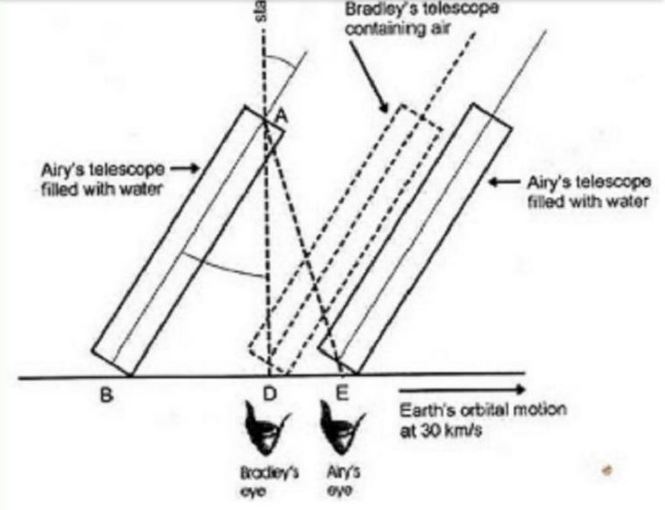
Bradley analysis – dashed lines above : The middle telescope is tilted to see
the aberrated starlight. When light moves through the telescope from A to D
the Earth – and telescope - move from B to D . This determines the aberration
angle of tilt , arc tan( BD/AD).
Airy analysis – solid lines above: With water added (left telescope), the light
travels the distance AD through the telescope slower, at ¾ of c.
So the telescope travels further at the Earth’s orbital speed, a distance BE, and
the aberration is now greater, arc sin( AD/BE ). Nice theory, but fails to
predict the actual result, shown in the right telescope – there’s NO CHANGE
in the tilting required!
The Earth’s motion as cause of aberration is simply refuted by Airy’s test – the
‘failure’ to increase aberration with water as the telescope medium, instead of
air.
Airy’s failure is in reality a ‘success’ for GC prediction and the ALFA model,
where the flexible aether ‘s sidereal rotation explains the result. The deflection
occurs in transit due to the sideways aether flow. The light path is bent in
space, before entering the telescope, while the Earth is at rest.
GC ALFA analysis : There are no D and E distances, since the Earth is
motionless. The light beam in water just travels slower, at ¾ of c, from A to B,
but there’s no sideways motion. So no additional tilting is needed….. Airy’s
test is a success – for GC and the ALFA model!
CONCLUSION: The deflection of starlight known as stellar aberration is NOT due
to the Earth’s motion, but is an external bending of light before reaching the
telescope.
SO, EARTH'S ORBITAL MOTION IS EXCLUDED AS A POSSIBLE REASON WHICH LIES BEHIND THIS PHENOMENA!!!THIS IS HOW YOU CAN BE DOUBLE-SURE THAT STELLAR ABERRATION IS NOT CAUSED BY EARTH'S SUPPOSED MOTION AROUND THE SUN :
If we accept the Copernican viewpoint and its unavoidable
extrapolations with regard to the structure of the universe, we
have to accept the consequences. Then we cannot hold on to the
picture of a simple sun- centered cosmos, of which not even
Newton was fully convinced, but which
Bradley and Molyneux
took for granted. Today the astronomers assure us that our Great
Light is only an insignificant member of a spiral Milky Way
galaxy, containing billions of stars. Our sun flies at a speed of
about 250 km/sec around the center of this system. And that is
not all, the ruling cosmology also tells us how the Milky Way
itself whirls at 360,000 km/hr through the space occupied by the
local group of galaxies. Now all these imposing particulars are
theoretically gathered from observations assuming the speed of
light to be 300,000 km/sec, at least, everywhere through our
spatial neighborhood. But if this cosmological panorama is put
through its paces, there is a hitch somewhere. The astronomical
theorists cannot have their cake and eat it. If they accept— as all
the textbooks still do!—Bradley's “proof” of the Copernican
truth, then their cosmological extrapolations of that truth clash
with a not-yet developed simple heliocentrism; that is to say, with
the model of an earth orbiting a spatially unmoved sun.
The other way around, when holding on to their galactic
conjectures, they are at a loss how to account for a steady 20”.5
stellar aberration. For in that scheme our earth, dragged along by
the sun, joins in this minor star's 250 km/sec revolution around
the center of the Milky Way.
If, for instance, in March we indeed
would be moving parallel to the sun's motion, our velocity would
become 250+30 = 280 km/sec, and in September 250-30 = 220
km/sec. The “aberration of starlight,” according to post-
Copernican doctrine, depends on the ratio of the velocity of the
earth to the speed of light. As that velocity changes the ratio
changes. Hence Bradley's 20”.496 should change, too. But it does
not. Therefore, there is truly a fly in this astronomical ointment,
paraded and promoted as a truth. ”Not true,” the theorists will object, “such out-dated reasoning in
a space knowing place cuts no ice with us. Relativity has no
difficulty with that kind of supposed contradiction.” I dare to
differ. Their Einsteinian panacea, foreshadowed by the
prevarications of Fresnel's “
We cannot decide,” Lorentz's “
We
cannot measure,” and Poincaré's “
We cannot observe"
is mere
eyewash.
Consider : according to the ruling paradigm, it makes no
physical difference whether I declare either the earth to move
with respect to everything else at rest, or declare the earth to be at
rest with respect to sun and stars moving around. Starting from an
earth at rest, and hence aberration being absent, then whatever the
truth, the annual standard size circlets of all the stars are real and
not caused by our 29.8 km/sec orbital velocity. Instead of a
heliocentric “aberration,” we are confronted with a geocentric
parallax, and these parallaxes being practically the same size for
all stars, these stars must be at the same distance from us. This
points to the existence of the stellatum of old.
This will be judged to be patently “unthinkable” or worse.
Bradley's unobservable and by Airy's failure emasculated “stellar
aberration” remains indispensable for holding on to a Big Bang
and a universe expanding into space or expanding space.
Manifestly, such a post- Copernican cosmos could not differ
much physically from the pre- Copernican one. To say that this is
a difference of motion only is nonsense. It allows me to agree
with
Stephen W. Hawking: “
You cannot disprove a theory by
finding even a single observation that disagrees with the
predictions of the theory.”
Conclusion:
Einstein's cure-all cures
nothing! Assuredly, I do not claim that the foregoing proves my
modified Tychonian hypothesis.
Experimentally, however, it
undoubtedly has the soundest credentials. More than three
centuries of efforts to disprove it have already come to naught.
The pseudo-heliocentric universe popularized for the benefit of
the man-in-the-street has, in fact, not a leg to stand on.2. In Galileo's time Solar System has been perceived very differently in relation to today's science. Why they had to enlarge Solar System so much? To displace the earth from it's central place in the universe and to transform her into insignificant planet even within Solar System, let alone within the whole Big Bang paradigm (a.k.a. Infinite Universe).
Edwin Hubble was the first to see the centrally located earth. In his 1937 book The Observational Approach to Cosmology, he expresses his deepest concerns about the fact that the red shift of galaxies was isotropic in whatever direction of the sky he looked, concluding:
“...Such a condition would imply that we occupy a unique position in the universe, analogous, in a sense, to the ancient conception of a central Earth... This hypothesis cannot be disproved, but it is unwelcome and would only be accepted as a last resort in order to save the phenomena. Therefore we disregard this possibility... the unwelcome position of a favored location must be avoided at all costs... such a favored position is intolerable... Therefore, in order to restore homogeneity, and to escape the horror of a unique position... must be compensated by spatial curvature. There seems to be no other escape.”
Modern cosmology has tried to explain this phenomenon using the Friedmann-Lemaitre-Robertson-Walker (FLRW) model of Einstein’s “spatial curvature” equations to produce a non-Euclidean universe that is expanding as if on the surface of a balloon. As such, all the galaxies will appear to expand away from each other so that no single point could be designated the center of the expansion.
But as
Stephen Hawking has admitted, the FLRW model has no evidence in its favor; rather, cosmologists choose it merely to preserve the Copernican principle.
He writes: “...the universe might look the same in every direction as seen from any other galaxy, too. This, as we have seen, was Friedmann’s second assumption. We have no scientific evidence for, or against, this assumption. We believe it only on grounds of modesty.”
His co-author in another book,
George F. R. Ellis admits much the same: “This assumption is made because it is believed to be unreasonable that we should be near the center of the Universe.”
Hawking admits that the evidence could just as well point to a central earth: “...all this evidence that the universe looks the same whichever direction we look in might seem to suggest there is something special about our place in the universe. In particular, it might seem that if we observe all other galaxies to be moving away from us, then we must be at the center of the universe.”
Using the simplest interpretation of the current cosmological evidence concerning galactic redshift; the anisotropy of the CMB; gamma-ray and X-ray bursts; and quasar distribution, as provided by the 2005 Sloan Digital Sky Survey; the
2001 Wilkinson Microwave Anisotropy Probe and other such studies, show that the Earth is at or very near the center of the universe and that alternative interpretations advancing homogeneity and the LCDM universe (e.g., “the center is everywhere and nowhere due to an expanding universe”) are contradicted by the di- quad- and octu-pole outcomes of the CMB; the large void area at the observation point; and the consistent concentric and quantized z-factor of the redshift around the observation point. Further evidence from the
Michelson-Morley and
Sagnac- type experiments from 1881 through 1932, as well as post-1932 maser and laser interferometry, including the
Sagnac-based pre-programming for the Global Positioning Satellites, show that some type of ponderable ether exists, which is in principle agreement with Quantum Mechanics but opposed to Special Relativity. It is postulated that interpretations of the historic interferometer experiments that were said to yield a “null” result were simply the result of presuming, without proof, that the Earth was translating at 30km/sec around the sun, which leads to the conclusion that Special Relativity was invented precisely to avoid having to answer the Michelson-Morley experiment by admitting to a motionless Earth. In actuality, none of the interferometer experiments showed a “null” result, and as such they give convincing evidence of an ether drift that can be easily accounted for within the margin of an ether-universe rotating around a non-rotating and non-translating Earth.
So, over the last decade, a number of anomalous cosmological observations have emerged which do not make sense according to the Copernican Principle, the latest being the Planck satellite results of March 2013. While the science behind the findings is complex, to put it simply, the Copernican Principle requires that any variation in the radiation from the Cosmic Microwave Background (thermal radiation assumed to be left over from the ‘Big Bang’) be more or less randomly distributed throughout the universe. However, the results of three separate missions, starting with the WMAP satellite in 2001, has shown anomalies in the background radiation which are aligned directly with the plane of our solar system and the equator of the Earth. This never-before-seen alignment of the Earth results in an axis through the universe, which scientists have dubbed the ‘Axis of Evil’, owing to the shocking implications for current models of the cosmos.
Laurence Krauss, American theoretical physicist and cosmologist, commented in 2005:
"
When you look at [the cosmic microwave background] map, you also see that the structure that is observed, is in fact, in a weird way, correlated with the plane of the earth around the sun. Is this Copernicus coming back to haunt us? That’s crazy. We’re looking out at the whole universe. There’s no way there should be a correlation of structure with our motion of the earth around the sun?—?the plane of the earth around the sun?—?the ecliptic. That would say we are truly the center of the universe."