The distortion of science

  • 206 Replies
  • 54281 Views
*

rabinoz

  • 26528
  • +0/-0
  • Real Earth Believer
Re: The distortion of science
« Reply #90 on: November 22, 2018, 07:16:06 PM »
An excerpt from one recent conversation between one funny flat-earther and me :
I notice how you only talk about Earth being flat and that being rejected by science.

Can you find any prominent scientist that lived in the last 100 years that accepts Earth is stationary?
No.

H. Thirring in 1918 and 1922 suggested that Einstein's theory of gravitation or GR should  be  taken  to  indicate  that  the  spontaneous  orientation  of  gyroscopes  and  the phenomenon of atmospheric wind could be treated as if the earth were stationary (not rotating) and 'the distant stars' were moving around it at a speed high enough (>>c) to generate strong gravitational effects (fictional centrifugal and Coriolis forces).
But Thirring wrote:
Quote
However, that argument is not cogent, as E. Mach showed, in particular. Namely, we do not necessarily need to attribute the existence of those centrifugal forces
to a motion of K′. If Newton’s laws of mechanics do not admit such a concept then that would quite probably be rooted in some flaw in the theory…”
I do not believe that "E. Mach showed" any such thing. He only postulated that concept and nowhere proved it or even privided any evidence to it - maybe you've found that evidence.

This might be some useful background material in Mach's Principle: Mach’s Principle, J V Narlikar

Quote from: cikljamas
«For there is no danger in saying that, by assuming the Earth moves and the sun stands still, one saves all of the appearances better than by postulating eccentrics and epicycles; and that is sufficient for the mathematician. However, it is different to want to affirm that in reality the sun is at the center of the world and only turns on itself, without moving from east to west, and the earth is in the third heaven and revolves with great speed around the sun; this is a very dangerous thing, likely not only to irritate all scholastic philosophers and theologians, but also to harm the Holy Faith by rendering Holy Scripture false.».

BELLARMINE TO FOSCARINI (GALILEO) : https://www.theflatearthsociety.org/forum/index.php?topic=71225.msg1931338#msg1931338
And why would we put any weight in that now?

Quote from: cikljamas
Galileo recanted his heliocentric belief :


I'll look in more detail later, but look at: Did Galileo Recant Heliocentrism a Year Before His Death? A Debate: Nickel v. Sungenis.

*

cikljamas

  • 2466
  • +1/-2
  • Ex nihilo nihil fit
Re: The distortion of science
« Reply #91 on: November 23, 2018, 05:31:13 PM »
Be that as it may, the question that awakens one's attention is - why should Relativity (GR), when predicting the outcome of the MGP experiment, expect a positive fringe shift with regard to the rotation of the earth, whereas beforehand, as a Special Theory (SR), it had based its axiomatic assumptions upon the null result of the MM experiment with regard to translation of the earth?
Because the MMX experiment was intended to measure a uniform linear velocity (no acceleration) and the MGP experiment was measuring a rotation which involves acceleration - big difference!

1. If, with General Relativity, Einstein had attempted to demonstrate that the fundamental laws of Physics ought to be the same in inertial and non-inertial, or revolving, frames of reference, why should inertial frames be unable to optically measure their translation, but non-inertial frames be able to measure their rotation?  The question is all the more poignant as Newton's Law of Gravitation was easily deduced from Kepler's Laws of Planetarian Translation, but remained disconnected from planetarian rotation. Yet, the circular-Galilean or elliptico-Keplerian motion of the planets must be considered to be just as much a form of angular motion as planetary rotation is.

Because Relativity, in its restricted form, had largely discarded the problem of rotation from consideration of the null effect of the MM-type experiments, it could appear to be consistent with both electromagnetic detectability of rotation and undetectability of translation, and thus appear to withstand not only  this  contradiction  but  also  its  ambivalence  with  regard  to  the  detectability  or undetectability of rotation!

The ensuing confusion amongst physicists was so deep, that the results of the MGP experiment could advantageously be seen to confirm Einstein's Relativity with respect to rotational motion, irrespective of the outcome of the experiment (!) - and just as well appeared to confirm the adequacy of Michelson's method to detect the rotary deflection predicted by aether theory.  While Relativity was satisfied with the negative result with respect to translation, it was nearly indifferent to the results obtained with respect to rotation.

This  ambiguous situation was reflected in the ranks of relativists. Those who believed that the positive result from the MGP experiment was significant, like Silberstein, would argue that all it proved was that "the earth rotates in its axis", and those who believed that the result was non-significant, like A. Compton, would conclude that the earth's rotation had no effect on the speed of light and that the MGP experiment had definitely disproved the aether-drag hypothesis and confirmed Relativity. The latter view has today become the accepted one, and most discussions of the speed of light tests ignore the MGP experiment and feel justified in doing so. 

Jaffe, in his book, "Michelson and the speed of light", gives the matter one paragraph in which he does not even report the findings.
However, at the time, in 1925, the lines were not yet drawn in the sand, and the perplexed and ambivalent state of physicists and relativists alike was translated by the famous New York Times headline of January 9, 1925 - "Michelson Proves Einstein Theory - Ether-Drift is Confirmed - Rays found to travel at different speeds when sent in opposite directions"!!

The paradox could not have been greater.

A. Compton was ultimately correct - if the results of the MGP experiment are, or were, to be considered significant, they could never be seen as proving Einstein's theory.  What was consistent with Mach's principle was the complete inability of an observer to detect either his rotation or his translation by optical reference to a fixed aether.  Hence, for A. Compton, the MGP experiment presented a non-significant phase difference and therefore confirmed Relativity because there was no aether-drag that could or should be invoked. 

With the triumph of this view, a new set of rules had insidiously crept into the game.  Relativity now required a null result in both the MM and the MGP experiments, and the door was closed on the matter of the aether.

2. For Sagnac, the result of his famous experiment proves the existence of the aether. In his paper, Sagnac also predicts that a similar effect would be observed from the diurnal Earth rotation (the Earth taken as a rotating turntable) using a very large interferometer. The argument of this author (Gianni Pascoli) appears a priori quite convincing. The existence of a propagation medium for light waves seems to be confirmed by his experiment.

But in science, an hypothesis cannot be validated only if it allows one to explain all the experiments, not one in particular. Other experiments definitively invalidate the hypothesis of the aether, according to Gianni Pascoli. Perhaps most famous is the crucial experiment of Michelson and Morley. The aim of this experiment was to measure the displacement of the Earth with respect to the aether. Using an interferometric device, they showed that the velocity of the aether wind, if any, was less than 5 km/s (we should remember that the alleged velocity of the Earth in the solar system is 30 km/s, and therefore much greater). The procedure has obviously been repeated several times within a year (in case at a given time, and by an extraordinary coincidence, the Earth's velocity at the time of measurement had been less than 5 km/s with respect to the aether), but no seasonal effects have been found. The Michelson–Morley experiment has been repeated with ever-increasing accuracy.

The Michelson-type experiment carried out by Georg Joos in 1930 allowed him to give a bound to the velocity of the aether wind of less than 1.5 km/s. More recently, experiments have been carried out using various sophisticated devices, such as lasers and masers, optical resonators and microwaves, etc. The conclusion is always the same: no measurable aether wind which speed would be close to the alleged orbital speed of the earth. If we only focus on the Michelson–Morley experiment, it is still perfectly legitimate to imagine that the Earth completely drags the aether in its translatory motion (Fresnel had already suggested in 1818 the hypothesis of a partial dragging of the aether with moving substances). In this case, the negative result of the Michelson experiment has a trivial explanation.

Unfortunately, however, such an assumption cannot be maintained. There are two immediate reasons for this :

---First of all, it is inconsistent with the aberration of fixed stars (as we know, during a year the stars describe a small ellipse on the background of the sky. This effect cannot occur if the aether is fully dragged by the Earth).

---Secondly, the experiment of Sagnac was repeated by Michelson and Gale in 1925, but this time taking the Earth as a rotating disk (as already suggested by Sagnac himself). These authors observed a displacement of the fringes of interferences, as had Sagnac in his own experiment. This positive result undoubtedly confirms that the Earth does not drag the hypothetical aether in its rotation (it is therefore illogical to admit that it drags this medium in its translation).

---The only acceptable conclusion that can be drawn from these two experiments, Michelson–Morley, on the one hand, and Michelson–Gale, on the other hand, is that the hypothesis of the existence of a medium of propagation for light is not tenable, unless we accept geocentric implications from the combined effect of both experiments (MM and MGP). In the classical context, it is clear that the Sagnac effect cannot at all be explained, unless we admit that the earth is at rest while the whole universe rotates around the stationary earth.

3. It appears rather amazing that the "correct relativistic interpretation" of the Sagnac effect took eight years. A seemingly obvious reason is that Sagnac's experiment was not very much discussed in the scientific literature, even in France after the discovery of 1913. Conscious of this situation, in 1919, Sagnac published five papers on his work in the Comptes rendus. The paradox is that his ideas were nevertheless borne by a French group of strong antirelativists. In 1919, Sagnac was even rewarded with the Pierson–Perrin Prize for his achievements on this topic (first for the experiment, seen as a rebuttal of the relativity principle, the constancy of light, and also for having proven the reality of absolute space and time).

Einstein published his theory of general relativity in 1915. (two years after Sagnac had conducted his famous, decisive experiment). Isn't that interesting???
« Last Edit: November 23, 2018, 05:33:34 PM by cikljamas »
"I can't breathe" George Floyd RIP

*

rabinoz

  • 26528
  • +0/-0
  • Real Earth Believer
Re: The distortion of science
« Reply #92 on: November 23, 2018, 07:27:02 PM »
Be that as it may, the question that awakens one's attention is - why should Relativity (GR), when predicting the outcome of the MGP experiment, expect a positive fringe shift with regard to the rotation of the earth, whereas beforehand, as a Special Theory (SR), it had based its axiomatic assumptions upon the null result of the MM experiment with regard to translation of the earth?
Because the MMX experiment was intended to measure a uniform linear velocity (no acceleration) and the MGP experiment was measuring a rotation which involves acceleration - big difference!

1. If, with General Relativity, Einstein had attempted to demonstrate that the fundamental laws of Physics ought to be the same in inertial and non-inertial, or revolving, frames of reference, why should inertial frames be unable to optically measure their translation, but non-inertial frames be able to measure their rotation?  The question is all the more poignant as Newton's Law of Gravitation was easily deduced from Kepler's Laws of Planetarian Translation, but remained disconnected from planetarian rotation. Yet, the circular-Galilean or elliptico-Keplerian motion of the planets must be considered to be just as much a form of angular motion as planetary rotation is.
Whoever claimed that
    "With General Relativity, Einstein had attempted to demonstrate that the fundamental laws of Physics ought to be the same in inertial and non-inertial, or revolving, frames of reference".

It appears that in the early stages of the development of GR he would liked to have had "the fundamental laws of Physics ought to be the same in inertial and non-inertial, or revolving, frames of reference" but Einstein was not attempting to "invent" a theory but to "discover" a theory of how things behave.

This is a massive quote, but if you won't go to the references I gave maybe I can bring a little here:

Einstein would have preferred a theory that fitted with Mach's Principle (Einstein's term for it), but found that he was unable to adhere to the relativity of angular motion.
And it was a thought experiment similar to yours that forced Einstein to depart from adherence to Mach's Principle with regard to angular motion.
He reasoned this way: << in the following I have tried to format it as Norton did, maybe unsuccessfully? >>
Quote
Relativity of Inertia ("Mach's Principle")
What also attracted Einstein in this analysis was that it promised to remedy a defect he perceived in both Newton's physics and in special relativity. In both, you will recall, it is just a brute fact that certain motions are distinguished as inertial. This, in Einstein's view, was worrisome. It was no better than the original idea that there is an ether state of absolute rest. There seemed to Einstein no good reason for why one state should be the absolute rest state rather than another. Correspondingly, Einstein saw no good reason for why some motions should be singled out as inertial and others as accelerating.

                              In 1916, Einstein formulated this worry in a thought experiment. He imagined two fluid bodies in a distant part of space. These bodies, the reader quickly infers, are like stars or planets, which form roughly spherical shapes under their own gravity. Einstein further imagined that there is relative rotation between the two bodies about the axis that joins them. This relative rotation is verifiable by observers on each body, who can trace out the motion of the other body. Each would judge the other to be rotating.
It can happen in ordinary Newtonian physics that one of these bodies is not rotating with respect to an inertial frame and the other one is. In that case, the second rotating body will bulge but not the first. This effect arises on the earth. It rotates about the axis of its north and south poles. It bulges slightly at the equator as a result of centrifugal forces that seek to fling the matter of the earth away from this axis.

                              It would be entirely unacceptable, Einstein now asserted, were this to happen to two spheres in an otherwise empty space. For there is no difference in the observable relations between the two spheres. Each rotates with respect to the other. So why should just one bulge? The supposition of Newton's absolute space or of inertial systems, Einstein protested, was an inadequate explanation. Einstein demanded something observable to make the difference.

Einstein was an avid reader of the physicist-philosopher Ernst Mach. In Mach's writings, Einstein had found what seemed to be a solution to the problem. Mach seemed to be proposing, Einstein thought, that the privileging of certain states of motion is due to the distribution of matter in the universe. Why is our frame of reference inertial? It is because the stars are at rest in our frame.          Why is my wording so careful here? it is not clear that what Einstein reported Mach as saying is what Mach actually said. For more, see John D. Norton, "Mach's Principle before Einstein." in J. Barbour and H. Pfister, eds., Mach's Principle: From Newton's Bucket to Quantum Gravity: Einstein Studies, Vol. 6. Boston: Birkhäuser, 1995, pp.9-57. Download.
When we try to accelerate, we feel inertial forces. These are the forces that make us dizzy when we spin in a fun fair; or they are the forces that throw our coffee in the air when our airplane hits an air pocket.

These forces, Einstein understood Mach to assert, arise from an interaction between the mass of our body (and our coffee) and all the other masses of the universe, distributed in the stars. Einstein first called this idea the "relativity of inertia" and later, in 1918, "Mach's Principle."

                              In the case of Einstein's two fluid spheres, the bulge of one of them would now be explained by the fact that this bulging sphere was rotating with respect to all the other masses of the universe, whereas the other sphere was not. That would be the observable difference between the two fluid bodies.
This analysis was clearly inspired by Mach's famous account of Newton's bucket experiment. Newton had noted that water in a spinning bucket adopts a concave surface. The concavity is a result, Newton urged, of its rotation with respect to absolute space. No, Mach had responded several hundred years later, all one has in the case of Newton's bucket in rotation with respect to the stars. We cannot know anything more than what our direct observations tell us. All they tell us is that these inertial forces arise when we accelerate relative to the stars.

The weakness of this analysis is that there is no account of how rotation with respect to distant masses could
produce these inertial forces. In 1907, Einstein hoped that his emerging theory of gravity would provide  the
mechanism. It could then satisfy Mach's Principle and, through it, generalize the principle of relativity to acceleration.
For in a theory that satisfies Mach's Principle, no state of motion is intrinsically inertial or accelerating.
When we see something accelerating, it is not accelerating absolutely in such a theory; it is merely accelerating
with respect to the stars. Preferred inertial motions need not enter into the account anymore. All motion,
accelerated or inertial, would be relative.

To deliver this sort of account of inertial forces, Einstein's theory would need to break down the strict division between inertial and accelerated motion of his special theory of relativity. The principle of equivalence promised to weaken this division. According to it, whether the physicist in the box was to be judged accelerating or not depended on your point of view. An inertial observer would judge the physicist to be accelerating uniformly in a gravitation free space. The physicist would judge him or herself to be unaccelerated in a gravitational field. It was a first step towards generalizing the principle of relativity to acceleration, Einstein believed.

Learning About Gravitation

By his own later judgment, Einstein did not, in the end, find a theory that fully satisfied Mach's Principle. The immediate benefit of his new principle of equivalence, however, was that it let Einstein learn a lot about gravitation. For the principle delivered to Einstein one special case of a gravitational field that, he believed, conformed with relativity theory and in which all bodies truly fell alike. Einstein's program of research on gravity in the five years following 1907 was simply to examine the properties of this one special case and to try to generalize them to recover a full theory. His early hope was that the generalization of the principle of relativity would somehow emerge in the course of those investigations.

From: Relativity of Inertia ("Mach's Principle")
So no, By his own later judgment, Einstein did not, in the end, find a theory that fully satisfied Mach's Principle.

And as a result, claiming that angular motions are purely relative is definitely in conflict with Einstein's GR. Einstein claimed no such thing.

Quote from: cikljamas
Because Relativity, in its restricted form, had largely discarded the problem of rotation from consideration of the null effect of the MM-type experiments, it could appear to be consistent with both electromagnetic detectability of rotation and undetectability of translation, and thus appear to withstand not only  this  contradiction  but  also  its  ambivalence  with  regard  to  the  detectability  or undetectability of rotation!
Special Relativity simply a "special" theory (hence the name!) that applied only to Inertial Reference Frames, ie non-accelerating reference frames.
Many people get into trouble by misapplying it to situations that involve acceleration and this includes rotation and the so-called twins-paradox.

Quote from: cikljamas
The ensuing confusion amongst physicists was so deep, that the results of the MGP experiment could advantageously be seen to confirm Einstein's Relativity with respect to rotational motion, irrespective of the outcome of the experiment (!) - and just as well appeared to confirm the adequacy of Michelson's method to detect the rotary deflection predicted by aether theory.  While Relativity was satisfied with the negative result with respect to translation, it was nearly indifferent to the results obtained with respect to rotation.
No, relativity was satisfied with the NULL result with respect to translation but GR fully explained the results obtained with respect to rotation but the MGP is also consistent with an aether with no entrainment - which the MMX and subsequent experiments all but ruled out. Michelson, himself, (who fully accepted GR) said as much before the experiment.

Quote from: cikljamas
This  ambiguous situation was reflected in the ranks of relativists. Those who believed that the positive result from the MGP experiment was significant, like Silberstein, would argue that all it proved was that "the earth rotates in its axis", and those who believed that the result was non-significant, like A. Compton, would conclude that the earth's rotation had no effect on the speed of light and that the MGP experiment had definitely disproved the aether-drag hypothesis and confirmed Relativity. The latter view has today become the accepted one, and most discussions of the speed of light tests ignore the MGP experiment and feel justified in doing so. 
I don't follow? Certainly Michelson and Silberstein, would argue that all it proved was that "the earth rotates on its axis" but none of those scientists ever had the slightest doubt as to that.

This is with reference to the Michelson-Gale-Pearson experiment to measure the earth's rotation using the Sagnac Effect, but is very relevant.
Quote from: Maths Pages
As mentioned above, as early as 1904 Michelson had proposed using such a device to measure the rotation of the earth, but he hadn't pursued the idea, since measurements of absolute rotation are fairly commonplace (e.g. Foucault's pendulum). Nevertheless, he (along with Gale) agreed to perform the experiment in 1925 (at considerable cost) at the urging of "relativists", who wished him to verify the shift of 236/1000 of a fringe predicted by special relativity. This was intended mainly to refute the theory of an ether fully dragged around with the spinning earth, as well as the only physically plausible ballistic theory of light propagation, both of which predict zero phase shift (for a circular device). Michelson was not enthusiastic, since classical optics on the assumption of a stationary ether predicted exactly the same shift does special relativity (as explained above). He said,
         "We will undertake this, although my conviction is strong that we shall prove only that
          the earth rotates on its axis, a conclusion which I think we may be said to be sure of already.
"
As Harvey Lemon wrote in his biographical sketch of Michelson, "The experiment, performed on the prairies west of Chicago, showed a displacement of 230/1000, in very close agreement with the prediction. The rotation of the Earth received another independent proof, the theory of relativity another verification. But neither fact had much significance." Michelson himself wrote that "this result may be considered as an additional evidence in favor of relativity - or equally as evidence of a stationary ether".
From Math Pages, 2.7  The Sagnac Effect
Note that Michelson himself claims that the Michelson-Gale-Pearson experiment  is
"an additional evidence in favor of relativity - or equally as evidence of a stationary ether".
But note that the Michelson-Gale-Pearson experiment
was evidence that there was no ether, that the ether moved with the earth or that the earth was stationary.
So the Michelson-Gale-Pearson experiment shows that the earth rotates, that is the earth not stationary.
But the Michelson-Morely experiment and numerous later experiments show that either there is no ether or that the earth is stationary.
The only consistent conclusion is that the earth rotates and that there is no ether.

Quote from: cikljamas
<< I've run time - maybe I'll get back to it. >>

3. It appears rather amazing that the "correct relativistic interpretation" of the Sagnac effect took eight years. A seemingly obvious reason is that Sagnac's experiment was not very much discussed in the scientific literature, even in France after the discovery of 1913. Conscious of this situation, in 1919, Sagnac published five papers on his work in the Comptes rendus. The paradox is that his ideas were nevertheless borne by a French group of strong antirelativists. In 1919, Sagnac was even rewarded with the Pierson–Perrin Prize for his achievements on this topic (first for the experiment, seen as a rebuttal of the relativity principle, the constancy of light, and also for having proven the reality of absolute space and time).
And a possible explanation is that the Sagnac effect can be explained without resorting the relativity and if analysed from an Inertial Reference Frame there is no problem.

Quote from: cikljamas
Einstein published his theory of general relativity in 1915. (two years after Sagnac had conducted his famous, decisive experiment). Isn't that interesting???
No, Einstein had been working in his GR for almost 10 years!

*

JackBlack

  • 26157
  • +51/-79
Re: The distortion of science
« Reply #93 on: November 23, 2018, 09:10:11 PM »
I noticed you completley ignored my response.
Have you found any prominent scientists in the past 100 years that say Earth is the stationary

1. If, with General Relativity, Einstein had attempted to demonstrate that the fundamental laws of Physics ought to be the same in inertial and non-inertial, or revolving, frames of reference, why should inertial frames be unable to optically measure their translation, but non-inertial frames be able to measure their rotation?
He didn't demonstrate that. They are not the same. The big difference, objects spanning an inertial reference frame, without forces acting upon them, do not move w.r.t each other.
Objects in a non-inertial reference frame, without forces acting upon them, do move w.r.t each other.

Yet, the circular-Galilean or elliptico-Keplerian motion of the planets must be considered to be just as much a form of angular motion as planetary rotation is.
Nope. The orbits can be seen as translation, rather than of the system itself rotating. This is especially true for the elliptical orbits, where it clearly isn't rotation.
This effects the rotation rate of the planet. For example, Earth rotates once every 23 hours and 56 minutes, not once every 24 hours. You can try setting it up differently, where the Earth rotates about its axis once every 24 hours, and rotates around the sun once every ~365.2425 days.
But the important part isn't the linear velocity, it is the angular velocity.
That is because any circular motion can be replaced by another circular motion with a centre of rotation elsewhere.

The paradox could not have been greater.
You are yet to show any paradox.

What was consistent with Mach's principle was the complete inability of an observer to detect either his rotation or his translation by optical reference to a fixed aether.
No, Mach's principle is that you can't tell if you are rotating or the entire universe is rotating around you.


Relativity now required a null result in both the MM and the MGP experiments
Stop lying. It required no such thing. If anything, it demanded the exact opposite.
For the inertial reference frame, the 2 beams cannot arrive at the same time., and the door was closed on the matter of the aether.[/b]

For Sagnac, the result of his famous experiment proves the existence of the aether.
And he was wrong.

---The only acceptable conclusion that can be drawn from these two experiments, Michelson–Morley, on the one hand, and Michelson–Gale, on the other hand, is that the hypothesis of the existence of a medium of propagation for light is not tenable, unless we accept geocentric implications from the combined effect of both experiments (MM and MGP). In the classical context, it is clear that the Sagnac effect cannot at all be explained, unless we admit that the earth is at rest while the whole universe rotates around the stationary earth.
Completely wrong.
Firstly, it wouldn't matter if Earth was rotating with the aether at rest, Earth was at rest with the aether rotating around Earth, or both rotating around the axis of Earth. All three would produce the same result.

But more importantly, that ignores stellar aberration, which makes sense in the context of Earth having a speed of roughly 30 km/s.
The detection of stellar aberration combined with the MM experiment refutes the aether model entirely.

*

Heavenly Breeze

  • 447
  • +0/-2
  • Pegasus from Gaul
Re: The distortion of science
« Reply #94 on: November 24, 2018, 07:58:33 AM »
"The further a society drifts from truth the more it will hate those who speak it."
- George Orwell
The earth believes, because magic exists!

*

cikljamas

  • 2466
  • +1/-2
  • Ex nihilo nihil fit
Re: The distortion of science
« Reply #95 on: November 25, 2018, 04:25:21 PM »
The results of the Sagnac experiment, the MGP experiment and the Brillet and Hall experiment, all indicate that one can effectively measure rotation by optical means, whether the interferometer is rotating or not.  Given the required resolution, a rotating interferometer will always be capable of optically measuring its own rate of rotation, as well as  that of the revolving frame on which its axis of rotation is inertially at rest. A stationary interferometer can only electromagnetically measure the rate of rotation of the revolving frame on which it is inertially at rest.

No relativist today would dream of disputing the findings of the Sagnac experiment. Most transoceanic planes, nuclear submarines and communications satellites navigate today with laser ring gyroscopes that utilize the Sagnac effect for position location. The accuracy of the original Sagnac experiment has been estimated at 1:100, but a repetition of the Sagnac experiment with lasers, in 1963, by Macek and Davis, confirmed the result to 1:10^12.

Curiously, many relativists and experimentalists get caught in their ignorance of the Sagnac effect. In 1979, Brillet and Hall reported a null result (absence of frequency shift) with frequency-locked laser beams, one set in a rotating interferometer, and the other kept stationary, and thus concluded  in favour of the isotropy of space. However, not only did they observe a 50 Hz signal at precisely the rotation rate of the turntable employed, but also another more troublesome signal, at 17Hz.

Aspden, who has suggested  that  the null result may well be  the  inevitable consequence of such  frequency-locked  laser  tests because "the frequency of the lasers will adjust to the reorientation of the apparatus exactly to cancel any effect due to motion through the  light-reference frame", commented on the 17Hz frequency shift findings of Brillet and Hall, which had been ignored by them as a "persistent spurious signal":

"Interpreting  the 17 Hz signal as the second harmonic of table rotation found by Brillet and Hall in relation to the laser frequency 8.85*1013 Hz, we find the ratio 1.92*10^-13 and, as  this  is 0.131  (v/c)^2, we  find  that v/c  is 1.21*10^-6, giving v as 363 m/sec.   If our theory is correct then, within the errors of measurement, this should be the west-east speed of  earth  rotation  at Boulder, Colorado.  Being  at  40°N, Boulder  has,  in  fact,  an  earth rotation speed of 355 m/sec." Apparently, Brillet and Hall were conducting a control on the MGP experiment using the Sagnac effect to detect the earth's speed of rotation and with the required resolution, without knowing it!

More recently still, there have been confirmations of  the Sagnac effect for electrons and neutrons. In 1993, Hasselbach and Nicklaus reported a shift of 0.06 fringes using rotating electron beams. The result clearly indicates that atmospheric charges flow faster westward than in the opposite direction.  Werner et al confirmed the Sagnac effect with neutron interferometry. With a swiveling apparatus, they showed that if the interferometer rotated  in  a N-S  plane  the  effect was extinguished, whereas in a W-E plane it was  at a maximum.

---The only acceptable conclusion that can be drawn from these two experiments, Michelson–Morley, on the one hand, and Michelson–Gale, on the other hand, is that the hypothesis of the existence of a medium of propagation for light is not tenable, unless we accept geocentric implications from the combined effect of both experiments (MM and MGP). In the classical context, it is clear that the Sagnac effect cannot at all be explained, unless we admit that the earth is at rest while the whole universe rotates around the stationary earth.
Completely wrong.
Firstly, it wouldn't matter if Earth was rotating with the aether at rest, Earth was at rest with the aether rotating around Earth, or both rotating around the axis of Earth. All three would produce the same result.

But more importantly, that ignores stellar aberration, which makes sense in the context of Earth having a speed of roughly 30 km/s.
The detection of stellar aberration combined with the MM experiment refutes the aether model entirely.

1. Let's consider hypotesis No 1 : "If Earth was rotating with the aether at rest" :

If we assumed that the earth is rotating with the aether at rest then we would have to deal with totally different kind of problem :
Instead of being unable to detect earth's orbital motion (Joos' upper limit = 1,54 km/s), and being able (by Michelson, Gale and Pearson) to establish (and confirm (by others) with different methods (see above)) an exact daily rotational velocity of an aether (even exactly matching expected speeds for a given latitudes), in such hypothetical situation (HC scenario) we would have to face quite an opposite difficulty : since the orbital velocity of the earth is almost 100 times greater than the earth's alleged rotational velocity at 40° N latitude, MGP kind of an experiments would yield much higher results (than expected), and MM kind of an experiments would regularly register exactly 108 000 km of earth's orbital velocity. 

2. Let's consider hypotesis No 2 : "Earth was at rest with the aether rotating around Earth" :

This is perfectly in accordance with reality : no orbital motion of the earth, no rotational motion of the earth, and an aether rotates around the motionless earth once per day.

3. Let's consider hypotesis No 3 : "or both rotating around the axis of Earth" :

This is utter nonsense, and here is why :

A) Aether rotates in the same direction of earths rotation twice faster than the earth : This would be the only way how someone could   
measure 363 m/s for the rotational speed of aether (around rotational earth) at 40°N.

PROBLEM : Wrong direction of aether's rotation. (atmospheric charges wouldn't flow faster westward, but eastward)

B) Aether rotates with the same speed of the earth in the same direction of earth's rotation.

PROBLEM : Atmospheric charges wouldn't flow faster neither westward nor eastward.

C) Aether rotates in an opposite direction of earth's rotation (at any speed).

PROBLEM : We would measure rotational speed of a rotating aether which would exceed earth's rotational speed.

ON TOP OF THAT : All three solutions (A,B,C) would be of a minor significance (if any significance at all) since we wouldn't be able to measure rotational speed of an aether around the rotating earth since the speed of aether flow due to orbital motion of the earth would be much (100 times) higher than the speed of an aether due to rotational motion of the earth (see No 1, above).
"I can't breathe" George Floyd RIP

*

rabinoz

  • 26528
  • +0/-0
  • Real Earth Believer
Re: The distortion of science
« Reply #96 on: November 25, 2018, 07:06:14 PM »
I'll leave all that to JackBlack, thanks.

Quote from: cikljamas
1. Let's consider hypothesis No 1 : "If Earth was rotating with the aether at rest" :

If we assumed that the earth is rotating with the aether at rest then we would have to deal with totally different kind of problem :
Instead of being unable to detect earth's orbital motion (Joos' upper limit = 1,54 km/s), and being able (by Michelson, Gale and Pearson) to establish (and confirm (by others) with different methods (see above)) an exact daily rotational velocity of an aether (even exactly matching expected speeds for a given latitudes), in such hypothetical situation (HC scenario) we would have to face quite an opposite difficulty : since the orbital velocity of the earth is almost 100 times greater than the earth's alleged rotational velocity at 40° N latitude, MGP kind of an experiments would yield much higher results (than expected), and MM kind of an experiments would regularly register exactly 108 000 km of earth's orbital velocity. 

2. Let's consider hypotesis No 2 : "Earth was at rest with the aether rotating around Earth" :

This is perfectly in accordance with reality : no orbital motion of the earth, no rotational motion of the earth, and an aether rotates around the motionless earth once per day.

3. Let's consider hypotesis No 3 : "or both rotating around the axis of Earth" :

This is utter nonsense, and here is why :

A) Aether rotates in the same direction of earths rotation twice faster than the earth : This would be the only way how someone could   
measure 363 m/s for the rotational speed of aether (around rotational earth) at 40°N.

PROBLEM : Wrong direction of aether's rotation. (atmospheric charges wouldn't flow faster westward, but eastward)

B) Aether rotates with the same speed of the earth in the same direction of earth's rotation.

PROBLEM : Atmospheric charges wouldn't flow faster neither westward nor eastward.

C) Aether rotates in an opposite direction of earth's rotation (at any speed).

PROBLEM : We would measure rotational speed of a rotating aether which would exceed earth's rotational speed.

ON TOP OF THAT : All three solutions (A,B,C) would be of a minor significance (if any significance at all) since we wouldn't be able to measure rotational speed of an aether around the rotating earth since the speed of aether flow due to orbital motion of the earth would be much (100 times) higher than the speed of an aether due to rotational motion of the earth (see No 1, above).

I'm not going over and over the same sort of re-hashed material!

Your "1. Let's consider hypothesis No 1 : If Earth was rotating with the aether at rest" is consistent with the Sagnac or MGP with no Aether or with Aether and zero dragging.

Your "2. Let's consider hypothesis No 2 : Earth was at rest with the aether rotating around Earth" is consistent with Sagnac or MGP but not with Bradley's stellar aberration.

Your "3. Let's consider hypothesis No 3 : or both rotating around the axis of Earth" is, I agree, nonsense and I won't bother with all your possibilities.

So we are left with the best explanation being no aether and Einstein's Relativity.

You might read again:
          The wonderful world of Hammar’s experiment by A. Sfarti or at The Wonderful World of Hammar’s Experiment by A. Sfarti

Quote from: Wikipedia
Aether drag hypothesis
Problems of complete aether dragging
Complete aether dragging can explain the negative outcome of all aether drift experiments (like the Michelson–Morley experiment). However, this theory is considered to be wrong for the following reasons:
  • The Fizeau experiment (1851) indicated only a partial entrainment of light.

  • The Sagnac effect shows that two rays of light, emanated from the same light source in different directions on a rotating platform, require different times to come back to the light source. However, if the aether is completely dragged by the platform this effect should not occur at all.

  • Oliver Lodge conducted experiments in the 1890s, seeking evidence that the propagation of light is influenced by being in the proximity of large rotating masses, and found no such influence.

  • In the Hammar experiment, conducted by Gustaf Wilhelm Hammar in 1935, a common path interferometer was used. Massive lead blocks were installed on both sides of only one leg of the interferometer. This arrangement should cause different amounts of aether drag and therefore produce a positive result. However, the result was again negative.

  • It is inconsistent with the phenomenon of stellar aberration. In stellar aberration the position of a star when viewed with a telescope swings each side of a central position by about 20.5 seconds of arc every six months. This amount of swing is the amount expected when considering the speed of earth's travel in its orbit. In 1871 Airy demonstrated that stellar aberration occurs even when a telescope is filled with water. It seems that if the aether drag hypothesis were true then stellar aberration would not occur because the light would be travelling in the aether which would be moving along with the telescope. Consider a bucket on a train about to enter a tunnel, and a drop of water drips from the tunnel entrance into the bucket at the very center. The drop will not hit the center at the bottom of the bucket. The bucket is analogous to the tube of a telescope, the drop is a photon and the train is the earth. If aether is dragged then the droplet would be traveling with the train when it is dropped and would hit the center of bucket at the bottom. The amount of stellar aberration, α, is given by:
            So:
    The speed at which the earth goes round the sun, v = 30 km/s, and the speed of light is c = 299,792,458 m/s which gives α = 20.5 seconds of arc every six months.
    This amount of aberration is observed and this contradicts the complete aether drag hypothesis.
The only interpretation consistent with all of the experiments taken together is that there can be no luminiferous aether (in the "old" sense of aether) leaving SR and GR as possible explanations.

*

JackBlack

  • 26157
  • +51/-79
Re: The distortion of science
« Reply #97 on: November 25, 2018, 08:06:50 PM »
The results of the Sagnac experiment, the MGP experiment and the Brillet and Hall experiment, all indicate that one can effectively measure rotation by optical means, whether the interferometer is rotating or not.  Given the required resolution, a rotating interferometer will always be capable of optically measuring its own rate of rotation, as well as  that of the revolving frame on which its axis of rotation is inertially at rest. A stationary interferometer can only electromagnetically measure the rate of rotation of the revolving frame on which it is inertially at rest.
Yes, under the standard interpretation of the Sagnac effect you can optically detect/measure the rotation of a ring interferometer; however that is due to the interferometer rotating. It can be rotating w.r.t. some inertial frame, or it can be "stationary" in a non-inertial, rotating reference frame.

People not knowing about it doesn't magically make it false.

I dislike using frequency locked laser beams (which already present a problem for actual laser ring gyros which typically means they rock back and forth to prevent that locking and allow detection of the rotation of Earth) due to the issues pointed out, and thus would question any results coming from them.
I am tempted to just throw out any results from electrons and neutrons as they are particles which can have loads of different velocities (any below that of light).

1. Let's consider hypotesis No 1 : "If Earth was rotating with the aether at rest" :
If we assumed that the earth is rotating with the aether at rest then we would have to deal with totally different kind of problem :
Instead of being unable to detect earth's orbital motion
This is focusing purely upon Earth's rotation, not its orbit.
If you want to include the orbit you then have additional factors to add in, if Earth orbits or not.
Even if you establish that Earth doesn't orbit the sun, or orbit w.r.t. the aether, that doesn't mean Earth is not rotating. They are 2 separate issues.

since the orbital velocity of the earth is almost 100 times greater than the earth's alleged rotational velocity at 40° N latitude, MGP kind of an experiments would yield much higher results (than expected), and MM kind of an experiments would regularly register exactly 108 000 km of earth's orbital velocity.
Nope. MGP kind of experiments are only capable of detecting rotation, not translation.
What they would detect is a slight offset from the 24 hour period, which they do. The MM type experiments would record the shift though.

2. Let's consider hypotesis No 2 : "Earth was at rest with the aether rotating around Earth" :
This is perfectly in accordance with reality : no orbital motion of the earth, no rotational motion of the earth, and an aether rotates around the motionless earth once per day.
No it isn't.
There are numerous other experiments and observations which show this isn't the case, or raise serious questions as to how this is possible.

3. Let's consider hypotesis No 3 : "or both rotating around the axis of Earth" :
This is utter nonsense, and here is why :
A) Aether rotates in the same direction of earths rotation twice faster than the earth : This would be the only way how someone could   
measure 363 m/s for the rotational speed of aether (around rotational earth) at 40°N.
Yes, that description is utter nonsense, but the possibility is not (at least if ignore the experiments showing aether is crap).
You would have Earth and the aether rotate in opposite directions at some rate between that of the stationary Earth, rotating aether and the rotating Earth, stationary aether.
For example, you would have Earth rotate so that it completes a revolution once every 48 hours, while the aether rotates in the opposite direction once every 48 hours.

However you are somewhat right in that you could have a more extreme situation. You could have the aether and Earth rotating in the same direction, at any speed, as long as the angular velocity of Earth was roughly 15 degrees per hour more than that of the aether.

That is because all you are detecting from the MGP experiment (under the aether model) is this relative motion, that the Earth moves these 15 degrees per hour more than the aether does.
It doesn't matter what the absolute speeds are (under the aether model), all that matters is that they are off by 15 degrees per hour.
If you wish to disagree, feel free to do the math showing that isn't the case.

But again, THIS MISSES THE IMPORTANT POINT!
When combined with other experiments the only acceptable conclusion regarding the motion of Earth through the aether is that the aether doesn't exist as the aether model of light cannot explain these phenomena.

*

cikljamas

  • 2466
  • +1/-2
  • Ex nihilo nihil fit
Re: The distortion of science
« Reply #98 on: November 26, 2018, 07:24:28 AM »
3. Let's consider hypotesis No 3 : "or both rotating around the axis of Earth" :
This is utter nonsense, and here is why :
A) Aether rotates in the same direction of earths rotation twice faster than the earth : This would be the only way how someone could   
measure 363 m/s for the rotational speed of aether (around rotational earth) at 40°N.
Yes, that description is utter nonsense, but the possibility is not (at least if ignore the experiments showing aether is crap).
You would have Earth and the aether rotate in opposite directions at some rate between that of the stationary Earth, rotating aether and the rotating Earth, stationary aether.
For example, you would have Earth rotate so that it completes a revolution once every 48 hours, while the aether rotates in the opposite direction once every 48 hours.
However you are somewhat right in that you could have a more extreme situation. You could have the aether and Earth rotating in the same direction, at any speed, as long as the angular velocity of Earth was roughly 15 degrees per hour more than that of the aether.

Well, since you are obviously aware of the fact that you have to attach aether's rotation (around the stationary earth) to the motion of the whole universe (including the sun) then in this hypothetical situation (which you have just described) we are no longer talking about the HELIOCENTRIC scenario, we are talking about GEOCENTRIC scenario.

So, instead of dealing with our major problem - which i pointed out yesterday (assuming that there is no inherent connection between motion of the stars, the sun and planets with the motion of aether (within your funny proposal)) : being unable to measure rotational speed of an aether around the rotating earth due to much higher speed of aether flow as a consequence of the alleged orbital motion of the earth - this time (after we have seen what you had in mind when talking about your murky, senseless idea) we (you) have to deal with quite another kind of a problem :

Jack is actually talking about GEOCENTRIC universe, isn't that so?

This is the same double talk techique which we can also recognize in the writtings of many scientists as i have already demonstrated in a several preceding  posts, especially in this one :

https://www.theflatearthsociety.org/forum/index.php?topic=78424.msg2117759#msg2117759

So, if we are at the center of the universe, then what has left of your heliocentric fairytale???

All that left is this :

The problem is that the 'aether' that Einstein increasingly appeared to have in mind, rather than becoming, as promised, a 'non-material, non-mechanical  and  gravitational  aether', became instead a pure metaphysical fiction; a disembodied physical reality endowed solely with a mathematical existence. Instead of discovering a dynamic aether comprised of non-mechanical and electrogravitic properties, Relativity  ended  up with a pure geometric form set in an imaginary four-dimensional Space-time.   

And this fiction succeeded in the minds of physicists because it became metaphysically endowed with mechanical properties, courtesy of the dictatorship of the absolute speed of light. Hence, the curvature of space  remains a  function of matter, and when the matter required to explain this curvature is found to be 'missing', recourse is taken to  the expedient explanation  that  it  is missing no  longer but has miraculously been 'born-again' as black or invisible (ie undetectable) mass... 

It is here that Relativity ceased being a scientific theory, to become an academic doctrine bandied about with the same arbitrariness
as any other religious vision of the world.  A platonic metaphysics of the form. It is physical nonsense to speak of a pure Space devoid of matter and  energy.  Such a pure Space is not an aether, but a meta-aether, a metaphysical aether, like the Ur-Aether of Lenard. And whether we call it the void of Spacetime and write it in four dimensions, or call it meta-aether and retain Euclidean Space as pure  container, it remains a metaphysical abstraction.
"I can't breathe" George Floyd RIP

*

JackBlack

  • 26157
  • +51/-79
Re: The distortion of science
« Reply #99 on: November 26, 2018, 12:09:49 PM »
Well, since you are obviously aware of the fact that you have to attach aether's rotation (around the stationary earth) to the motion of the whole universe (including the sun) then in this hypothetical situation (which you have just described) we are no longer talking about the HELIOCENTRIC scenario, we are talking about GEOCENTRIC scenario.
Your point?
I don't really care. We are talking about a hypothetical reality where aether is real and Earth does not translate w.r.t. the aether (which is shown to be wrong by stellar aberration).
In this magic fantasyworld the observed relative rotation of the aether w.r.t. Earth works regardless of what is moving as long as Earth angular velocity and the aether's differ  by ~15 degrees per hour.

But as you seem to not even want to discuss this, lets just go back to reality shall we?
These experiments along with that of stellar aberration show conclusively that the aether does not exist, and thus that light does not propagate as a wave through the aether and that the ballistic model of light is wrong.

This means you cannot conclude that Earth doesn't orbit the sun from the null result of the MM type interferometer experiments. In fact, you couldn't really conclude anything about Earth's motion from light until a new model was made. But we have that new model, which is consistent and can explain these phenomenon just fine. This shows that inertial translation in general cannot be observed, and instead only non-inertial motion can be detected.

This shows what the OP is talking about.
You quite happily accept experiments which you think support you and are happy to blatantly lie or misrepresent things to pretend science supports you; while an honest examination of the science shows your position to be pure nonsense based upon models which have been soundly refuted as they cannot explain reality at all.

Now going to stop distorting science and instead accept that the aether has been refuted?


Hence, the curvature of space  remains a  function of matter, and when the matter required to explain this curvature is found to be 'missing'
It isn't found to be missing, it simply isn't observed. It is quite arrogant to think we have the capability to determine from Earth all the matter that exists in a galaxy just from observations of light from the galaxy. It also isn't undetectable, it is detectable via its gravitational effects.

*

cikljamas

  • 2466
  • +1/-2
  • Ex nihilo nihil fit
Re: The distortion of science
« Reply #100 on: November 26, 2018, 12:41:02 PM »
Jack, you are the best example of the distortion of truth and common sense.

1. Let's begin with this honest testimony :

What I have now to record, I do with regret, and only because my sense of duty in the pursuit of truth compels me. It is the circumstance that SIR GEORGE AIRY, who retired from his position as Astronomer Royal in 1881, related— some nine years later— how he had for some time been harassed by a suspicion that certain errors had crept into some of the com­putations published in 1866, and that, though he had set himself seriously to the work of revision, his powers were no longer what they had been, and he was never able to examine sufficiently into the work. Then he spoke of a “ grievous error that had been committed in one of the first steps,” and pathetically added— “ My spirit in the work was broken, and I have never heartily proceeded with it since.” My sympathy goes out to Sir George in his tribulation of the spirit due to advancing age, while I am not unmindful of myself, for I realize that in him I have lost one who would have been a friend, who would have listened when I said that all was not as it should be with the science of astronomy ; and stood by my side, encouraging and helping, when I, younger and stronger, strove to put it right. I do not know whether Sir George Airy was influenced or not by the result of the Michelson-Morley experiment, but it is at least a noteworthy coincidence that he made those comments only three years later ; but in any case science has need of him, and of such evident open- mindedness and sincerity as his, now.

Not content to believe that the earth did not move, further experiments were carried out by Nordmeyer in the year 1903, to test the earth’s velocity in relation to the Intensities of Light from the heavenly bodies, but he also failed to discover ANY MOVEMENT.

Even then astronomers were determined to hold on to their ancient theories, and deny the facts which had been twice demonstrated by the best means known to modern physical science.


2. Airy put water in the telescope to test Bradley's claim that the moving Earth
caused aberration; he saw no change in aberration angle with the water
added.  This was termed a ‘failure’, since Bradley’s theory of receiver motion
predicted a change with the index of refraction – n.


Bradley analysis – dashed lines above  :  The middle telescope is tilted to see
the aberrated starlight.  When light moves through the telescope from A to D
the Earth – and telescope - move from B to D .  This determines the aberration
angle of tilt ,  arc tan( BD/AD).
Airy analysis – solid lines above:   With water added (left telescope), the light
travels the distance AD through the telescope slower, at ¾ of c.
So the telescope travels further at the Earth’s orbital speed, a distance BE, and
the aberration is now greater, arc sin( AD/BE ).   Nice theory, but fails to
predict the actual result, shown in the right telescope – there’s NO CHANGE
in the tilting required! 
The Earth’s motion as cause of aberration is simply refuted by Airy’s test – the
‘failure’ to increase aberration with water as the telescope medium, instead of
air.
Airy’s failure is in reality a ‘success’ for GC prediction and the ALFA model,
where the flexible aether ‘s sidereal rotation explains the result. The deflection
occurs in transit due to the sideways aether flow. The light path is bent in
space, before entering the telescope, while the Earth is at rest. 

GC ALFA analysis :  There are no D and E distances, since the Earth is
motionless.  The light beam in water just travels slower, at ¾ of c, from A to B,
but there’s no sideways motion.  So no additional tilting is needed….. Airy’s
test is a success – for GC and the ALFA model!

CONCLUSION: The deflection of starlight known as stellar aberration is NOT due
to the Earth’s motion, but is an external bending of light before reaching the
telescope.

3. Everything explained in details : http://www.geocentricity.com/ba1/no066/vdkamp.html

4.

"I can't breathe" George Floyd RIP

*

JackBlack

  • 26157
  • +51/-79
Re: The distortion of science
« Reply #101 on: November 26, 2018, 01:21:06 PM »
Jack, you are the best example of the distortion of truth and common sense.
Projecting again I see.

1. Let's begin with this honest testimony :
Or how about we skip the "testimony" and go straight to the facts?
The key part of stellar aberration is that it shows Earth must be in motion with respect to any aether that exists which light propagates through. This is directly contradicted by MM which shows Earth must be stationary w.r.t. any aether.

You continually focusing on "testimony" rather than the actual science behind it is another example of you trying to distort science.
You don't care what the actual science shows. All you care about is manipulating whatever quotes you can find to try and prop your case.

As I have pointed out before, Airy's experiment was a complete failure. Not simply a null result, but a failure.
The theory behind it literally makes no sense (which isn't actually all that surprising given how nonsensical the aether already was).
His experiment requires water to be able to interact with and drag the light, to reduce its velocity, yet at the same time, to not interact with the light and not affect its direction at all. This makes no sense. If it is going to interact with the light and slow it down why would it not also drag it along?

Even if you want to ignore that complete and utter failure of reason, you still have the same massive problem:
Stellar aberration under the aether model of light shows Earth moves w.r.t. the aether. Airy's failure (when you ignore the problems with it) allegedly shows that Earth is at rest and the aether is moving, effectively in an orbit around us at some 30 km/s. This relative motion would still produce a result in the MM experiment.
You still have 2 contradictory experiments, one showing Earth moves w.r.t. the aether and one showing Earth is stationary w.r.t. the aether. This is a direct contradiction.

The aether was being adhered to religiously because people thought that if light was a wave (as some experiments showed it to be) then it needed a medium to travel, that it would not be able to travel through a vacuum. They were wrong.

This shows the aether model to be pure garbage.

You repeatedly ignoring this and instead trying to run down various rabbit holes is you blatantly distorting science to fit your narrative.

*

rabinoz

  • 26528
  • +0/-0
  • Real Earth Believer
Re: The distortion of science
« Reply #102 on: November 26, 2018, 02:00:53 PM »
Jack, you are the best example of the distortion of truth and common sense.

1. Let's begin with this honest testimony :

What I have now to record, I do with regret, and only because my sense of duty in the pursuit of truth compels me. It is the circumstance that SIR GEORGE AIRY, who retired from his position as Astronomer Royal in 1881, related— some nine years later— how he had for some time been harassed by a suspicion that certain errors had crept into some of the com­putations published in 1866, and that, though he had set himself seriously to the work of revision, his powers were no longer what they had been, and he was never able to examine sufficiently into the work. Then he spoke of a “ grievous error that had been committed in one of the first steps,” and pathetically added— “ My spirit in the work was broken, and I have never heartily proceeded with it since.” My sympathy goes out to Sir George in his tribulation of the spirit due to advancing age, while I am not unmindful of myself, for I realize that in him I have lost one who would have been a friend, who would have listened when I said that all was not as it should be with the science of astronomy ; and stood by my side, encouraging and helping, when I, younger and stronger, strove to put it right. I do not know whether Sir George Airy was influenced or not by the result of the Michelson-Morley experiment, but it is at least a noteworthy coincidence that he made those comments only three years later ; but in any case science has need of him, and of such evident open- mindedness and sincerity as his, now.

Not content to believe that the earth did not move, further experiments were carried out by Nordmeyer in the year 1903, to test the earth’s velocity in relation to the Intensities of Light from the heavenly bodies, but he also failed to discover ANY MOVEMENT.

Even then astronomers were determined to hold on to their ancient theories and deny the facts which had been twice demonstrated by the best means known to modern physical science.
Honest testimony can be honestly incorrect. At the time there were quite a few conflicting theories as to the propagation of light.
George Airy was, presumably, certain of the reality of the luminiferous aether and so could honestly believe that had experiment has proved that the earth was stationary.

George Airy would not be the first nor the last competent and honest scientist to have his opinions shown to be incorrect - history is littered with these.

Quote from: cikljamas
Airy’s failure is in reality a ‘success’ for GC prediction and the ALFA model, where the flexible aether ‘s sidereal rotation explains the result. The deflection occurs in transit due to the sideways aether flow. The light path is bent in space, before entering the telescope, while the Earth is at rest. 
Or alternatively "Airy’s failure is in reality a ‘success’ for " the theory that there is no luminiferous aether.

If you are suggesting that "the flexible aether's sidereal rotation explains the result" how does that explain stellar aberration showing a sinusoidal variation with an annual period?
Sidereal rotation is one revolution in about 23 hours 56 minutes.


*

sandokhan

  • Flat Earth Sultan
  • Flat Earth Scientist
  • 7272
  • +7/-41
Re: The distortion of science
« Reply #103 on: November 26, 2018, 02:07:02 PM »
Stellar aberration under the aether model of light shows Earth moves w.r.t. the aether.

You haven't done your homework on this one either.

Not surprising, given the fact that you do not even know the correct definition of the Sagnac effect.

Arago showed that a light beam (pointed toward or away from Earth's supposed orbit) had the same refraction in glass as the refraction of starlight in glass.

It always showed the Earth at rest in the ether.

Then, Fresnel came up with the experiment that bears his name.

https://www.theflatearthsociety.org/forum/index.php?topic=30499.msg2054512#msg2054512 (Fresnel formula hoax)

Then, Fizeau.

https://www.theflatearthsociety.org/forum/index.php?topic=30499.msg2053484#msg2053484 (Fizeau experiment hoax)

However, Hoek put an end to the debate regarding the stellar aberration.

Mascart did the same thing.


Hoek and Mascart experiments:

https://www.theflatearthsociety.org/forum/index.php?topic=30499.msg1956136#msg1956136

Martinus Hoek, “Determination de la vitesse avec laquelle est entrainée une onde
lumineuse traversant un milieu en mouvement,” Arch. Neerl., 1868, 3, pp. 180-185;
and 1869, 4, pp. 443-450

"In 1868, M. Hoek, an astronomer from Utrecht, split a light beam so that it would travel in opposite directions, and he had the beams travel through both water and air. Again, since light travels slower in water, then as the light beams meet back at the starting point, one beam will come in slower than the other and cause what is known as “fringes” on the receiving plate, that is, alternating light and dark patterns. Working on the idea that as the Earth moved through space it was doing so against the ether, which creates friction against the light (and which Fresnel described as a “drag”), if the apparatus of Hoek’s experiment were turned in the direction of the Earth’s movement, and then subsequently perpendicular to it, there would not only be fringes but a noticeable shifting of the fringes.

To his surprise, Hoek noticed no significant difference in the fringes, not in accord with an Earth supposedly moving 30 km/sec."

Mascart Experiment

E. Mascart, "Sur les modifications qu'eprouve la lumiere par suite du mouvement de la source lumineuse", Ann. de l'Ecole norm. 1, 1872, 157-214

Still another experiment was performed just one year after Airy’s findings to test for the motion of the Earth. In 1872 Eleuthère Elie Nicolas Mascart devised an experiment in which he could detect the motion of the Earth through ether by measuring the rotation of the plane of polarization of light propagated along the axis of a quartz crystal. Mascart was awarded the 1873 Grand Prix of the Paris Academy of Sciences for this work

Polarization is a phenomenon of white light, which propagates along the axis of forward movement at many different angles but is reduced to just one angle. Polarizers are filters containing long-chain polymer molecules that are oriented in one specific position. As such, the incident light vibrating in the same plane as the polymer molecules is the only light absorbed, while light vibrating at right angles to the plane is passed through the polarizer. Mascart set up the experiment so that if the Earth were passing through the ether at the expected clip of 30 km/sec, then the light’s plane of polarization would be affected. Mascart found no such results. His experiment was just another indication that Earth was not moving.

You were saying... what?

*

sandokhan

  • Flat Earth Sultan
  • Flat Earth Scientist
  • 7272
  • +7/-41
Re: The distortion of science
« Reply #104 on: November 26, 2018, 02:38:14 PM »
Yes, jackblack, rabinoz and of course lonegranger have no idea, no knowledge, no scientific inference whatsoever about the correct definition of the Sagnac effect.

Now instead of adding and subtracting based upon direction, we will add the terms of the same colour, corresponding to the one beam rotating around the interferometer and then find the difference.
dt=l1/(c - v1)+l2/(c + v2)-l1/(c + v1)-l2/(c - v2)
=l1/(c - v1)-l1/(c + v1)+l2/(c + v2)-l2/(c - v2)
=l1(c + v1-c + v1)/(c2 - v12)+l2(c - v2-c - v2)/(c2 - v22)
=2*l1v1/(c2 - v12)-2*l2v2/(c2 - v22)

They are in good company: Michelson had no idea either.

Here is the correct definition of the Sagnac effect:

https://www.mathpages.com/rr/s2-07/2-07.htm

Two pulses of light are sent in opposite directions around a loop.

Loop = a structure, series, or process, the end of which is connected to the beginning.

What you, jackblack, have done, is to compare two open segments of the interferometer, and not the two loops as required by the definition of the Sagnac effect.

And your readers are not amused, since you claimed all the while the opposite.

Your very equations and words betray your utter ignorance of the science of the Sagnac effect.

Here is how it's done.


Point A is located at the detector
Point B is in the bottom right corner
Point C is in the upper right corner
Point D is in the upper left corner

l1 is the upper arm.
l2 is the lower arm.

Here is the most important part of the derivation of the full/global Sagnac effect for an interferometer located away from the center of rotation.

A > B > C > D > A is a continuous counterclockwise path, a negative sign -

A > D > C > B > A is a continuous clockwise path, a positive sign +

The Sagnac phase difference for the clockwise path has a positive sign.

The Sagnac phase difference for the counterclockwise has a negative sign.


Sagnac phase components for the A > D > C > B > A path (clockwise path):

l1/(c - v1)

-l2/(c + v2)

Sagnac phase components for the A > B > C > D > A path (counterclockwise path):

l2/(c - v2)

-l1/(c + v1)


For the single continuous clockwise path we add the components:

l1/(c - v1) - l2/(c + v2)

For the single continuous counterclockwise path we add the components:

l2/(c - v2) - l1/(c + v1)


The net phase difference will be (let us remember that the counterclockwise phase difference has a negative sign attached to it, that is why the substraction of the phase differences becomes an addition):

{l1/(c - v1) - l2/(c + v2)} - (-){l2/(c - v2) - l1/(c + v1)} = {l1/(c - v1) - l2/(c + v2)} + {l2/(c - v2) - l1/(c + v1)}

Rearranging terms:

l1/(c - v1) - l1/(c + v1) + {l2/(c - v2) - l2/(c + v2)} =

2(v1l1 + v2l2)/c2

Exactly the formula obtained by Professor Yeh:

φ = -2(φ2 - φ1) = 4π(R1L1 + R2L2)Ω/λc = 4π(V1L1 + V2L2)/λc

Since Δφ = 2πc/λ x Δt, Δt = 2(R1L1 + R2L2)Ω/c2 = 2(V1L1 + V2L2)/c2

CORRECT SAGNAC FORMULA:

2(V1L1 + V2L2)/c2


You must derive the equations for the loops, and not for the open segments (as you have done).

HERE IS THE DEFINITION OF THE SAGNAC EFFECT:

Two pulses of light sent in opposite direction around a closed loop (either circular or a single uniform path), while the interferometer is being rotated.

Loop = a structure, series, or process, the end of which is connected to the beginning.

A single continuous pulse A > B > C > D > A, while the other one, A > D > C > B > A is in the opposite direction, and has the negative sign.

Experimentally, the Michelson-Gale test was a closed loop, but not mathematically. Michelson treated mathematically each of the longer sides/arms of the interferometer as a separate entity: no closed loop was formed at all. Therefore the mathematical description put forth by Michelson has nothing to do with the correct definition of the Sagnac effect (two pulses of light are sent in opposite direction around a closed loop) (either circular or a single uniform path). By treating each side/arm separately, Michelson was describing and analyzing the Coriolis effect, not the Sagnac effect.

Loop = a structure, series, or process, the end of which is connected to the beginning.

Connecting the two sides through a single mathematical description closes the loop; treating each side separately does not. The Sagnac effect requires, by definition, a structure, the end of which is connected to the beginning.

Now instead of adding and subtracting based upon direction, we will add the terms of the same colour, corresponding to the one beam rotating around the interferometer and then find the difference.
dt=l1/(c - v1)+l2/(c + v2)-l1/(c + v1)-l2/(c - v2)
=l1/(c - v1)-l1/(c + v1)+l2/(c + v2)-l2/(c - v2)
=l1(c + v1-c + v1)/(c2 - v12)+l2(c - v2-c - v2)/(c2 - v22)
=2*l1v1/(c2 - v12)-2*l2v2/(c2 - v22)

Now, what the frell is this?

The author of this unscientific piece of garbage cannot distinguish between two opposite directions.

We no longer have a Sagnac interferometer whose center of rotation coincides with its geometrical center: the interferometer is located away from the center of rotation, as such each and every direction MUST HAVE THE CORRECT SIGN.

This guy has the same sign for opposite directions:

l1/(c - v1)+l2/(c + v2)

and

-l1/(c + v1)-l2/(c - v2)

Catastrophically wrong!!!

Here is the correct analysis:

Sagnac phase components for the A > D > C > B > A path (clockwise path):

l1/(c - v1)

-l2/(c + v2)

Sagnac phase components for the A > B > C > D > A path (counterclockwise path):

l2/(c - v2)

-l1/(c + v1)


For the single continuous clockwise path we add the components:

l1/(c - v1) - l2/(c + v2)

For the single continuous counterclockwise path we add the components:

l2/(c - v2) - l1/(c + v1)


The proper signs, in accordance with the direction, are in place.

What jackblack did is to substract the phase differences for TWO SEPARATE OPEN SEGMENTS, and not for the TWO LOOPS (as required by the defintion of the Sagnac effect).

He assigned the wrong signs, moreover, he did not complete the counterclockwise and the clockwise addition of the components of the phase differences.

We have the following terms, both have the same direction, that means one of them corresponds to the red in the inner segment and one to orange on the outer segment. I will colour code them for clarity:
l1/(c - v1)
l2/(c - v2)

Then, we have the remaining terms, in the opposite direction, likewise meaning one is for orange one is for red, noting that red travelled along l1 in the previous one so now it must travel along l2 in this one:
l1/(c + v1)
l2/(c + v2)

Then, if they ARE in opposite direction, they must have the OPPOSITE SIGN.

Here is the correct analysis:

Sagnac phase components for the A > D > C > B > A path (clockwise path):

l1/(c - v1)

-l2/(c + v2)

Sagnac phase components for the A > B > C > D > A path (counterclockwise path):

l2/(c - v2)

-l1/(c + v1)


For the single continuous clockwise path we add the components:

l1/(c - v1) - l2/(c + v2)

For the single continuous counterclockwise path we add the components:

l2/(c - v2) - l1/(c + v1)


jackblack assigned the SAME SIGN, even though he just said a few lines earlier, that they are in fact in opposite direction.

« Last Edit: November 26, 2018, 02:58:36 PM by sandokhan »

*

sandokhan

  • Flat Earth Sultan
  • Flat Earth Scientist
  • 7272
  • +7/-41
Re: The distortion of science
« Reply #105 on: November 26, 2018, 03:11:16 PM »
Not only he got the wrong signs, next he is comparing TWO OPEN SEGMENTS (arms l1 and l2) to each other, and not the TWO LOOPS:

l1/(c - v1)-l1/(c + v1)+l2/(c + v2)-l2/(c - v2)
=l1(c + v1-c + v1)/(c2 - v12)+l2(c - v2-c - v2)/(c2 - v22)


The very definition of the Sagnac effect requires a comparison of TWO LOOPS.

A > B > C > D > A is a continuous counterclockwise path, a negative sign -

A > D > C > B > A is a continuous clockwise path, a positive sign +

The Sagnac phase difference for the clockwise path has a positive sign.

The Sagnac phase difference for the counterclockwise has a negative sign.

For the single continuous clockwise path we add the components:

l1/(c - v1) - l2/(c + v2)

For the single continuous counterclockwise path we add the components:

l2/(c - v2) - l1/(c + v1)


The net phase difference will be (let us remember that the counterclockwise phase difference has a negative sign attached to it, that is why the substraction of the phase differences becomes an addition):

{l1/(c - v1) - l2/(c + v2)} - (-){l2/(c - v2) - l1/(c + v1)} = {l1/(c - v1) - l2/(c + v2)} + {l2/(c - v2) - l1/(c + v1)}

Rearranging terms:

l1/(c - v1) - l1/(c + v1) + {l2/(c - v2) - l2/(c + v2)} =

2(v1l1 + v2l2)/c2

Exactly the formula obtained by Professor Yeh:

φ = -2(φ2 - φ1) = 4π(R1L1 + R2L2)Ω/λc = 4π(V1L1 + V2L2)/λc

Since Δφ = 2πc/λ x Δt, Δt = 2(R1L1 + R2L2)Ω/c2 = 2(V1L1 + V2L2)/c2

CORRECT SAGNAC FORMULA:

2(V1L1 + V2L2)/c2


By contrast, jackblack used the wrong signs and compared two open segments to each other: a catastrophe of unmitigated proportions.

« Last Edit: November 26, 2018, 03:20:41 PM by sandokhan »

*

JackBlack

  • 26157
  • +51/-79
Re: The distortion of science
« Reply #106 on: November 26, 2018, 03:59:10 PM »
You haven't done your homework on this one either.
You sure do love repeating that garbage.
Continually insulting people doesn't magically negate what they say, nor does repeatedly lying and being unable to answer extremely simple question.
Nor does running off on tangents to try and pretend you are right.

Notice how you completely ignore the issue of stellar aberration and instead run off on tangents similar to Airy's failure?

Continually relying upon experiments which rely upon aether while repeatedly ignoring the massive problems with it doesn't help make your argument. It shows you have none.

Yes, there are numerous experiments which if the aether model was correct would indicate no motion of Earth w.r.t. the aether. Then there are others which show the opposite, that if the aether model was correct there is motion of Earth w.r.t. the aether.
Just focusing on those that show no motion while ignoring the contradictory results is a blatant misrepresentation of science.

When the experiments are taken together and analysed honestly, the only rational conclusion regarding the aether is that it doesn't exist, that light does not propagate through an aether at a fixed speed relative to this aether.

So good job bringing up more experiments to help show the aether model is garbage.
So why do you keep clinging to it?

They are in good company: Michelson had no idea either.
As you are going completely against many people, including basically all scientists, and actual derivations which show you to be wrong; have you ever considered the extremely likely possibility that you are the one that is wrong?

Repeating the same refuted bullshit won't magically make you correct.
If you wish to assert the accepted definition and formula for the Sagnac effect is wrong, you need to back it up. Yet you can't even answer extremely simple questions regarding it.

I know the definition. It is a shift in 2 counterpropagating beams of light around a loop which is rotating. This matches what I have indicated many times.
On the other hand you completely discard this and instead have pure nonsense.


Here is the most important part of the derivation of the full/global Sagnac effect for an interferometer located away from the center of rotation.
A > B > C > D > A is a continuous counterclockwise path, a negative sign -
A > D > C > B > A is a continuous clockwise path, a positive sign +
Yes, ignoring the sign which I don't particular care about at this time (as the important part is really the difference), this is what I have said repeatedly.
This is what results in the formula I have shown.
Instead of accepting this, your delusional nonsense has this:
Path 1 - A>B, D>C.
Path 2 - C>D, B>A

But you don't actually bother listing what is A B C and D, so who really knows what letters are where.

You leave out the 2 other arms, and you have one segment of each path in the wrong direction.

Sagnac phase components for the A > D > C > B > A path (clockwise path):
l1/(c - v1)
-l2/(c + v2)
No. You are literally saying it takes negative time to do something. That is pure garbage.
The actual times:
l1/(c - v1)
l2/(c + v2)

Again, there are 4 legs, not 2. This means you should actually have 4 components.
If you assume arm 2 and 4 to be insignificant (which is technically wrong for a rectangle, as they need to be radial to have no effect, but then again you don't even have a constant v for a rectangle either), then you end up with arm 1, where the light is propagating with the motion of the apparatus, a time of (again, just accepting the formula you provided rather than double checking it):
l1/(c - v1)
which is larger than if it is at rest.

Then for the time in arm 3 you get:
l3/(c + v3)
which is smaller than if the arm is at rest.
You need to add these 2 POSITIVE times to get a reference time for the loop (as well as 2 lots for arm 2 and 4).

You don't magically have negative times.
Then you do this again for the other loop, and then find the difference.

Exactly the formula obtained by Professor Yeh:
Which just goes to show how utterly wrong you are.
His experiment was fundamentally different to get a different formula.
It is completely irrelevant and you repeatedly bringing it up just shows how pathetic your argument is.

Now, what the frell is this?
This is a correct derivation (or part thereof) which has the light travelling around the loop rather than criss crossing, and without having magic negative times.

This guy has the same sign for opposite directions:
Yes, do you know why?
Because amazingly enough it doesn't matter if it goes in the opposite direction, it still takes a positive time.
You don't magically go backwards in time by going against the rotation.
Just how stupid do you think people are?

So now do I need to ask you simple questions about time and how you end up with magic negative times?

For the single continuous clockwise path we add the components:
Yes, just like I did, but unlike your garbage, I had positive times, as it doesn't reach the end before it leaves like your nonsense indicates.

l1/(c - v1) + l2/(c + v2)

For the single continuous counterclockwise path we add the components:
And again, we have positive times, because the light gets to the end of an arm after it leaves the start of it, not before.

l2/(c - v2) + l1/(c + v1)

The net phase difference will be (let us remember that the counterclockwise phase difference has a negative sign attached to it, that is why the substraction of the phase differences becomes an addition):
Or to put it simpler without bothering with the magic negative sign attached, we find the difference between the 2 propagation times as that is what the shift is. But again, we don't use your nonsense negative times.
That is what I did which you have no rational objection to.
This leaves us with what I showed before:

2(v1l1 - v3l3)/c2

So as you seem to fail to understand how times work, tell us simply how long it takes for the orange beam in arm 3 below to travel from the right side of it to the left side of it, assuming the arm has a length of l3, and is traveling at a velocity of v3.
Instead of trying to jump straight to the formula, show the derivation.


If you can't do something as simple as that, just do everyone including yourself a favour by remaining silent.

*

sandokhan

  • Flat Earth Sultan
  • Flat Earth Scientist
  • 7272
  • +7/-41
Re: The distortion of science
« Reply #107 on: November 26, 2018, 04:21:14 PM »
I know the definition. It is a shift in 2 counterpropagating beams of light around a loop which is rotating.

Where are your loops???

You are still comparing two OPEN SEGMENTS: defying the very definition of the Sagnac effect.

Path 1 - A>B, D>C.
Path 2 - C>D, B>A


Completely wrong!

The paths are very clear:

A > B > C > D > A is a continuous counterclockwise path, a negative sign -
A > D > C > B > A is a continuous clockwise path, a positive sign +

Yes, ignoring the sign which I don't particular care about at this time

You CANNOT ignore the sign, since by your own admission you have light beams travelling in opposite directions.

You are literally saying it takes negative time to do something.

No negative times at all.

Just two loops, continuous paths, as required by the definition of the Sagnac effect.
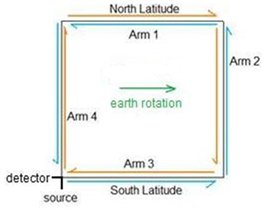


Point A is located at the detector
Point B is in the bottom right corner
Point C is in the upper right corner
Point D is in the upper left corner

Here is the most important part of the derivation of the full/global Sagnac effect for an interferometer located away from the center of rotation.

A > B > C > D > A is a continuous counterclockwise path, a negative sign -

A > D > C > B > A is a continuous clockwise path, a positive sign +

The Sagnac phase difference for the clockwise path has a positive sign.

The Sagnac phase difference for the counterclockwise has a negative sign.


Sagnac phase components for the A > D > C > B > A path (clockwise path):

l1/(c - v1)

-l2/(c + v2)

Sagnac phase components for the A > B > C > D > A path (counterclockwise path):

l2/(c - v2)

-l1/(c + v1)


For the single continuous clockwise path we add the components:

l1/(c - v1) - l2/(c + v2)

For the single continuous counterclockwise path we add the components:

l2/(c - v2) - l1/(c + v1)


The net phase difference will be (let us remember that the counterclockwise phase difference has a negative sign attached to it, that is why the substraction of the phase differences becomes an addition):

{l1/(c - v1) - l2/(c + v2)} - (-){l2/(c - v2) - l1/(c + v1)} = {l1/(c - v1) - l2/(c + v2)} + {l2/(c - v2) - l1/(c + v1)}

Rearranging terms:

l1/(c - v1) - l1/(c + v1) + {l2/(c - v2) - l2/(c + v2)} =

2(v1l1 + v2l2)/c2


BY CONTRAST, here is what you did:

Now instead of adding and subtracting based upon direction, we will add the terms of the same colour, corresponding to the one beam rotating around the interferometer and then find the difference.
dt=l1/(c - v1)+l2/(c + v2)-l1/(c + v1)-l2/(c - v2)
=l1/(c - v1)-l1/(c + v1)+l2/(c + v2)-l2/(c - v2)
=l1(c + v1-c + v1)/(c2 - v12)+l2(c - v2-c - v2)/(c2 - v22)
=2*l1v1/(c2 - v12)-2*l2v2/(c2 - v22)

We have the following terms, both have the same direction, that means one of them corresponds to the red in the inner segment and one to orange on the outer segment. I will colour code them for clarity:
l1/(c - v1)
l2/(c - v2)

Then, we have the remaining terms, in the opposite direction, likewise meaning one is for orange one is for red, noting that red travelled along l1 in the previous one so now it must travel along l2 in this one:
l1/(c + v1)
l2/(c + v2)

Then, if they ARE in opposite direction, they must have the OPPOSITE SIGN.

You used the SAME sign for opposite directions.

Moreover, you compared two open segments, and not the two loops of the Sagnac interferometer.

l1/(c - v1)
l2/(c + v2)

Again, there are 4 legs, not 2. This means you should actually have 4 components.
If you assume arm 2 and 4 to be insignificant (which is technically wrong for a rectangle, as they need to be radial to have no effect, but then again you don't even have a constant v for a rectangle either), then you end up with arm 1, where the light is propagating with the motion of the apparatus, a time of (again, just accepting the formula you provided rather than double checking it):
l1/(c - v1)
which is larger than if it is at rest.

Then for the time in arm 3 you get:
l3/(c + v3)
which is smaller than if the arm is at rest.
You need to add these 2 POSITIVE times to get a reference time for the loop (as well as 2 lots for arm 2 and 4).


You seem to need medical attention jackblack.

Of course the times will be larger and smaller, since you are dealing with DIFFERENT VELOCITIES, c - v1 - v2 and c + v1 + v2.

Positive times? Everyone is laughing at you.

You used the wrong signs.

You compared two open segments, in full defiance of the definition of the Sagnac effect.

I added correctly the terms for the two loops.

His experiment was fundamentally different to get a different formula.

The very same experiment: two different velocities, two different lengths.

Do not fool yourself into believing anything else.

Because amazingly enough it doesn't matter if it goes in the opposite direction, it still takes a positive time.
You don't magically go backwards in time by going against the rotation.


No backward time at all.

I am obeying the very definition of the Sagnac effect: comparing two LOOPS in opposite direction.

Each sign has been assigned properly.

No error at all.

You, on the other hand, used the wrong signs and compared two open segments.

Yes, just like I did, but unlike your garbage, I had positive times, as it doesn't reach the end before it leaves like your nonsense indicates.

l1/(c - v1) + l2/(c + v2)


Do you understand the definition of the Sagnac effect?

Let me remind you of it:

https://www.mathpages.com/rr/s2-07/2-07.htm

Two pulses of light are sent in opposite directions around a loop.

Loop = a structure, series, or process, the end of which is connected to the beginning.

What you, jackblack, have done, is to compare two open segments of the interferometer, and not the two loops as required by the definition of the Sagnac effect.

l1/(c - v1) + l2/(c + v2)

You have the wrong sign!!!

These beams are in opposite direction: one has a positive sign l1/(c - v1), the other has a negative sign -l2/(c + v2).

But again, we don't use your nonsense negative times.

There are NO negative signs.

Just TWO LOOPS: one counterclockwise, one clockwise.

Exactly as required by the defintion of the Sagnac effect.

Please read:

Here is how it's done.


Point A is located at the detector
Point B is in the bottom right corner
Point C is in the upper right corner
Point D is in the upper left corner

l1 is the upper arm.
l2 is the lower arm.

Here is the most important part of the derivation of the full/global Sagnac effect for an interferometer located away from the center of rotation.

A > B > C > D > A is a continuous counterclockwise path, a negative sign -

A > D > C > B > A is a continuous clockwise path, a positive sign +

The Sagnac phase difference for the clockwise path has a positive sign.

The Sagnac phase difference for the counterclockwise has a negative sign.


Sagnac phase components for the A > D > C > B > A path (clockwise path):

l1/(c - v1)

-l2/(c + v2)

Sagnac phase components for the A > B > C > D > A path (counterclockwise path):

l2/(c - v2)

-l1/(c + v1)


For the single continuous clockwise path we add the components:

l1/(c - v1) - l2/(c + v2)

For the single continuous counterclockwise path we add the components:

l2/(c - v2) - l1/(c + v1)


The net phase difference will be (let us remember that the counterclockwise phase difference has a negative sign attached to it, that is why the substraction of the phase differences becomes an addition):

{l1/(c - v1) - l2/(c + v2)} - (-){l2/(c - v2) - l1/(c + v1)} = {l1/(c - v1) - l2/(c + v2)} + {l2/(c - v2) - l1/(c + v1)}

Rearranging terms:

l1/(c - v1) - l1/(c + v1) + {l2/(c - v2) - l2/(c + v2)} =

2(v1l1 + v2l2)/c2


You, on the other hand, COMPARED TWO OPEN SEGMENTS, and used the WRONG SIGNS.


tell us simply how long it takes for the orange beam in arm 3 below to travel from the right side of it to the left side of it, assuming the arm has a length of l3, and is traveling at a velocity of v3.

Again, you are comparing SIDES/ARMS, not the two LOOPS as required by the definition of the Sagnac effect.

Your full ignorance of the Sagnac effect is incredible.

HERE IS THE DEFINITION OF THE SAGNAC EFFECT:

Two pulses of light sent in opposite direction around a closed loop (either circular or a single uniform path), while the interferometer is being rotated.

Loop = a structure, series, or process, the end of which is connected to the beginning.

A single continuous pulse A > B > C > D > A, while the other one, A > D > C > B > A is in the opposite direction, and has the negative sign.


*

JackBlack

  • 26157
  • +51/-79
Re: The distortion of science
« Reply #108 on: November 26, 2018, 04:57:25 PM »
Where are your loops???
That has been explained repeatedly. One is the blue loop, one is the orange loop.
We are both ignoring arm 2 and 4, and focusing on the 2 segments with a direction of motion aligned with the motion of the light.

Path 1 - A>B, D>C.
Path 2 - C>D, B>A

Completely wrong!
Yes, so why do you keep doing this?

Skipping some BS.

You are literally saying it takes negative time to do something.
No negative times at all.
You are calculating times taken. You are claiming it takes this long to travel around the loop:
l1/(c - v1)
-l2/(c + v2)
 There should be no negative in here.
You are literally saying it takes less time to travel the entire loop than it takes to travel segment 1.
That is physically impossible and requires negative time.

Your analysis either has crossed loops or negative time, both complete garbage.

And skipping the rest of your garbage because you are just repeating the same refuted nonsense.

So how about we start nice and simple for you. Lets start with a system that isn't in motion.

How long does it take for light to propagate around the ring?
Assume that the length are l1, w, l3, w for arm1, arm2, arm 3 and arm4 respectively.

No motion, just a simple beam of light propagating around a stationary ring.
How long does it take for the light to make it around?
« Last Edit: November 26, 2018, 06:32:18 PM by JackBlack »

*

rabinoz

  • 26528
  • +0/-0
  • Real Earth Believer
Re: The distortion of science
« Reply #109 on: November 26, 2018, 05:04:34 PM »
Stellar aberration under the aether model of light shows Earth moves w.r.t. the aether.

You haven't done your homework on this one either.

I tried doing my homework on the question of "How does current flat earth model explain sunrise and sunsets?"

And read in the first reply:
The FES FAQ has to be written by someone who really knows FET.
There is no 32 mile diameter Sun.
The Sun does rise and set.
Here is the real theory:
https://www.theflatearthsociety.org/forum/index.php?topic=30499.msg1939818#msg1939818
Which claimed:
Quote from: sandokhan
Re: Advanced Flat Earth Theory « Reply #410 on: August 09, 2017, 07:07:14 AM »
EARTH - SUN DISTANCE: 15-20 KILOMETERS I
The Sun's diameter is some 600 meters:

Then looking further, I find:
Quote from: sandokhan
Re: Advanced Flat Earth Theory « Reply #512 on: April 04, 2018, 01:01:13 AM »
EARTH-SUN DISTANCE: ~10 KILOMETERS II
https://www.theflatearthsociety.org/forum/index.php?topic=30499.msg1939818#msg1939818 (part I)
The Earth-Sun distance was first estimated to be somewhere around 25 km (in stark contrast to the 3000 mi distance claimed by the UA proponents). Using a variety of proofs, estimates and calculations, that distance was reduced to 12-15 km. Now, more proofs showing that this distance can be even lower, some 10 km.:

Since I know that these are completely incorrect I doubt the wisdom of this Great Teacher.

So until you satisfactorily explain your evidence for the sun being 600 m in diameter and 15-20 km (or is it 12-15 km or even some 10 km?) above the earth I'll choose to ignore all your other claims.
« Last Edit: December 25, 2018, 03:50:07 AM by rabinoz »

?

Themightykabool

  • 13121
  • +58/-81
Re: The distortion of science
« Reply #110 on: November 26, 2018, 06:10:39 PM »
You should start calling it sunnear and sunfar.

*

rabinoz

  • 26528
  • +0/-0
  • Real Earth Believer
Re: The distortion of science
« Reply #111 on: November 26, 2018, 09:14:23 PM »
You should start calling it sunnear and sunfar.
Maybe Sandokhan's distance to the sun explains this:

I witnessed the most mysterious thing ever - Plane flying THROUGH the Sun by Shahzwar Bugti

*

sandokhan

  • Flat Earth Sultan
  • Flat Earth Scientist
  • 7272
  • +7/-41
Re: The distortion of science
« Reply #112 on: November 26, 2018, 10:44:48 PM »
One is the blue loop, one is the orange loop.


Your formulas say otherwise: you are comparing two OPEN SEGMENTS, and not the TWO LOOPS as required by the definition of the Sagnac effect.

Here is what you posted:

Now instead of adding and subtracting based upon direction, we will add the terms of the same colour, corresponding to the one beam rotating around the interferometer and then find the difference.
dt=l1/(c - v1)+l2/(c + v2)-l1/(c + v1)-l2/(c - v2)
=l1/(c - v1)-l1/(c + v1)+l2/(c + v2)-l2/(c - v2)
=l1(c + v1-c + v1)/(c2 - v12)+l2(c - v2-c - v2)/(c2 - v22)
=2*l1v1/(c2 - v12)-2*l2v2/(c2 - v22)

You are using the WRONG SIGN!!!

You have two opposite directions.

Yet, you are using the very same sign for both.

You are the one using NEGATIVE TIMES.

l1/(c - v1)+l2/(c + v2)

and

-l1/(c + v1)-l2/(c - v2)

Catastrophically wrong!!!


You have no loop at all!


By your own admission, those light beams travel in OPPOSITE DIRECTION.

We have the following terms, both have the same direction, that means one of them corresponds to the red in the inner segment and one to orange on the outer segment. I will colour code them for clarity:
l1/(c - v1)
l2/(c - v2)

Then, we have the remaining terms, in the opposite direction, likewise meaning one is for orange one is for red, noting that red travelled along l1 in the previous one so now it must travel along l2 in this one:
l1/(c + v1)
l2/(c + v2)

Then, if they ARE in opposite direction, they must have the OPPOSITE SIGN.


You committed a huge blunder by using the same sign for both light beams.

That is why your "analysis" is pure garbage.

You are not using the correct definition of the Sagnac effect:


https://www.mathpages.com/rr/s2-07/2-07.htm

Two pulses of light are sent in opposite directions around a loop.

Loop = a structure, series, or process, the end of which is connected to the beginning.

What you, jackblack, have done, is to compare two open segments of the interferometer, and not the two loops as required by the definition of the Sagnac effect.

There should be no negative in here.
You are literally saying it takes less time to travel the entire loop than it takes to travel segment 1.


Of course.

You are dealing with the Sagnac effect, or have you forgotten even this basic fact?

If you rotate the Sagnac interferometer, you are going to get LESS TIME for one loop (because of a greater velocity) and MORE TIME for the second loop (again, because of a smaller velocity).

Is that a surprise to you?

That is physically impossible and requires negative time.


Each and every Sagnac interferometer records this basic experimental observation: you will have different times for the two loops.

It requires two different velocities, in our case:

c - v1 - v2 and c +  v1 + v2

No motion, just a simple beam of light propagating around a stationary ring.

You are defying the definition of the Sagnac interferometer experiment.

Read again:

Two pulses of light sent in opposite direction around a closed loop (either circular or a single uniform path), while the interferometer is being rotated.

Loop = a structure, series, or process, the end of which is connected to the beginning.

A single continuous pulse A > B > C > D > A, while the other one, A > D > C > B > A is in the opposite direction, and has the negative sign.

The Sagnac effect = light's travel times will be different along the two loop as the interferometer is being rotated.


You have no loops at all: you are comparing two open segments.

You are defying the definition of the Sagnac effect, which requires two loops of counterpropagating waves.

You used the same sign for light beams which travel in opposite direction, a huge error.


Here is the correct analysis:


Point A is located at the detector
Point B is in the bottom right corner
Point C is in the upper right corner
Point D is in the upper left corner

l1 is the upper arm.
l2 is the lower arm.

Here is the most important part of the derivation of the full/global Sagnac effect for an interferometer located away from the center of rotation.

A > B > C > D > A is a continuous counterclockwise path, a negative sign -

A > D > C > B > A is a continuous clockwise path, a positive sign +

The Sagnac phase difference for the clockwise path has a positive sign.

The Sagnac phase difference for the counterclockwise has a negative sign.


Sagnac phase components for the A > D > C > B > A path (clockwise path):

l1/(c - v1)

-l2/(c + v2)

Sagnac phase components for the A > B > C > D > A path (counterclockwise path):

l2/(c - v2)

-l1/(c + v1)


For the single continuous clockwise path we add the components:

l1/(c - v1) - l2/(c + v2)

For the single continuous counterclockwise path we add the components:

l2/(c - v2) - l1/(c + v1)


The net phase difference will be (let us remember that the counterclockwise phase difference has a negative sign attached to it, that is why the substraction of the phase differences becomes an addition):

{l1/(c - v1) - l2/(c + v2)} - (-){l2/(c - v2) - l1/(c + v1)} = {l1/(c - v1) - l2/(c + v2)} + {l2/(c - v2) - l1/(c + v1)}

Rearranging terms:

l1/(c - v1) - l1/(c + v1) + {l2/(c - v2) - l2/(c + v2)} =

2(v1l1 + v2l2)/c2

Exactly the formula obtained by Professor Yeh:

φ = -2(φ2 - φ1) = 4π(R1L1 + R2L2)Ω/λc = 4π(V1L1 + V2L2)/λc

Since Δφ = 2πc/λ x Δt, Δt = 2(R1L1 + R2L2)Ω/c2 = 2(V1L1 + V2L2)/c2

CORRECT SAGNAC FORMULA:

2(V1L1 + V2L2)/c2


You must derive the equations for the loops, and not for the open segments (as you have done).


« Last Edit: November 26, 2018, 10:53:28 PM by sandokhan »

*

JackBlack

  • 26157
  • +51/-79
Re: The distortion of science
« Reply #113 on: November 26, 2018, 11:40:52 PM »
One is the blue loop, one is the orange loop.
Your formulas say otherwise: you are comparing two OPEN SEGMENTS, and not the TWO LOOPS as required by the definition of the Sagnac effect.
No, I'm comparing the loop.
But that seems too advanced for you, so we need to start at the very basic level.

You are using the WRONG SIGN!!!
You have two opposite directions.
Yet, you are using the very same sign for both.
You are the one using NEGATIVE TIMES.
Yes, I am using the very same sign for both. Do you know why? Because both are positive times, not negative times like you want to pretend.

Then, if they ARE in opposite direction, they must have the OPPOSITE SIGN.
No, the sign at the front corresponds to the sign of the time. Is it a positive time or a negative time?

The sign for the directionality occurs elsewhere in the formula, specifically where the velocity of the arm is compared with the velocity of the light.
notice how one has c+v while the other has c-v?

So again, let's stick to the basics.
How long does it take the light to go around the stationary ring?

For completeness, and to avoid confusion, we will have l1 for arm1, l2 for arm 2, l3 for arm 3 and l4 for arm 4.

Can you provide an answer to this very simple question?
Can you provide the derivation for it?

*

sandokhan

  • Flat Earth Sultan
  • Flat Earth Scientist
  • 7272
  • +7/-41
Re: The distortion of science
« Reply #114 on: November 27, 2018, 01:42:08 AM »
No, I'm comparing the loop.

There are NO loops in your analysis.

Just the comparison of two OPEN SEGMENTS.

Here is the proof, using your own words.

We have the following terms, both have the same direction, that means one of them corresponds to the red in the inner segment and one to orange on the outer segment. I will colour code them for clarity:
l1/(c - v1)
l2/(c - v2)

Then, we have the remaining terms, in the opposite direction, likewise meaning one is for orange one is for red, noting that red travelled along l1 in the previous one so now it must travel along l2 in this one:
l1/(c + v1)
l2/(c + v2)

Now instead of adding and subtracting based upon direction, we will add the terms of the same colour, corresponding to the one beam rotating around the interferometer and then find the difference.
dt=l1/(c - v1)+l2/(c + v2)-l1/(c + v1)-l2/(c - v2)
=l1/(c - v1)-l1/(c + v1)+l2/(c + v2)-l2/(c - v2)
=l1(c + v1-c + v1)/(c2 - v12)+l2(c - v2-c - v2)/(c2 - v22)
=2*l1v1/(c2 - v12)-2*l2v2/(c2 - v22)

You are lying to yourself, and you are lying to your readers.

Where are the loops???

l1/(c - v1)+l2/(c + v2)-l1/(c + v1)-l2/(c - v2)

You are analyzing two different, open segments: the arms l1 and l2.

No loops at all.


https://www.mathpages.com/rr/s2-07/2-07.htm

Two pulses of light are sent in opposite directions around a loop.

Loop = a structure, series, or process, the end of which is connected to the beginning.

What you, jackblack, have done, is to compare two open segments of the interferometer, and not the two loops as required by the definition of the Sagnac effect.


Here are the two loops in full view:


Point A is located at the detector
Point B is in the bottom right corner
Point C is in the upper right corner
Point D is in the upper left corner

l1 is the upper arm.
l2 is the lower arm.

Here is the most important part of the derivation of the full/global Sagnac effect for an interferometer located away from the center of rotation.

A > B > C > D > A is a continuous counterclockwise path, a negative sign -

A > D > C > B > A is a continuous clockwise path, a positive sign +

The Sagnac phase difference for the clockwise path has a positive sign.

The Sagnac phase difference for the counterclockwise has a negative sign.


Sagnac phase components for the A > D > C > B > A path (clockwise path):

l1/(c - v1)

-l2/(c + v2)

Sagnac phase components for the A > B > C > D > A path (counterclockwise path):

l2/(c - v2)

-l1/(c + v1)


For the single continuous clockwise path we add the components:

l1/(c - v1) - l2/(c + v2)

For the single continuous counterclockwise path we add the components:

l2/(c - v2) - l1/(c + v1)


I have two loops, you have two open segments.


Yes, I am using the very same sign for both. Do you know why? Because both are positive times, not negative times like you want to pretend.

You are the one using negative times, not me.

Why?

Because you are using the same sign for light beams which travel in opposite directions.

They cannot have the same sign at all.

Very basic physics, but well outside of your understanding.

By your own admission, the following terms HAVE OPPOSITE DIRECTIONS:

l1/(c - v1)+l2/(c + v2)

and

-l1/(c + v1)-l2/(c - v2)

Catastrophically wrong!!!


Opposite direction = OPPOSITE SIGNS

There are no negative "times" in my analysis at all.

Each clockwise and counterclockwise path has two components. We properly add them to form the two loops, as required by the defintion of the Sagnac effect.


You have no loops at all.

You are analyzing two different open segments.


No, the sign at the front corresponds to the sign of the time. Is it a positive time or a negative time?

The sign for the directionality occurs elsewhere in the formula, specifically where the velocity of the arm is compared with the velocity of the light.
notice how one has c+v while the other has c-v?


By now, you are down to these miserable and pathetic tactics?

Have you totally lost it, jackblack?

You are mixing up two different concepts: the speeds and the sign of directionality of the beams.

The two different speeds are marked by c + v and c - v: NO DIRECTIONALITY OF THE LIGHT BEAMS HERE. The c + v and c - v terms are derived from the TIME DIFFERENCES OF THE PATHS, very basic Sagnac experiment analysis.

You must use the proper signs to describe the directionality of the light beams, however.

YOU USED THE WRONG SIGNS:

By your own admission, the following terms HAVE OPPOSITE DIRECTIONS:

l1/(c - v1)+l2/(c + v2)

and

-l1/(c + v1)-l2/(c - v2)

Catastrophically wrong!!!


Opposite direction = OPPOSITE SIGNS


How long does it take the light to go around the stationary ring?

You are trolling the upper forums.

Do you understand what we are discussing here?

THE SAGNAC EFFECT.

Let me remind you of the definition:

The Sagnac effect = light's travel times will be different along the two loop as the interferometer is being rotated.


We are comparing the phase differences of the light beams, as the interferometer IS BEING ROTATED, not while it is stationary.


You used the wrong signs.

You have no loops at all.


« Last Edit: November 27, 2018, 01:52:44 AM by sandokhan »

*

JackBlack

  • 26157
  • +51/-79
Re: The distortion of science
« Reply #115 on: November 27, 2018, 01:58:39 AM »
Just the comparison of two OPEN SEGMENTS.
It is effectively the same as yours. The only difference is that you have magical negative times which makes no sense at all.


I know Sagnac is for a rotating ring, but we are starting with a stationary one as you don't seem to understand that at all, and instead are just repeating the same refuted nonsense again and again.
We have to start at the basics before we go onto more complex things. If you don't understand the basics you have no chance at understanding the more complex things.

Now can you answer the simple question:
How long does it take the light to go around the stationary ring?
For completeness, and to avoid confusion, we will have l1 for arm1, l2 for arm 2, l3 for arm 3 and l4 for arm 4.

*

sandokhan

  • Flat Earth Sultan
  • Flat Earth Scientist
  • 7272
  • +7/-41
Re: The distortion of science
« Reply #116 on: November 27, 2018, 02:13:30 AM »
It is effectively the same as yours.

They could not be more different.

Here are your words:

We have the following terms, both have the same direction, that means one of them corresponds to the red in the inner segment and one to orange on the outer segment. I will colour code them for clarity:
l1/(c - v1)
l2/(c - v2)

Then, we have the remaining terms, in the opposite direction, likewise meaning one is for orange one is for red, noting that red travelled along l1 in the previous one so now it must travel along l2 in this one:
l1/(c + v1)
l2/(c + v2)

Now instead of adding and subtracting based upon direction, we will add the terms of the same colour, corresponding to the one beam rotating around the interferometer and then find the difference.
dt=l1/(c - v1)+l2/(c + v2)-l1/(c + v1)-l2/(c - v2)
=l1/(c - v1)-l1/(c + v1)+l2/(c + v2)-l2/(c - v2)
=l1(c + v1-c + v1)/(c2 - v12)+l2(c - v2-c - v2)/(c2 - v22)
=2*l1v1/(c2 - v12)-2*l2v2/(c2 - v22)

Where are the loops???

Without the two loops you have no Sagnac effect: you must have two continuous loops or you are not analyzing the Sagnac effect at all.

l1/(c - v1)+l2/(c + v2)-l1/(c + v1)-l2/(c - v2)
l1/(c - v1)-l1/(c + v1)+l2/(c + v2)-l2/(c - v2)

You are comparing two different, open segments: the arms l1  and l2.

No loops at all.


You are comparing the segments A - B (the terms l2/(c + v2)-l2/(c - v2) ) and C - D ((the terms l1/(c - v1)-l1/(c + v1) ).

You have no loops at all.

Which means you do not understand the definition of the Sagnac effect:


https://www.mathpages.com/rr/s2-07/2-07.htm

Two pulses of light are sent in opposite directions around a loop.

Loop = a structure, series, or process, the end of which is connected to the beginning.

What you, jackblack, have done, is to compare two open segments of the interferometer, and not the two loops as required by the definition of the Sagnac effect.


Here are the two loops in full view:


Point A is located at the detector
Point B is in the bottom right corner
Point C is in the upper right corner
Point D is in the upper left corner

l1 is the upper arm.
l2 is the lower arm.

Here is the most important part of the derivation of the full/global Sagnac effect for an interferometer located away from the center of rotation.

A > B > C > D > A is a continuous counterclockwise path, a negative sign -

A > D > C > B > A is a continuous clockwise path, a positive sign +


The Sagnac phase difference for the clockwise path has a positive sign.

The Sagnac phase difference for the counterclockwise has a negative sign.


Sagnac phase components for the A > D > C > B > A path (clockwise path):

l1/(c - v1)

-l2/(c + v2)

Sagnac phase components for the A > B > C > D > A path (counterclockwise path):

l2/(c - v2)

-l1/(c + v1)


For the single continuous clockwise path we add the components:

l1/(c - v1) - l2/(c + v2)

For the single continuous counterclockwise path we add the components:

l2/(c - v2) - l1/(c + v1)


I have two loops, you have two open segments.


The only difference is that you have magical negative times which makes no sense at all.

The only difference is that you are using the wrong signs: it cannot be more magical than that. Imagine: to use the same sign for light beams travelling in opposite directions.

You have light beams which are travelling in opposite directions.

Yet you are using the same sign to describe both.

A catastrophic error.

They cannot have the same sign at all.

Very basic physics, but well outside of your understanding.

By your own admission, the following terms HAVE OPPOSITE DIRECTIONS:

l1/(c - v1)+l2/(c + v2)

and

-l1/(c + v1)-l2/(c - v2)

Yet, you use the same sign to describe them.

Catastrophically wrong!!!


Opposite direction = OPPOSITE SIGNS

l1/(c - v1)
which is larger than if it is at rest.

Then for the time in arm 2 you get:
l2/(c + v2)
which is smaller than if the arm is at rest.


Of course the times will be larger and smaller, since you are dealing with DIFFERENT VELOCITIES, c - v1 - v2 and c + v1 + v2.

Negative times? Everyone is laughing at you. The source of your misunderstanding the notion of the "negative time" stems from your inability to properly study the definition of the Sagnac effect.

You used the wrong signs, which means not only your full use of negative times in full defiance of scientific principles, but that you are comparing two segments: your analysis has nothing to do with the Sagnac effect.

You compared two open segments, in full defiance of the definition of the Sagnac effect.

Each clockwise and counterclockwise path has two components. We properly add them to form the two loops, as required by the defintion of the Sagnac effect.

We are analyzing two CONTINUOUS loops, each having several components.

Each continuous loop has a definite direction.


You have no loops at all.

You are analyzing two different open segments.


I use the correct signs for both LOOPS.

The velocity addition equations are correct: c - v1 - v2 and c + v1 + v2.

You have no velocity equations at all, since you used the wrong signs and no loops at all.


Your analysis lacks both the loops and the correct signs.

Which means you have no idea of the correct definition of the Sagnac effect:

The Sagnac effect = light's travel times will be different along the two loops as the interferometer is being rotated.

You have no loops.

We are analyzing the Sagnac effect, not a stationary interferometer.

We are analyzing the phase differences of the light beams as they travel around the loops of the interferometer.

Your requests for a stationary interferometer are more signs of basic trolling.

Your analysis lacks both the correct signs and the two loops required by the correct definition of the Sagnac effect.

We have to start at the basics before we go onto more complex things.

You used the wrong signs and have no loops at all.

It doesn't get more basic than this.

You have no understanding of the very basics of the Sagnac effect.

The Sagnac effect consists of TWO CONTINUOUS LOOPS: since you compared two open segments, using the wrong signs, it means you have no grasp at all of the definition of the Sagnac effect.

« Last Edit: November 27, 2018, 04:56:47 AM by sandokhan »

*

JackBlack

  • 26157
  • +51/-79
Re: The distortion of science
« Reply #117 on: November 27, 2018, 11:56:51 AM »
Where are the loops???
Do you not understand? You are arguing against yourself. The only difference between my analysis and yours is that instead of adding together the time taken for the segments to produce the loop you instead found the different, in effect claiming one segment takes a negative time.

Now stop repeating the same refuted crap and stick to the basics as you clearly don't even understand that.

It doesn't get more basic than this.
Oh yes it does. We deal with stationary loops. If you can't understand that then we deal with a single length. Do I need to resort to that level of basics with you?

Now can you answer the simple question:
How long does it take the light to go around the stationary ring?
For completeness, and to avoid confusion, we will have l1 for arm1, l2 for arm 2, l3 for arm 3 and l4 for arm 4.

?

Lonegranger

  • 4083
  • +0/-0
Re: The distortion of science
« Reply #118 on: November 27, 2018, 11:10:04 PM »
The way this thread has developed has proven my point. Science is not a good place for proper debate as there is too much space for misinformation, cherry picking, fake news and outright deception.
One of the main flat earth proponents who likes to quote scientists continually refuses point blank to answer questions on why none of the scientists he mentions are flat earth believers! He is also fond of quoting Nobel prize winners, so why has there has never been or will ever be any Nobel prize awarded for discoveries related to the flat earth? Would this not be o e of the greatest revelations ever?
If you want to use science in an argument  or debate you must embrace all of science and not just those tiny bits that suit your requirements. Rejecting those parts of science that are impossible to argue against by claiming conspiracy is no more than an anti scientific copout.

*

cikljamas

  • 2466
  • +1/-2
  • Ex nihilo nihil fit
Re: The distortion of science
« Reply #119 on: November 28, 2018, 06:40:21 AM »
The way this thread has developed has proven my point. Science is not a good place for proper debate as there is too much space for misinformation, cherry picking, fake news and outright deception.
One of the main flat earth proponents who likes to quote scientists continually refuses point blank to answer questions on why none of the scientists he mentions are flat earth believers! He is also fond of quoting Nobel prize winners, so why has there has never been or will ever be any Nobel prize awarded for discoveries related to the flat earth? Would this not be o e of the greatest revelations ever?
If you want to use science in an argument  or debate you must embrace all of science and not just those tiny bits that suit your requirements. Rejecting those parts of science that are impossible to argue against by claiming conspiracy is no more than an anti scientific copout.

1. The earth is obviously NOT flat!!!
2. The earth is obviously stationary!!!
3. Just imagine yourself (or better try it in reality) walking on treadmill at 5-10 km/h (2,7 m/s -5,5 m/s) :
This girl is demonstrating these speeds (she is walking about 10 km/h in the first part of a video, and in the second part (closer to the end of the video) she is walking about 5-6 km/h) :

Now, try to imagine (or better try it in reality) that she (or better you yourself) suddenly stops.
Have you imagined this scenario? Have you figured out what would be your feeling (due to instantly restored initial momentum)?
Now, try this same procedure on the motionless ground, that is to say : just walk with the same speed and all of a sudden stop walking and try to imagine (or better try it in reality and see if you feel the same feeling as in the first scenario) what would you feel? Would you feel an effect of an instant restoration of lost momentum?
*It is just not the same thing to get the velocity back and to lose velocity!!!*
------------------------------------------------------------------------------------------------------------------
STATIONARY EARTH SCENARIO :

The boat sails 30 knots per hour towards west

After one hour the boat is 30 nm westward from it's starting position (within earth's frame of reference and with respect to the frame of reference of absolute space, also).

As soon as we turn off the engine which propels the propeller of the boat, there will be no need for restoration of anything (non-pre-existing initial inertia).

The consequence / the effect = the boat will simply rest at the calm water of the canal with no kind of perturbation/disturbance/commotion.

Concorde had a take-off speed of 220 knots (250 mph) or 400 km/h...Now, imagine concorde is rolling in a counter direction of earth's spin somewhere along the Arctic circle (at 400 km/h) where the alleged speed of earth's rotation is about 700 km/h.


SPINNING EARTH SCENARIO :

The river flows 30 knots per hour towards east

The boat sails 30 knots per hour towards west

After one hour the boat is 30 nm westward from it's starting position (within earth's frame of reference), although with respect to the frame of reference of absolute space the boat didn't move at all.

While boat propeller runs, it's work counteracts inertial impact of river's flow (towards east) on a boat, that is to say : boat propeller's work cancels out boat's initial inertia (due to the river's flow) and the boat stays at the same spatial position all the time.

As soon as we turn off the engine which propels the propeller of the boat, the river's flow is going to restore initial inertia of the boat.

The consequence / the effect = As soon the wind stops (as soon the boat propeller ceases to spin) the strength of river's flow is going to exert it's force on the boat in eastward direction, and almost instantly restore boat's lost initial inertia by abruptly putting the boat in eastward motion.
---------------------------------------------------------------------------------------------------------------------------------------------
So, if the air behaved like a gas, not like a water (which presumes gradual restoration of lost INITIAL INERTIA) we should expected such outcome : Even before leaving the ground concorde would cancel out more than 50 % of it's initial inertia (momentum). What does that mean? It means that at the very moment of taking off, concorde passengers should be able to notice (very perceptibly) rotational motion of the earth beneath them assuming that the pilot of concorde right after taking off, turns concorde to the left or to the right (it doesn't make any difference), so that their direction of flight is now perpendicular to the direction of earth's rotation. Concorde passengers should be able (while concorde is restoring it's initial angular momentum (which he had before taking off)) to see VERY DISTINCTLY AND PERCEPTIBLY how the earth is turning below them from their left side to their right side (if concorde has turned to the right), or from their right to their left (if concorde has turned to the left).

If the air behaved like a water, which presumes INSTANT RESTITUTION/REGAINING of partially lost INITIAL INERTIA of concorde, *passengers would be subdued (in the very moment the pilot of concorde abruptly turns an airplane to the right or to the left) to an effect of enormously strong abrupt instant sideways blow which would tend to carry concorde in a direction of earth's rotation.*

Isn't that so? If you still think that it isn't so, please explain why it isn't so!
-------------------------------------------------------------------------------------------
Boris Popovich was quite right when posting his comment (you can find his comment below this very video, just scroll down a little bit) : Armando Silvier I lived in Germany and I drove Mercedes at 200km\h, and that's insanely fast. The surface of the earth travels almost ten times faster!!! *you are comparing that to clock arms? Seriously?* And we are not talking about linear path, but circular. You can't compare it to walking on the train while train is moving either. It's literally taking off and landing on a moving target. Use a little bit of common sense. The thing is that even if it is not very significant because of the inertia, it is not accounted for in any way, which means that we are NOT moving! Try to go deeper into the flight paths and the whole technology and you will see that moving earth is not a factor. That's because it's NOT.

ACCOMPANYING VIDEO :

PTOLOMY'S ARGUMENT AGAINST ROTATION OF THE EARTH : http://adsabs.harvard.edu/full/1890SidM....9..293H
"I can't breathe" George Floyd RIP