crescent moon question

  • 342 Replies
  • 84219 Views
?

reinertm

  • 1
  • +0/-0
crescent moon question
« on: February 13, 2023, 05:14:29 AM »
Hallo,

I´m from Frankfurt / Germany.
Since end of 2022 I´m interested in the flat earth model.
I have got a question who the crescent moon works in these model.
Which object is before the moon to see the crescent moon?
Are these explanations oder videos to explain this?

Thank for the help.

Best regards

Marcus

?

Kami

  • 1164
  • +2/-0
Re: crescent moon question
« Reply #1 on: February 15, 2023, 01:45:21 PM »
Good luck. I have heard many explanations on how the moon works on this forum, and not one of them could not be debunked by just looking at it over the course of an hour with a $100 telescope or good binoculars.

*

bulmabriefs144

  • 6256
  • +79/-78
  • Roco the Fox
Re: crescent moon question
« Reply #2 on: February 16, 2023, 07:04:09 AM »
The explanation given for Round Earth model is that the moon reflects sunlight.

We're choosing not to deviate from that, meaning Round Earthers will have to debate against their own models if they protest this idea.

The difference between RE and FE is a contrived curvature theory about how the ground curves and this is why we can't see things in the sky.

Quick experiment: Face a tree with a protractor and measure angle to the top at different distances. As it gets more distance, it appears smaller, not being it curves around something, but because there is visible angle reduction. Then it vanishes from view.

In the same way, the sun appears to sink into the water as it moves out of range. If we were to use this same protractor on the sun, we would see that sun goes from 180/0 (set and invisible, even with telescope), to 45/135 at morning and late day, to 90 at noon. This is basic angles, and if you're gonna debate this either, you're full of crap.


So I've given two things, one of which is part of your own theory, and the other is part of basic math. And people will still debate this, even though all I've questioned is whether curvature exists. Because from these measurements, a perfectly logical explanation is that standing on a flat surface, you can't see more than 180 degrees.

This is how reflected light from the sun is nonetheless visible to the moon, even though we cannot see it. The angle is too extreme for us to see from the ground, but it's in direct line for the moon.

So what about the phases? Again, angles.

Full moon: Sun is in direct line with moon 180 or 0 degrees (across from it)
New moon: sun is facing 90 degrees from moon
Everything else: angles between 0 and 90, or 90 and 180.

I observed exactly this during the last crescent. I simply looked at the position of the sun and the position of the moon while both were out.
If ρ=m/V, then B=ρsurfobj


Here's my Bible, if ya wanna read

*

Stash

  • Ethical Stash
  • 13398
  • +2/-2
  • I am car!
Re: crescent moon question
« Reply #3 on: February 16, 2023, 08:51:14 AM »
As it gets more distance, it appears smaller, not being it curves around something, but because there is visible angle reduction.

It does not.

As an object moves further away, it appears to get smaller...


However, the Moon does not, as observed…Setting Moon timelapse...


A small close Moon should be observed like this…


It is not.

Not to mention, a flat earth sun, circling the tropics, people would simultaneously see different phases and different sides of the Moon depending upon their location, south of the tropics, north of the tropics. This does not happen and is not observed by all of humanity.


?

Kami

  • 1164
  • +2/-0
Re: crescent moon question
« Reply #4 on: February 16, 2023, 12:38:11 PM »
A few points
- for a crescent moon to be caused by a reflection from the sun, the moon has to be round, not flat.
- If the sun stays above the (flat) earth at all times, it never drops below 0 (or above 180) degrees. The angle gets smaller and smaller, but never reaches 0. This is simple math: The angle of the sun above the ground would be the arctan(height/distance). If distance gets bigger and bigger, height/distance becomes smaller and smaller, but never 0. That means that the angle also never becomes zero.
- When you see a full moon *above* the horizon that means that the sun must be directly opposite to it, and thus *below* the horizon. This is not possible in the FE model

Thus, the FE moon model is not consistent with observations.

*

JackBlack

  • 26157
  • +51/-79
Re: crescent moon question
« Reply #5 on: February 16, 2023, 12:50:43 PM »
The explanation given for Round Earth model is that the moon reflects sunlight.
We're choosing not to deviate from that, meaning Round Earthers will have to debate against their own models if they protest this idea.
No, we still debate your model, as your model provides no explanation for a full moon, nor why everyone sees the same phase of the moon.

In the RE model, during a full moon, the moon and sun are roughly 180 degrees apart. Everyone looking at the moon is looking at it from the same direction, roughly 400 000 km away on Earth. Because of this, they all see basically the same thing, just at a different apparent position relative to the surface of the curved they are standing on.

Conversely, for a FE, using the typical north pole centred FE model with the sun and moon at 5000 km high, the full moon would occur when the sun and moon are above points separated by 180 degrees of latitude.
Those directly under the moon would see a quarter moon, as the side closest to the sun would be illuminated, but the side away from the sun would be in darkness.
If they move towards the sun, they would see the moon appear to be more full, reaching a maximum when you are as far away from the moon as possible on the sun side of it.
Conversely, if they move away from the sun, the moon would appear less full.

The phase would vary dramatically all over Earth.

The difference between RE and FE is a contrived curvature theory about how the ground curves and this is why we can't see things in the sky.
No, the difference between RE and FE is the FE relies upon dishonestly taking something that works in the RE model, and just pretending that even though the geometry is drastically different, it will still just magically work in the FE model.

For the purpose of this explanation, the difference is above, the massive difference in geometry.
Because the FE has the moon quite close to Earth, different people are viewing it from drastically different angles and so they will see a different portion of the moon and a different amount lit up.

In short, the FE "explanation" can't explain it, while the RE explanation can.

Quick experiment: Face a tree with a protractor and measure angle to the top at different distances. As it gets more distance, it appears smaller, not being it curves around something, but because there is visible angle reduction. Then it vanishes from view.
Or, do it with a larger object, and a more accurate measuring device.
As it gets further way, but before the horizon, it is only getting smaller. It is still entirely in view, with nothing blocking any portion of it.
But then as it goes over the horizon, the bottom starts to vanish, with more and more vanishing with greater distance, even with the top clearly resolvable.

This demonstrates it is not simply shrinking. Instead something, i.e. the curvature of Earth, is causing Earth to obstruct the view.

If it was actually just due to perspective, it would shrink until it was unresolvable.

In the same way, the sun appears to sink into the water as it moves out of range.
Again, pure nonsense.
The sun and moon are fundamentally different to the above experiment.

In the above experiment we clearly observe the object to be getting smaller, that is the angular size of the object is smaller with greater distance.
But this does not happen with the sun and moon. Instead, the remain roughly the same size for the entire day you can see them, and from any location.

This shows that the distance remains roughly constant so it is not a greater distance to the sun making it appear to sink.

So I've given two things, one of which is part of your own theory, and the other is part of basic math. And people will still debate this, even though all I've questioned is whether curvature exists. Because from these measurements, a perfectly logical explanation is that standing on a flat surface, you can't see more than 180 degrees.
No, you have taken something from the RE model, which works in the RE model, completely ignored the geometry required for it and forced it into a FE model and pretending it should still magically work even with the geometry completely different. This explanation requires a very distant moon, with the sun and moon being on opposite sides of Earth for a full moon. So while it would work with the ancient FE model, where the sun circled Earth going below it, it wouldn't work with the modern versions.

You then got basic math, and proceeded to throw it out the window, completely ignoring a fundamental difference between your experiment and what is observed in reality for the sun and moon.

You also ignore the basic math that demonstrates your model is pure BS.
If Earth was flat, with the sun circling above, then the angle to the sun would be trivial to calculate:
a = atan(h/d)
or tan(a)=h/d
or h=d*tan(a)
or d=h/tan(a)
where h is the height of the sun, and d is the distance to the subsolar point.

Using the typical BS number of 5000 km, then even if you where on one side of your fantasy disc and the sun was above the other side, the angle to the sun should be 7 degrees above the horizon. It should never set.
And those numbers are based upon another simple observation, if it is the equinox, then the sun is observed to pass directly overhead on the equator, and reach a peak angle of 45 degrees when you are at 45 degrees north, approximately 5000 km away from the equator.
Using the formula above solved for h, that gives h=5000 km*tan(45 degrees) = 5000 km.

I observed exactly this during the last crescent. I simply looked at the position of the sun and the position of the moon while both were out.
How about you try it for a full moon, and figure out where the sun has to be for that.
That is 180 degrees apart, so if the moon is visible in the sky, that means the sun needs to be below you, or for a FE, it needs to be below Earth.

*

bulmabriefs144

  • 6256
  • +79/-78
  • Roco the Fox
Re: crescent moon question
« Reply #6 on: February 19, 2023, 05:32:30 AM »
A few points
- for a crescent moon to be caused by a reflection from the sun, the moon has to be round, not flat.
You can't just assert things and expect them to be believed. You're not dealing with preaching to the choir here. People with different opinions have different ways of thinking, and they don't always align with your assumptions. First of these, apparently is that sun and moon are even at the same angle as depicted in RE systems. In RE, we have nonsense about how the moon is in the path of the sun, but a simple look up in the sky shows this model to be bogus.

Yeah. Too bad that I have seen the sun and moon in the sky together, and they were across from each other not sun obstructing moon or vice versa.

- If the sun stays above the (flat) earth at all times, it never drops below 0 (or above 180) degrees. The angle gets smaller and smaller, but never reaches 0. This is simple math: The angle of the sun above the ground would be the arctan(height/distance). If distance gets bigger and bigger, height/distance becomes smaller and smaller, but never 0. That means that the angle also never becomes zero.
You may be right about this. However, what we are really talking about when we discuss human vision is a 90 degree arc of potential vision seeing in front of you, 90 degrees behind you (only by turning  around), and a bit less than 90 degrees to the side. This should mean 360 degrees. So you can see everything on a flat Earth, right? This should be enough for me to see that fat Earth is wrong, right? Wrong. To try to confuse you less, we start this arc at 0 behind you, and say that 0 to 89 degrees behind you can't be seen, and 90 to 180 (zero is now 180) can be seen. Why did I do it this way? Well, it's for what comes next. Grab a small tennis ball, and start holding it directly above your head. Move your arm fully extended (so it forms an arc) down until it is in front of you. This is the 180/0 point. Switch hands, and hold the original hand in front of you, representing the horizon. Now, that ball at arms length can travel all the way to the ground, but I'm gonna try to show you something. Hold the second hand up and in front as much as possible. Compare it to the horizon. It should be like 45 to 60 degrees, right? But if you could disembody that hand and move it away, the angular optics would continue to decrease until it faded out of sight. But as a sun is bigger than your hand, you can see it until it reaches the horizon.
This is the point where the level of 180/0 sight to the sky collides with 180/0 distance of objects in the sky. You can't see it anymore because it is above you, yet appears below you, and has blended with the horizon. But if I were to teleport you to a mountain top, you would see a far horizon. Range of vision moves and extends with you. It is not based on a curve.


Not gonna answer the last one cause it's based on faulty assumptions and I probably answered it on my response to #2.
If ρ=m/V, then B=ρsurfobj


Here's my Bible, if ya wanna read

?

Kami

  • 1164
  • +2/-0
Re: crescent moon question
« Reply #7 on: February 19, 2023, 09:33:01 AM »
A few points
- for a crescent moon to be caused by a reflection from the sun, the moon has to be round, not flat.
You can't just assert things and expect them to be believed. You're not dealing with preaching to the choir here. People with different opinions have different ways of thinking, and they don't always align with your assumptions. First of these, apparently is that sun and moon are even at the same angle as depicted in RE systems. In RE, we have nonsense about how the moon is in the path of the sun, but a simple look up in the sky shows this model to be bogus.

Yeah. Too bad that I have seen the sun and moon in the sky together, and they were across from each other not sun obstructing moon or vice versa.

- If the sun stays above the (flat) earth at all times, it never drops below 0 (or above 180) degrees. The angle gets smaller and smaller, but never reaches 0. This is simple math: The angle of the sun above the ground would be the arctan(height/distance). If distance gets bigger and bigger, height/distance becomes smaller and smaller, but never 0. That means that the angle also never becomes zero.
You may be right about this. However, what we are really talking about when we discuss human vision is a 90 degree arc of potential vision seeing in front of you, 90 degrees behind you (only by turning  around), and a bit less than 90 degrees to the side. This should mean 360 degrees. So you can see everything on a flat Earth, right? This should be enough for me to see that fat Earth is wrong, right? Wrong. To try to confuse you less, we start this arc at 0 behind you, and say that 0 to 89 degrees behind you can't be seen, and 90 to 180 (zero is now 180) can be seen. Why did I do it this way? Well, it's for what comes next. Grab a small tennis ball, and start holding it directly above your head. Move your arm fully extended (so it forms an arc) down until it is in front of you. This is the 180/0 point. Switch hands, and hold the original hand in front of you, representing the horizon. Now, that ball at arms length can travel all the way to the ground, but I'm gonna try to show you something. Hold the second hand up and in front as much as possible. Compare it to the horizon. It should be like 45 to 60 degrees, right? But if you could disembody that hand and move it away, the angular optics would continue to decrease until it faded out of sight. But as a sun is bigger than your hand, you can see it until it reaches the horizon.
This is the point where the level of 180/0 sight to the sky collides with 180/0 distance of objects in the sky. You can't see it anymore because it is above you, yet appears below you, and has blended with the horizon. But if I were to teleport you to a mountain top, you would see a far horizon. Range of vision moves and extends with you. It is not based on a curve.


Not gonna answer the last one cause it's based on faulty assumptions and I probably answered it on my response to #2.

Okay, please show a picture of a flat disk that is illuminated to show a crescent shape.

Regarding your second part: I did not understand your ramblings, I am only talking about angle above the horizon, nothing about what you can see when you turn around. It is very, very simple math. If the earth is flat, and the sun has a height above the plane, then its angle on the sky never drops to zero, so it should always be above a (perfectly flat) horizon. No idea where you want to go with your little thought experiment, but it does not negate this very simple fact.

*

JackBlack

  • 26157
  • +51/-79
Re: crescent moon question
« Reply #8 on: February 19, 2023, 12:27:56 PM »
A few points
- for a crescent moon to be caused by a reflection from the sun, the moon has to be round, not flat.
You can't just assert things and expect them to be believed.
You can't just dismiss such obvious things and expect others to accept your dismissal.

It is quite simple, if the moon is flat, then a light shining on it to reflect off it and cause it to appear lit up, will result in the entire surface being illuminated.

You are proposing using an element of the RE model.
Specifically that the phases of the moon are caused by the reflected sunlight.
That relies upon the moon being round.

If you want to dismiss that and propose an alternative, then don't claim to be using the RE model.
If you don't want to accept how the RE model actually explains the phases of the moon, then don't lie by claiming to be using the RE model as an explanation.

You cannot simple take the RE explanation that works, and strip away almost everything that makes it work, all to pretend your delusional garbage can work.
At least not if you have any sense of integrity.

First of these, apparently is that sun and moon are even at the same angle as depicted in RE systems.
Only during a solar eclipse.
At other times, it goes either further north or further south of the sun.
You not understanding 3D is your problem.

And this alignment, even when we ignore the 3D nature of it, only occurs once every orbit of the moon.
For most of the time, they will not be aligned.

So your observation of seeing the sun and moon together but not one blocking the other is entirely in line with the model you hate.

You may be right about this. However, what we are really talking about when we discuss human vision is a 90 degree arc of potential
We can leave your delusional parabola out of this, as you are yet to address any of the faults with it.

Moving your arm around is not explaining just what magic you have which causes things to magically appear lower than they are.

If you wanted an honest comparison you wouldn't be moving the ball in an arc. You would be moving it in a straight line, horizontal where it passes over your head.
But you know that will produce what you need.
So you resort to dishonest distractions.

In order to address this issue you need to address the equation provided, an equation which is easy to very.
For a flat surface, an object, directly above a point a distance of d away from you, at a height of h above your eye, will have an angle of elevation (a) given by:
tan(a)=h/d.
or a=atan(h/d).

You have nothing to show any fault with this.

Likewise, you can observe how the angular size of an object will vary based upon distance.
Where the distance to object (l), and its width in a direction perpendicular to a line from your eye to it (w), gives the angular size as:
a=2*atan(w/(2l)).

And if you want, you can use the numbers above to calculate l as l=sqrt(h^2+d^2), to get:
a=2*atan(w/(2*sqrt(h^2+d^2)))

Once more, simple math demonstrates that your claim is complete garbage.
The fact that the sun and moon both appear roughly the same size throughout the day, from passing directly overhead, to setting over the horizon; clearly demonstrates that the distance to them remains roughly the same, which means their angle changing has nothing at all to do with the distance to them.

If you wish to claim otherwise, then you need to explain just what magic exists in your delusional fantasy to make this basic math no longer work.

Not gonna answer the last one cause it's based on faulty assumptions and I probably answered it on my response to #2.
As you answered nothing in your response to #2, it most certainly doesn't.
Regardless, your response to #2 was entirely focusing on the angle you observe an object at.
#3 is focusing on the angle of the light approaching the moon.
A full moon observed high in the sky requires the sun to be below a FE.

*

bulmabriefs144

  • 6256
  • +79/-78
  • Roco the Fox
Re: crescent moon question
« Reply #9 on: February 20, 2023, 05:35:20 AM »
A few points
- for a crescent moon to be caused by a reflection from the sun, the moon has to be round, not flat.
You can't just assert things and expect them to be believed. You're not dealing with preaching to the choir here. People with different opinions have different ways of thinking, and they don't always align with your assumptions. First of these, apparently is that sun and moon are even at the same angle as depicted in RE systems. In RE, we have nonsense about how the moon is in the path of the sun, but a simple look up in the sky shows this model to be bogus.

Yeah. Too bad that I have seen the sun and moon in the sky together, and they were across from each other not sun obstructing moon or vice versa.

- If the sun stays above the (flat) earth at all times, it never drops below 0 (or above 180) degrees. The angle gets smaller and smaller, but never reaches 0. This is simple math: The angle of the sun above the ground would be the arctan(height/distance). If distance gets bigger and bigger, height/distance becomes smaller and smaller, but never 0. That means that the angle also never becomes zero.
You may be right about this. However, what we are really talking about when we discuss human vision is a 90 degree arc of potential vision seeing in front of you, 90 degrees behind you (only by turning  around), and a bit less than 90 degrees to the side. This should mean 360 degrees. So you can see everything on a flat Earth, right? This should be enough for me to see that fat Earth is wrong, right? Wrong. To try to confuse you less, we start this arc at 0 behind you, and say that 0 to 89 degrees behind you can't be seen, and 90 to 180 (zero is now 180) can be seen. Why did I do it this way? Well, it's for what comes next. Grab a small tennis ball, and start holding it directly above your head. Move your arm fully extended (so it forms an arc) down until it is in front of you. This is the 180/0 point. Switch hands, and hold the original hand in front of you, representing the horizon. Now, that ball at arms length can travel all the way to the ground, but I'm gonna try to show you something. Hold the second hand up and in front as much as possible. Compare it to the horizon. It should be like 45 to 60 degrees, right? But if you could disembody that hand and move it away, the angular optics would continue to decrease until it faded out of sight. But as a sun is bigger than your hand, you can see it until it reaches the horizon.
This is the point where the level of 180/0 sight to the sky collides with 180/0 distance of objects in the sky. You can't see it anymore because it is above you, yet appears below you, and has blended with the horizon. But if I were to teleport you to a mountain top, you would see a far horizon. Range of vision moves and extends with you. It is not based on a curve.


Not gonna answer the last one cause it's based on faulty assumptions and I probably answered it on my response to #2.

Okay, please show a picture of a flat disk that is illuminated to show a crescent shape.

Regarding your second part: I did not understand your ramblings, I am only talking about angle above the horizon, nothing about what you can see when you turn around. It is very, very simple math. If the earth is flat, and the sun has a height above the plane, then its angle on the sky never drops to zero, so it should always be above a (perfectly flat) horizon. No idea where you want to go with your little thought experiment, but it does not negate this very simple fact.

Yes I agree, I probably ought to make a picture later on.

But I also think you're doing what is called "filtering".

You see, people's brains, including mine, tend to gravitate towards what they have learned and reject what people have told them isn't true. So their brains do a "blah blah blah, I'm not hearing you!!!" thing.
It was only after I said, "Yes, I've been told the Earth is round. But that's not good enough anymore. I have these nagging questions, and the explanations for then now sound like excuses," that I finally started to consider RE might be wrong.

This is why it is difficult to break intellectual programming.

The rambling, as you say, is to get you to visualize something. It works far better if you try it out with real objects. Get a ball, plushie, or small unholy idol.

 With one hand, trace a line up from the ground to the horizon. Hold that horizon line using your hand. Now with the other arm (because you didn't listen before, and your heart was hardened, you will feel the pain of bowing to other gods), pull your joint out of socket continually reaching forward until you bow and your arm is even with this hand horizon.

The is what your eye actually does. It converges the point that ground meets the sky with the point that the sky appears to meet the ground.


Haven't watched yet.
« Last Edit: February 20, 2023, 05:40:23 AM by bulmabriefs144 »
If ρ=m/V, then B=ρsurfobj


Here's my Bible, if ya wanna read

?

Kami

  • 1164
  • +2/-0
Re: crescent moon question
« Reply #10 on: February 20, 2023, 08:50:44 AM »
No, I do not have a 'hardened heart', what you are saying just makes no sense.
As an example:
'the angular optics would continue to decrease', I have no idea what you mean by that
'You can't see it anymore because it is above you, yet appears below you' that makes zero sense

Regarding your sketch: The eye does not 'lift the ground up to the horizon'; the horizon is an artifact of perspective:
Observed angle is always arctan(height/distance). If you take an object of arbitrary height (positive [above eye level], or negative [below eye level]) and move it further and further away, the distance increases, meaning that height/distance approaches zero, and thus the observed angle also approaches zero. That explains why the 'sky and the ground meet', because they both converge to the same point.
You will notice what doesn't happen, though: An object with positive height (sun) having an angle that is smaller than an object of negative height (ground). This is literally middle-school trigonometry, simply based on the assumption that light moves in a straight line.

A little off-topic:
According to your graphic, the ground obeys your weird 'perspective rules' and rises up to cover the boat, which weirdly does not obey your 'perspective rules'.

But we are running WILDLY off-topic, this is about what causes a crescent moon shape in FE. So, I will be waiting for you to upload a picture of a crescent-shaped illumination on a flat surface. Happy to provide one on a ball, if you doubt that that is possible ;)


*

Stash

  • Ethical Stash
  • 13398
  • +2/-2
  • I am car!
Re: crescent moon question
« Reply #11 on: February 20, 2023, 10:30:12 AM »
This is why it is difficult to break intellectual programming.

Yes, your intellectual programming is quite severe. Here's what you have to explain and it has nothing to with how the eye works. You have to figure out how on a flat earth people from various locations see the moon differently, when in reality, they don't...


*

JackBlack

  • 26157
  • +51/-79
Re: crescent moon question
« Reply #12 on: February 20, 2023, 12:59:55 PM »
Yes I agree, I probably ought to make a picture later on.
Yes, you really should, as your claim is pure BS and outright defies both the RE model that you are relying upon to explain the phases, and basic math.

But I also think you're doing what is called "filtering".
No, we aren't.
We are pointing out massive issues with your claims, which you just ignore because you hate reality.

It was only after I said, "Yes, I've been told the Earth is round. But that's not good enough anymore. I have these nagging questions, and the explanations for then now sound like excuses," that I finally started to consider RE might be wrong.
Really? It seems more likely that you were conned into a religion or experienced some traumatic event which lead you to reject reality.

You are yet to provide a single example of a RE explanation which doesn't make sense or which sounds like an excuse, nor have you been able to provide a fault with the RE model, nor have you been able to provide a viable alternative in the form of a FE model.

Look at what you have done in this thread, you just take the RE model's explanation of the phases of the moon and claim it works just fine in your flat fantasy, and that the only difference is that Earth is flat.
That is making an excuse to prop up a completely failed model.
The FE model cannot explain the moon phases, but instead of accepting that, you just make up excuses, pretending that because the RE has an explanation that it can be used regardless of the shape of Earth.

It works far better if you try it out with real objects. Get a ball, plushie, or small unholy idol.
What makes you think we haven't?

When we try with real objects, we can see moving it in a circle around us, keeping it the same distance away matches what is observed with the sun and moon. In this case (the test object, the sun and the moon) keep the angular size fairly constant, and the angular speed remains constant. All that changes is the direction to the object, where it appears to set because it is going down, not because it is going further away.

If instead we move the ball like the FE model pretends the sun move, we notice a dramatic change in the angular size of the ball. We also observe that it never actually sets. The best you get is it appearing very small and not being resolvable.
But importantly, it gets smaller and appears to move slower. Neither of these happen with the sun.

If you had actually bothered trying it with real objects, you would see your fantasy doesn't match reality.

The is what your eye actually does. It converges the point that ground meets the sky with the point that the sky appears to meet the ground.
It isn't your eye, it is what light does. And it takes an infinite distance for it to converge.
Your image is a blatant lie, a lie refuted by basic math.
The convergence point is an infinite distance away. It will not be reached at any finite distance.
Importantly, observations clearly demonstrate it is NOT a convergence point causing this.
If it was convergence, the object would shrink to a point, i.e. it would converge.
Instead, we see it start disappearing from the bottom up while still clearly not converged.

With the claimed height of the sun, compared to its size, the sun would shrink to an unresolvable point long before it got to the horizon.

And importantly, with convergence, NOTHING will ever appear to go into a flat Earth.
If an object was touching a flat Earth, moving away from it will keep the bottom of it appearing to touch Earth as it got smaller and smaller, until it became an unresolvable point.
At no distance will it magically appear to sink into Earth.

Unless you can actually provide an explanation for just what magic is causing this phenomenon which defies scaled down observations and simple math, your claim is clearly BS.
It is a pathetic excuse given by FEers to pretend their fantasy works.
« Last Edit: February 20, 2023, 01:01:51 PM by JackBlack »

*

bulmabriefs144

  • 6256
  • +79/-78
  • Roco the Fox
Re: crescent moon question
« Reply #13 on: February 21, 2023, 06:18:19 AM »
This is why it is difficult to break intellectual programming.

Yes, your intellectual programming is quite severe. Here's what you have to explain and it has nothing to with how the eye works. You have to figure out how on a flat earth people from various locations see the moon differently, when in reality, they don't...


Actually, I deprogrammed myself. Which is why it looks like such a crappy job.  ;D

On the other hand, most of you here continue to parrot what they probably learned in the first year they took astronomy type classes in school. We'll call this teacher Mrs Curricula Ultimato. Mrs Ultimato taught you so much, and she was nice and sweet, so even 25 years later, what she told you will always stick with you.

It'd be a shame if something... happened to her.  ;)

No, but seriously. Just cuz someone is nice and leaves a big dent on your subconscious doesn't mean you can trust everything they say, or that it is right.

It's funny that you think I'm brainwashed, when I actually set out to find things for myself. For several days, I watched the sky to verify or disprove RE. When it started to look as though RE was false, I didn't hang on to any nostalgia. I just chucked such ideas in the trash and moved on.

This is why I say you have a filter. You let previous assumptions from other people color your ideas. Then you can't stand that someone else thinks differently.

Kami, a person who has a hardened heart will be unwilling to see God's truth, even when it is before their eyes. They will have itching ears that lead them instead to falsehoods.

When a person sees a sunset, they will not reconcile this phenomenon with exactly what happens when a dear friend drives away from them. They will make up some story about a distance in curvature. Even though you can see from Ireland, miles beyond the supposed curvature to Scotland. Nor do they reconcile they fact that our vision is quite limited, with objects in the heavens. Uhhhh yeah, if I can't see very far because I'm nearsighted, you honestly think it's likely that an object being a huge ball is gonna make any difference?


You can technically see Everest from 120 miles away. But when your vision gets kinda blurry at even reading words 50 ft away, it kinda defies logic that we can see light years away.

https://earthsky.org/astronomy-essentials/how-far-is-a-light-year/
Quote
How far is that? Multiply the number of seconds in one year by the number of miles or kilometers that light travels in one second, and there you have it: one light-year. It’s about 5.9 trillion miles

Oh that's all! No big deal. We can just look up in the sky and see the North Star clear as day.
https://www.space.com/15567-north-star-polaris.html
Quote
Polaris is located at a distance of 323 light-years from Earth, ... or slightly less than the moon's apparent diameter, away from the North Celestial Pole.

Also, what's this about the moon's diameter? The moon is not "slightly less" than 5.9 trillion x 323. It's suppose to be only...
Quote
The equatorial diameter of the Moon is 3,476.28 km. And the polar diameter of the Moon is 3,471.94 km.

Yeeeeeahhh I can't see a picture of a crane clearly without glasses. Less than 30 ft away. From a mile or two away, I can see a forest, but I can't pick out individual nuts or berries, and barely can see their leaves. But I can supposedly see stars from trillions of miles away. It's not curvature that is making these trees distant enough that these nuts can't be seen. It's regular distance.

Lastly, Stash has it ever occurred to you that everyone is actually seeing the bottom of the moon? Not that the moon actually has another side. It's not a spherical object.
« Last Edit: February 21, 2023, 06:25:57 AM by bulmabriefs144 »
If ρ=m/V, then B=ρsurfobj


Here's my Bible, if ya wanna read

*

Stash

  • Ethical Stash
  • 13398
  • +2/-2
  • I am car!
Re: crescent moon question
« Reply #14 on: February 21, 2023, 06:26:33 AM »
This is why it is difficult to break intellectual programming.

Yes, your intellectual programming is quite severe. Here's what you have to explain and it has nothing to with how the eye works. You have to figure out how on a flat earth people from various locations see the moon differently, when in reality, they don't...


Actually, I deprogrammed myself. Which is why it looks like such a crappy job.  ;D

You didn't address the actual topic. Moon phases on a flat earth, how does it work? Specifically...

How on a flat earth people from various locations see the moon differently, when in reality, they don't:


?

Kami

  • 1164
  • +2/-0
Re: crescent moon question
« Reply #15 on: February 21, 2023, 09:24:33 AM »
So once you get debunked in some aspect you just move on to spout more BS, got it. If you want to discuss seeing into the distance, be my guest, but please open a different thread for that. This one is about explaining the crescent moon, and I am still waiting for the picture you claimed you wanted to provide.

*

bulmabriefs144

  • 6256
  • +79/-78
  • Roco the Fox
Re: crescent moon question
« Reply #16 on: February 21, 2023, 12:07:38 PM »
Finally drew a model.


The sun has a "facing", much like a flashlight. That is, you can't hit things to your side when you shine a flashlight ahead of you.  The phases have to do with where the sun and moon are, lined up against each other.
« Last Edit: February 21, 2023, 12:30:04 PM by bulmabriefs144 »
If ρ=m/V, then B=ρsurfobj


Here's my Bible, if ya wanna read

*

Stash

  • Ethical Stash
  • 13398
  • +2/-2
  • I am car!
Re: crescent moon question
« Reply #17 on: February 21, 2023, 12:40:08 PM »
Finally drew a model.


The sun has a "facing", much like a flashlight. That is, you can't hit things to your side when you shine a flashlight ahead of you.  The phases have to do with where the sun and moon are, lined up against each other.

You still haven't solved the issue and actually made it worse. Your diagram still shows people in different locations seeing different phases at the same time. That does not happen in reality.
Folks in S America would see a third quarter half moon whereas folks in N. America would see a waning gibbous and folks in Europe, Asia, and Africa would see a full moon all at the same time. That does not happen in reality.

Try again.

*

JackBlack

  • 26157
  • +51/-79
Re: crescent moon question
« Reply #18 on: February 21, 2023, 01:19:32 PM »
Actually, I deprogrammed myself. Which is why it looks like such a crappy job.  ;D
No, you programmed yourself.
You had a crap education, and hated reality, and decided to program yourself into believing complete BS.

Deprograming yourself would result in you recognising that you can't just take an explanation from the RE, ignore how it works, and stick it in a FE model and pretend it is fine.

Quote
On the other hand, most of you here continue to parrot what they probably learned in the first year they took astronomy type classes in school.
No, we continue to explain reality to you, to explain why you are wrong.
We aren't going to reject reality and start spouting delusional BS, just because we were taught reality in school.

Quote
It's funny that you think I'm brainwashed
No, it isn't.

We are supporting a coherent model which actually explains reality.
We have provided an explanation of why the phases are explained on a RE, and why that doesn't work for your FE fantasy.
We have explained how we know the distance is not changing significantly at all.

And what is your response? Just ignore all that and claim we are brainwashed.

If the delusional BS you were spouting was true, you would be able to justify it and defend it.
You would be able to make coherent arguments and refute the arguments against you.
You would be able to stay on topic rather than jumping around all over the place.

Just focusing on this thread, you are yet to explain how the moon phases work on a FE, nor show any fault with the RE explanation.

This garbage post of yours makes no attempt at all to explain it. Instead you just ramble on about other BS.

Quote
I watched the sky to verify or disprove RE. When it started to look as though RE was false
Yet you are completely incapable of providing a single thing which shows the RE to be false.
So that is clearly fantasy.
What you actually mean is that you hated the RE model and were looking for a way to discard it. Once you found an excuse you latched onto it and discarded the RE.
There wasn't any evidence to show it is false, just your irrational hatred.

Quote
When a person sees a sunset, they will not reconcile this phenomenon with exactly what happens when a dear friend drives away from them. They will make up some story about a distance in curvature.
You mean a rational person would come up with a coherent explanation which doesn't ignore the mountains of evidence that Earth is round, just to support their delusional fantasy.
Instead, they will accept that the angular size of the sun remaining roughly constant means the distance has not changed significantly, so the sun must be going "down" relative to them, not simply going away.
When they reconcile it with a friend, who also observes the same angular size, but a different position in the sky (and even better for the moon where they can clearly see the same face), they recognise that it must be their reference, Earth itself, which is at a different angle.

You cannot show any fault with this, nor are you capable of providing a viable alternative.

Quote
Nor do they reconcile they fact that our vision is quite limited
You mean you cling to a delusional that our vision is somehow magically limited so after a certain distance you magically can't see an object.
A delusional that is not supported by any evidence or rational thought at all, and which is contradicted by so much it isn't funny.

You are the one rejecting facts. Not us.

You don't even seem to be able to understand the difference between being able to see and object and being able to resolve it.
You also don't understand the concept of angular size and what effect it will have.

Quote
if I can't see very far because I'm nearsighted, you honestly think it's likely that an object being a huge ball is gonna make any difference?
Yes, as you have shown here:
Quote
Yeeeeeahhh I can't see a picture of a crane clearly without glasses. Less than 30 ft away. From a mile or two away, I can see a forest
This shows that size matters.
For a small object, like a picture of a crane, you can't resolve it.
But for a much larger object, you can.

So there is no magical distance where your vision cuts off.
You refuted yourself.

Quote
Lastly, Stash has it ever occurred to you that everyone is actually seeing the bottom of the moon? Not that the moon actually has another side. It's not a spherical object.
Yes.
That is one of the options that is covered in using the moon to show a RE.

Everyone sees roughly the same face of the moon.
With the FE fantasy having the moon so close:
If it was a 3D object, they should be seeing different portions of it, regardless of exactly what that shape is.
If it was a 2D object, then they are still viewing it from different angles, which will significantly distort it.
The simple example is a circle/disc.
If you view a disc from along a line passing through the centre perpendicular to the plane of the disc, it will appear as a circle.
If you then move away from that line, the circle in the direction you have moved away, will compress, making it into an oval, until you view it from such a wide angle that it changes to a line (or more that you can see the side, not the face).
You can easily see this by picking up a coin (or another disc shaped object) and rotating it around in your hand.
The only time it appears as a circle is when you view it straight on.
Yet during a full moon EVERYONE sees the moon as a circle.

And you would still have the issue of angular size, where if the moon was further away it would appear smaller.

So it doesn't matter if the moon is 2D or 3D. Everyone is looking at it from the same direction. So the fact it doesn't appear in the same location relative to Earth near where the observers are means that the direction of Earth is different for those locations, i.e. Earth isn't flat.

So claiming the moon is flat wont help you.

But more relevant to the discussion at hand, the only viable explanation for the phases relies upon it being a spherical object.
The explanation from the RE you wanted to insert into your delusional BS relies upon it being a spherical object.

The sun has a "facing", much like a flashlight. That is, you can't hit things to your side when you shine a flashlight ahead of you.  The phases have to do with where the sun and moon are, lined up against each other.
Just what is that angle meant to be measuring?
Have you ever looked at a flashlight?
Most will have a circular region of illumination.
If you try to light up a disc with that, moving from one side to the other, you will never get a crescent.
Instead, you will get a region which looks like a Venn diagram:
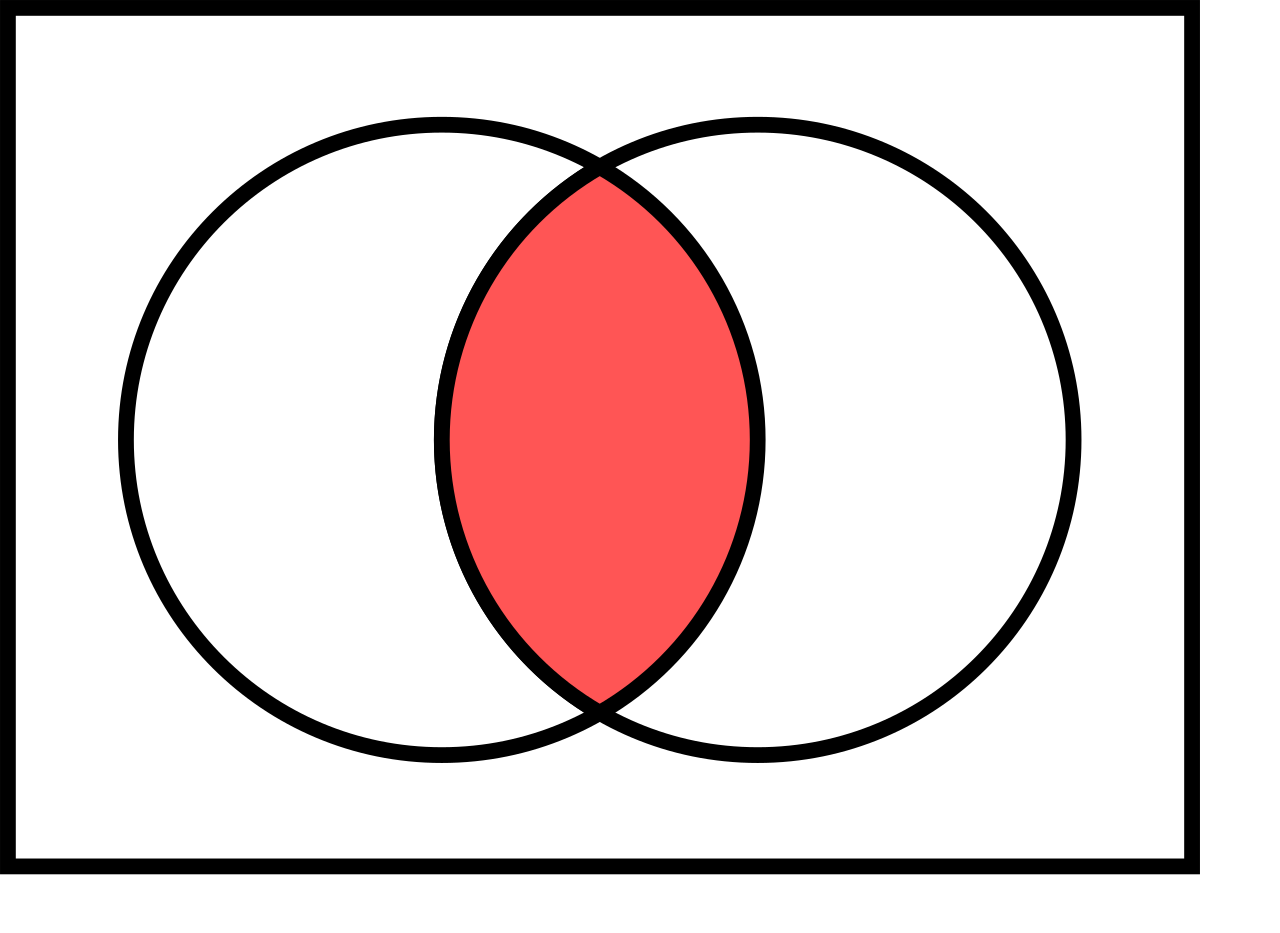
The region in red is what a "cresent" moon would look like.

So no, that doesn't explain it at all.

And before you try to change the shape of the spotlight, that would just cause problems for the gibbous portion.

The other big issue is how it changes.
With this ridiculous idea, the moon would be a new moon when it is outside of the spotlight, then very rapidly change to a full moon as it enters the spotlight, remaining as a full moon for the entire duration it is inside it.

How about you try drawing an actual model, a top down view, showing the sun with its spotlight and defining an angle that will determine the phase, and then using that to show what the different phases would look like and how long they would last.

*

Stash

  • Ethical Stash
  • 13398
  • +2/-2
  • I am car!
Re: crescent moon question
« Reply #19 on: February 21, 2023, 01:37:44 PM »
Doesn't work...


Doesn't work...

?

Kami

  • 1164
  • +2/-0
Re: crescent moon question
« Reply #20 on: February 21, 2023, 03:09:05 PM »
Finally drew a model.


The sun has a "facing", much like a flashlight. That is, you can't hit things to your side when you shine a flashlight ahead of you.  The phases have to do with where the sun and moon are, lined up against each other.

Just to re-iterate JackBlack in a tl;dr:

- your model does not explain why everyone sees the same moon phase on earth, on the contrary, it requires everyone to see a different phase depending on location
- your model can not produce a crescent shape

So, in summary, your model utterly fails to predict two very simple, repeatable observations and is therefore plain wrong.

*

bulmabriefs144

  • 6256
  • +79/-78
  • Roco the Fox
Re: crescent moon question
« Reply #21 on: February 22, 2023, 07:13:55 AM »
I thought that was obvious from the model.

The sun and moon are overhead. We are looking at the same part rotating with the same angular alignment all through the day. The sun shines on the moon whether in North America or Australia. They gradually get out of sync, and then light from the sun isn't being cast on the moon.

Whether the moon rotates as a sphere or not is irrelevant. Regardless of where you see it from, you are always seeing the same part of the moon. The underside. But it doesn't seem to be rotating just orbiting.
« Last Edit: February 22, 2023, 07:16:11 AM by bulmabriefs144 »
If ρ=m/V, then B=ρsurfobj


Here's my Bible, if ya wanna read

*

Stash

  • Ethical Stash
  • 13398
  • +2/-2
  • I am car!
Re: crescent moon question
« Reply #22 on: February 22, 2023, 10:02:17 AM »
I thought that was obvious from the model.

The sun and moon are overhead. We are looking at the same part rotating with the same angular alignment all through the day. The sun shines on the moon whether in North America or Australia. They gradually get out of sync, and then light from the sun isn't being cast on the moon.

Whether the moon rotates as a sphere or not is irrelevant. Regardless of where you see it from, you are always seeing the same part of the moon. The underside. But it doesn't seem to be rotating just orbiting.

Sorry, your explanation doesn’t even come close to solving the fact that in your model people at different locations would see a different phase of the moon at the same time. That does not happen in reality.

Try again. You need to explain this...


*

JackBlack

  • 26157
  • +51/-79
Re: crescent moon question
« Reply #23 on: February 22, 2023, 12:29:03 PM »
I thought that was obvious from the model.
Quite the opposite.
Instead it has been repeatedly explained why your "model" doesn't work.

The sun and moon are overhead. We are looking at the same part rotating with the same angular alignment all through the day. The sun shines on the moon whether in North America or Australia. They gradually get out of sync, and then light from the sun isn't being cast on the moon.
This doesn't explain it.
Try actually drawing how the different phases work.
What is the alignment of your magical spotlight, and what is its shape.

Whether the moon rotates as a sphere or not is irrelevant. Regardless of where you see it from, you are always seeing the same part of the moon. The underside. But it doesn't seem to be rotating just orbiting.
Unless you want to have the moon very far away, say 400 000 km, but at least a distance many times the size of Earth, it does matter.

If the moon is far away then, as an approximation, everyone on Earth sees it from the same direction, seeing the same portion or same side of it.
This makes it appear the same to everyone.

But if it is close, such that the distance between observers is significant compared to the distance to the moon (such as in the FE model), then it would be seen from different angles.
A spherical moon would always appear circular, but we would see different portions of it, and importantly for phases, that means we see different phases, but as well as that, we would also see different sections of it, rather than everyone seeing the same face.
A flat disc (circular) moon would instead appear flattened. i.e. only those it is directly facing would see it as a circle, everyone else would see it as an oval. But everyone would see the same portion illuminated.

So for a FE model, with the moon nearby, the shape does matter; but no shape will match what is observed in reality.

*

bulmabriefs144

  • 6256
  • +79/-78
  • Roco the Fox
Re: crescent moon question
« Reply #24 on: February 22, 2023, 12:37:59 PM »
I thought that was obvious from the model.

The sun and moon are overhead. We are looking at the same part rotating with the same angular alignment all through the day. The sun shines on the moon whether in North America or Australia. They gradually get out of sync, and then light from the sun isn't being cast on the moon.

Whether the moon rotates as a sphere or not is irrelevant. Regardless of where you see it from, you are always seeing the same part of the moon. The underside. But it doesn't seem to be rotating just orbiting.

Sorry, your explanation doesn’t even come close to solving the fact that in your model people at different locations would see a different phase of the moon at the same time. That does not happen in reality.

Try again. You need to explain this...


No I don't. You need to explain why the sun is in one position and people are looking at it while it's sort of fixed in one location while the moon is all about.


Supposedly, you all think the sun and moon are different elevations, and that the sun is just a big shrunken object.  But there is no proof of different elevation.

From Australia to India to America, if you are looking overhead, and the two astronomical bodies are above you, you are looking at them underneath every time. It's an image projected on a domed screen. The same as a flat image reflected on a windshield appears to face upright, the facedown image of the moon is projected so it appears to face us instead. But it cannot do so (in either flat or round Earth) from every position. In other words, your round Earth model would have the same exact concerns as you accuse of me. The sun and moon reflect (refract?) against the atmosphere.
 

Black arrow is new moon, white arrow is full moon. Crescent is due to the sun hitting only a sliver of the moon.
The objects stay parallel as they orbit the Earth. They stay in line of each other on opposite sides of the atmospheric dome. It's only over the course of a month that they get out of sync.

Supposedly you guys are round Earthers but you can't think in three dimensions or you would be able to understand the last picture. As it is, I don't hold out strong hopes for this picture either.


« Last Edit: February 22, 2023, 12:47:15 PM by bulmabriefs144 »
If ρ=m/V, then B=ρsurfobj


Here's my Bible, if ya wanna read

*

Stash

  • Ethical Stash
  • 13398
  • +2/-2
  • I am car!
Re: crescent moon question
« Reply #25 on: February 22, 2023, 01:04:43 PM »
I thought that was obvious from the model.

The sun and moon are overhead. We are looking at the same part rotating with the same angular alignment all through the day. The sun shines on the moon whether in North America or Australia. They gradually get out of sync, and then light from the sun isn't being cast on the moon.

Whether the moon rotates as a sphere or not is irrelevant. Regardless of where you see it from, you are always seeing the same part of the moon. The underside. But it doesn't seem to be rotating just orbiting.

Sorry, your explanation doesn’t even come close to solving the fact that in your model people at different locations would see a different phase of the moon at the same time. That does not happen in reality.

Try again. You need to explain this...


No I don't. You need to explain why the sun is in one position and people are looking at it while it's sort of fixed in one location while the moon is all about.


From Australia to India to America, if you are looking overhead, and the two astronomical bodies are above you, you are looking at them from the same angle every time. It's an image projected on a domed screen. 

Black arrow is new moon, white arrow is full moon. Crescent is due to the sun hitting only a sliver of the moon.

Supposedly you guys are round Earthers but you can't think in three dimensions or you would be able to understand the last picture. As it is, I don't hold out strong hopes for this picture either.

Ok, got it, now we're getting to the meat & potatoes.

The moon (and presumably the sun) is a projection on a dome and you're the one not thinking in 3D as you are hung up on a 2D projection even though you've been shown clear evidence for a 3D moon...


So:

- How high is this dome?
- Where is this 'projector(s)' located?
- Who is manning this 'projector' or is it automated?
- How did this 'projector' come to be?
- Since you solely rely on first-hand experinece, how have you 'experienced' this dome and projector?

*

JackBlack

  • 26157
  • +51/-79
Re: crescent moon question
« Reply #26 on: February 22, 2023, 01:30:16 PM »
No I don't. You need to explain why the sun is in one position and people are looking at it while it's sort of fixed in one location while the moon is all about.
No, we don't. Try drawing it to scale.

The distance between Australia and America, along the surface of Earth, is roughly 12 000 km. The distance to the moon is closer to 350 000 km (as a minimum). That is a ratio of 1:30.

In the steaming pile of crap you have provided to blatantly misrepresent the RE model, the observers are ~719 px away from each other, while the moon is ~500 px above Earth. That ratio is entirely wrong.

And you likely know this, but you don't care because you are happy to blatantly lie to everyone to pretend there is a problem.

You can either draw a scale diagram, or look at what the parallax would actually be.

If you go from opposite sides of Earth, a distance of 12742 km apart, this gives a parallax angle of ~2 degrees. That means the observers would be looking at the moon with a separation of 2 degrees, as the absolute worse case.

And when you start getting to that point, you actually need to check just how accurately people see the same face, as they don't actually see the exact same face. The portion we see varies over time, but only slightly.

If you want a scale diagram, you have this:

If you want to look more at the moon so you can see the difference, you have this:

The lines passing through the centre are the lines to Earth (in the middle), and the lines to each observer, reaching a point where it is tangent to Earth, i.e. the limit of being able to see the moon, ignoring refraction).
The 2 lines on the left, and the 2 lines on the right, are the lines from each observer, to a point tangent on the moon.
It is the tiny difference between those 2 points in each set which create the difference between what the people can see.

So for the RE, everyone on Earth will see basically the same view of the moon.

Now compare this to a FE:


Notice those large orange lines?
They represent the difference expected for a FE, just for people 12 000 km apart.

So once more, the RE explains it. The FE does not.
Your dishonest garbage doesn't mean the RE doesn't.

Supposedly, you all think the sun and moon are different elevations, and that the sun is just a big shrunken object.  But there is no proof of different elevation.
Do you mean different distance from Earth?
If so, that is made quite obvious during a solar eclipse, where the moon passes between Earth and the sun.
We can also tell the moon must be smaller due to the existence of annular eclipses, where the moon doesn't fully block out the sun anywhere.
But more relevant to the discussion, it is made obvious by the phases of the moon.
You can draw a triangle connecting Earth, the moon and the sun.
The angle of this triangle at the moon dictates the phase of the moon. When this angle is ~180 degrees, it is a new moon, when it is ~0 degrees it is a full moon. But most important for this is when it is ~90 degrees, which is when it is a quarter moon.
And importantly, during this quarter moon, the angle between the sun and moon at Earth is also ~90 degrees.
This means the distance to the sun must be many times the distance to the moon.

So it isn't just that we think, it is that the evidence clearly demonstrates this fact. A fact that doesn't match the FE, and observations which the FE can't explain.

It's an image projected on a domed screen.
Where is this magical dome?
What magically causes this projection, especially at the particular locations they are observed at?

You are just coming up with pathetic excuses to cling to a failed fantasy.

But it cannot do so (in either flat or round Earth) from every position. In other words, your round Earth model would have the same exact concerns as you accuse of me.
As above, you are entirely wrong.
Due to the distance to the moon, the change expected for a RE is negligible. So it does NOT suffer this problem.
And again, if you really want to go into it, these tiny changes are observed, so that just further demonstrates the RE model is correct.

Likewise, in terms of distance variation, a FE fantasy with the moon 5000 km above Earth has the distance to the moon vary from 5000 km to ~ 11000 km (if we use the RE numbers for how far it is visible. If we use FE numbers, it gets much worse). This varies by a factor of more than 2. This means the moon overhead should appear at least twice as large (twice the angular size) as the moon near the horizon.
Conversely, for a RE, even if we had someone see it straight through Earth, and consider the moon closer than at perigee as 350 000 km, the distance will vary from 343629 km to 356371 km, or changing by a factor of 1.03, making the change in apparent size negligible (but again, if you observe closely, you can see the change).

It is only when you try and bring the moon close to Earth that you have these problems.

The delusional FE fantasy needs to have the moon close to explain the different apparent position of the moon relative to Earth.
That is what causes the problems.

So the RE model doesn't suffer from these problems, the FE SB does.
Black arrow is new moon, white arrow is full moon. Crescent is due to the sun hitting only a sliver of the moon.
The objects stay parallel as they orbit the Earth. They stay in line of each other on opposite sides of the atmospheric dome. It's only over the course of a month that they get out of sync.

Supposedly you guys are round Earthers but you can't think in three dimensions or you would be able to understand the last picture. As it is, I don't hold out strong hopes for this picture either.
[/quote]
We can understand your last picture, and recognise it doesn't help you at all as it doesn't explain.
Try providing a image which actually demonstrates what has been asked, as that crap does not.

Firstly, decide on the shape of your delusional moon.
Then try drawing a diagram showing the moon in various positions and how the sun is hitting it to cause the phases.
Then try drawing in how different people all see the same view.
Just drawing in crappy lines like you have doesn't explain any of it.

*

bulmabriefs144

  • 6256
  • +79/-78
  • Roco the Fox
Re: crescent moon question
« Reply #27 on: February 23, 2023, 05:38:13 AM »
I thought that was obvious from the model.

The sun and moon are overhead. We are looking at the same part rotating with the same angular alignment all through the day. The sun shines on the moon whether in North America or Australia. They gradually get out of sync, and then light from the sun isn't being cast on the moon.

Whether the moon rotates as a sphere or not is irrelevant. Regardless of where you see it from, you are always seeing the same part of the moon. The underside. But it doesn't seem to be rotating just orbiting.

Sorry, your explanation doesn’t even come close to solving the fact that in your model people at different locations would see a different phase of the moon at the same time. That does not happen in reality.

Try again. You need to explain this...


No I don't. You need to explain why the sun is in one position and people are looking at it while it's sort of fixed in one location while the moon is all about.


From Australia to India to America, if you are looking overhead, and the two astronomical bodies are above you, you are looking at them from the same angle every time. It's an image projected on a domed screen. 

Black arrow is new moon, white arrow is full moon. Crescent is due to the sun hitting only a sliver of the moon.

Supposedly you guys are round Earthers but you can't think in three dimensions or you would be able to understand the last picture. As it is, I don't hold out strong hopes for this picture either.

Ok, got it, now we're getting to the meat & potatoes.

The moon (and presumably the sun) is a projection on a dome and you're the one not thinking in 3D as you are hung up on a 2D projection even though you've been shown clear evidence for a 3D moon...


So:

- How high is this dome?
- Where is this 'projector(s)' located?
- Who is manning this 'projector' or is it automated?
- How did this 'projector' come to be?
- Since you solely rely on first-hand experinece, how have you 'experienced' this dome and projector?

Ah right. I've been "shown" "clear" "evidence."
 Where was this evidence from? Oh right. From NASA, Smithsonian, or some company connect through megacorporations to one of the list of companies mentioned by WonderWorks Inc. In other words, more models by WonderWorks Inc. I can't say I've been show it so make as receive spammy images that people want my to believe against my will. And what about this is clear? You have a picture of the moon that isn't even full.

Meanwhile, with my naked eye, the moon appears to be a flat projection. The moon is a flat projection. It just has shadows around the edges. But since you're so fixated on these NASA photos, here's a video called "NASA photos prove moon is a projection."


Now for your questions:
-Dunno. Don't care. Accurate numbers are for chumps. The dome of the sky and the dome of the parabola are two different things. If you're curious, you can do the same sort of math this guy did.

The problem is that the dome of the sky is objective reality and has an accurate measurement based on the total surface area of Earth. But the dome of the parabola is based on perspective. Let us suppose you have a tape measure that is Guinness book of records length. Large enough to circle around the Earth's equatorial diameter and back to you (you would claim this is proof of round Earth, but this is because you don't understand how East works in a flat Earth).  Both you and the guy in the boat pulling this superlong tape measure would reach a point where the tape measure disappears out of sight. You see, the point at which we humans can actually see is pretty limited. Which makes this question absurdly moot. Don't know. Don't care. It's probably farther than I think but nearer than you think (the latter being much nearer).
-For the purposes of argument, we are not going with a "projector" e.g. Bat Signal. Within Earth's (real) atmosphere, the sun and moon are projected from flat above us to upright. Then our eyes turn it into a 3D image because we are insane and think the images inside the cave are real.

-It's not a projector, it's a projection. Your can put a coaster near a car window (I forget if it has to be inside, or can be outside). Light does its thing, and you can see the image of a coaster perfectly upright.
- Inductive reasoning. In much the same way as this car reflection, I've realized that the moon can't be visible for X hours a day near me, and simultaneously be orbiting the Earth at high speed. (1)I'd be unable to see it as it races around the Earth, (2) somehow we see it for more than 1/3 of the day? In terms of perspective with other objects this doesn't track. Mom can move out of my sight within a few minutes driving a car, even on a straight road. But an object moving around the world that doesn't disappear from sight? Projection. (3) And before you ask, I know we aren't spinning at 1000+ mph viewing another object. I know this from primary school playground stuff. You guys don't observe anything. I was supposedly called ADD cuz I "couldn't pay attention" but what really happened was I wouldn't pay attention to brainwashing. I paid attention just fine. Merry-go-round. What happens to objects as you spin around? Honestly that ride made me sick, but there is a substantial and observable difference between four kids circling me, and me spinning around and viewing them. You actually can tell the difference between viewing the moon from a spinning world, and the sun and moon orbiting us. Unless you're not paying attention.
« Last Edit: February 23, 2023, 06:57:51 AM by bulmabriefs144 »
If ρ=m/V, then B=ρsurfobj


Here's my Bible, if ya wanna read

*

JackBlack

  • 26157
  • +51/-79
Re: crescent moon question
« Reply #28 on: February 23, 2023, 12:55:22 PM »
Notice how yet again you have entirely failed to explain how the phases of the moon work?

Ah right. I've been "shown" "clear" "evidence."
Where was this evidence from? Oh right. From NASA, Smithsonian, or some company
Yes we know, you want to bury your head in the sand and remain wilfully ignorant.
You hate reality and have no interest in any evidence that shows that your delusional fantasy is pure garbage.

But this evidence you can get for yourself.
Go and take high resolution photos of the moon throughout the year, and throughout the night for a few full moons.
Then compare them.

You don't need to believe what someone else shows you, you can get the evidence yourself.

The sole reason you have no interest in that, is that it will destroy your fantasy, and you can't claim you are in on a conspiracy to mislead yourself.

Meanwhile, with my naked eye, the moon appears to be a flat projection.
Based upon what?
It sure seems like you just see it as you want to.

It just has shadows around the edges.
Are you insane? Have you never looked at the moon?
The phases are shadows.

But since you're so fixated on these NASA photos, here's a video called "NASA photos prove moon is a projection."
How about instead of linking to a shitty video you probably haven't watched, you instead link to the NASA photo(s) and explain how they prove the moon is a projection.

-Dunno. Don't care.
Of course you don't. You don't care about anything that shows your delusional fantasy to be garbage.
You just happily accept not knowing, so you can cling to your delusional BS.

The problem is that the dome of the sky is objective reality and has an accurate measurement
If it did, you would be able to provide those measurements.
There is no evidence at all for your dome.
It is pure fantasy.
Just like there is no evidence at all for your delusional parabola, nor does it even make sense.

- Inductive reasoning.
Inductive reasoning does not lead to your delusional BS.

I've realized that the moon can't be visible for X hours a day near me, and simultaneously be orbiting the Earth at high speed.
And notice that it is just "realised"?
You don't have any evidence or logical thought to justify it.
So you need to just assert without any justification at all.

So with that, your "inductive reasoning" fails entirely.

But what makes it even more ridiculous is that you have had this delusional BS refuted countless times.

You can see roughly 1/2 of the celestial spheres.
If the moon is over the equator, you can see it for roughly 12 hours each day.

Mom can move out of my sight within a few minutes
Because your mom is not 350 000 - 400 000 km high.

If you would like an example of inductive reasoning, here is a far better one:
An object at sea level disappears from sight after roughly 5 km due to being obstructed by the curvature of Earth.
If you increase your elevation, it will disappear further away.
Likewise, if it increases its altitude, it will disappear further away.

The moon, being much much much much higher, will be visible for much longer.

In fact, due to the same angular size over the course of a day, we know it must be very far away, many times the size of Earth, meaning from the POV of Earth, it would be following a circle around the centre of Earth, with the angle to it based upon its position in that circle, meaning we should be able to see it for roughly 12 hours, depending on latitude and position of the moon.

I know we aren't spinning at 1000+ mph viewing another object. I know this from primary school playground stuff.
Where you yet again entirely fail to actually understand.
And you dishonestly cling to the 1000+ archaic units per hour.
Earth rotates at roughly 1 revolution per day.
That is half the speed of the an analogue clock.

Again, using induction, and paying attention to other things, like driving or riding in a car, you can see when you make a tight turn such as in the city, at moderate speed, you notice a quite significant push outwards.
But making a wide turn, at much faster speeds such as on the highway, you don't feel yourself being pushed out anywhere near as much.
We can see that the force experienced depends on the speed and the radius of the turn.
Or you can do the math to show exactly what acceleration is needed.
We get a=v^2/r=v*omega=omega^2*r.
Doing the math, you get a =0.03 m/s^2.
i.e. basically nothing.

So there you go entirely failing yet again.

I was supposedly called ADD cuz I "couldn't pay attention"
And it shows, with you continually spouting delusional garbage, which you cannot justify at all, which has been repeatedly refuted.
So ADD, or severely brain damaged.

You actually can tell the difference between viewing the moon from a spinning world, and the sun and moon orbiting us. Unless you're not paying attention.
That's right, and we have. For example, Foucault's pendulum and laser ring gyroscopes clearly demonstrate that Earth is turning, rotating on its axis.
You don't accept this because you aren't paying attention; because you are wilfully ignorant.
« Last Edit: February 23, 2023, 12:57:38 PM by JackBlack »

*

Stash

  • Ethical Stash
  • 13398
  • +2/-2
  • I am car!
Re: crescent moon question
« Reply #29 on: February 23, 2023, 01:15:59 PM »
I thought that was obvious from the model.

The sun and moon are overhead. We are looking at the same part rotating with the same angular alignment all through the day. The sun shines on the moon whether in North America or Australia. They gradually get out of sync, and then light from the sun isn't being cast on the moon.

Whether the moon rotates as a sphere or not is irrelevant. Regardless of where you see it from, you are always seeing the same part of the moon. The underside. But it doesn't seem to be rotating just orbiting.

Sorry, your explanation doesn’t even come close to solving the fact that in your model people at different locations would see a different phase of the moon at the same time. That does not happen in reality.

Try again. You need to explain this...


No I don't. You need to explain why the sun is in one position and people are looking at it while it's sort of fixed in one location while the moon is all about.


From Australia to India to America, if you are looking overhead, and the two astronomical bodies are above you, you are looking at them from the same angle every time. It's an image projected on a domed screen. 

Black arrow is new moon, white arrow is full moon. Crescent is due to the sun hitting only a sliver of the moon.

Supposedly you guys are round Earthers but you can't think in three dimensions or you would be able to understand the last picture. As it is, I don't hold out strong hopes for this picture either.

Ok, got it, now we're getting to the meat & potatoes.

The moon (and presumably the sun) is a projection on a dome and you're the one not thinking in 3D as you are hung up on a 2D projection even though you've been shown clear evidence for a 3D moon...


So:

- How high is this dome?
- Where is this 'projector(s)' located?
- Who is manning this 'projector' or is it automated?
- How did this 'projector' come to be?
- Since you solely rely on first-hand experinece, how have you 'experienced' this dome and projector?

Ah right. I've been "shown" "clear" "evidence."
 Where was this evidence from? Oh right. From NASA, Smithsonian, or some company connect through megacorporations to one of the list of companies mentioned by WonderWorks Inc.

Nope, you're wrong yet again. Those are all from amateur astrophotographers. No NASA, et al involved, just people like you or me with telescopes and cameras that are readily available to us. If you really wanted to put your money where your mouth is, you'd actually go out of your way to look through a basic Celestron. But you won't. You'd prefer to armchair your way about the world.

Meanwhile, with my naked eye, the moon appears to be a flat projection.

Therein lies your problem...Too lazy to look at anything without just your naked eye. I suppose you're against the use of microscopes and glasses too.

The moon is a flat projection. It just has shadows around the edges. But since you're so fixated on these NASA photos, here's a video called "NASA photos prove moon is a projection."

Again, not sure why you're all hung up on NASA when NASA has nothing to do with this.

Now for your questions:
-Dunno. Don't care. Accurate numbers are for chumps. The dome of the sky and the dome of the parabola are two different things. If you're curious, you can do the same sort of math this guy did.

In regard to your response to How high is this dome?

Accurate numbers are for chumps? Pretty much says it all about the veracity of any of your claims. And referencing a zelda video further says it all about the veracity of any of your claims. Child-like, at best.

You don't believe in accuracy? And you have no idea how high your dome is? Not even a rough guess? And no evidence of its existence? Interesting

The problem is that the dome of the sky is objective reality and has an accurate measurement based on the total surface area of Earth. But the dome of the parabola is based on perspective. Let us suppose you have a tape measure that is Guinness book of records length. Large enough to circle around the Earth's equatorial diameter and back to you (you would claim this is proof of round Earth, but this is because you don't understand how East works in a flat Earth).  Both you and the guy in the boat pulling this superlong tape measure would reach a point where the tape measure disappears out of sight. You see, the point at which we humans can actually see is pretty limited. Which makes this question absurdly moot. Don't know. Don't care. It's probably farther than I think but nearer than you think (the latter being much nearer).

In regard to your response to Where is this 'projector(s)' located?

I have no idea what all that was all about. East? Tape measures? Guinness book? How far we can see? Since at ground level, we can generally only see about 3 miles to the horizon, your saying that the Moon must be closer than that, otherwise we couldn't see it due to the limitations of our sight?

If you don't know, then you don't know and, apparently, don't care. Therefore you can't say it's farther than you think and closer than I think. You have no idea either way. So you just decide to make up things?

-For the purposes of argument, we are not going with a "projector" e.g. Bat Signal. Within Earth's (real) atmosphere, the sun and moon are projected from flat above us to upright. Then our eyes turn it into a 3D image because we are insane and think the images inside the cave are real.

In regard to your response to Who is manning this 'projector' or is it automated?

Projected from where? Where are the sun and moon projected from? Where are these flat disks located that are then replicated on some dome? They have to be somewhere otherwise there would be nothing to project.

-It's not a projector, it's a projection. Your can put a coaster near a car window (I forget if it has to be inside, or can be outside). Light does its thing, and you can see the image of a coaster perfectly upright.

In regard to your response to How did this 'projector' come to be?

Ok, so where is the "coaster" of a moon located and who put it there? Something has to exist to be projected/reflected in your coaster example, i.e., the coaster.  So where is this moon coaster that is casting it's image on the dome like the coaster on the window?

What evidence do you have of the existence of this coaster like moon?

- Inductive reasoning. In much the same way as this car reflection, I've realized that the moon can't be visible for X hours a day near me, and simultaneously be orbiting the Earth at high speed. (1)I'd be unable to see it as it races around the Earth, (2) somehow we see it for more than 1/3 of the day? In terms of perspective with other objects this doesn't track. Mom can move out of my sight within a few minutes driving a car, even on a straight road. But an object moving around the world that doesn't disappear from sight? Projection. (3) And before you ask, I know we aren't spinning at 1000+ mph viewing another object. I know this from primary school playground stuff. You guys don't observe anything. I was supposedly called ADD cuz I "couldn't pay attention" but what really happened was I wouldn't pay attention to brainwashing. I paid attention just fine. Merry-go-round. What happens to objects as you spin around? Honestly that ride made me sick, but there is a substantial and observable difference between four kids circling me, and me spinning around and viewing them. You actually can tell the difference between viewing the moon from a spinning world, and the sun and moon orbiting us. Unless you're not paying attention.

In regard to your response to Since you solely rely on first-hand experinece, how have you 'experienced' this dome and projector?

So you inductive reasoning is based upon playground structures. Pretty much says it all.

And lastly, you still haven't even remotely answered the question as to how the phases of the moon works. How do the phases of the moon work?
« Last Edit: February 23, 2023, 01:17:38 PM by Stash »