You are so deep in denial you don't see something on a video that everyone else can clearly see.
Oh no, I clearly saw a burn when I slowed the video on YouTube.
But there is a difference between denial and skepticism.
Denial says it doesn't happen. Skepticism says it doesn't matter.
It doesn't matter because the film had to be slowed to well below a second in order to see this flame. It smoked itself out, yet the video recorder dishonestly calls this proof.
Fractional seconds of ignition are not proof. This proves that the oxidizer allows for few seconds of burn. But it also proves that the oxidizer very quickly burns off.
I am in denial of nothing. I know there was a burn.
However, you are in denial of the fact that this fire smoked out. Even though you can see in real time that for several seconds smoke will linger in this chamber, far more than flame.
In even a low oxygen zone (mesosphere, for instance) rocket fuel will burn weaker and last for a shorter time. We know this from reduced forward momentum. If forward motion were INCREASED the rocket should have shattered the front of its vacuum tube, and then slowed down when it left the tube. But no, the tube was less then 15 feet, yet it lacked escape velocity. If I introduced a pinprick in front, the rocket might achieve escape velocity. The object travels faster and farther and with more force because of the oxygen added.
We know from this that the bizarre claim that objects travel faster in space is wrong.
We know that objects have to use oxidizers in order to function in space by ignition. In we know from their own estimates (those three fuel tank systems I quoted earlier) that they are extremely inefficient in fuel use. We know this, ironically from your video, which shows the breakdown of oxidizer. I ignored the video about water burning a rocket, because water can be aerobic even if it is water enough to snuff most fires.
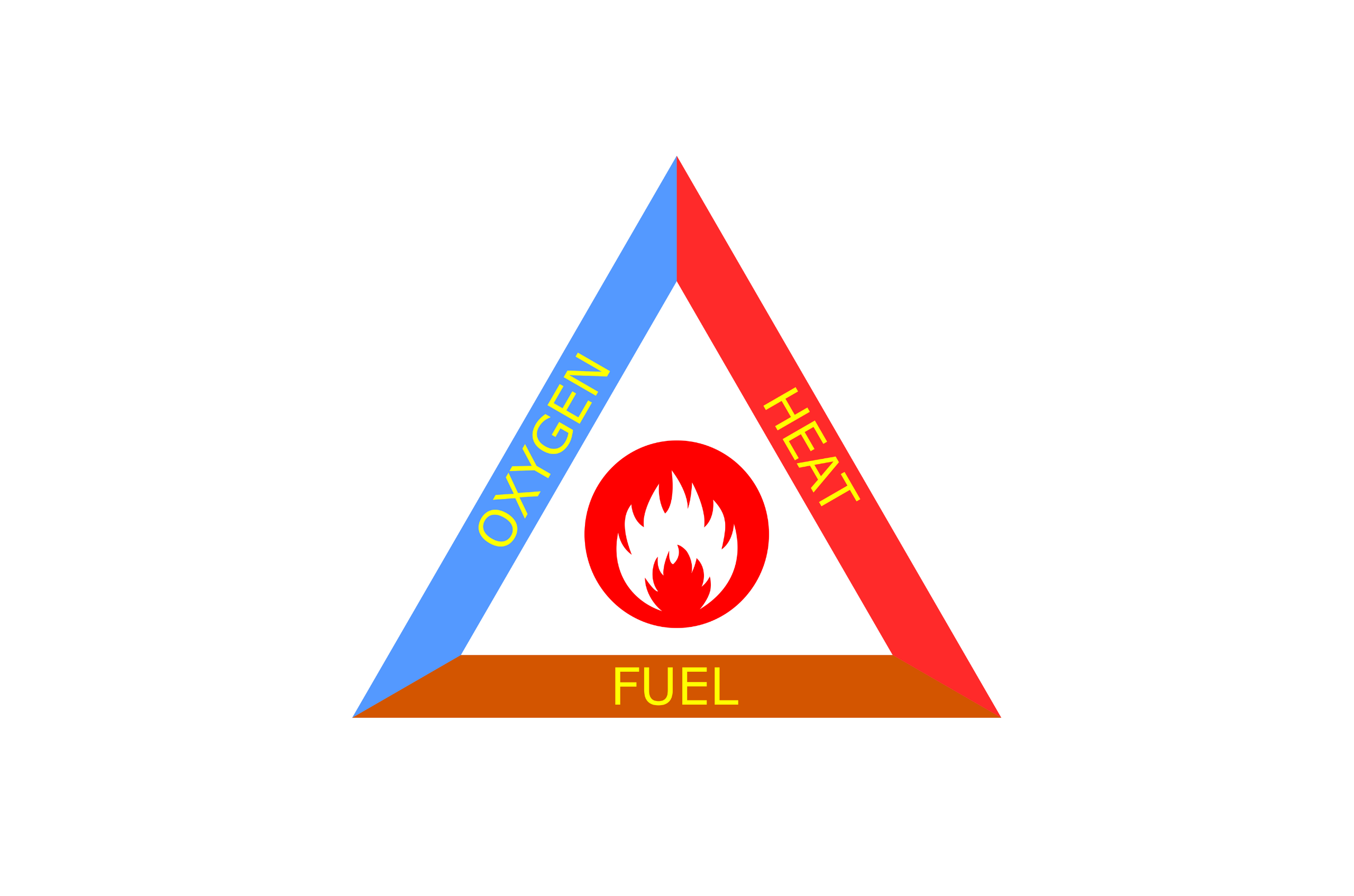
This is a fire triangle, to fight fire, one of these things is removed. Am I going to trust this, the fruit of years of experience fighting fire? Or the dubious claims of a man who used slo-mo to "disprove" the basic laws of fire safety?
Oh yes, you have a big impressive tank. Let's say for each oz, the rocket burns for 10 seconds (even though we saw it snuff in under a second). And I dunno, but I'm guessing that container is between 50 and 150 tons. I'm also guess once spent, it cannot be moved, so you'd better have more portable means of oxidizer after that, as you can't exactly drag it out of place and put in a new one.
16 oz in a pound, so 160 seconds per pound
2000 lb in a ton, so 320000 secobds per ton
150 tons, so 48000000 seconds total
60 minutes per second, so 800000 minutes
60 minutes in an hour, 13333.3333333 hours
24 hours in a day, so 555.555555554 days.
That's nice, but we are assuming a very ideal time for burning, one that gives us a full ten seconds of burn per oz. Actually, what we observed was closer to half a second or even a quarter.
Reducing total based on one second, so 55.5555555554 days.
Reducing total based on being a fraction of a second, so about 28 days.
For a 150 tons of fuel, assuming that the fuel isn't blown all at once, you could theoretically take a trip that lasted 28 days. This is also assuming all fuel isn't snuffed immediately and that it's possible to portion it ounce by ounce. That's a really big ask, that I'm going to allow because it still won't make a difference.
https://www.space.com/24701-how-long-does-it-take-to-get-to-mars.htmlNASA says it takes 21 months (not days, months) for a round trip involving Mars. A heavier oxidizer barrel creates drag that makes takeoff and motion in general even slower. That is, simply adding 30 more tanks (1 month being 30ish days) would just load down the rocket and make it harder to get anywhere. You'd also need a shuttle several times as big to load all of these giant space wasters. I suppose you could fly to the moon, based on their distance. But you couldn't fly to Mars which is 10.5 months one way, and you couldn't fly to Venus which is between 3.5 months and 6.5 months depending on orbit. And apparently Mercury is 7 years away.
https://astronomytelescopes.net/how-long-does-it-take-to-get-to-venus/https://jacksofscience.com/how-long-would-it-take-to-get-to-mercury/None of these are within that 28 day window. And keep in mind, somehow you need to make a round trip. That's only 14 days of usable movement unless you save nothing for the way back.
And all of that is not assuming what I just stated, that motion is slowed in the absence of air. All of that is using time as though the speed projections of NASA are accurate. But rather than enormous 360,000 mph notions, the speed seems like it would slow down actually (based on no escape from a 15 ft or so tube.
So that's 14 days of kinda drifting towards things instead of the image of rocketing towards them because no air means less speed, not more.
Denial says it doesn't happen. Skepticism says it doesn't matter.
https://www.quora.com/Does-a-rocket-fly-faster-on-earth-or-in-outer-space?share=1It doesn't matter because we are TOLD that rockets travel faster in space, but this shows drag from lack of oxygen. Meaning even if you got your ship to burn fuel for 28 days or got an even bigger tank, meaning more drag

(more drag

)
the fastest speeds you wil reach are within Earth's atmosphere. And what are these speeds?
I don't know. I have asked this question several times to the internet, and they deflect to projected speeds outside the atmosphere, talking about how the speed varies depending on the mission. "Yes but what is the takeoff speed?" Or that the escape speed is 17,600 to 25,000 mph. "Yes but what is the speed within the atmosphere?"
Yeahhh, no. We're going to assume the numbers are inflated by projection and further inflated by the assumption that speed increased without oxygen, even though that video showed it lack forward motion enough to smash its container when tethered.
So if it somehow managed 25,000 mph within the atmosphere, it would surely be reduced by 1/2 or even 1/10 motion in a vacuum. 2500 mph is about 60000 mpd.
Moon is 238,855 miles away. Meaning you could still reach the moon in 3.9 days. But basically nothing else. Everything else requires much much more oxidizer and you get to the rule of diminishing return.
For space travel to be possible, you need a non-air non-ignition form of propulsion, or to find an atmospheric bridge between planets. Other options simply do not work from a cost effective standpoint, nor a drag standpoint.