The rotational and the orbital CORIOLIS EFFECT formulas were derived for the first time in 1904 by A. Michelson, and they feature AN AREA:
http://www.conspiracyoflight.com/Michelson-Gale/Michelson_1904.pdfGeorges Sagnac derived THE SAME FORMULA, featuring an area, the CORIOLIS EFFECT formula.
The original papers published by G. Sagnac (The Luminiferous Ether is Detected as a Wind Effect Relative to the Ether Using a Uniformly Rotating Interferometer):
http://zelmanov.ptep-online.com/papers/zj-2008-07.pdfhttp://zelmanov.ptep-online.com/papers/zj-2008-08.pdfIn 1913, Georges Sagnac measured ONLY the Coriolis effect, and not the true Sagnac effect (proportional to the linear velocity and radius of rotation).
Here is the shape of the interferometer used by Sagnac:

Is there a way to clearly distinguish between the formulas required for an irregularly shaped interferometer and a symmetrically shaped interferometer?
Yes, there is: using graduate level differential geometry.
Please read:
https://link.springer.com/article/10.1023/A:1023972214666https://arxiv.org/pdf/gr-qc/0103091.pdfCoriolis Force and Sagnac Effect
Because of acting of gravity-like Coriolis force the trajectories of co- and anti-rotating photons have different radii in the rotating reference frame, while in the case of the equal radius the effective gravitational potentials for the photons have to be different.

An interferometer with DIFFERENT RADII (located away from the center of rotation) will manifest the Coriolis force in the form of a phase shift 4AΩ/c^2.
Different sets of radii and the center of rotation do not coincide with the geometrical center of the interferometer.
That is why Sagnac had to use the formula which features the area and the angular velocity: he only measured the CORIOLIS EFFECT.
Even if the shape of the interferometer is made to look more symmetrical, there are still two different radii to deal with:

This is the formula derived by G. Sagnac:
4AΩ/c^2.
THIS IS THE CORIOLIS EFFECT FORMULA.
Here is the precise proof, peer-reviewed in an IOP article.
THIS IS AN IOP ARTICLE, one of the most comprehensive papers on the Sagnac effect ever published.


Here is reference #27:
 http://www.conspiracyoflight.com/Michelson-Gale/Silberstein.pdf
The formula derived by Dr. Silberstein, peer reviewed in the IOP article, and described by the author as the "effect of the Coriolis forces" is this:
dt = 4ωA/c^2
Here is a direct derivation of the same formula using only the Coriolis force:
https://www.ias.ac.in/article/fulltext/pram/087/05/0071The derivation has NO LOOPS at all.
Just a comparison of two sides.
Here is how Dr. Silberstein's CORIOLIS EFFECT formula was derived:
The propagation of light in rotating systems, Journal of the Optical Society of America, vol. V, number 4, 1921
He proved that the real cause of the phenomenon measured by Georges Sagnac was the CORIOLIS FORCE EFFECT.

Dr. Silberstein proved that the effect measured by Sagnac is A PHYSICAL EFFECT, a deflection/inflection of the light beams due to the CORIOLIS FORCE.
In 1922, he extended the definition used in his 1921 paper on the nature of the rays arriving from the collimator:
http://gsjournal.net/Science-Journals/Historical%20Papers-Mechanics%20/%20Electrodynamics/Download/2645Dr. Ludwik Silberstein, a physicist on the same level with Einstein and Michelson, partially inspired and supported the Michelson-Gale experiment.
In 1921, Dr. Silberstein proposed that the Sagnac effect, as it relates to the rotation of the Earth or to the effect of the ether drift, must be explained in terms of the Coriolis effect: the direct action of Coriolis forces on counterpropagating waves.
http://www.conspiracyoflight.com/Michelson-Gale/Silberstein.pdfThe propagation of light in rotating systems, Journal of the Optical Society of America, vol. V, number 4, 1921
Dr. Silberstein developed the formula published by A. Michelson using very precise details, not to be found anywhere else.
He uses the expression kω for the angular velocity, where k is the aether drag factor.
He proves that the formula for the Coriolis effect on the light beams is:
dt = 2ωσ/c
2Then, Dr. Silberstein analyzes the area σ and proves that it is actually a SUM of two other areas (page 300 of the paper, page 10 of the pdf document).
The effect of the Coriolis force upon the interferometer will be to create a convex and a concave shape of the areas: σ
1 and σ
2.
The sum of these two areas is replaced by 2A and this is how the final formula achieves its final form:
dt = 4ωA/c
2A = σ
1 + σ
2That is, the CORIOLIS EFFECT upon the light beams is totally related to the closed contour area.Here are the DEFINITIONS USED BY MODERN SCIENCE TO DESCRIBE THE SAGNAC EFFECT:
https://www.mathpages.com/rr/s2-07/2-07.htmIf two pulses of light are sent in opposite directions around a stationary circular loop of radius R, they will travel the same inertial distance at the same speed, so they will arrive at the end point simultaneously.
http://www.cleonis.nl/physics/phys256/sagnac.phpEssential in the Sagnac effect is that a loop is closed.
http://www.einsteins-theory-of-relativity-4engineers.com/sagnac-effect.htmlThe Sagnac effect is observed when coherent light travels around a closed loop in opposite directions and the phases of the two signals are compared at a detector.
THE SAGNAC EFFECT DOES NOT REQUIRE AN AREA, only the CORIOLIS EFFECT is proportional to an area.
Michelson and Gale COMPARED TWO SIDES ONLY, not any loops at all:
http://articles.adsabs.harvard.edu/cgi-bin/nph-iarticle_query?1925ApJ....61..137M&data_type=PDF_HIGH&whole_paper=YES&type=PRINTER&filetype=.pdf
The final formula used by Michelson features an AREA: it is the CORIOLIS EFFECT formula.
Using a phase-conjugate mirror, for the first time in 1986, Professor Yeh was able to derive the TRUE SAGNAC FORMULA which is proportional to the velocity of the light beams.

page 152 of the pdf document, section Recent Advances in Photorefractive Nonlinear Optics page 4
The MPPC acts like a normal mirror and Sagnac interferometry is obtained. Here is the derivation of my formula, using TWO LOOPS:
https://www.theflatearthsociety.org/forum/index.php?topic=30499.msg2117351#msg2117351Here is the final formula:
2(V1L1 + V2L2)/c2My formula is confirmed at the highest possible scientific level, having been published in the best OPTICS journal in the world, Journal of Optics Letters, and it is used by the US NAVAL RESEARCH OFFICE, Physics Division.
A second reference which confirms my global/generalized Sagnac effect formula.
https://apps.dtic.mil/dtic/tr/fulltext/u2/a206219.pdfStudies of phase-conjugate optical devices concepts
US OF NAVAL RESEARCH, Physics Division
Dr. P. Yeh
PhD, Caltech, Nonlinear Optics
Principal Scientist of the Optics Department at Rockwell International Science Center
Professor, UCSB
"Engineer of the Year," at Rockwell Science Center
Leonardo da Vinci Award in 1985
Fellow of the Optical Society of America, the Institute of Electrical and Electronics Engineers
page 152 of the pdf document, section Recent Advances in Photorefractive Nonlinear Optics page 4
The MPPC acts like a normal mirror and Sagnac interferometry is obtained. 
Phase-Conjugate Multimode Fiber Gyro
Published in the Journal of Optics Letters, vol. 12, page 1023, 1987
page 69 of the pdf document, page 1 of the article
A second confirmation of the fact that my formula is correct.
Here is the first confirmation:

Self-pumped phase-conjugate fiber-optic gyro, I. McMichael, P. Yeh, Optics Letters 11(10):686-8 · November 1986
http://www.dtic.mil/dtic/tr/fulltext/u2/a170203.pdf (appendix 5.1)
Exactly the formula obtained by Professor Yeh:
φ = -2(φ
2 - φ
1) = 4π(R
1L
1 + R
2L
2)Ω/λc = 4π(V
1L
1 + V
2L
2)/λc
Since Δφ = 2πc/λ x Δt, Δt = 2(R1L1 + R2L2)Ω/c2 = 2(V1L1 + V2L2)/c2CORRECT SAGNAC FORMULA:
2(V1L1 + V2L2)/c2The very same formula obtained for a Sagnac interferometer which features two different lengths and two different velocities.
http://www.dtic.mil/dtic/tr/fulltext/u2/a170203.pdfANNUAL TECHNICAL REPORT PREPARED FOR THE US OF NAVAL RESEARCH.
Page 18 of the pdf document, Section 3.0 Progress:
Our first objective was to demonstrate that the phase-conjugate fiberoptic gyro (PCFOG) described in Section 2.3 is sensitive to rotation. This phase shift plays an important role in the detection of the Sagnac phase shift due to rotation. Page 38 of the pdf document, page 6 of Appendix 3.1
it does demonstrate the measurement of the Sagnac phase shift Eq. (3)HERE IS EQUATION (3) OF THE PAPER, PAGE 3 OF APPENDIX 3.1:
φ = -2(φ
2 - φ
1) = 4π(R
1L
1 + R
2L
2)Ω/λc = 4π(V
1L
1 + V
2L
2)/λc
Since Δφ = 2πc/λ x Δt, Δt = 2(R1L1 + R2L2)Ω/c2 = 2(V1L1 + V2L2)/c2CORRECT SAGNAC FORMULA:
2(V1L1 + V2L2)/c2
The Coriolis effect is a physical effect upon the light beams: it is proportional to the area of the interferometer. It is a comparison of two sides.
The Sagnac effect is an electromagnetic effect upon the velocities of the light beams: it is proportional to the radius of rotation. It is a comparison of two loops.
Two different phenomena require two very different formulas.
My SAGNAC EFFECT formula proven and experimentally fully established at the highest possible level of science.Let us now compare the two derivations, using two loops (Sagnac effect) and two sides (Coriolis effect):
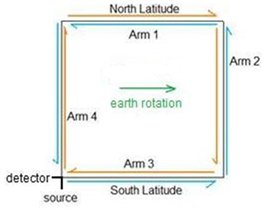
Point A is located at the detector
Point B is in the bottom right corner
Point C is in the upper right corner
Point D is in the upper left corner
l
1 is the upper arm.
l
2 is the lower arm.
Here is the most important part of the derivation of the full/global Sagnac effect for an interferometer located away from the center of rotation.
A > B > C > D > A is a continuous counterclockwise path, a negative sign -
A > D > C > B > A is a continuous clockwise path, a positive sign +
The Sagnac phase difference for the clockwise path has a positive sign.
The Sagnac phase difference for the counterclockwise has a negative sign.
Sagnac phase components for the A > D > C > B > A path (clockwise path):
l
1/(c - v
1)
-l
2/(c + v
2)
Sagnac phase components for the A > B > C > D > A path (counterclockwise path):
l
2/(c - v
2)
-l
1/(c + v
1)
For the single continuous clockwise path we add the components:
l
1/(c - v
1) - l
2/(c + v
2)
For the single continuous counterclockwise path we add the components:
l
2/(c - v
2) - l
1/(c + v
1)
The net phase difference will be (let us remember that the counterclockwise phase difference has a negative sign attached to it, that is why the substraction of the phase differences becomes an addition):
{l
1/(c - v
1) - l
2/(c + v
2)} - (-){l
2/(c - v
2) - l
1/(c + v
1)} = {l
1/(c - v
1) - l
2/(c + v
2)}
+ {l
2/(c - v
2) - l
1/(c + v
1)}
Rearranging terms:
l
1/(c - v
1) - l
1/(c + v
1)
+ {l
2/(c - v
2) - l
2/(c + v
2)} =
2(v
1l
1 + v
2l
2)/c
2Exactly the formula obtained by Professor Yeh:
φ = -2(φ
2 - φ
1) = 4π(R
1L
1 + R
2L
2)Ω/λc = 4π(V
1L
1 + V
2L
2)/λc
Since Δφ = 2πc/λ x Δt, Δt = 2(R
1L
1 + R
2L
2)Ω/c
2 = 2(V
1L
1 + V
2L
2)/c
2CORRECT SAGNAC FORMULA:
2(V1L1 + V2L2)/c2Self-pumped phase-conjugate fiber-optic gyro, I. McMichael, P. Yeh, Optics Letters 11(10):686-8 · November 1986
http://www.dtic.mil/dtic/tr/fulltext/u2/a170203.pdf (appendix 5.1)
This is how the correct Sagnac formula is derived: we have single continuous clockwise path, and a single continuous counterclockwise path.
If we desire the Coriolis effect, we simply substract as follows:
dt = l
1/(c - v
1) - l
1/(c + v
1) - (l
2/(c - v
2) - l
2/(c + v
2))
Of course, by proceeding as in the usual manner for a Sagnac phase shift formula for an interferometer whose center of rotation coincides with its geometrical center, we obtain:
2v
1l
1/(c
2 - v
21) - 2v
2l
2/(c
2 - v
22)
l = l
1 = l
22l[(v
1 - v
2)]/c
22lΩ[(R
1 - R
2)]/c
2R
1 - R
2 = h
2lhΩ/c
2By having substracted two different Sagnac phase shifts, valid for the two different segments, we obtain the CORIOLIS EFFECT formula.
However, for the SAGNAC EFFECT, we have a single CONTINUOUS CLOCKWISE PATH, and a single CONTINUOUS COUNTERCLOCKWISE PATH, as the definition of the Sagnac effect entails.