Start with the basics. Good idea. So the first thing is to know how far it has to travel in its 92 minutes so you can calculate the velocity it has to be moving at. Easy, and basic -- take a look at the flat earth map and see how far it has to travel.
Oh -- I forgot. There isn't a flat earth map.
Like I said, all you need's a lower bound. It doesn't have to be a distance people accept as accurate, just so long as they accept it as a lower bound.
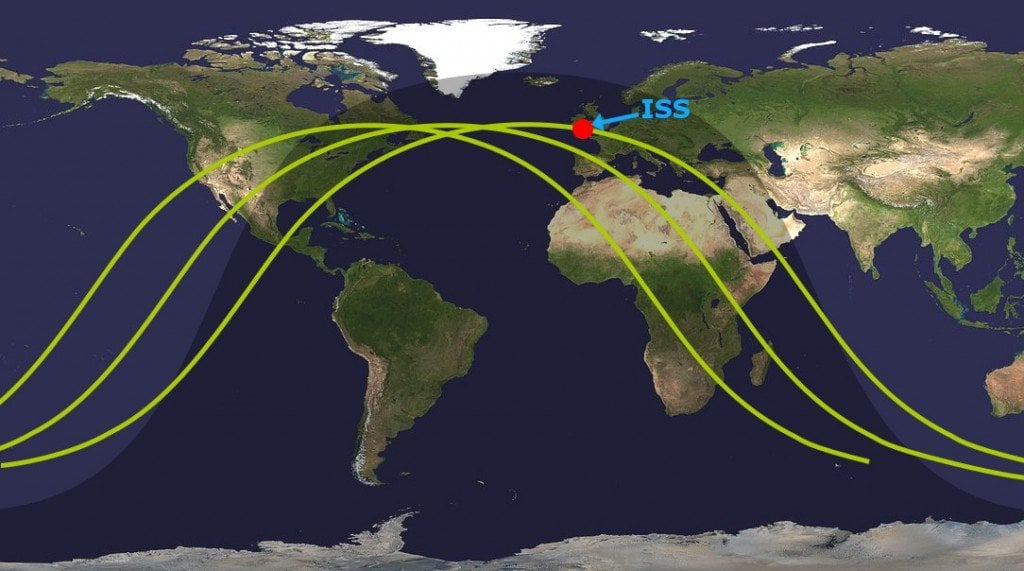
Given the common diagram of the ISS' path, presumably corroborated by claimed observation times, a lower bound would be a straight shot around the, say, equator. Certainly not every orbit will necessarily be that, but so long as some are it means those are the speeds it has to be capable of reaching.
For the sake of error, I'll lop 10,000km off the RE measure of the length of the equator. Sure, it's a lot, but in the interests of giving the FE model every chance it seems a pretty good way of getting a lower bound. (Please, leave aside all the arguments of how that distance could or could not be verified, all that matters is that this value is likely less than the truth of any model).
The ISS would then travel at the speed 5,434m/s, or 19,565km/h, or 12,157mph. Still easily supersonic, and considerably faster than the known fastest jet.
However, the fastest
unmanned aerial vehicle was the HTV-2 Falcon, at 21,245km/h, so our figure is within the realm of possibility, though whether it can be sustained is a whole other question. There's also the fact that this vehicle's launch altitude was 100 miles, getting it past most air resistance; while this will certainly be something to bear in mind, it does mean that it was technically in space and so may not be acceptable as a recourse.
Of the two HTV-2s launched, the mission was planned to be just 30 minutes which allows only for a partial journey. The first disintegrated after 9 minutes, the second lost contact also after nine minutes and crashed after three more. This was in 2010.
Trig can probably get us our altitude, using two distances on land that can both observe the ISS at a set time, using the angle of inclination. At the very least it's an estimate, possibly in terms of size, so we can see how feasible our Falcon comparison is.
Remaining questions:
Altitude, air resistance, possibility of sustained flight.