The distortion of science

  • 206 Replies
  • 54246 Views
?

Lonegranger

  • 4083
  • +0/-0
Re: The distortion of science
« Reply #30 on: November 20, 2018, 05:50:23 AM »
Irrelevent.

Einstein FAILED mathematics and physics in high school.

He could not pass a basic engineering exam.

Someone else did his homework for him, while attending university.

Yet, you seem to trust this person when it comes to understanding the universe.

Here is what happens when you do that: a failure on A GRAND COSMIC SCALE.

DARK FLOW, the defiance of the general relativity on a cosmic scale:

https://www.theflatearthsociety.org/forum/index.php?topic=30499.msg1936995#msg1936995


Relativity has had a great impact on modern science and there is tremendous amount of supporting evidence

FAKE SPECIAL RELATIVITY TESTS:

https://www.theflatearthsociety.org/forum/index.php?topic=30499.msg865008#msg865008

And there is considerable experimental evidence for Einstein's General Relativity too

TOTAL DEMOLITION OF GENERAL RELATIVITY: HOW EINSTEIN FAKED THE 1919/1922 SHIFT EXPERIMENTS AND HOW EINSTEIN FUDGED THE MERCURY PERIHELION EQUATION:

https://www.theflatearthsociety.org/forum/index.php?topic=30499.msg769750#msg769750

By the way your might compare your Sagnac calculations with these General relativistic Sagnac formula revised, Paolo Maraner · Jean-Pierre Zendri

Their result is still the Coriolis effect formula:

4AΩ/c^2

You are embarrassing yourself beyond redemption.

Do you understand the significance of a power series expansion?

The main term is the Coriolis effect formula.

The next term is O(wr/c)2.

Do you understand the meaning of the symbol O()?

The relativistic correction is MUCH SMALLER IN MAGNITUDE THAN THE MAIN TERM.

And please show us experimental verification of your claimed sun height of 12 to 20 km above the earth.

ABSOLUTE PROOF THAT THE SHAPE OF THE SUN CANNOT BE SPHERICAL AT ALL:

"The atmospheric pressure of the sun, instead of being 27.47 times greater than the atmospheric pressure of the earth (as expected because of the gravitational pull of the large solar mass), is much smaller: candy o i need you sunday dress ruby rings candy o i need you so could you help me in purple hum, assorted cards razor lights, you bring and all to prove you're on the move and vanishing candy o i need you so candy o i need you so the edge of night distract yourself obstacles don't work homogenize, decentralize it's just a quirk different ways to see you through all the same in the end peculiar star that's who you are do you have to win  the pressure there varies according to the layers of the atmosphere from one-tenth to one-thousandth of the barometric pressure on the earth; at the base of the reversing layer the pressure is 0.005 of the atmospheric pressure at sea level on the earth; in the sunspots, the pressure drops to one ten-thousandth of the pressure on the earth.

The pressure of light is sometimes referred to as to explain the low atmospheric pressure on the sun. At the surface of the sun, the pressure of light must be 2.75 milligrams per square centimeter; a cubic centimeter of one gram weight at the surface of the earth would weigh 27.47 grams at the surface of the sun."


Thus the attraction by the solar mass is 10,000 times greater than the repulsion of the solar light. Recourse is taken to the supposition that if the pull and the pressure are calculated for very small masses, the pressure exceeds the pull, one acting in proportion to the surface, the other in proportion to the volume. But if this is so, why is the lowest pressure of the solar atmosphere observed over the sunspots where the light pressure is least?

Because of its swift rotation, the gaseous sun should have the latitudinal axis greater than the longitudinal, but it does not have it. The sun is one million times larger than the earth, and its day is but twenty-six times longer than the terrestrial day; the swiftness of its rotation at its equator is over 125 km. per minute; at the poles, the velocity approaches zero. Yet the solar disk is not oval but round: the majority of observers even find a small excess in the longitudinal axis of the sun. The planets act in the same manner as the rotation of the sun, imposing a latitudinal pull on the luminary.

Gravitation that acts in all directions equally leaves unexplained the spherical shape of the sun. As we saw in the preceding section, the gases of the solar atmosphere are not under a strong pressure, but under a very weak one. candy o i need you sunday dress ruby rings candy o i need you so could you help me in purple hum, assorted cards razor lights, you bring and all to prove you're on the move and vanishing candy o i need you so candy o i need you so the edge of night distract yourself obstacles don't work homogenize, decentralize it's just a quirk different ways to see you through all the same in the end peculiar star that's who you are do you have to win  Therefore, the computation, according to which the ellipsoidity of the sun, that is lacking, should be slight, is not correct either. Since the gases are under a very low gravitational pressure, the centrifugal force of rotation must have formed quite a flat sun.

If planets and satellites were once molten masses, as cosmological theories assume, they would not have been able to obtain a spherical form, especially those which do not rotate, as Mercury or the moon (with respect to its primary)."


The Sun exhibits a variety of phenomena that defy contemporary theoretical understanding.

Eugene N. Parker


It is not coincidence that the photosphere has the appearance, the temperature and spectrum of an electric arc; it has arc characteristics because it an electric arc, or a large number of arcs in parallel.

British physicist C. E. R. Bruce


It is likely that the problem of the dynamics of the explosions affecting the prominences will only be solved when the electrical conditions obtaining in the chromosphere and inner corona are better understood.

Italian solar astronomer Giorgio Abetti


Observations give a wealth of detail about the photosphere, chromosphere and the corona. Yet we have difficulty in matching the observations with a theory.

Solar Interior & Atmosphere, J.-C. Pecker


The modern astrophysical concept that ascribes the sun’s energy to thermonuclear reactions deep in the solar interior is contradicted by nearly every observable aspect of the sun.

Ralph E. Juergens


PRESSURE: 10-13 BAR = 0.0000000000001 BAR

The entire chromosphere will then be subjected to the full centrifugal force of rotation, as will the photosphere itself of course.

Completely unexplained by modern science.

Since the gases are under a very low gravitational pressure, the centrifugal force of rotation must have formed quite a flat sun.

NO further recourse can be made for gravity.

Gravity has already balanced out as much as was possible of the gaseous pressure, and still we are left with A VERY LOW PRESSURE.

Solar gravity has balanced out the thermal pressure.

At this point in time the sun will turn into A HUGE GAS CENTRIFUGE WITH NO OUTER CASING, running at some 1,900 m/s.

That is, the solar gases in the photosphere and cromosphere are just standing there, with no explanation by modern science whatsoever.

As if this wasn't enough, we have the huge centrifugal force factor that is exerted each and every second on the photosphere and the cromosphere.

The centrifugal force would cause the sun to collapse into a disk in no time at all.


"However, the gravity is opposed by the internal pressure of the stellar gas which normally results from heat produced by nuclear reactions. candy o i need you sunday dress ruby rings candy o i need you so could you help me in purple hum, assorted cards razor lights, you bring and all to prove you're on the move and vanishing candy o i need you so candy o i need you so the edge of night distract yourself obstacles don't work homogenize, decentralize it's just a quirk different ways to see you through all the same in the end peculiar star that's who you are do you have to win  This balance between the forces of gravity and the pressure forces is called hydrostatic equilibrium, and the balance must be exact or the star will quickly respond by expanding or contracting in size. So powerful are the separate forces of gravity and pressure that should such an imbalance occur in the sun, it would be resolved within half an hour."


Then, the heliocentrists have to deal with the Nelson effect:

https://www.theflatearthsociety.org/forum/index.php?topic=30499.msg1645824#msg1645824 (the Nelson effect of all the other planets, pulling constantly on the sun's atmosphere, acting permanently, are added to the centrifugal force)

Recourse can be made to the Clayton model equation or even the Lane-Emden equation in order to show that the value for g (computed using the 10-13 bar value in the chromosphere) is much smaller than the centrifugal acceleration.

The Clayton model provides us with the g value: g = 0,0000507 m/s^2 which is much lower than the centrifugal acceleration figure:

P(r) = 2πgr2a2ρ2ce-x2/3M

where a = (31/2M/21/24πρc)1/3

a = 106,165,932.3

x = r/a

M = 1.989 x 1030 kg
central density = 1.62 x 10⁵ kg/m3

G = gr2/m(r)

m(r) = M(r/R)3(4 - 3r/R); if r = R, then M = m(r)

Using P(700,000,000) = 1.0197 x 10⁻⁹ kg/m2 value, we get:


g = 0,0000507 m/s2


RATIO


ac/g = 0.0063/0.0000507 = 124.26


Accuracy of the Clayton model:


And you are going to have to explain the radius of the sun paradox, the fact that the Sun has a distinct surface:

https://www.theflatearthsociety.org/forum/index.php?topic=30499.msg2075989#msg2075989 (part I)

https://www.theflatearthsociety.org/forum/index.php?topic=30499.msg2090897#msg2090897 (part II)

https://www.theflatearthsociety.org/forum/index.php?topic=30499.msg2093726#msg2093726 (part III)

I’m afraid all you say is irrelevant, what he did when he was a younger man is of no consequence and in no way diminishes his achievements. He won a Nobel prize, which I suppose is pretty good and was he considered by his peers at the time to be amongst the greatest geniuses ever. I’m afraid what you think when compared what true men of science thought is meaningless  in comparison.

You argument or reasoning that somehow him failing an exam brings his achievements  into question is pretty weak and childish.

Why not start with all the experiments and day to day functionality that confirms his work. To deny them would be simply be akin to shoving your head in some sand while singing la la la..

*

sandokhan

  • Flat Earth Sultan
  • Flat Earth Scientist
  • 7272
  • +7/-41
Re: The distortion of science
« Reply #31 on: November 20, 2018, 05:59:50 AM »
Take a better look whom you are responding to.

*

cikljamas

  • 2466
  • +1/-2
  • Ex nihilo nihil fit
Re: The distortion of science
« Reply #32 on: November 20, 2018, 06:09:34 AM »
Take a better look whom you are responding to.

Nice avatar! :)
Now, after all that has been written on the previous (downloaded) page, how would you summarize (in layman terms) what we can conclude from the results of MGPX???
"I can't breathe" George Floyd RIP

*

sandokhan

  • Flat Earth Sultan
  • Flat Earth Scientist
  • 7272
  • +7/-41
Re: The distortion of science
« Reply #33 on: November 20, 2018, 06:22:22 AM »
Totally incorrect

In 1894, Einstein leaves Luitpold Gymnasium without a degree.

https://www.einstein-website.de/z_biography/chronological_table.html

In fact, he dropped out of the Gymnasium.

https://books.google.ro/books?id=6UV0wMmnrIUC&pg=PA48&lpg=PA48&dq=einstein+luitpold+gymnasium+dropped+out&source=bl&ots=D3IMe4bghv&sig=j7Wlxo7JZZuL4E1rSUi08iKRt44&hl=en&sa=X&ved=2ahUKEwjRwaLFkePeAhUrLcAKHRvXB9oQ6AEwF3oECAkQAQ#v=onepage&q=einstein%20luitpold%20gymnasium%20dropped%20out&f=false

In 1895 he fails the entrance exam to the Polytechnic University.

This is happening in October 1895.

Yet, we are to believe that in October 1896, he passes all of his classes with a mark of 6.

Sorry, it doesn't work out like that.

It could be that the REAL notes he received at Luitpold (where 6 is rock bottom) were switched over to the certificate from Aarau.

We know for sure that Paul Biefeld did Einstein's homework while both were attending the same university:

http://ttbrown.com/defying_gravity/12_biefeld-brown.html

“Yes,” Biefeld told the Denison campus newspaper, “when Einstein would forget to go to a class, he would come and borrow my notes to get caught up on what he had missed."

Einstein could not have gotten it more wrong.

The entire Universe defies his theory of relativity:

https://www.theflatearthsociety.org/forum/index.php?topic=30499.msg1936995#msg1936995

Dark flow has been described as taking a hammer and beating the living tar out of Einstein’s gravitational theory of the universe.

*

sandokhan

  • Flat Earth Sultan
  • Flat Earth Scientist
  • 7272
  • +7/-41
Re: The distortion of science
« Reply #34 on: November 20, 2018, 06:58:02 AM »
How would you summarize (in layman terms) what we can conclude from the results of MGPX?

Albert Michelson and Henry Gale measured the Coriolis effect of the ether drift in 1925 (Clearing, Illinois).

However, Michelson claimed that the formula derived by him was the Sagnac effect formula.

Thus, already having received a Nobel prize for his previous experiments which now turn out to be Sagnac experiments in disguise, Michelson was able to hijack the entire debate on geocentrism vs. heliocentrism for the next one hundred years.

Several geocentrists, most notable R. Sungenis and R. Barrett, tried to argue that, given Mach's principle, the MGX experiment cannot distinguish between a rotating earth and a rotating ether field.

However, the heliocentrists responded immediately saying: "show us proof of the aether entrainment", while at the same time they brought up Hammar's experiment.

That is why geocentrists are helpless when faced with the claim made by Michelson: that back in 1925 he measured the Sagnac effect.

Even if they tried to argue that Michelson measured something else, the heliocentrists will respond: "show us then the correct formula".


Here is the formula put forth by Michelson:


http://articles.adsabs.harvard.edu/cgi-bin/nph-iarticle_query?1925ApJ....61..137M&data_type=PDF_HIGH&whole_paper=YES&type=PRINTER&filetype=.pdf

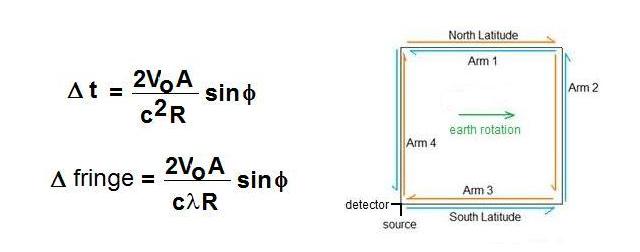
Here is the diagram:


The equation derived by Michelson leads directly to the Coriolis effect formula:

dt = l1/(c - v1) - l1/(c + v1) - (l2/(c - v2) - l2/(c + v2))

Of course, by proceeding as in the usual manner for a Sagnac phase shift formula for an interferometer whose center of rotation coincides with its geometrical center, we obtain:

2v1l1/(c2 - v21) - 2v2l2/(c2 - v22)

l = l1 = l2

2l[(v1 - v2)]/c2

2lΩ[(R1 - R2)]/c2

R1 - R2 = h

2lhΩ/c2

By having substracted two different Sagnac phase shifts, valid for the two different segments, we obtain the CORIOLIS EFFECT formula.

The Coriolis effect means that the phase shift will be caused by the physical modification of the light paths (inflection and deflection due to the Coriolis force effect on the light beams).


The Coriolis effect formula:


https://www.ias.ac.in/article/fulltext/pram/087/05/0071

Dr. Ludwik Silberstein derived the same formula in 1921:

https://www.theflatearthsociety.org/forum/index.php?topic=30499.msg2068289#msg2068289

In 1921, Dr. Silberstein proposed that the Sagnac effect, as it relates to the rotation of the Earth or to the effect of the ether drift, must be explained in terms of the Coriolis effect: the direct action of Coriolis forces on counterpropagating waves.

http://www.conspiracyoflight.com/Michelson-Gale/Silberstein.pdf

The propagation of light in rotating systems, Journal of the Optical Society of America, vol. V, number 4, 1921

He proves that the formula for the Coriolis effect on the light beams is:

dt = 2ωσ/c^2

Then, Dr. Silberstein analyzes the area σ and proves that it is actually a SUM of two other areas (page 300 of the paper, page 10 of the pdf document).

The effect of the Coriolis force upon the interferometer will be to create a convex and a concave shape of the areas: σ1 and σ2.

The sum of these two areas is replaced by 2A and this is how the final formula achieves its final form:

dt = 4ωA/c^2

A = σ1 + σ2

That is, the CORIOLIS EFFECT upon the light beams is totally related to the closed contour area.


However, in 1986, for the first time, Professor Yeh provided the experimental proof that Michelson's derivation is totally wrong, as it pertains to the Sagnac effect.

Self-pumped phase-conjugate fiber-optic gyro, I. McMichael, P. Yeh, Optics Letters 11(10):686-8 · November 1986 

http://www.dtic.mil/dtic/tr/fulltext/u2/a170203.pdf (appendix 5.1)

Dr. P. Yeh
PhD, Caltech, Nonlinear Optics

Principal Scientist of the Optics Department at Rockwell International Science Center
Professor, UCSB


Just like in the MGX, we have two different velocities and two different lengths.

Light from a laser is split into two separate fibers, F1 and F2 which are coiled such that light travels clockwise in F1 and counterclockwise in F2.

The Sagnac phase shift for the first fiber F1:

+2πR1L1Ω/λc

The Sagnac phase shift for the second fiber F2:

-2πR2L2Ω/λc

These are two separate Sagnac effects, each valid for the two fibers, F1 and F2.

The use of the phase conjugate mirror permits the revealing of the final formula, the total phase difference:

φ = -2(φ2 - φ1) = 4π(R1L1 + R2L2)Ω/λc = 4π(V1L1 + V2L2)/λc

To obtain the correct Sagnac effect for two separate segments (which feature different lengths and different speeds) of an interferometer which is located away from the center of rotation, one has to add (not substract) the two distinct components.


dt = l1/(c - v1) - l1/(c + v1) - (l2/(c - v2) - l2/(c + v2))

For each separate segment/arm of the interferometer, each with a slightly different length and a slightly distinct velocity, the calculations proceed as follows:

l1/(c - v1) - l1/(c + v1) = 2l1v1/c2

l2/(c - v2) - l2/(c + v2) = 2l2v2/c2

The phase differences have already been obtained.

By substracting these phase differences, one is actually going to derive the Coriolis effect formula.

Since the phase differences have already been calculated, one has to ADD them in order to get the final, total Sagnac effect:

2[(l1v1 + l2v2)]/c2

This fact has never been observed to the present day.

For a Sagnac interferometer, located away from the center of rotation, one has to ADD the separate phase differences in order to obtain the full Sagnac effect:

dt = l1/(c - v1) - l1/(c + v1) + (l2/(c - v2) - l2/(c + v2))

The same formula as that obtained by Professor Yeh.

This is a beautiful generalization of the Sagnac effect where the center of rotation coincides with the geometrical center of the interferometer:

Sagnac formula for an interferometer whose center of rotation coincides with its geometrical center:

Δt = l/(c - v) - l/(c + v)

Sagnac formula for an interferometer located away from the center of rotation (different radii, different velocities):

Δt = (l1 + l2)/(c - v1 - v2) - (l1 + l2)/(c + v1 + v2)

Proof:

Δt = l1/(c - v1) - l1/(c + v1) + (l2/(c - v2) - l2/(c + v2))

l1/(c - v1) + l2/(c - v2) = (l1c - l1v2 + l2c - l2v1)/(c2 - cv1 - cv2 + v1v2)

l1/(c + v1) + l2/(c + v2) = (l1c + l1v2 + l2c + l2v1)/(c2 + cv1 + cv2 + v1v2)

Since we have already added the correct Sagnac differences, corresponding to the (l1 + l2)/(c - v1 - v2) and (l1 + l2)/(c + v1 + v2) terms, now the final phase difference can be correctly derived:

(l1c - l1v2 + l2c - l2v1)/(c2 - cv1 - cv2 + v1v2) - (l1c + l1v2 + l2c + l2v1)/(c2 + cv1 + cv2 + v1v2) = 2[(l1v1 + l2v2)]/c2

The Coriolis effect formula by contrast is just the physical effect of the Coriolis force upon the light beams, a modification of the paths of the light beams leading to a final formula where the effect is directly proportional to the area and to the angular velocity.

The Sagnac effect is an electromagnetic effect, the modification of the velocities of the light beams, c + v1 + v2 and c - v1 - v2, leading to the final formula where the Sagnac effect is directly proportional to the linear velocity (radius of rotation x angular velocity) and the length of the segments of the interferometer.

Michelson only measured the Coriolis effect and not the rotational Sagnac effect, since he substracted twice within the same derivation, he obtained a Coriolis effect formula.

*

sandokhan

  • Flat Earth Sultan
  • Flat Earth Scientist
  • 7272
  • +7/-41
Re: The distortion of science
« Reply #35 on: November 20, 2018, 07:21:14 AM »
Now, let us compare the two formulas, Coriolis vs. Sagnac, using the latitude, for the Michelson-Gale experiment.

The turning of the MGX area at the hypothetical rotational speed of the Earth takes place a distance of some 4,250 km from the center of the Earth (latitude 41°46').

FULL CORIOLIS EFFECT FOR THE MGX:

4AΩsinΦ/c2

FULL SAGNAC EFFECT FOR THE MGX:

4Lv(cos2Φ1 + cos2Φ2)/c2


Sagnac effect/Coriolis effect ratio:

R((cos2Φ1 + cos2Φ2)/hsinΦ

R = 4,250 km

h = 0.33924 km


The rotational Sagnac effect is much greater than the Coriolis effect for the MGX.

Φ1 = Φ = 41°46' = 41.76667°

Φ2 = 41°45' = 41.75°

R((cos2Φ1 + cos2Φ2) = 4729.885

hsinΦ = 0.225967

4729.885/0.225967 = 20,931.72

THE ROTATIONAL SAGNAC EFFECT IS 21,000 TIMES GREATER THAN THE CORIOLIS EFFECT.


Michelson and Gale recorded ONLY the Coriolis effect, and not the rotational Sagnac effect.


Let us take a look, again, at the formula derived by Professor Yeh:

φ = -2(φ2 - φ1) = 4π(R1L1 + R2L2)Ω/λc

Since Δφ = 2πc/λ x Δt, Δt = 2(R1L1 + R2L2)Ω/c2 = 2(V1L1 + V2L2)c2

The very same formula derived by me:

Δt = (l1 + l2)/(c - v1 - v2) - (l1 + l2)/(c + v1 + v2) = 2[(l1v1 + l2v2)]/c2

Now, the correct formula features the VELOCITY ADDITION EQUATIONS in a proper form.

Sagnac formula for an interferometer whose center of rotation coincides with its geometrical center:

Δt = l/(c - v) - l/(c + v)

Sagnac formula for an interferometer located away from the center of rotation (different radii, different velocities):

Δt = (l1 + l2)/(c - v1 - v2) - (l1 + l2)/(c + v1 + v2)


The hare brained argument put forth by the RE (one beam to go forwards along both arcs) is easily debunked.

This is as far as Michelson went with his derivation:

dt = l1/(c - v1) - l1/(c + v1) - (l2/(c - v2) - l2/(c + v2))

Immediately we obtain the Coriolis effect formula, as proven in my previous message.

2v1l1/(c2 - v21) - 2v2l2/(c2 - v22)

l = l1 = l2

2l[(v1 - v2)]/c2

2lΩ[(R1 - R2)]/c2

R1 - R2 = h

2lhΩ/c2


However, as shown by Professor Yeh's groundbreaking experiment, once we have the phase shifts (which have been already substracted, for each arm of the interferometer), we have to add them to the correct Sagnac effect formula.

2[(l1v1 + l2v2)]/c2

Two SEPARATE phase shifts for each arm.

Each arm features a different velocity and a different length, as required by A. Michelson.

Having obtained the phase shifts, by substraction, we add the final results to obtain the Sagnac effect, exactly as Professor Yeh did.


*

cikljamas

  • 2466
  • +1/-2
  • Ex nihilo nihil fit
Re: The distortion of science
« Reply #36 on: November 20, 2018, 09:22:02 AM »
Very confusing, i must admit.

It seems that you are claiming that Michelson didn't measure the rotation of the earth a.k.a the rotation of an aether?

Quote No 1 :

Quote
Michelson-Gale confirmed that the Earth was spinning. If you take anything else from it you are misrepresenting their findings or you do not understand it properly.

To quote:

    The outcome of the experiment was that the angular velocity of the Earth as measured by astronomy was confirmed to within measuring accuracy.

    The experiment is consistent with relativity for the same reason as all other Sagnac type experiments (see Sagnac effect). That is, rotation is absolute in special relativity, because there is no inertial frame of reference in which the whole device is at rest during the complete process of rotation, thus the light paths of the two rays are different in all of those frames, consequently a positive result must occur.

Here's another quote on gravitational ether:

    However, this theory was directly refuted by the Michelson–Gale–Pearson experiment (1925). The great difference of this experiment against the usual Sagnac experiments is the fact that the rotation of earth itself was measured. If the aether is completely dragged by the Earth's gravitational field, a negative result has to be expected - but the result was positive.

Now, let's see this very interesting quote :

Quote
Two months after publication of the first paper, Sagnac would conclude his second and final paper on the matter with these words-
"The result of this methodology demonstrates that, in the surrounding space [of the apparatus], light is propagated with a velocity Vo
which is independent of the movement of the parts of the system, light source (...) and the optical circuit.
"

This is the central theme of Sagnac: that the propagation of light appears to be independent of the state of rotation of his self-contained apparatus, exactly because one can differentially measure its advance or retardation as a function of the speed of rotation of the apparatus.

What is the consequence of the Sagnac experiment for the MGP experiment?  To begin with, Sagnac's apparatus was rotating (with the control fringe pattern being obtained first with the apparatus 'at rest'), whereas the MGP setup was a stationary one. 

This fact is intimately linked to the nature of the measurements in question: the Sagnac experiment detects the rotation of the revolving interferometer (relative to the 'rest state'), whereas the MGP experiment, with its interferometer fixed to the local revolving frame, detected the rotation of the earth. 

Because of the resolution limits, the Sagnac experiment could never have hoped to detect the rotation of the earth, anymore than the MM experiment could have detected the rotation of its own apparatus. 

What the Sagnac experiment did, however, unequivocally demonstrate was that there was a precedent for the optical detection of rotary
motion.

But relativists, including Einstein, largely discarded this fact for nearly three decades. 

An open-loop Sagnac effect (dt= 2A?/c2) is today well established for the paths of electromagnetic signals around the planet: employing the GPS satellite relay system, delays have been measured by clocks on the order of fractions of microseconds in the W-E transmission with respect to the E-W transmission.
 

So, an open-loop Sagnac effect proves that there is a rotational motion of an aether around the stationary earth.

Why?

Because an open-loop Sagnac effect can be the consequence of earth's rotation within stationary aether or it can be the result of the rotation of an aether around the stationary earth.

Since all interferometry experiments which were designed to detect earth's orbital motion yielded too small fringe shifts (hence "null result"), then there is no way that an open-loop Sagnac effect can be ascribed to the alleged earth's rotational motion, and instead it must be assigned to the rotation of an aether around the stationary earth.

Case closed!
« Last Edit: November 20, 2018, 09:26:29 AM by cikljamas »
"I can't breathe" George Floyd RIP

*

sandokhan

  • Flat Earth Sultan
  • Flat Earth Scientist
  • 7272
  • +7/-41
Re: The distortion of science
« Reply #37 on: November 20, 2018, 11:06:12 AM »
The Coriolis effect is a PHYSICAL EFFECT, a deflection of the light beam.

The Sagnac effect is an ELECTROMAGNETIC EFFECT, a modification of the velocity of the light beam.

These facts are well known.

The topological considerations of the Sagnac effect, using Stokes' rule/theorem, confirm these findings:

https://www.theflatearthsociety.org/forum/index.php?topic=30499.msg2023979#msg2023979


Now, let us take a closer look at the entire process of derivation of both sets of formulas.

This is Michelson's derivation, which leads to the Coriolis effect formula:

dt = l1/(c - v1) - l1/(c + v1) - (l2/(c - v2) - l2/(c + v2))

Two consecutive substractions.

Here is the diagram:


Now, let carefully analyze this equation.

We have the following terms, both have the same direction:

l1/(c - v1)

l2/(c - v2)


Then, we have the remaining terms, in the opposite direction:

l1/(c + v1)

l2/(c + v2)


To obtain the Sagnac effect, we must ADD the terms in the SAME DIRECTION, and substract the final difference.

This is what the Sagnac effect actually entails: BEAMS IN OPPOSITE DIRECTION, A ROTATION OF THE INTERFEROMETER, AND THE FINAL MEASUREMENT OF THE PHASE DIFFERENCE.

l1/(c - v1) + l2/(c - v2) = (l1c - l1v2 + l2c - l2v1)/(c2 - cv1 - cv2 + v1v2)

l1/(c + v1) + l2/(c + v2) = (l1c + l1v2 + l2c + l2v1)/(c2 + cv1 + cv2 + v1v2)

Since we have already added the correct Sagnac terms (both sets located in opposite directions), corresponding to the (l1 + l2)/(c - v1 - v2) and (l1 + l2)/(c + v1 + v2) terms, now the final phase difference can be correctly derived:

(l1c - l1v2 + l2c - l2v1)/(c2 - cv1 - cv2 + v1v2) - (l1c + l1v2 + l2c + l2v1)/(c2 + cv1 + cv2 + v1v2) = 2[(l1v1 + l2v2)]/c2


The classic Sagnac formula for an interferometer whose center of rotation coincides with its geometrical center:

Δt = l/(c - v) - l/(c + v)

Now, the CORRECT, generalized Sagnac effect formula, which features the correct velocity addition formula, as well as the addition of the paths:

Δt = (l1 + l2)/(c - v1 - v2) - (l1 + l2)/(c + v1 + v2)

The latter formula is a GENERALIZATION of the former phase difference formula.


We add the terms which are located in the same direction, and substract the final difference.

By constrast, Michelson substracted TWICE, thus obtaining the CORIOLIS EFFECT formula.

That is, he substracted, once, the terms located in the same direction, and then, twice, he substracted the final difference.

Here is Michelson's final formula:

4AΩsinΦ/c2

A formula proportional to the AREA OF THE INTERFEROMETER, measuring a PHYSICAL EFFECT, the Coriolis effect.

Now, the correct Sagnac formula:

Δt = (l1 + l2)/(c - v1 - v2) - (l1 + l2)/(c + v1 + v2) = 2[(l1v1 + l2v2)]/c2

This formula is proportional to the VELOCITY OF THE LIGHT BEAMS, exactly what the Sagnac effect entails.

The formula derived by Professor Yeh:

φ = -2(φ2 - φ1) = 4π(R1L1 + R2L2)Ω/λc

Since Δφ = 2πc/λ x Δt, Δt = 2(R1L1 + R2L2)Ω/c2 = 2(V1L1 + V2L2)c2
« Last Edit: November 20, 2018, 11:09:46 AM by sandokhan »

?

Lonegranger

  • 4083
  • +0/-0
Re: The distortion of science
« Reply #38 on: November 20, 2018, 12:20:51 PM »
Take a better look whom you are responding to.

Why? please elaborate.

*

cikljamas

  • 2466
  • +1/-2
  • Ex nihilo nihil fit
Re: The distortion of science
« Reply #39 on: November 20, 2018, 12:25:12 PM »
@Sandokhan, in order to try to clarify all this, i am going to put forward a few simple questions :

1. Is this line of reasoning right or wrong, according to you :

If there were no aether then both beams would take the same time the  earth's  rotation. The same result would be observed if the earth were rotating and the aether were standing still, or if the  earth were standing still with the universe, including the  aether rotating around it, or if the earth were partially rotating and the aether were partially rotating.

2. Do you consider MGP experiment useless because Michelson screw up the math, or we can still make something useful out of his measurements by modifying his wrong math?

3. Do you agree with the following line of reasoning (regarding geocentric implications of an open-loop Sagnac effect), i repeat :

So, an open-loop Sagnac effect proves that there is a rotational motion of an aether around the stationary earth.

Why?

Because an open-loop Sagnac effect can be the consequence of earth's rotation within stationary aether or it can be the result of the rotation of an aether around the stationary earth.

Since all interferometry experiments which were designed to detect earth's orbital motion yielded too small fringe shifts (hence "null result"), then there is no way that an open-loop Sagnac effect can be ascribed to the alleged earth's rotational motion, and instead it must be assigned to the rotation of an aether around the stationary earth.

I WOULD APPRECIATE IF YOU REPLIED TO MY THREE QUESTIONS WITH YES OR NO, AND AFTER EACH SPECIFIC YES OR NO YOU CAN ADD AS MANY BLOCKS OF TEXT AS YOU WISH... :)

Thanks!
"I can't breathe" George Floyd RIP

*

JackBlack

  • 26157
  • +51/-79
Re: The distortion of science
« Reply #40 on: November 20, 2018, 12:50:57 PM »
Irrelevent.
Einstein FAILED mathematics and physics in high school.
Yes, that is right, that claim is irrelevant.
Not only is it an outright lie, it has absolutely nothing to do with your completely incorrect derivation of the Sagnac effect.

[skipping over your irrelevant BS which doesn't involve providing a derivation or justification]

Here is the diagram:

Finally, a diagram.
Now can you use that to show why you should add instead of subtract?

By having subtracted two different Sagnac phase shifts, valid for the two different segments, we obtain the CORIOLIS EFFECT formula.
Which is the only way to do it due to the direction of propagation of the light around the loop.
Anything else will not match the physical reality.

[and more irrelevant garbage skipped].

Still no justification for why you add rather than subtract.

Perhaps these diagram can help.
For this the centre of rotation is the blue dot, and we ignore the phase shift on moving in and out (i.e. the dashed lines).
The phase shift for each segment is the time taken for the forwards propagating light beam minus the time taken for the backwards propagating light beam. i.e. the inside one minus the outside one.

This is what we have in reality:

Notice that the light beams reverse direction between the 2 segments. The red one moves with the rotation on one and against it on the other.
This means the overall time shift will be the difference between them, i.e. the red one takes more time in the inner segment but less time on the outer segment. As such, we need to subtract the 2 individual shifts.

The better way to do this is to instead calculate the total time for red and orange and then use that to determine the difference, as I have already done and you were completely unable to refute.

Meanwhile, this is what your nonsense demands:

Notice how now the red path goes forwards in both segments. This means that it will take longer for both segments and thus you must add the shifts. But also notice this requires the light path to no longer follow the loop and instead cross over in the middle.
But now, these crossing sections cannot possibly be radial and will contribute to the shift as well and thus must also be considered.
As such, adding the 2 shifts does not correspond to the simple ring interferometer and in no way produces the correct result.

*

JackBlack

  • 26157
  • +51/-79
Re: The distortion of science
« Reply #41 on: November 20, 2018, 01:02:37 PM »
So, an open-loop Sagnac effect proves that there is a rotational motion of an aether around the stationary earth.
At the risk of having Sandy go down yet another rabbit hole, his open loop Sagan nonsense is reliant upon properties of a phase conjugate mirror which have not been demonstrated, likely because he has no idea what a phase conjugate mirror actually is.

It isn't just a fancy piece of glass which magically has phase conjugate properties. It is an optically pumped medium (i.e. they shoot lasers at it, normally 2, I think it must be 2 but I'm not sure if more still work) which results in interference to produce the phase conjugate effect. He has failed to demonstrate that this applies generally to any reference frame, which is especially problematic as a simple analysis indicates that isn't the case at all.
For a simple explanation of why, if you have this PCM in an inertial reference frame which is moving away from an emitter and detector, then the beam of light going towards it is redshifted to the frame of the PCM. The PCM then reflects this, keeping it consistent in its reference frame. This is then redshifted to go back into the reference from of the emitter and detector. As such the detector receives red shifted light.
The same issue applies to sideways motion. If you have a source which reflects light off a stationary PCM (in its reference frame) at an angle, then it will come back to the source.
However if this angle is steep enough that the PCM can be put into motion such that in the PCM's reference frame the light comes in normal to the PCM, then it will reflect normal to the PCM in its frame and thus will behave like a normal mirror in the source's reference frame.

To put all that simply, motion of the PCM can affect the interference between the 4 beams of light (incoming, outgoing, and the 2 pumps) which means it will no longer have the phase conjugate properties.
« Last Edit: November 20, 2018, 01:04:21 PM by JackBlack »

*

sandokhan

  • Flat Earth Sultan
  • Flat Earth Scientist
  • 7272
  • +7/-41
Re: The distortion of science
« Reply #42 on: November 20, 2018, 01:06:16 PM »
Stop bullshitting your readers.

By now, you are down to shitty diagrams, which is pathetic: they are caricatures drawn with your left hand, useless garbage.

Anything else will not match the physical reality.

Here is some reality for you.

in 1986, for the first time, Professor Yeh provided the experimental proof that Michelson's derivation is totally wrong, as it pertains to the Sagnac effect.

Self-pumped phase-conjugate fiber-optic gyro, I. McMichael, P. Yeh, Optics Letters 11(10):686-8 · November 1986 

http://www.dtic.mil/dtic/tr/fulltext/u2/a170203.pdf (appendix 5.1)

Dr. P. Yeh
PhD, Caltech, Nonlinear Optics

Principal Scientist of the Optics Department at Rockwell International Science Center
Professor, UCSB


Just like in the MGX, we have two different velocities and two different lengths.

Light from a laser is split into two separate fibers, F1 and F2 which are coiled such that light travels clockwise in F1 and counterclockwise in F2.

The Sagnac phase shift for the first fiber F1:

+2πR1L1Ω/λc

The Sagnac phase shift for the second fiber F2:

-2πR2L2Ω/λc

These are two separate Sagnac effects, each valid for the two fibers, F1 and F2.

The use of the phase conjugate mirror permits the revealing of the final formula, the total phase difference:

φ = -2(φ2 - φ1) = 4π(R1L1 + R2L2)Ω/λc = 4π(V1L1 + V2L2)/λc

To obtain the correct Sagnac effect for two separate segments (which feature different lengths and different speeds) of an interferometer which is located away from the center of rotation, one has to add (not substract) the two distinct components.


Take a look at the final formula derived by Professor Yeh:

φ = -2(φ2 - φ1) = 4π(R1L1 + R2L2)Ω/λc

Since Δφ = 2πc/λ x Δt, Δt = 2(R1L1 + R2L2)Ω/c2 = 2(V1L1 + V2L2)c2

Exactly my formula:

Δt = (l1 + l2)/(c - v1 - v2) - (l1 + l2)/(c + v1 + v2) = 2[(l1v1 + l2v2)]/c2

Here is the diagram:


The equation derived by Michelson leads directly to the Coriolis effect formula:

dt = l1/(c - v1) - l1/(c + v1) - (l2/(c - v2) - l2/(c + v2))

Of course, by proceeding as in the usual manner for a Sagnac phase shift formula for an interferometer whose center of rotation coincides with its geometrical center, we obtain:

2v1l1/(c2 - v21) - 2v2l2/(c2 - v22)

l = l1 = l2

2l[(v1 - v2)]/c2

2lΩ[(R1 - R2)]/c2

R1 - R2 = h

2lhΩ/c2

By having substracted two different Sagnac phase shifts, valid for the two different segments, we obtain the CORIOLIS EFFECT formula.

The Coriolis effect means that the phase shift will be caused by the physical modification of the light paths (inflection and deflection due to the Coriolis force effect on the light beams).


The Coriolis effect formula:


https://www.ias.ac.in/article/fulltext/pram/087/05/0071


The Coriolis effect is a PHYSICAL EFFECT, a deflection of the light beam.

The Sagnac effect is an ELECTROMAGNETIC EFFECT, a modification of the velocity of the light beam.

These facts are well known.

Now, let us take a closer look at the entire process of derivation of both sets of formulas.

This is Michelson's derivation, which leads to the Coriolis effect formula:

dt = l1/(c - v1) - l1/(c + v1) - (l2/(c - v2) - l2/(c + v2))

Two consecutive substractions.

Here is the diagram:


Now, let carefully analyze this equation.

We have the following terms, both have the same direction:

l1/(c - v1)

l2/(c - v2)


Then, we have the remaining terms, in the opposite direction:

l1/(c + v1)

l2/(c + v2)


To obtain the Sagnac effect, we must ADD the terms in the SAME DIRECTION, and substract the final difference.

This is what the Sagnac effect actually entails: BEAMS IN OPPOSITE DIRECTION, A ROTATION OF THE INTERFEROMETER, AND THE FINAL MEASUREMENT OF THE PHASE DIFFERENCE.

l1/(c - v1) + l2/(c - v2) = (l1c - l1v2 + l2c - l2v1)/(c2 - cv1 - cv2 + v1v2)

l1/(c + v1) + l2/(c + v2) = (l1c + l1v2 + l2c + l2v1)/(c2 + cv1 + cv2 + v1v2)

Since we have already added the correct Sagnac terms (both sets located in opposite directions), corresponding to the (l1 + l2)/(c - v1 - v2) and (l1 + l2)/(c + v1 + v2) terms, now the final phase difference can be correctly derived:

(l1c - l1v2 + l2c - l2v1)/(c2 - cv1 - cv2 + v1v2) - (l1c + l1v2 + l2c + l2v1)/(c2 + cv1 + cv2 + v1v2) = 2[(l1v1 + l2v2)]/c2


The classic Sagnac formula for an interferometer whose center of rotation coincides with its geometrical center:

Δt = l/(c - v) - l/(c + v)

Now, the CORRECT, generalized Sagnac effect formula, which features the correct velocity addition formula, as well as the addition of the paths:

Δt = (l1 + l2)/(c - v1 - v2) - (l1 + l2)/(c + v1 + v2)

The latter formula is a GENERALIZATION of the former phase difference formula.


We add the terms which are located in the same direction, and substract the final difference.

By constrast, Michelson substracted TWICE, thus obtaining the CORIOLIS EFFECT formula.

That is, he substracted, once, the terms located in the same direction, and then, twice, he substracted the final difference.

Here is Michelson's final formula:

4AΩsinΦ/c2

A formula proportional to the AREA OF THE INTERFEROMETER, measuring a PHYSICAL EFFECT, the Coriolis effect.

Now, the correct Sagnac formula:

Δt = (l1 + l2)/(c - v1 - v2) - (l1 + l2)/(c + v1 + v2) = 2[(l1v1 + l2v2)]/c2

This formula is proportional to the VELOCITY OF THE LIGHT BEAMS, exactly what the Sagnac effect entails.

The formula derived by Professor Yeh:

φ = -2(φ2 - φ1) = 4π(R1L1 + R2L2)Ω/λc

Since Δφ = 2πc/λ x Δt, Δt = 2(R1L1 + R2L2)Ω/c2 = 2(V1L1 + V2L2)c2

I win!

*

sandokhan

  • Flat Earth Sultan
  • Flat Earth Scientist
  • 7272
  • +7/-41
Re: The distortion of science
« Reply #43 on: November 20, 2018, 01:12:38 PM »
reliant upon properties of a phase conjugate mirror which have not been demonstrated

Stop bullshitting your readers.

The experiment performed by Professor Yeh was published in one of the most prestigious scientific journals in the world: Journal of Optics Letters.

Self-pumped phase-conjugate fiber-optic gyro, I. McMichael, P. Yeh, Optics Letters 11(10):686-8 · November 1986 

http://www.dtic.mil/dtic/tr/fulltext/u2/a170203.pdf (appendix 5.1)

Dr. P. Yeh
PhD, Caltech, Nonlinear Optics

Principal Scientist of the Optics Department at Rockwell International Science Center

Professor, UCSB

It was published in the ANNUAL TECHNICAL REPORT OF THE US OFFICE OF NAVAL RESEARCH.

Professor Yeh is one of the greatest experts in the world on the Sagnac effect.

Here is the final formula derived by Professor Yeh:

φ = -2(φ2 - φ1) = 4π(R1L1 + R2L2)Ω/λc

Since Δφ = 2πc/λ x Δt, Δt = 2(R1L1 + R2L2)Ω/c2 = 2(V1L1 + V2L2)c2

The very same formula derived by me:

Δt = (l1 + l2)/(c - v1 - v2) - (l1 + l2)/(c + v1 + v2) = 2[(l1v1 + l2v2)]/c2

*

JackBlack

  • 26157
  • +51/-79
Re: The distortion of science
« Reply #44 on: November 20, 2018, 02:15:09 PM »
Stop bullshitting your readers.
Good advice, you should try following it for once.

Self-pumped phase-conjugate fiber-optic gyro
We are not talking about them. They have no place in this discussion.
Once you admit you were completely wrong regarding your formula for a simple ring interferometer the like of MMG, then we can move on to other experiments.
For now you need to explain why you add the 2 phase shifts.

So again, why do you add the 2 segments?

To obtain the Sagnac effect, we must ADD the terms in the SAME DIRECTION, and substract the final difference.
No, we don't.
That is the exact opposite of what we do.
Again, that corresponds to this:


We want to find the time difference between the red and orange paths.
You require that the red path goes with the rotation along both segments, but that is not how the experiment is actually conducted.
This is how the experiment is conducted:


So we have 4 times (were for simplicity I will just take yours rather than deriving them myself):
We have the following terms, both have the same direction, that means one of them corresponds to the red in the inner segment and one to orange on the outer segment. I will colour code them for clarity:
l1/(c - v1)
l2/(c - v2)

Then, we have the remaining terms, in the opposite direction, likewise meaning one is for orange one is for red, noting that red travelled along l1 in the previous one so now it must travel along l2 in this one:
l1/(c + v1)
l2/(c + v2)

Now instead of adding and subtracting based upon direction, we will add the terms of the same colour, corresponding to the one beam rotating around the interferometer and then find the difference.
dt=l1/(c - v1)+l2/(c + v2)-l1/(c + v1)-l2/(c - v2)
=l1/(c - v1)-l1/(c + v1)+l2/(c + v2)-l2/(c - v2)
=l1(c + v1-c + v1)/(c2 - v12)+l2(c - v2-c - v2)/(c2 - v22)
=2*l1v1/(c2 - v12)-2*l2v2/(c2 - v22)

Which now allows for simplification without ending up with 0 by noting v<<c, thus we get:
dt=2*l1v1/c2-2*l2v2/c2
=(2*l1v1-2*l2v2)/c2
=2*(l1v1-l2v2)/c2

Notice it is a difference of terms, not an addition like you claim.

So again, why do you insist on adding when it clearly doesn't match the physical reality of the experiment?
Adding them requires that the light path criss cross rather than follows the loop, and ignores the phase shift from the criss crossing.

I win!
No, you lose, big time, as you are yet to show why you subtract when that does not match the physical experiment. In fact that is effectively you kicking the ball into your own goal.

*

sandokhan

  • Flat Earth Sultan
  • Flat Earth Scientist
  • 7272
  • +7/-41
Re: The distortion of science
« Reply #45 on: November 20, 2018, 02:25:47 PM »
2*(l1v1-l2v2)/c2

Congratulations, you have just derived the CORIOLIS EFFECT formula.

Full derivation of the above formula using the CORIOLIS FORCE:

https://www.researchgate.net/publication/308921264_Spinning_Earth_and_its_Coriolis_effect_on_the_circuital_light_beams_Verification_of_the_special_relativity_theory

Dr. Ludwik Silberstein derived the same formula in 1921:

https://www.theflatearthsociety.org/forum/index.php?topic=30499.msg2068289#msg2068289

In 1921, Dr. Silberstein proposed that the Sagnac effect, as it relates to the rotation of the Earth or to the effect of the ether drift, must be explained in terms of the Coriolis effect: the direct action of Coriolis forces on counterpropagating waves.

http://www.conspiracyoflight.com/Michelson-Gale/Silberstein.pdf

The propagation of light in rotating systems, Journal of the Optical Society of America, vol. V, number 4, 1921

Dr. Silberstein developed the formula published by A. Michelson using very precise details, not to be found anywhere else.

He uses the expression kω for the angular velocity, where k is the aether drag factor.

He proves that the formula for the Coriolis effect on the light beams is:

dt = 2ωσ/c^2

Then, Dr. Silberstein analyzes the area σ and proves that it is actually a SUM of two other areas (page 300 of the paper, page 10 of the pdf document).

The effect of the Coriolis force upon the interferometer will be to create a convex and a concave shape of the areas: σ1 and σ2.

The sum of these two areas is replaced by 2A and this is how the final formula achieves its final form:

dt = 4ωA/c^2

A = σ1 + σ2

That is, the CORIOLIS EFFECT upon the light beams is totally related to the closed contour area.

In 1922, Dr. Silberstein published a second paper on the subject, where he generalizes the nature of the rays arriving from the collimator:

http://gsjournal.net/Science-Journals/Historical%20Papers-Mechanics%20/%20Electrodynamics/Download/2645

In 1924, one year before the Michelson-Gale experiment, Dr. Silberstein published a third paper, where he again explicitly links the Coriolis effect to the counterpropagating light beams in the interferometer:

https://www.tandfonline.com/doi/abs/10.1080/14786442408634503


So again, why do you add the 2 segments?

I have already explained, which means you are not paying attention while you are drawing those shitty diagrams.

Now, let us take a closer look at the entire process of derivation of both sets of formulas.

This is Michelson's derivation, which leads to the Coriolis effect formula:

dt = l1/(c - v1) - l1/(c + v1) - (l2/(c - v2) - l2/(c + v2))

Two consecutive substractions.

Here is the diagram:


Now, let carefully analyze this equation.

We have the following terms, both have the same direction:

l1/(c - v1)

l2/(c - v2)


Then, we have the remaining terms, in the opposite direction:

l1/(c + v1)

l2/(c + v2)


To obtain the Sagnac effect, we must ADD the terms in the SAME DIRECTION, and substract the final difference.

This is what the Sagnac effect actually entails: BEAMS IN OPPOSITE DIRECTION, A ROTATION OF THE INTERFEROMETER, AND THE FINAL MEASUREMENT OF THE PHASE DIFFERENCE.

l1/(c - v1) + l2/(c - v2) = (l1c - l1v2 + l2c - l2v1)/(c2 - cv1 - cv2 + v1v2)

l1/(c + v1) + l2/(c + v2) = (l1c + l1v2 + l2c + l2v1)/(c2 + cv1 + cv2 + v1v2)

Since we have already added the correct Sagnac terms (both sets located in opposite directions), corresponding to the (l1 + l2)/(c - v1 - v2) and (l1 + l2)/(c + v1 + v2) terms, now the final phase difference can be correctly derived:

(l1c - l1v2 + l2c - l2v1)/(c2 - cv1 - cv2 + v1v2) - (l1c + l1v2 + l2c + l2v1)/(c2 + cv1 + cv2 + v1v2) = 2[(l1v1 + l2v2)]/c2


The classic Sagnac formula for an interferometer whose center of rotation coincides with its geometrical center:

Δt = l/(c - v) - l/(c + v)

Now, the CORRECT, generalized Sagnac effect formula, which features the correct velocity addition formula, as well as the addition of the paths:

Δt = (l1 + l2)/(c - v1 - v2) - (l1 + l2)/(c + v1 + v2)

The latter formula is a GENERALIZATION of the former phase difference formula.


We add the terms which are located in the same direction, and substract the final difference.

By constrast, Michelson substracted TWICE, thus obtaining the CORIOLIS EFFECT formula.

That is, he substracted, once, the terms located in the same direction, and then, twice, he substracted the final difference.

Here is Michelson's final formula:

4AΩsinΦ/c2

A formula proportional to the AREA OF THE INTERFEROMETER, measuring a PHYSICAL EFFECT, the Coriolis effect.

Now, the correct Sagnac formula:

Δt = (l1 + l2)/(c - v1 - v2) - (l1 + l2)/(c + v1 + v2) = 2[(l1v1 + l2v2)]/c2

This formula is proportional to the VELOCITY OF THE LIGHT BEAMS, exactly what the Sagnac effect entails.

The formula derived by Professor Yeh:

φ = -2(φ2 - φ1) = 4π(R1L1 + R2L2)Ω/λc

Since Δφ = 2πc/λ x Δt, Δt = 2(R1L1 + R2L2)Ω/c2 = 2(V1L1 + V2L2)c2


They have no place in this discussion.

They certainly do.

The formula derived by Professor Yeh is identical to the one derived by me.

Experimental proof published in the Journal of Optics Letters.

Please read:

Self-pumped phase-conjugate fiber-optic gyro, I. McMichael, P. Yeh, Optics Letters 11(10):686-8 · November 1986 

http://www.dtic.mil/dtic/tr/fulltext/u2/a170203.pdf (appendix 5.1)

Dr. P. Yeh
PhD, Caltech, Nonlinear Optics

Principal Scientist of the Optics Department at Rockwell International Science Center
Professor, UCSB


Just like in the MGX, we have two different velocities and two different lengths.

Light from a laser is split into two separate fibers, F1 and F2 which are coiled such that light travels clockwise in F1 and counterclockwise in F2.

The Sagnac phase shift for the first fiber F1:

+2πR1L1Ω/λc

The Sagnac phase shift for the second fiber F2:

-2πR2L2Ω/λc

These are two separate Sagnac effects, each valid for the two fibers, F1 and F2.

The use of the phase conjugate mirror permits the revealing of the final formula, the total phase difference:

φ = -2(φ2 - φ1) = 4π(R1L1 + R2L2)Ω/λc = 4π(V1L1 + V2L2)/λc

To obtain the correct Sagnac effect for two separate segments (which feature different lengths and different speeds) of an interferometer which is located away from the center of rotation, one has to add (not substract) the two distinct components.


Take a look at the final formula derived by Professor Yeh:

φ = -2(φ2 - φ1) = 4π(R1L1 + R2L2)Ω/λc

Since Δφ = 2πc/λ x Δt, Δt = 2(R1L1 + R2L2)Ω/c2 = 2(V1L1 + V2L2)c2

Exactly my formula:

Δt = (l1 + l2)/(c - v1 - v2) - (l1 + l2)/(c + v1 + v2) = 2[(l1v1 + l2v2)]/c2

I win!

Again.
« Last Edit: November 20, 2018, 02:41:46 PM by sandokhan »

*

JackBlack

  • 26157
  • +51/-79
Re: The distortion of science
« Reply #46 on: November 20, 2018, 02:51:03 PM »
2*(l1v1-l2v2)/c2
Congratulations, you have just derived the CORIOLIS EFFECT formula.
Yes, which is also known as the Sagnac effect.
You are still yet to explain why you subtract, will it be found in this post?
Nope, just the same baseless assertions.

Again, reality, what MMG was, and what has the subtraction of the shifts from the individual segments.


Again, your nonsense, where you add the shifts, adding the time taken in the same direction, while ignoring the shift from the criss cross:


Unless you can explain why you add the segments in the same direction, instead of adding the segments which contain the same light beam, you lose.

And no, repeating the same BS, or trying to talk about a completely different experiment is not explaining it.

So again, why do you add, when that would require the light beam to propagate in the same direction along both segments, requiring the light beams to criss cross in the middle leading to additional shifts; rather than subtract, which instead requires the light to travel along the loop?

Until you actually answer that, anything else you post is irrelevant.

*

JackBlack

  • 26157
  • +51/-79
Re: The distortion of science
« Reply #47 on: November 20, 2018, 02:55:52 PM »
Perhaps this will help, using your picture:


I am assuming you consider the shift in arm 2 and arm 4 to be insignificant.
So taking arm 1 to have a length of l1 and travelling at a velocity of v1, and likewise for arm 3 with l3 and v3, answer the following questions:
What is the time taken for the light beam indicated in brown for arm 1?
What is the time taken for the light beam indicated in brown for arm 3?
Thus what is the total time taken for the light beam indicated in brown for arm1 and arm 3?

What is the time taken for the light beam indicated in blue for arm 1?
What is the time taken for the light beam indicated in blue for arm 3?
Thus what is the total time taken for the light beam indicated in blue for arm1 and arm 3?

Thus what is the difference in time taken for the light beams? (Note: this is the difference between the 3rd and 6th questions above)?

Note: this is fundamentally different to your claim, where you add the blue in arm 1 with the brown in arm 3, even though they are different light beams.

*

sandokhan

  • Flat Earth Sultan
  • Flat Earth Scientist
  • 7272
  • +7/-41
Re: The distortion of science
« Reply #48 on: November 20, 2018, 03:08:01 PM »
Yes, which is also known as the Sagnac effect.

Can't be both.

Here is the CORIOLIS EFFECT FORMULA:


Full derivation of the above formula using the CORIOLIS FORCE:

https://www.researchgate.net/publication/308921264_Spinning_Earth_and_its_Coriolis_effect_on_the_circuital_light_beams_Verification_of_the_special_relativity_theory

Dr. Ludwik Silberstein derived the same formula in 1921:

https://www.theflatearthsociety.org/forum/index.php?topic=30499.msg2068289#msg2068289

In 1921, Dr. Silberstein proposed that the Sagnac effect, as it relates to the rotation of the Earth or to the effect of the ether drift, must be explained in terms of the Coriolis effect: the direct action of Coriolis forces on counterpropagating waves.

http://www.conspiracyoflight.com/Michelson-Gale/Silberstein.pdf

The propagation of light in rotating systems, Journal of the Optical Society of America, vol. V, number 4, 1921

Dr. Silberstein developed the formula published by A. Michelson using very precise details, not to be found anywhere else.

He uses the expression kω for the angular velocity, where k is the aether drag factor.

He proves that the formula for the Coriolis effect on the light beams is:

dt = 2ωσ/c^2

Then, Dr. Silberstein analyzes the area σ and proves that it is actually a SUM of two other areas (page 300 of the paper, page 10 of the pdf document).

The effect of the Coriolis force upon the interferometer will be to create a convex and a concave shape of the areas: σ1 and σ2.

The sum of these two areas is replaced by 2A and this is how the final formula achieves its final form:

dt = 4ωA/c^2

A = σ1 + σ2

That is, the CORIOLIS EFFECT upon the light beams is totally related to the closed contour area.

In 1922, Dr. Silberstein published a second paper on the subject, where he generalizes the nature of the rays arriving from the collimator:

http://gsjournal.net/Science-Journals/Historical%20Papers-Mechanics%20/%20Electrodynamics/Download/2645

In 1924, one year before the Michelson-Gale experiment, Dr. Silberstein published a third paper, where he again explicitly links the Coriolis effect to the counterpropagating light beams in the interferometer:

https://www.tandfonline.com/doi/abs/10.1080/14786442408634503


People are beginning to wonder if you are all there, jackblack.

You have just been shown two important historical references where the SAME formula is derived, and it is the CORIOLIS EFFECT formula.


to talk about a completely different experiment is not explaining it.

The very same experiment.

Sagnac effect featuring two different lengths and two different velocities.

The formula derived by Professor Yeh is identical to the one derived by me.

Experimental proof published in the Journal of Optics Letters.

Please read:

Self-pumped phase-conjugate fiber-optic gyro, I. McMichael, P. Yeh, Optics Letters 11(10):686-8 · November 1986 

http://www.dtic.mil/dtic/tr/fulltext/u2/a170203.pdf (appendix 5.1)

Dr. P. Yeh
PhD, Caltech, Nonlinear Optics

Principal Scientist of the Optics Department at Rockwell International Science Center
Professor, UCSB


Just like in the MGX, we have two different velocities and two different lengths.

Light from a laser is split into two separate fibers, F1 and F2 which are coiled such that light travels clockwise in F1 and counterclockwise in F2.

The Sagnac phase shift for the first fiber F1:

+2πR1L1Ω/λc

The Sagnac phase shift for the second fiber F2:

-2πR2L2Ω/λc

These are two separate Sagnac effects, each valid for the two fibers, F1 and F2.

The use of the phase conjugate mirror permits the revealing of the final formula, the total phase difference:

φ = -2(φ2 - φ1) = 4π(R1L1 + R2L2)Ω/λc = 4π(V1L1 + V2L2)/λc

To obtain the correct Sagnac effect for two separate segments (which feature different lengths and different speeds) of an interferometer which is located away from the center of rotation, one has to add (not substract) the two distinct components.


Take a look at the final formula derived by Professor Yeh:

φ = -2(φ2 - φ1) = 4π(R1L1 + R2L2)Ω/λc

Since Δφ = 2πc/λ x Δt, Δt = 2(R1L1 + R2L2)Ω/c2 = 2(V1L1 + V2L2)c2

Exactly my formula:

Δt = (l1 + l2)/(c - v1 - v2) - (l1 + l2)/(c + v1 + v2) = 2[(l1v1 + l2v2)]/c2


Each and every aspect raised by you was carefully analyzed and posted earlier.

The equation derived by Michelson leads directly to the Coriolis effect formula:

dt = l1/(c - v1) - l1/(c + v1) - (l2/(c - v2) - l2/(c + v2))

Of course, by proceeding as in the usual manner for a Sagnac phase shift formula for an interferometer whose center of rotation coincides with its geometrical center, we obtain:

2v1l1/(c2 - v21) - 2v2l2/(c2 - v22)

l = l1 = l2

2l[(v1 - v2)]/c2

2lΩ[(R1 - R2)]/c2

R1 - R2 = h

2lhΩ/c2

By having substracted two different Sagnac phase shifts, valid for the two different segments, we obtain the CORIOLIS EFFECT formula.

This is Michelson's derivation, which leads to the Coriolis effect formula:

dt = l1/(c - v1) - l1/(c + v1) - (l2/(c - v2) - l2/(c + v2))

Two consecutive substractions.

Here is the diagram:


Now, let carefully analyze this equation.

We have the following terms, both have the same direction:

l1/(c - v1)

l2/(c - v2)


Then, we have the remaining terms, in the opposite direction:

l1/(c + v1)

l2/(c + v2)


To obtain the Sagnac effect, we must ADD the terms in the SAME DIRECTION, and substract the final difference.

This is what the Sagnac effect actually entails: BEAMS IN OPPOSITE DIRECTION, A ROTATION OF THE INTERFEROMETER, AND THE FINAL MEASUREMENT OF THE PHASE DIFFERENCE.

l1/(c - v1) + l2/(c - v2) = (l1c - l1v2 + l2c - l2v1)/(c2 - cv1 - cv2 + v1v2)

l1/(c + v1) + l2/(c + v2) = (l1c + l1v2 + l2c + l2v1)/(c2 + cv1 + cv2 + v1v2)

Since we have already added the correct Sagnac terms (both sets located in opposite directions), corresponding to the (l1 + l2)/(c - v1 - v2) and (l1 + l2)/(c + v1 + v2) terms, now the final phase difference can be correctly derived:

(l1c - l1v2 + l2c - l2v1)/(c2 - cv1 - cv2 + v1v2) - (l1c + l1v2 + l2c + l2v1)/(c2 + cv1 + cv2 + v1v2) = 2[(l1v1 + l2v2)]/c2


The classic Sagnac formula for an interferometer whose center of rotation coincides with its geometrical center:

Δt = l/(c - v) - l/(c + v)

Now, the CORRECT, generalized Sagnac effect formula, which features the correct velocity addition formula, as well as the addition of the paths:

Δt = (l1 + l2)/(c - v1 - v2) - (l1 + l2)/(c + v1 + v2)

The latter formula is a GENERALIZATION of the former phase difference formula.


We add the terms which are located in the same direction, and substract the final difference.

By constrast, Michelson substracted TWICE, thus obtaining the CORIOLIS EFFECT formula.

That is, he substracted, once, the terms located in the same direction, and then, twice, he substracted the final difference.

Here is Michelson's final formula:

4AΩsinΦ/c2

A formula proportional to the AREA OF THE INTERFEROMETER, measuring a PHYSICAL EFFECT, the Coriolis effect.

Now, the correct Sagnac formula:

Δt = (l1 + l2)/(c - v1 - v2) - (l1 + l2)/(c + v1 + v2) = 2[(l1v1 + l2v2)]/c2

This formula is proportional to the VELOCITY OF THE LIGHT BEAMS, exactly what the Sagnac effect entails.


You have only the Coriolis effect formula.

I have the correct generalized Sagnac effect formula, proven experimentally by Professor Yeh.

I win.

Each and every time.

*

JackBlack

  • 26157
  • +51/-79
Re: The distortion of science
« Reply #49 on: November 20, 2018, 03:32:25 PM »
more repetitions of the same refuted garbage
Stop just repeating the same crap.
You need to explain why you add.
Baselessly asserting that you need to add the segments going the same way is not answering why you need to add, it is just reasserting that you do.

Repeating the same refuted claims again and again while ignoring what has been said doesn't mean you win. It means you lose and you are a sore loser that doesn't want to admit you have lost, so you keep pretending you haven't.


Again, adding the segments going the same direction corresponds to this:

As in order to add the segments doing the same direction, you need the right light beam to travel along both segments in the same direction.

That is not what the experiment is.

Again, try answering the simple questions based upon your picture:
Perhaps this will help, using your picture:


I am assuming you consider the shift in arm 2 and arm 4 to be insignificant.
So taking arm 1 to have a length of l1 and travelling at a velocity of v1, and likewise for arm 3 with l3 and v3, answer the following questions:
What is the time taken for the light beam indicated in brown for arm 1?
What is the time taken for the light beam indicated in brown for arm 3?
Thus what is the total time taken for the light beam indicated in brown for arm1 and arm 3?

What is the time taken for the light beam indicated in blue for arm 1?
What is the time taken for the light beam indicated in blue for arm 3?
Thus what is the total time taken for the light beam indicated in blue for arm1 and arm 3?

Thus what is the difference in time taken for the light beams? (Note: this is the difference between the 3rd and 6th questions above)?

Note: this is fundamentally different to your claim, where you add the blue in arm 1 with the brown in arm 3, even though they are different light beams.

Can you answer these very simple questions? Or do you know that answering them will show you to be wrong?

*

rabinoz

  • 26528
  • +0/-0
  • Real Earth Believer
Re: The distortion of science
« Reply #50 on: November 20, 2018, 04:19:16 PM »
And please show us experimental verification of your claimed sun height of 12 to 20 km above the earth.

<< Totally irrelevant to the  question asked! >>

So please show us experimental verification of your claimed sun height of 12 to 20 km above the earth.

*

rabinoz

  • 26528
  • +0/-0
  • Real Earth Believer
Re: The distortion of science
« Reply #51 on: November 20, 2018, 07:39:34 PM »
ABSOLUTE PROOF THAT THE SHAPE OF THE SUN CANNOT BE SPHERICAL AT ALL:
Absolutely incorrect and the sun IS almost perfectly spherical!
Quote from: sandokhan
"The atmospheric pressure of the sun, instead of being 27.47 times greater than the atmospheric pressure of the earth (as expected because of the gravitational pull of the large solar mass), is much smaller:

the pressure there varies according to the layers of the atmosphere from one-tenth to one-thousandth of the barometric pressure on the earth; at the base of the reversing layer the pressure is 0.005 of the atmospheric pressure at sea level on the earth; in the sunspots, the pressure drops to one ten-thousandth of the pressure on the earth.
This is quite meaningless because the atmospheric pressure of the earth that we measure is at the surface of the solid earth and the sun has no such solid surface.

Quote from: sandokhan
The pressure of light is sometimes referred to as to explain the low atmospheric pressure on the sun. At the surface of the sun, the pressure of light must be 2.75 milligrams per square centimeter; a cubic centimeter of one gram weight at the surface of the earth would weigh 27.47 grams at the surface of the sun."


What you seem to ignore is that those depths are measured from the very ill-defined surface of the photosphere.
Hence those pressures are largely (there are many other minor effects) just the "solar atmospheric pressure" due to the weight of the  "solar atmospheric" above that depth.

The atmospheric pressure on earth is also due to the weight of the atmospheric but we measure from the well-defined earth's surface.

Quote from: sandokhan
Because of its swift rotation, There is no "swift rotation"!

Quote from: sandokhan
the gaseous sun should have the latitudinal axis greater than the longitudinal, but it does not have it.
The sun is one million times larger than the earth, and its day is but twenty-six times longer than the terrestrial day; the swiftness of its rotation at its equator is over 125 km. per minute; at the poles, the velocity approaches zero. Yet the solar disk is not oval but round: the majority of observers even find a small excess in the longitudinal axis of the sun. The planets act in the same manner as the rotation of the sun, imposing a latitudinal pull on the luminary.
Your "swift rotation" is only one revolution per 24.47 days (at the equator) is not really such a "swift rotation".
The surface gravitation on the sun is about 274 m/s2 and the centripetal acceleration at the equator (ω2/Rsun) about 0.00614 m/s2.
Since g >>  Acent the sun would be expected to be almost round, which it is:
Quote
NASA Science, How Round is the Sun?

In this diagram, the sun's oblateness has been magnified 10,000 times for easy visibility.
The blue curve traces the sun's shape averaged over a three month period.
The black asterisked curve traces a shorter 10-day average. The wiggles in the 10-day curve are real, caused by strong magnetic ridges in the vicinity of sunspots.

Quote from: sandokhan
Gravitation that acts in all directions equally leaves unexplained the spherical shape of the sun. As we saw in the preceding section, the gases of the solar atmosphere are not under a strong pressure, but under a very weak one.
No, it doesn't. The shape does not fit the ideal gravitational shape exactly but that is due to magnetic ridges at the sunspot and they are relatively quite small!

And near the surface of the sun's atmosphere, "the gases of the solar atmosphere are not under a strong pressure, but under a very weak one" but deeper down the situation is quite different.

*

rabinoz

  • 26528
  • +0/-0
  • Real Earth Believer
Re: The distortion of science
« Reply #52 on: November 20, 2018, 08:58:26 PM »
Take a better look whom you are responding to.
Are you joking or just a joke?

*

sandokhan

  • Flat Earth Sultan
  • Flat Earth Scientist
  • 7272
  • +7/-41
Re: The distortion of science
« Reply #53 on: November 20, 2018, 10:37:31 PM »
It doesn't matter how beautiful your theory is, it doesn't matter how smart you are. If it doesn't agree with experiment, it's wrong.

Richard P. Feynman

Here is the precise experiment carried out by Professor Yeh.

Self-pumped phase-conjugate fiber-optic gyro, I. McMichael, P. Yeh, Optics Letters 11(10):686-8 · November 1986 

http://www.dtic.mil/dtic/tr/fulltext/u2/a170203.pdf (appendix 5.1)

Dr. P. Yeh
PhD, Caltech, Nonlinear Optics

Principal Scientist of the Optics Department at Rockwell International Science Center
Professor, UCSB


Just like in the MGX, we have two different velocities and two different lengths.

Light from a laser is split into two separate fibers, F1 and F2 which are coiled such that light travels clockwise in F1 and counterclockwise in F2.

The Sagnac phase shift for the first fiber F1:

+2πR1L1Ω/λc

The Sagnac phase shift for the second fiber F2:

-2πR2L2Ω/λc

These are two separate Sagnac effects, each valid for the two fibers, F1 and F2.

The use of the phase conjugate mirror permits the revealing of the final formula, the total phase difference:

φ = -2(φ2 - φ1) = 4π(R1L1 + R2L2)Ω/λc = 4π(V1L1 + V2L2)/λc

To obtain the correct Sagnac effect for two separate segments (which feature different lengths and different speeds) of an interferometer which is located away from the center of rotation, one has to add (not substract) the two distinct components.


Take a look at the final formula derived by Professor Yeh:

φ = -2(φ2 - φ1) = 4π(R1L1 + R2L2)Ω/λc

Since Δφ = 2πc/λ x Δt, Δt = 2(R1L1 + R2L2)Ω/c2 = 2(V1L1 + V2L2)c2

Exactly my formula:

Δt = (l1 + l2)/(c - v1 - v2) - (l1 + l2)/(c + v1 + v2) = 2[(l1v1 + l2v2)]/c2


My formula agrees precisely and exactly with the experimental proof.


What you did is to derive the CORIOLIS EFFECT formula.

This is what you wrote:

2*(l1v1-l2v2)/c2

Here is the CORIOLIS EFFECT FORMULA:


Full derivation of the above formula using the CORIOLIS FORCE:

https://www.researchgate.net/publication/308921264_Spinning_Earth_and_its_Coriolis_effect_on_the_circuital_light_beams_Verification_of_the_special_relativity_theory

Dr. Ludwik Silberstein derived the same formula in 1921:

https://www.theflatearthsociety.org/forum/index.php?topic=30499.msg2068289#msg2068289

In 1921, Dr. Silberstein proposed that the Sagnac effect, as it relates to the rotation of the Earth or to the effect of the ether drift, must be explained in terms of the Coriolis effect: the direct action of Coriolis forces on counterpropagating waves.

http://www.conspiracyoflight.com/Michelson-Gale/Silberstein.pdf

The propagation of light in rotating systems, Journal of the Optical Society of America, vol. V, number 4, 1921

Dr. Silberstein developed the formula published by A. Michelson using very precise details, not to be found anywhere else.

He uses the expression kω for the angular velocity, where k is the aether drag factor.

He proves that the formula for the Coriolis effect on the light beams is:

dt = 2ωσ/c^2

Then, Dr. Silberstein analyzes the area σ and proves that it is actually a SUM of two other areas (page 300 of the paper, page 10 of the pdf document).

The effect of the Coriolis force upon the interferometer will be to create a convex and a concave shape of the areas: σ1 and σ2.

The sum of these two areas is replaced by 2A and this is how the final formula achieves its final form:

dt = 4ωA/c^2

A = σ1 + σ2

That is, the CORIOLIS EFFECT upon the light beams is totally related to the closed contour area.

In 1922, Dr. Silberstein published a second paper on the subject, where he generalizes the nature of the rays arriving from the collimator:

http://gsjournal.net/Science-Journals/Historical%20Papers-Mechanics%20/%20Electrodynamics/Download/2645

In 1924, one year before the Michelson-Gale experiment, Dr. Silberstein published a third paper, where he again explicitly links the Coriolis effect to the counterpropagating light beams in the interferometer:

https://www.tandfonline.com/doi/abs/10.1080/14786442408634503


As in order to add the segments doing the same direction, you need the right light beam to travel along both segments in the same direction.

Completely wrong.

You have no idea what you are talking about.

The CORIOLIS EFFECT involves two substractions.

The SAGNAC EFFECT involves one substraction and one addition.

Here is why you have to add.

The equation derived by Michelson leads directly to the Coriolis effect formula:

dt = l1/(c - v1) - l1/(c + v1) - (l2/(c - v2) - l2/(c + v2))

Of course, by proceeding as in the usual manner for a Sagnac phase shift formula for an interferometer whose center of rotation coincides with its geometrical center, we obtain:

2v1l1/(c2 - v21) - 2v2l2/(c2 - v22)

l = l1 = l2

2l[(v1 - v2)]/c2

2lΩ[(R1 - R2)]/c2

R1 - R2 = h

2lhΩ/c2

By having substracted two different Sagnac phase shifts, valid for the two different segments, we obtain the CORIOLIS EFFECT formula.

This is Michelson's derivation, which leads to the Coriolis effect formula:

dt = l1/(c - v1) - l1/(c + v1) - (l2/(c - v2) - l2/(c + v2))

Two consecutive substractions.

Here is the diagram:


Here is how the phase components work out.

Now, let carefully analyze this equation.

We have the following terms, both have the same direction:

l1/(c - v1)

l2/(c - v2)


Then, we have the remaining terms, in the opposite direction:

l1/(c + v1)

l2/(c + v2)


To obtain the Sagnac effect, we must ADD the terms in the SAME DIRECTION, and substract the final difference.

This is what the Sagnac effect actually entails: BEAMS IN OPPOSITE DIRECTION, A ROTATION OF THE INTERFEROMETER, AND THE FINAL MEASUREMENT OF THE PHASE DIFFERENCE.

l1/(c - v1) + l2/(c - v2) = (l1c - l1v2 + l2c - l2v1)/(c2 - cv1 - cv2 + v1v2)

l1/(c + v1) + l2/(c + v2) = (l1c + l1v2 + l2c + l2v1)/(c2 + cv1 + cv2 + v1v2)

Since we have already added the correct Sagnac terms (both sets located in opposite directions), corresponding to the (l1 + l2)/(c - v1 - v2) and (l1 + l2)/(c + v1 + v2) terms, now the final phase difference can be correctly derived:

(l1c - l1v2 + l2c - l2v1)/(c2 - cv1 - cv2 + v1v2) - (l1c + l1v2 + l2c + l2v1)/(c2 + cv1 + cv2 + v1v2) = 2[(l1v1 + l2v2)]/c2


Or we can proceed from the first equation provided by Michelson.

l1/(c - v1) - l1/(c + v1) = 2l1v1/c2

l2/(c - v2) - l2/(c + v2) = 2l2v2/c2

The phase differences have already been obtained.

By substracting these phase differences, one is actually going to derive the Coriolis effect formula.

Since the phase differences have already been calculated, one has to ADD them in order to get the final, total Sagnac effect, just like the PEER REVIEWED PAPER provided by Professor Yeh:

2[(l1v1 + l2v2)]/c2


The classic Sagnac formula for an interferometer whose center of rotation coincides with its geometrical center:

Δt = l/(c - v) - l/(c + v)

Now, the CORRECT, generalized Sagnac effect formula, which features the correct velocity addition formula, as well as the addition of the paths:

Δt = (l1 + l2)/(c - v1 - v2) - (l1 + l2)/(c + v1 + v2)

The latter formula is a GENERALIZATION of the former phase difference formula.


We add the terms which are located in the same direction, and substract the final difference.

By constrast, Michelson substracted TWICE, thus obtaining the CORIOLIS EFFECT formula.

That is, he substracted, once, the terms located in the same direction, and then, twice, he substracted the final difference.

Here is Michelson's final formula:

4AΩsinΦ/c2

A formula proportional to the AREA OF THE INTERFEROMETER, measuring a PHYSICAL EFFECT, the Coriolis effect.

Now, the correct Sagnac formula:

Δt = (l1 + l2)/(c - v1 - v2) - (l1 + l2)/(c + v1 + v2) = 2[(l1v1 + l2v2)]/c2

This formula is proportional to the VELOCITY OF THE LIGHT BEAMS, exactly what the Sagnac effect entails.


You have only the Coriolis effect formula.

I have the correct generalized Sagnac effect formula, proven experimentally by Professor Yeh.

I have a peer reviewed paper which was published in one of the best scientific journals in the world, which agrees with me.

The very same formula.

This formula is used by the US OFFICE OF NAVAL RESEARCH as well.

Here it is:

φ = -2(φ2 - φ1) = 4π(R1L1 + R2L2)Ω/λc

Since Δφ = 2πc/λ x Δt, Δt = 2(R1L1 + R2L2)Ω/c2 = 2(V1L1 + V2L2)c2

THIS FORMULA ADDS THE PHASE DIFFERENCES, for a Sagnac interferometer which features two arms of different length, and different velocities.

Here is my formula:

Δt = (l1 + l2)/(c - v1 - v2) - (l1 + l2)/(c + v1 + v2) = 2[(l1v1 + l2v2)]/c2

A precise agreement.

« Last Edit: November 20, 2018, 11:00:26 PM by sandokhan »

*

sandokhan

  • Flat Earth Sultan
  • Flat Earth Scientist
  • 7272
  • +7/-41
Re: The distortion of science
« Reply #54 on: November 20, 2018, 10:43:30 PM »
Absolutely incorrect and the sun IS almost perfectly spherical!

Let's put your word to the test.


PRESSURE: 10-13 BAR = 0.0000000000001 BAR

The entire chromosphere will then be subjected to the full centrifugal force of rotation, as will the photosphere itself of course.

Completely unexplained by modern science.

Since the gases are under a very low gravitational pressure, the centrifugal force of rotation must have formed quite a flat sun.

NO further recourse can be made for gravity.

Gravity has already balanced out as much as was possible of the gaseous pressure, and still we are left with A VERY LOW PRESSURE.

Solar gravity has balanced out the thermal pressure.

At this point in time the sun will turn into A HUGE GAS CENTRIFUGE WITH NO OUTER CASING, running at some 1,900 m/s.

That is, the solar gases in the photosphere and cromosphere are just standing there, with no explanation by modern science whatsoever.

As if this wasn't enough, we have the huge centrifugal force factor that is exerted each and every second on the photosphere and the cromosphere.

The centrifugal force would cause the sun to collapse into a disk in no time at all.


"However, the gravity is opposed by the internal pressure of the stellar gas which normally results from heat produced by nuclear reactions. This balance between the forces of gravity and the pressure forces is called hydrostatic equilibrium, and the balance must be exact or the star will quickly respond by expanding or contracting in size. So powerful are the separate forces of gravity and pressure that should such an imbalance occur in the sun, it would be resolved within half an hour."


Then, the heliocentrists have to deal with the Nelson effect:

https://www.theflatearthsociety.org/forum/index.php?topic=30499.msg1645824#msg1645824 (the Nelson effect of all the other planets, pulling constantly on the sun's atmosphere, acting permanently, are added to the centrifugal force)

Recourse can be made to the Clayton model equation or even the Lane-Emden equation in order to show that the value for g (computed using the 10-13 bar value in the chromosphere) is much smaller than the centrifugal acceleration.

The Clayton model provides us with the g value: g = 0,0000507 m/s^2 which is much lower than the centrifugal acceleration figure:

P(r) = 2πgr2a2ρ2ce-x2/3M

where a = (31/2M/21/24πρc)1/3

a = 106,165,932.3

x = r/a

M = 1.989 x 1030 kg
central density = 1.62 x 10⁵ kg/m3

G = gr2/m(r)

m(r) = M(r/R)3(4 - 3r/R); if r = R, then M = m(r)

Using P(700,000,000) = 1.0197 x 10⁻⁹ kg/m2 value, we get:


g = 0,0000507 m/s2


RATIO


ac/g = 0.0063/0.0000507 = 124.26


Accuracy of the Clayton model:


And you are going to have to explain the radius of the sun paradox, the fact that the Sun has a distinct surface:

https://www.theflatearthsociety.org/forum/index.php?topic=30499.msg2075989#msg2075989 (part I)

https://www.theflatearthsociety.org/forum/index.php?topic=30499.msg2090897#msg2090897 (part II)

https://www.theflatearthsociety.org/forum/index.php?topic=30499.msg2093726#msg2093726 (part III)


Hence those pressures are largely (there are many other minor effects) just the "solar atmospheric pressure" due to the weight of the  "solar atmospheric" above that depth.

You still don't get it.

"The atmospheric pressure of the sun, instead of being 27.47 times greater than the atmospheric pressure of the earth (as expected because of the gravitational pull of the large solar mass), is much smaller: the pressure there varies according to the layers of the atmosphere from one-tenth to one-thousandth of the barometric pressure on the earth; at the base of the reversing layer the pressure is 0.005 of the atmospheric pressure at sea level on the earth; in the sunspots, the pressure drops to one ten-thousandth of the pressure on the earth.

The pressure of light is sometimes referred to as to explain the low atmospheric pressure on the sun. At the surface of the sun, the pressure of light must be 2.75 milligrams per square centimeter; a cubic centimeter of one gram weight at the surface of the earth would weigh 27.47 grams at the surface of the sun."


Thus the attraction by the solar mass is 10,000 times greater than the repulsion of the solar light. Recourse is taken to the supposition that if the pull and the pressure are calculated for very small masses, the pressure exceeds the pull, one acting in proportion to the surface, the other in proportion to the volume. But if this is so, why is the lowest pressure of the solar atmosphere observed over the sunspots where the light pressure is least?

Because of its swift rotation, the gaseous sun should have the latitudinal axis greater than the longitudinal, but it does not have it. The sun is one million times larger than the earth, and its day is but twenty-six times longer than the terrestrial day; the swiftness of its rotation at its equator is over 125 km. per minute; at the poles, the velocity approaches zero. Yet the solar disk is not oval but round: the majority of observers even find a small excess in the longitudinal axis of the sun. The planets act in the same manner as the rotation of the sun, imposing a latitudinal pull on the luminary.

Gravitation that acts in all directions equally leaves unexplained the spherical shape of the sun. As we saw in the preceding section, the gases of the solar atmosphere are not under a strong pressure, but under a very weak one. Therefore, the computation, according to which the ellipsoidity of the sun, that is lacking, should be slight, is not correct either. Since the gases are under a very low gravitational pressure, the centrifugal force of rotation must have formed quite a flat sun.

If planets and satellites were once molten masses, as cosmological theories assume, they would not have been able to obtain a spherical form, especially those which do not rotate, as Mercury or the moon (with respect to its primary)."


The surface gravitation on the sun is about 274 m/s2 and the centripetal acceleration at the equator (ω2/Rsun) about 0.00614 m/s2.
Since g >>  Acent the sun would be expected to be almost round, which it is:


Let's put your word to the test.


PRESSURE: 10-13 BAR = 0.0000000000001 BAR

The entire chromosphere will then be subjected to the full centrifugal force of rotation, as will the photosphere itself of course.

Completely unexplained by modern science.

Since the gases are under a very low gravitational pressure, the centrifugal force of rotation must have formed quite a flat sun.

NO further recourse can be made for gravity.

Gravity has already balanced out as much as was possible of the gaseous pressure, and still we are left with A VERY LOW PRESSURE.

Solar gravity has balanced out the thermal pressure.

At this point in time the sun will turn into A HUGE GAS CENTRIFUGE WITH NO OUTER CASING, running at some 1,900 m/s.

That is, the solar gases in the photosphere and cromosphere are just standing there, with no explanation by modern science whatsoever.

As if this wasn't enough, we have the huge centrifugal force factor that is exerted each and every second on the photosphere and the cromosphere.

The centrifugal force would cause the sun to collapse into a disk in no time at all.


"However, the gravity is opposed by the internal pressure of the stellar gas which normally results from heat produced by nuclear reactions. This balance between the forces of gravity and the pressure forces is called hydrostatic equilibrium, and the balance must be exact or the star will quickly respond by expanding or contracting in size. So powerful are the separate forces of gravity and pressure that should such an imbalance occur in the sun, it would be resolved within half an hour."


Then, the heliocentrists have to deal with the Nelson effect:

https://www.theflatearthsociety.org/forum/index.php?topic=30499.msg1645824#msg1645824 (the Nelson effect of all the other planets, pulling constantly on the sun's atmosphere, acting permanently, are added to the centrifugal force)

Recourse can be made to the Clayton model equation or even the Lane-Emden equation in order to show that the value for g (computed using the 10-13 bar value in the chromosphere) is much smaller than the centrifugal acceleration.

The Clayton model provides us with the g value: g = 0,0000507 m/s^2 which is much lower than the centrifugal acceleration figure:

P(r) = 2πgr2a2ρ2ce-x2/3M

where a = (31/2M/21/24πρc)1/3

a = 106,165,932.3

x = r/a

M = 1.989 x 1030 kg
central density = 1.62 x 10⁵ kg/m3

G = gr2/m(r)

m(r) = M(r/R)3(4 - 3r/R); if r = R, then M = m(r)

Using P(700,000,000) = 1.0197 x 10⁻⁹ kg/m2 value, we get:


g = 0,0000507 m/s2


RATIO


ac/g = 0.0063/0.0000507 = 124.26


Accuracy of the Clayton model:


*

JackBlack

  • 26157
  • +51/-79
Re: The distortion of science
« Reply #55 on: November 20, 2018, 11:41:13 PM »
More useless spam
No where in there did you answer the questions. Instead you just repeated the same refuted BS.
Repeating the same refuted BS doesn't magically make you correct.
You need to address the issues raised. So again:

WHY DO YOU ADD RATHER THAN SUBTRACT?
Adding requires that the same beam of light travels with the direction of rotation in both segments.
This means it starts at the back, travels along one segment than magically warps to the back of the other segment, and then moves forward again.
This makes absolutely no sense and does not match the experiment at all.
It isn't surprising that a result which literally does not match the experiment, isn't produced.

Subtracting the shift corresponds to the light travelling in one direction around the loop, first going with the rotation in one segment and then against the rotation in the other to complete the loop.

Again, answer these simple questions if you are capable of doing so (if you can't, stop talking as you clearly don't understand what you are talking about):
Perhaps this will help, using your picture:


I am assuming you consider the shift in arm 2 and arm 4 to be insignificant.
So taking arm 1 to have a length of l1 and travelling at a velocity of v1, and likewise for arm 3 with l3 and v3, answer the following questions:
What is the time taken for the light beam indicated in brown for arm 1?
What is the time taken for the light beam indicated in brown for arm 3?
Thus what is the total time taken for the light beam indicated in brown for arm1 and arm 3?

What is the time taken for the light beam indicated in blue for arm 1?
What is the time taken for the light beam indicated in blue for arm 3?
Thus what is the total time taken for the light beam indicated in blue for arm1 and arm 3?

Thus what is the difference in time taken for the light beams? (Note: this is the difference between the 3rd and 6th questions above)?

Note: this is fundamentally different to your claim, where you add the blue in arm 1 with the brown in arm 3, even though they are different light beams.

*

sandokhan

  • Flat Earth Sultan
  • Flat Earth Scientist
  • 7272
  • +7/-41
Re: The distortion of science
« Reply #56 on: November 21, 2018, 01:05:19 AM »
This is what you put forth in front of your readers, the following equation:

2*(l1v1-l2v2)/c2

It is very easy to show that this is the CORIOLIS EFFECT formula, which requires two consecutive substractions.

If you want the Sagnac effect, you have to add.

The equation derived by Michelson leads directly to the Coriolis effect formula:

dt = l1/(c - v1) - l1/(c + v1) - (l2/(c - v2) - l2/(c + v2))

Of course, by proceeding as in the usual manner for a Sagnac phase shift formula for an interferometer whose center of rotation coincides with its geometrical center, we obtain:

2v1l1/(c2 - v21) - 2v2l2/(c2 - v22)

l = l1 = l2

2l[(v1 - v2)]/c2

2lΩ[(R1 - R2)]/c2

R1 - R2 = h

2lhΩ/c2

By having substracted two different Sagnac phase shifts, valid for the two different segments, we obtain the CORIOLIS EFFECT formula.


Can you understand this much?

You have derived the CORIOLIS EFFECT formula.

Here are the papers to prove it.

Full derivation of the above formula using the CORIOLIS FORCE:

https://www.researchgate.net/publication/308921264_Spinning_Earth_and_its_Coriolis_effect_on_the_circuital_light_beams_Verification_of_the_special_relativity_theory

Dr. Ludwik Silberstein derived the same formula in 1921:

https://www.theflatearthsociety.org/forum/index.php?topic=30499.msg2068289#msg2068289

In 1921, Dr. Silberstein proposed that the Sagnac effect, as it relates to the rotation of the Earth or to the effect of the ether drift, must be explained in terms of the Coriolis effect: the direct action of Coriolis forces on counterpropagating waves.

http://www.conspiracyoflight.com/Michelson-Gale/Silberstein.pdf

The propagation of light in rotating systems, Journal of the Optical Society of America, vol. V, number 4, 1921

Dr. Silberstein developed the formula published by A. Michelson using very precise details, not to be found anywhere else.

He uses the expression kω for the angular velocity, where k is the aether drag factor.

He proves that the formula for the Coriolis effect on the light beams is:

dt = 2ωσ/c^2

Then, Dr. Silberstein analyzes the area σ and proves that it is actually a SUM of two other areas (page 300 of the paper, page 10 of the pdf document).

The effect of the Coriolis force upon the interferometer will be to create a convex and a concave shape of the areas: σ1 and σ2.

The sum of these two areas is replaced by 2A and this is how the final formula achieves its final form:

dt = 4ωA/c^2

A = σ1 + σ2

That is, the CORIOLIS EFFECT upon the light beams is totally related to the closed contour area.


Adding requires that the same beam of light travels with the direction of rotation in both segments.
This means it starts at the back, travels along one segment than magically warps to the back of the other segment, and then moves forward again.


You are lying through your teeth.

Adding requires no such thing at all.

Here is the diagram:


HERE IS THE DEFINITION OF THE SAGNAC EFFECT:

Two pulses of light sent in opposite direction, while the interferometer is being rotated.

For each arm of the interferometer we ADD the componets which are in the same direction, two of each.

THEN WE SUBSTRACT THE PHASE DIFFERENCE.

Very simple to follow.

Here is how the phase components work out.

Now, let carefully analyze this equation.

We have the following terms, both have the same direction:

l1/(c - v1)

l2/(c - v2)


Then, we have the remaining terms, in the opposite direction:

l1/(c + v1)

l2/(c + v2)


To obtain the Sagnac effect, we must ADD the terms in the SAME DIRECTION, and substract the final difference.

This is what the Sagnac effect actually entails: BEAMS IN OPPOSITE DIRECTION, A ROTATION OF THE INTERFEROMETER, AND THE FINAL MEASUREMENT OF THE PHASE DIFFERENCE.

l1/(c - v1) + l2/(c - v2) = (l1c - l1v2 + l2c - l2v1)/(c2 - cv1 - cv2 + v1v2)

l1/(c + v1) + l2/(c + v2) = (l1c + l1v2 + l2c + l2v1)/(c2 + cv1 + cv2 + v1v2)

Since we have already added the correct Sagnac terms (both sets located in opposite directions), corresponding to the (l1 + l2)/(c - v1 - v2) and (l1 + l2)/(c + v1 + v2) terms, now the final phase difference can be correctly derived:

(l1c - l1v2 + l2c - l2v1)/(c2 - cv1 - cv2 + v1v2) - (l1c + l1v2 + l2c + l2v1)/(c2 + cv1 + cv2 + v1v2) = 2[(l1v1 + l2v2)]/c2


Or we can proceed from the first equation provided by Michelson.

l1/(c - v1) - l1/(c + v1) = 2l1v1/c2

l2/(c - v2) - l2/(c + v2) = 2l2v2/c2

The phase differences have already been obtained.

By substracting these phase differences, one is actually going to derive the Coriolis effect formula.

Since the phase differences have already been calculated, one has to ADD them in order to get the final, total Sagnac effect, just like the PEER REVIEWED PAPER provided by Professor Yeh:

2[(l1v1 + l2v2)]/c2


The classic Sagnac formula for an interferometer whose center of rotation coincides with its geometrical center:

Δt = l/(c - v) - l/(c + v)

Now, the CORRECT, generalized Sagnac effect formula, which features the correct velocity addition formula, as well as the addition of the paths:

Δt = (l1 + l2)/(c - v1 - v2) - (l1 + l2)/(c + v1 + v2)

The latter formula is a GENERALIZATION of the former phase difference formula.


does not match the experiment, isn't produced.

I am sorry, did you say experiment?

Self-pumped phase-conjugate fiber-optic gyro, I. McMichael, P. Yeh, Optics Letters 11(10):686-8 · November 1986 

http://www.dtic.mil/dtic/tr/fulltext/u2/a170203.pdf (appendix 5.1)


Just like in the MGX, we have two different velocities and two different lengths.

Light from a laser is split into two separate fibers, F1 and F2 which are coiled such that light travels clockwise in F1 and counterclockwise in F2.


HERE IS THE FINAL EQUATION/FORMULA DERIVED BY PROFESSOR YEH, PEER REVIEWED, PUBLISHED IN THE JOURNAL OF OPTICS LETTERS, USED BY THE US OFFICE OF NAVAL RESEARCH:

φ = -2(φ2 - φ1) = 4π(R1L1 + R2L2)Ω/λc = 4π(V1L1 + V2L2)/λc

Since Δφ = 2πc/λ x Δt, Δt = 2(R1L1 + R2L2)Ω/c2 = 2(V1L1 + V2L2)c2


CORRECT SAGNAC FORMULA:

2(V1L1 + V2L2)/c2


It matches exactly the formula derived by me:

Δt = (l1 + l2)/(c - v1 - v2) - (l1 + l2)/(c + v1 + v2) = 2[(l1v1 + l2v2)]/c2


Thus what is the difference in time taken for the light beams?

Here is how the phase difference is calculated.

HERE IS THE DEFINITION OF THE SAGNAC EFFECT:

Two pulses of light sent in opposite direction, while the interferometer is being rotated.

For each arm of the interferometer we ADD the componets which are in the same direction, two of each.

THEN WE SUBSTRACT THE PHASE DIFFERENCE.

Very simple to follow.

Here is how the phase components work out.

Now, let carefully analyze this equation.

We have the following terms, both have the same direction:

l1/(c - v1)

l2/(c - v2)


Then, we have the remaining terms, in the opposite direction:

l1/(c + v1)

l2/(c + v2)


To obtain the Sagnac effect, we must ADD the terms in the SAME DIRECTION, and substract the final difference.

This is what the Sagnac effect actually entails: BEAMS IN OPPOSITE DIRECTION, A ROTATION OF THE INTERFEROMETER, AND THE FINAL MEASUREMENT OF THE PHASE DIFFERENCE.

l1/(c - v1) + l2/(c - v2) = (l1c - l1v2 + l2c - l2v1)/(c2 - cv1 - cv2 + v1v2)

l1/(c + v1) + l2/(c + v2) = (l1c + l1v2 + l2c + l2v1)/(c2 + cv1 + cv2 + v1v2)

Since we have already added the correct Sagnac terms (both sets located in opposite directions), corresponding to the (l1 + l2)/(c - v1 - v2) and (l1 + l2)/(c + v1 + v2) terms, now the final phase difference can be correctly derived:

(l1c - l1v2 + l2c - l2v1)/(c2 - cv1 - cv2 + v1v2) - (l1c + l1v2 + l2c + l2v1)/(c2 + cv1 + cv2 + v1v2) = 2[(l1v1 + l2v2)]/c2


You have derived the Coriolis effect formula.

I have the correct Sagnac effect formula, proven experimentally by Professor Yeh.

I win.
« Last Edit: November 21, 2018, 01:07:07 AM by sandokhan »

*

JackBlack

  • 26157
  • +51/-79
Re: The distortion of science
« Reply #57 on: November 21, 2018, 01:12:50 AM »
This is what you put forth in front of your readers, the following equation:
2*(l1v1-l2v2)/c2
It is very easy to show that this is the CORIOLIS EFFECT formula
Which is the Sagnac effect.

If you want the Sagnac effect, you have to add.
No, if you want a pure BS effect which doesn't match reality at all, then you need to add.

Again, stop repeating the same refuted BS and try to answer these simple questions:
Perhaps this will help, using your picture:


I am assuming you consider the shift in arm 2 and arm 4 to be insignificant.
So taking arm 1 to have a length of l1 and travelling at a velocity of v1, and likewise for arm 3 with l3 and v3, answer the following questions:
What is the time taken for the light beam indicated in brown for arm 1?
What is the time taken for the light beam indicated in brown for arm 3?
Thus what is the total time taken for the light beam indicated in brown for arm1 and arm 3?

What is the time taken for the light beam indicated in blue for arm 1?
What is the time taken for the light beam indicated in blue for arm 3?
Thus what is the total time taken for the light beam indicated in blue for arm1 and arm 3?

Thus what is the difference in time taken for the light beams? (Note: this is the difference between the 3rd and 6th questions above)?

Note: this is fundamentally different to your claim, where you add the blue in arm 1 with the brown in arm 3, even though they are different light beams.
Until you answer these questions, you have no ground to stand upon.

?

Lonegranger

  • 4083
  • +0/-0
Re: The distortion of science
« Reply #58 on: November 21, 2018, 01:20:54 AM »
Anyone reading this thread will wonder what’s going on!
There was an experiment carried out by a guy called Sagnac to prove the existance of the aether and disprove relativity.  He himself did not believe in a flat unmoving earth, which is quite ironical.

The irony I speak of is in the whole concept behind the experiment and that of the MM experiment. Both experiments were designed to account for the rotating of the earth! Why was the Sagnac experiment spun? If anything the Sagnac experiment irrespective of what you believe the results to be was designed on the basis of the earth being a rotating globe.

If you belive in the Sagnac experiment it follows that you must also believe the world is NOT  flat and stationary!

Just to reiterate neither Sagnac or any other the other physicists who took part in such experiments believed in a flat earth. This experiment has been hijacked by flat earthers in a kack -handed way to try and prove the existance of the aether and disprove Relativity. They have of course failed on both counts, see below.  What they have also done is to contradict their own flat earth beliefs.

Sabdokhan loves to quote science and scientists, the same science and scientists who believe in a spinning globe earth and not a flat one. This is a clear example of both cherry picking and the distortion of science. I think in his answers Sandokhan has proved himself to be guilty of both.

My challenge to Sandokhan is to explain all these contradictions, in plain English. Your attempt to baffle people by copying pages of cut and paste equations is not how to debate a point, all it does is allow you to hide behind a smokescreen of numbers.


http://www.space-lab.ru/files/pages/PIRT_VII-XII/pages/text/PIRT_X/Sfarti_2.pdf

*

sandokhan

  • Flat Earth Sultan
  • Flat Earth Scientist
  • 7272
  • +7/-41
Re: The distortion of science
« Reply #59 on: November 21, 2018, 01:21:33 AM »
Which is the Sagnac effect.

Can't be both.

Here is the CORIOLIS EFFECT FORMULA derived by Michelson:

dt = l1/(c - v1) - l1/(c + v1) - (l2/(c - v2) - l2/(c + v2))

Of course, by proceeding as in the usual manner for a Sagnac phase shift formula for an interferometer whose center of rotation coincides with its geometrical center, we obtain:

2v1l1/(c2 - v21) - 2v2l2/(c2 - v22)

l = l1 = l2

2l[(v1 - v2)]/c2

2lΩ[(R1 - R2)]/c2

R1 - R2 = h

2lhΩ/c2

By having substracted two different Sagnac phase shifts, valid for the two different segments, we obtain the CORIOLIS EFFECT formula.


Can you understand this much?

You have derived the CORIOLIS EFFECT formula.

Here are the papers to prove it.

Full derivation of the above formula using the CORIOLIS FORCE:

https://www.researchgate.net/publication/308921264_Spinning_Earth_and_its_Coriolis_effect_on_the_circuital_light_beams_Verification_of_the_special_relativity_theory

Dr. Ludwik Silberstein derived the same formula in 1921:

https://www.theflatearthsociety.org/forum/index.php?topic=30499.msg2068289#msg2068289

In 1921, Dr. Silberstein proposed that the Sagnac effect, as it relates to the rotation of the Earth or to the effect of the ether drift, must be explained in terms of the Coriolis effect: the direct action of Coriolis forces on counterpropagating waves.

http://www.conspiracyoflight.com/Michelson-Gale/Silberstein.pdf

The propagation of light in rotating systems, Journal of the Optical Society of America, vol. V, number 4, 1921

Dr. Silberstein developed the formula published by A. Michelson using very precise details, not to be found anywhere else.

He uses the expression kω for the angular velocity, where k is the aether drag factor.

He proves that the formula for the Coriolis effect on the light beams is:

dt = 2ωσ/c^2

Then, Dr. Silberstein analyzes the area σ and proves that it is actually a SUM of two other areas (page 300 of the paper, page 10 of the pdf document).

The effect of the Coriolis force upon the interferometer will be to create a convex and a concave shape of the areas: σ1 and σ2.

The sum of these two areas is replaced by 2A and this is how the final formula achieves its final form:

dt = 4ωA/c^2

A = σ1 + σ2

That is, the CORIOLIS EFFECT upon the light beams is totally related to the closed contour area.


You can't have it both ways.

What you derived, as proven in these papers, is the CORIOLIS EFFECT formula.


What you want is the SAGNAC EFFECT.

I have answered your questions regarding the final formula for the phase differences.

With more details than anyone else would be willing to offer.

Please read again.

Here is the diagram:


HERE IS THE DEFINITION OF THE SAGNAC EFFECT:

Two pulses of light sent in opposite direction, while the interferometer is being rotated.

For each arm of the interferometer we ADD the componets which are in the same direction, two of each.

THEN WE SUBSTRACT THE PHASE DIFFERENCE.

Very simple to follow.

Here is how the phase components work out.

Now, let carefully analyze this equation.

We have the following terms, both have the same direction:

l1/(c - v1)

l2/(c - v2)


Then, we have the remaining terms, in the opposite direction:

l1/(c + v1)

l2/(c + v2)


To obtain the Sagnac effect, we must ADD the terms in the SAME DIRECTION, and substract the final difference.

This is what the Sagnac effect actually entails: BEAMS IN OPPOSITE DIRECTION, A ROTATION OF THE INTERFEROMETER, AND THE FINAL MEASUREMENT OF THE PHASE DIFFERENCE.

l1/(c - v1) + l2/(c - v2) = (l1c - l1v2 + l2c - l2v1)/(c2 - cv1 - cv2 + v1v2)

l1/(c + v1) + l2/(c + v2) = (l1c + l1v2 + l2c + l2v1)/(c2 + cv1 + cv2 + v1v2)

Since we have already added the correct Sagnac terms (both sets located in opposite directions), corresponding to the (l1 + l2)/(c - v1 - v2) and (l1 + l2)/(c + v1 + v2) terms, now the final phase difference can be correctly derived:

(l1c - l1v2 + l2c - l2v1)/(c2 - cv1 - cv2 + v1v2) - (l1c + l1v2 + l2c + l2v1)/(c2 + cv1 + cv2 + v1v2) = 2[(l1v1 + l2v2)]/c2


Or we can proceed from the first equation provided by Michelson.

l1/(c - v1) - l1/(c + v1) = 2l1v1/c2

l2/(c - v2) - l2/(c + v2) = 2l2v2/c2

The phase differences have already been obtained.

By substracting these phase differences, one is actually going to derive the Coriolis effect formula.

Since the phase differences have already been calculated, one has to ADD them in order to get the final, total Sagnac effect, just like the PEER REVIEWED PAPER provided by Professor Yeh:

2[(l1v1 + l2v2)]/c2


The classic Sagnac formula for an interferometer whose center of rotation coincides with its geometrical center:

Δt = l/(c - v) - l/(c + v)

Now, the CORRECT, generalized Sagnac effect formula, which features the correct velocity addition formula, as well as the addition of the paths:

Δt = (l1 + l2)/(c - v1 - v2) - (l1 + l2)/(c + v1 + v2)

The latter formula is a GENERALIZATION of the former phase difference formula.


you have no ground to stand upon.

I stand on the same ground as Professor Yeh, as the Journal of Optics Letters, as THE US OFFICE OF NAVAL RESEARCH.

Here is the formula published, peer reviewed, by Professor Yeh:

φ = -2(φ2 - φ1) = 4π(R1L1 + R2L2)Ω/λc = 4π(V1L1 + V2L2)/λc

Since Δφ = 2πc/λ x Δt, Δt = 2(R1L1 + R2L2)Ω/c2 = 2(V1L1 + V2L2)/c2


CORRECT SAGNAC FORMULA:

2(V1L1 + V2L2)/c2


It matches exactly the formula derived by me:

Δt = (l1 + l2)/(c - v1 - v2) - (l1 + l2)/(c + v1 + v2) = 2[(l1v1 + l2v2)]/c2


You derived the Coriolis effect formula, as proven above.

I have derived the Sagnac effect formula, as proven above.

Let us compare the two formulas.

The turning of the MGX area at the hypothetical rotational speed of the Earth takes place a distance of some 4,250 km from the center of the Earth (latitude 41°46').

FULL CORIOLIS EFFECT FOR THE MGX:

4AΩsinΦ/c2

FULL SAGNAC EFFECT FOR THE MGX:

4Lv(cos2Φ1 + cos2Φ2)/c2


Sagnac effect/Coriolis effect ratio:

R((cos2Φ1 + cos2Φ2)/hsinΦ

R = 4,250 km

h = 0.33924 km


The rotational Sagnac effect is much greater than the Coriolis effect for the MGX.

Φ1 = Φ = 41°46' = 41.76667°

Φ2 = 41°45' = 41.75°

R((cos2Φ1 + cos2Φ2) = 4729.885

hsinΦ = 0.225967

4729.885/0.225967 = 20,931.72

THE ROTATIONAL SAGNAC EFFECT IS 21,000 TIMES GREATER THAN THE CORIOLIS EFFECT.