It doesn't matter how beautiful your theory is, it doesn't matter how smart you are. If it doesn't agree with experiment, it's wrong.
Richard P. Feynman
Here is the precise experiment carried out by Professor Yeh.
Self-pumped phase-conjugate fiber-optic gyro, I. McMichael, P. Yeh, Optics Letters 11(10):686-8 · November 1986
http://www.dtic.mil/dtic/tr/fulltext/u2/a170203.pdf (appendix 5.1)
Dr. P. Yeh
PhD, Caltech, Nonlinear Optics
Principal Scientist of the Optics Department at Rockwell International Science Center
Professor, UCSB

Just like in the MGX, we have two different velocities and two different lengths.
Light from a laser is split into two separate fibers, F1 and F2 which are coiled such that light travels clockwise in F1 and counterclockwise in F2.
The Sagnac phase shift for the first fiber F1:
+2πR
1L
1Ω/λc
The Sagnac phase shift for the second fiber F2:
-2πR
2L
2Ω/λc
These are two separate Sagnac effects, each valid for the two fibers, F1 and F2.
The use of the phase conjugate mirror permits the revealing of the final formula, the total phase difference:
φ = -2(φ
2 - φ
1) = 4π(R
1L
1 + R
2L
2)Ω/λc = 4π(V
1L
1 + V
2L
2)/λc
To obtain the correct Sagnac effect for two separate segments (which feature different lengths and different speeds) of an interferometer which is located away from the center of rotation, one has to
add (not substract) the two distinct components.
Take a look at the final formula derived by Professor Yeh:
φ = -2(φ
2 - φ
1) = 4π(R
1L
1 + R
2L
2)Ω/λc
Since Δφ = 2πc/λ x Δt, Δt = 2(R
1L
1 + R
2L
2)Ω/c
2 = 2(V
1L
1 + V
2L
2)c
2Exactly my formula:
Δt = (l1 + l2)/(c - v1 - v2) - (l1 + l2)/(c + v1 + v2) = 2[(l1v1 + l2v2)]/c2My formula agrees precisely and exactly with the experimental proof.
What you did is to derive the CORIOLIS EFFECT formula.
This is what you wrote:
2*(l1v1-l2v2)/c2Here is the CORIOLIS EFFECT FORMULA:
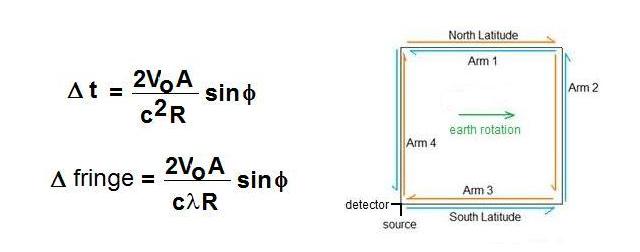
Full derivation of the above formula using the CORIOLIS FORCE:
https://www.researchgate.net/publication/308921264_Spinning_Earth_and_its_Coriolis_effect_on_the_circuital_light_beams_Verification_of_the_special_relativity_theoryDr. Ludwik Silberstein derived the same formula in 1921:
https://www.theflatearthsociety.org/forum/index.php?topic=30499.msg2068289#msg2068289In 1921, Dr. Silberstein proposed that the Sagnac effect, as it relates to the rotation of the Earth or to the effect of the ether drift, must be explained in terms of the Coriolis effect: the direct action of Coriolis forces on counterpropagating waves.
http://www.conspiracyoflight.com/Michelson-Gale/Silberstein.pdfThe propagation of light in rotating systems, Journal of the Optical Society of America, vol. V, number 4, 1921
Dr. Silberstein developed the formula published by A. Michelson using very precise details, not to be found anywhere else.
He uses the expression kω for the angular velocity, where k is the aether drag factor.
He proves that the formula for the Coriolis effect on the light beams is:
dt = 2ωσ/c^2
Then, Dr. Silberstein analyzes the area σ and proves that it is actually a SUM of two other areas (page 300 of the paper, page 10 of the pdf document).
The effect of the Coriolis force upon the interferometer will be to create a convex and a concave shape of the areas: σ1 and σ2.
The sum of these two areas is replaced by 2A and this is how the final formula achieves its final form:
dt = 4ωA/c^2
A = σ1 + σ2
That is, the CORIOLIS EFFECT upon the light beams is totally related to the closed contour area.
In 1922, Dr. Silberstein published a second paper on the subject, where he generalizes the nature of the rays arriving from the collimator:
http://gsjournal.net/Science-Journals/Historical%20Papers-Mechanics%20/%20Electrodynamics/Download/2645In 1924, one year before the Michelson-Gale experiment, Dr. Silberstein published a third paper, where he again explicitly links the Coriolis effect to the counterpropagating light beams in the interferometer:
https://www.tandfonline.com/doi/abs/10.1080/14786442408634503As in order to add the segments doing the same direction, you need the right light beam to travel along both segments in the same direction.Completely wrong.
You have no idea what you are talking about.
The CORIOLIS EFFECT involves two substractions.
The SAGNAC EFFECT involves one substraction and one addition.
Here is why you have to add.
The equation derived by Michelson leads directly to the Coriolis effect formula:
dt = l
1/(c - v
1) - l
1/(c + v
1) - (l
2/(c - v
2) - l
2/(c + v
2))
Of course, by proceeding as in the usual manner for a Sagnac phase shift formula for an interferometer whose center of rotation coincides with its geometrical center, we obtain:
2v
1l
1/(c
2 - v
21) - 2v
2l
2/(c
2 - v
22)
l = l
1 = l
22l[(v
1 - v
2)]/c
22lΩ[(R
1 - R
2)]/c
2R
1 - R
2 = h
2lhΩ/c
2By having substracted two different Sagnac phase shifts, valid for the two different segments, we obtain the CORIOLIS EFFECT formula.
This is Michelson's derivation, which leads to the Coriolis effect formula:
dt = l
1/(c - v
1) - l
1/(c + v
1) - (l
2/(c - v
2) - l
2/(c + v
2))
Two consecutive substractions.
Here is the diagram:
Here is how the phase components work out.
Now, let carefully analyze this equation.
We have the following terms, both have the same direction:
l1/(c - v1)
l2/(c - v2)Then, we have the remaining terms, in the opposite direction:
l1/(c + v1)
l2/(c + v2)To obtain the Sagnac effect, we must ADD the terms in the SAME DIRECTION, and substract the final difference.
This is what the Sagnac effect actually entails: BEAMS IN OPPOSITE DIRECTION, A ROTATION OF THE INTERFEROMETER, AND THE FINAL MEASUREMENT OF THE PHASE DIFFERENCE.
l1/(c - v1) + l2/(c - v2) = (l
1c - l
1v
2 + l
2c - l
2v
1)/(c
2 - cv
1 - cv
2 + v
1v
2)
l1/(c + v1) + l2/(c + v2) = (l
1c + l
1v
2 + l
2c + l
2v
1)/(c
2 + cv
1 + cv
2 + v
1v
2)
Since we have already added the correct Sagnac terms (both sets located in opposite directions), corresponding to the (l
1 + l
2)/(c - v
1 - v
2) and (l
1 + l
2)/(c + v
1 + v
2) terms, now the final phase difference can be correctly derived:
(l
1c - l
1v
2 + l
2c - l
2v
1)/(c
2 - cv
1 - cv
2 + v
1v
2) - (l
1c + l
1v
2 + l
2c + l
2v
1)/(c
2 + cv
1 + cv
2 + v
1v
2) = 2[(l
1v
1 + l
2v
2)]/c
2Or we can proceed from the first equation provided by Michelson.
l
1/(c - v
1) - l
1/(c + v
1) = 2l
1v
1/c
2l
2/(c - v
2) - l
2/(c + v
2) = 2l
2v
2/c
2The phase differences have already been obtained.
By substracting these phase differences, one is actually going to derive the Coriolis effect formula.
Since the phase differences have already been calculated, one has to ADD them in order to get the final, total Sagnac effect, just like the PEER REVIEWED PAPER provided by Professor Yeh:
2[(l
1v
1 + l
2v
2)]/c
2The classic Sagnac formula for an interferometer whose center of rotation coincides with its geometrical center:
Δt = l/(c - v) - l/(c + v)Now, the CORRECT, generalized Sagnac effect formula, which features the correct velocity addition formula, as well as the addition of the paths:
Δt = (l1 + l2)/(c - v1 - v2) - (l1 + l2)/(c + v1 + v2)The latter formula is a GENERALIZATION of the former phase difference formula.
We add the terms which are located in the same direction, and substract the final difference.
By constrast, Michelson substracted TWICE, thus obtaining the CORIOLIS EFFECT formula.
That is, he substracted, once, the terms located in the same direction, and then, twice, he substracted the final difference.
Here is Michelson's final formula:
4AΩsinΦ/c
2A formula proportional to the AREA OF THE INTERFEROMETER, measuring a PHYSICAL EFFECT, the Coriolis effect.
Now, the correct Sagnac formula:
Δt = (l1 + l2)/(c - v1 - v2) - (l1 + l2)/(c + v1 + v2) = 2[(l1v1 + l2v2)]/c2This formula is proportional to the VELOCITY OF THE LIGHT BEAMS, exactly what the Sagnac effect entails.
You have only the Coriolis effect formula.
I have the correct generalized Sagnac effect formula, proven experimentally by Professor Yeh.
I have a peer reviewed paper which was published in one of the best scientific journals in the world, which agrees with me.
The very same formula.
This formula is used by the US OFFICE OF NAVAL RESEARCH as well.
Here it is:
φ = -2(φ
2 - φ
1) = 4π(R
1L
1 + R
2L
2)Ω/λc
Since Δφ = 2πc/λ x Δt, Δt = 2(R
1L
1 + R
2L
2)Ω/c
2 = 2(V
1L
1 + V
2L
2)c
2THIS FORMULA ADDS THE PHASE DIFFERENCES, for a Sagnac interferometer which features two arms of different length, and different velocities.
Here is my formula:
Δt = (l1 + l2)/(c - v1 - v2) - (l1 + l2)/(c + v1 + v2) = 2[(l1v1 + l2v2)]/c2A precise agreement.