Let me put a little more detail into my argument:
you cannot adequately explain why the curvature of the earth is not apparent on an ocean horizon which stretches one hundred miles in length.
Perhaps you have just never listened long enough to adequately understand why? What follows is a great opportunity for you.
Tell me, exactly how far does this ocean horizon stretch, in length, outside of your picture. How far? Tell me if I'm wrong: 360 degrees. All the way around. That does not necessarily mean the Earth is flat. It does not mean the Earth is spherical. It does not mean it is square. It could be infinite. It could be a trapezoid. But it could
not be very small. Right?
What it does mean is that you can see all the way around yourself. Congratulations: that which you observe does not mean a damn thing, and you cannot come to a single conclusion about where you are or what you are standing on. You're in the same sinking boat as all of us. But do not be discouraged; we have an ability to organize many different observations all at once to better understand what it is we are doing, where we really are, and how to get somewhere we have never been. We will use this ability henceforth to assemble a picture of what it is we are standing on.
Lets assume first we are standing on a perfectly flat disk that is 16000 miles in diameter. Almost anywhere on the surface is fine for us to stand, because the chaotic atmosphere only allows us to see 25 miles in any direction. Now think hard about this: can one actually 'see' the horizon of this surface? Can one see a definite line encircling oneself?
Think about the chaotic atmosphere. As you look further and further away, the surface gets cloudier and dimmer, until it blends in with the sky. There is no line of horizon in this model. There is only a gradient blending the surface into the sky.
Just like this:

Even if one assumes they can see 1000 miles through the atmosphere, there still will not be a definite line of horizon on a flat Earth model because of the diffusion of the atmosphere (that's a funny word for a flat Earth: atmosphere. You should make up a new one).
Now lets say you are 10 feet tall, standing on the top of a sphere 8000 miles in diameter. As I proved
previously, the horizon is 5.5 miles in radius (that means in every direction around you; 360 degrees). You can physically see farther than that (how far does not matter), but the highest point of the ocean in your line-of-sight before it declines downward is 5.5 miles away. This makes a very definite, sharp line of horizon before the chaotic atmosphere interferes.
Now about that horizon: Let's find out just how curved it is on a spherical Earth:
The height of a spherical cap (as depicted below by the "small circle" image) with a small-circle radius of 5.5 miles and a spherical radius of 4000 miles (8000 mile diameter) is another easy Pythagorean triangle:
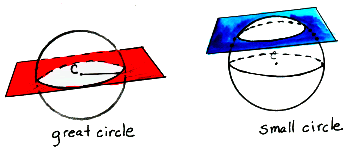
(4000 - x)^2 + 5.5^2 = 4000^2 ; (where x is the distance from the blue plane to the top of the sphere)
Solving with Mathematica yields a height of 19.965 feet.
That means that you, at an altitude of ten feet, are about a total of 30 feet higher than the plane of the horizon. Keep in mind the horizon is 5.5 miles away. That is, 29,000 feet away, which puts the horizon at a declination of:
arcsin(30/29000) = 0.06 degrees from the horizontal.
If you don't think that angle is very small, take out your protractor and try to draw two lines 0.06 degrees apart. They will end up looking like a single fat line on one end (even if your protractor had that great of precision). That is because 30 feet is very small compared to 30,000 feet. As I've said a number of times before: understanding scale is key to understanding anything larger or smaller than yourself. I guarantee that if you cannot quantify it then you cannot understand it.
That is why one cannot ever hope to notice the curvature of the earth by just looking at the horizon; it is negligible. The Earth is huge, and we are not.