And the eyes determines what you eventually see.
No, its not that simple. The CCD-chip that gathers the light instead of your eye, is waaaay more sensitive than a human eye. It simply sees better in the dark. Just like a cat has better nightvision than a human.
A cat has better night vison because it's cones are made for that purpose. CCD's are made to capture what the human eye sees to reproduce pictures faithfully as to what we observe. Go ahead, take your camera outside and take a picture - see if it shows things better than you can see without night vision attachments. In fact they have less resolution than the human eye.
http://www.cambridgeincolour.com/tutorials/cameras-vs-human-eye.htm"Most current digital cameras have 5-20 megapixels, which is often cited as falling far short of our own visual system. This is based on the fact that at 20/20 vision, the human eye is able to resolve the equivalent of a 52 megapixel camera (assuming a 60° angle of view)."
Yes. But it is more sensitive, can collect light over long periods of time, and combine pictures taken at different wavelengths. Your eye cant do that.
Which has nothing to do with the amount of light it gathers - which is determined only by aperture size. A one hour exposure on Sunday gathers no more light than a one hour exposure on Tuesday. The two overlaid only increase the detail or resolution - not the amount of light collected on each exposure. You can make what is within range appear brighter and more detailed, but putting one exposure on top of another does not increase the distance except by a very slight amount.
Would a cat see the same thing as you if it looked in the telescope, or would it see things you cant see since its eyes are more sensitive to light? Now imagine using a CCD that is thousands of times more sensitive than the cat of an eye, and combining the light recieved over an hour into one picture. How good your eyesight is, is irrelevant.
A CCD again is not made to see in the dark - but to reproduce the colors that the human eye sees faithfully. Only with infrared lights can a camera see better than you in the dark, IF the CCD is equipped to see in the infrared. But again, seeing in infrared does not increase distance nor the louight gatheing power, it remains the same as light is all frequencies combined.
This is simply untrue. The distance is not determined solely by the aperture. Put a blind man in front of the telescope and say that again. Or a person that has sightly worse eyesight than you, or better for that matter.
Since you want to be ridiculous put a cap over the telescope. Same results as putting a blind man.
http://www.telescopes.com/blogs/helpful-information/18966596-understanding-telescopes"A telescope's most important attribute is its aperture, which determines the brightness and sharpness of everything you see through your scope. Technically, this is the diameter of the main lens or mirror and as the aperture increases so does the details of the image you see. Depending on the aperture you will either see an open or a restricted field of view. For example a good 10" aperture scope shows sharper images than even a well-made 6" aperture telescope."
You seem to focus only on how much light is collected. You need to factor in the CCDs ability to sum that light over time, and its ability to see stuff that is way beyond the capabilities of your eyes.
Apparently you need to read some books on how telescopes work.
https://starizona.com/acb/basics/equip_whichisbest.aspx"Aperture
The diameter of the lens or mirror in a telescope--the aperture--is the single most important factor for stargazing. The bigger the aperture, the more light the telescope gathers. Ultimately this is the main purpose of a telescope: to gather as much light as possible and funnel it into your eye. Since the light-gathering ability of a telescope is determined by the area of the lens or mirror, doubling the aperture quadruples the light-gathering ability. A small difference in aperture makes a big difference in what you see. A look at the picture below shows the difference between the area of an 8" telescope mirror and the typical 7mm opening of the human eye. An 8" telescope gathers more than 800 times as much light as the unaided eye."
Random image pulled of the internet, just to give you an idea...the CCD in Hubble is probably vastly superior to the ones used to make that chart btw.
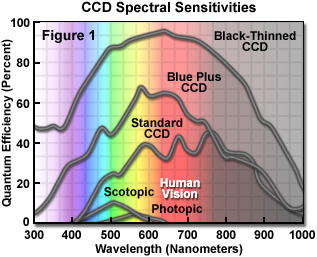
The CCD in Hubble is far less than your eye.
https://answers.yahoo.com/question/index?qid=20090207234120AAvedWz"The Wide Field Camera 3 (WFC3), which is to be installed during the servicing mission in 2009, will also have 2 CCD chips each of 2048 x 4096 pixels for a total of 16 mega-pixels. "
http://www.cambridgeincolour.com/tutorials/cameras-vs-human-eye.htm"Most current digital cameras have 5-20 megapixels, which is often cited as falling far short of our own visual system. This is based on the fact that at 20/20 vision, the human eye is able to resolve the equivalent of a 52 megapixel camera (assuming a 60° angle of view)."
So even someone with less than 20/20 vision (52 megapixels) has more resolution that Hubble which only amounts to 16 megapixels.
And we have not even started to talk about light extinction due to dust, the amount of which has been sadly underestimated.
https://en.wikipedia.org/wiki/Ulysses_%28spacecraft%29"Ulysses discovered that dust coming into the Solar System from deep space was 30 times more abundant than previously expected."