Telescope Distances

  • 15 Replies
  • 5844 Views
Telescope Distances
« on: January 27, 2016, 07:34:34 PM »
How far do you believe the Hubble allows us to see?

It's mirror has a surface area of 49,062.5 cm^2 the average human eye has a surface area of  0.38465 cm^2.

In comparison with the lens of the eye it has an objective diameter of 357.14 times larger than the human eye. It's surface area is 127,551 times that of the human eye.
This means Hubble collects 127,551 times more light than the human eye, so can make objects appear 127,551 times brighter than with the human eye.

Now, being the inverse square law of light says that the apparent intensity of the light of a point source is inversely proportional to the square of its distance to the observer. This means that if the distance of a star is doubled its apparent light is reduced four times. If its distance is increased three times its apparent luminosity is reduced nine times.

https://en.wikipedia.org/wiki/Inverse-square_law

Assuming that a star is so far away that it is barely visible to the naked eye, we know that the Hubble telescope can make the star appear 127,551 times brighter. Does this mean that the  Hubble telescope enables an observer to see the star if it were 127,551 times farther away? The answer is no. The Inverse Square Law says that the light that we receive from a star is  inversely proportional to the square of its distance. According to this law, at that distance, the light of the star becomes 127,551^2 or 16,269,262,700  times dimmer, far too dim for us to see with the telescope.

This raises the question: What is the maximum distance an object can be seen through the Hubble telescope? The  answer is 357.14 times the distance that the naked eye can see. The  reason is that an object 357.14 times farther away, its light  becomes 127,551 times dimmer. Since the Hubble telescope can make a star appear 127,551 times brighter, then looking through the telescope the star would be barely visible.

Of course this does not take into account long exposures to film or digital media which would increase the distance several times.

So would someone taking the inverse square law of light into effect show me how we can see galaxies a claimed 13.7 billion light years away? Remember - magnification spreads out the light received and so does not make a star appear brighter, but actually dimmer. Because this would mean the human eye can see 38,360,306 million light years?????

http://www.physics.ucla.edu/~huffman/m31.html
« Last Edit: January 27, 2016, 08:30:45 PM by Justatruthseeker »
Fabricated Ad-hoc Inventions Repeatedly Invoked in Effort to Defend Untenable Scientific Theory - Fairie Dust

?

j79

  • 54
  • +0/-0
Re: Telescope Distances
« Reply #1 on: January 28, 2016, 09:29:30 AM »
The short answer: the CCD's used in telescopes and cameras are much more sensitive than the human eye. And you mention yourself that prolonged exposures pushes that difference even further. On top of that it has the ability to detect infrared and other frequencies that the human eye cant see at all. I dont really see how the sensitivity of the human eye is relevant to begin with to be honest...noone is actually looking through these telescopes with their eyes, they are watching a screen.
« Last Edit: January 28, 2016, 09:31:39 AM by j79 »

Re: Telescope Distances
« Reply #2 on: January 28, 2016, 10:04:32 AM »
The short answer: the CCD's used in telescopes and cameras are much more sensitive than the human eye. And you mention yourself that prolonged exposures pushes that difference even further. On top of that it has the ability to detect infrared and other frequencies that the human eye cant see at all. I dont really see how the sensitivity of the human eye is relevant to begin with to be honest...noone is actually looking through these telescopes with their eyes, they are watching a screen.

And the eyes determines what you eventually see. But the ability to see other spectrum's has nothing to do with the telescopes ability to gather light. Only the size of the aperture determines that. The Hubble's aperture enables it to gather 127,551 times more light - regardless of which spectrum it looks in. If it looks in the infrared spectrum it sees no more light than it's aperture allows - and then does not see in the visible spectrum.

https://starizona.com/acb/basics/observing_theory.aspx

"How much more light a telescope gathers compared to the unaided eye is determined by the ratio between the light-gathering area of the telescope and the light-gathering area of the eye. "

What spectrum it looks in has nothing to do with the distance it can see. The distance is determined solely by its aperture size. It receives all wavelengths, just as your eye does. It's ability to focus on a different wavelength has nothing to do with the distance it can see, which again is solely determined by the aperture size. It would see no further in infrared then it would in the visible spectrum, the same amount of light is gathered regardless of which spectrum it looks in.

Resolution may be increased - but distance is unaffected.
Fabricated Ad-hoc Inventions Repeatedly Invoked in Effort to Defend Untenable Scientific Theory - Fairie Dust

?

j79

  • 54
  • +0/-0
Re: Telescope Distances
« Reply #3 on: January 28, 2016, 12:02:25 PM »
And the eyes determines what you eventually see.

No, its not that simple. The CCD-chip that gathers the light instead of your eye, is waaaay more sensitive than a human eye. It simply sees better in the dark. Just like a cat has better nightvision than a human.

But the ability to see other spectrum's has nothing to do with the telescopes ability to gather light. Only the size of the aperture determines that. The Hubble's aperture enables it to gather 127,551 times more light - regardless of which spectrum it looks in. If it looks in the infrared spectrum it sees no more light than it's aperture allows - and then does not see in the visible spectrum.

Yes. But it is more sensitive, can collect light over long periods of time, and combine pictures taken at different wavelengths. Your eye cant do that.

https://starizona.com/acb/basics/observing_theory.aspx

"How much more light a telescope gathers compared to the unaided eye is determined by the ratio between the light-gathering area of the telescope and the light-gathering area of the eye. "

Would a cat see the same thing as you if it looked in the telescope, or would it see things you cant see since its eyes are more sensitive to light? Now imagine using a CCD that is thousands of times more sensitive than the cat of an eye, and combining the light recieved over an hour into one picture. How good your eyesight is, is irrelevant.

What spectrum it looks in has nothing to do with the distance it can see. The distance is determined solely by its aperture size. It receives all wavelengths, just as your eye does. It's ability to focus on a different wavelength has nothing to do with the distance it can see, which again is solely determined by the aperture size. It would see no further in infrared then it would in the visible spectrum, the same amount of light is gathered regardless of which spectrum it looks in.

Resolution may be increased - but distance is unaffected.

This is simply untrue. The distance is not determined solely by the aperture. Put a blind man in front of the telescope and say that again. Or a person that has sightly worse eyesight than you, or better for that matter.

You seem to focus only on how much light is collected. You need to factor in the CCDs ability to sum that light over time, and its ability to see stuff that is way beyond the capabilities of your eyes.

Random image pulled of the internet, just to give you an idea...the CCD in Hubble is probably vastly superior to the ones used to make that chart btw.
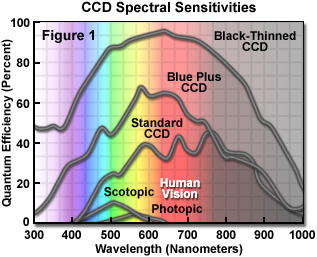
« Last Edit: January 28, 2016, 12:10:30 PM by j79 »

Re: Telescope Distances
« Reply #4 on: January 28, 2016, 05:42:09 PM »
And the eyes determines what you eventually see.

No, its not that simple. The CCD-chip that gathers the light instead of your eye, is waaaay more sensitive than a human eye. It simply sees better in the dark. Just like a cat has better nightvision than a human.

A cat has better night vison because it's cones are made for that purpose. CCD's are made to capture what the human eye sees to reproduce pictures faithfully as to what we observe. Go ahead, take your camera outside and take a picture - see if it shows things better than you can see without night vision attachments. In fact they have less resolution than the human eye.

http://www.cambridgeincolour.com/tutorials/cameras-vs-human-eye.htm

"Most current digital cameras have 5-20 megapixels, which is often cited as falling far short of our own visual system. This is based on the fact that at 20/20 vision, the human eye is able to resolve the equivalent of a 52 megapixel camera (assuming a 60° angle of view)."

Quote
Yes. But it is more sensitive, can collect light over long periods of time, and combine pictures taken at different wavelengths. Your eye cant do that.

Which has nothing to do with the amount of light it gathers - which is determined only by aperture size. A one hour exposure on Sunday gathers no more light than a one hour exposure on Tuesday. The two overlaid only increase the detail or resolution - not the amount of light collected on each exposure. You can make what is within range appear brighter and more detailed, but putting one exposure on top of another does not increase the distance except by a very slight amount.


Quote
Would a cat see the same thing as you if it looked in the telescope, or would it see things you cant see since its eyes are more sensitive to light? Now imagine using a CCD that is thousands of times more sensitive than the cat of an eye, and combining the light recieved over an hour into one picture. How good your eyesight is, is irrelevant.

A CCD again is not made to see in the dark - but to reproduce the colors that the human eye sees faithfully. Only with infrared lights can a camera see better than you in the dark, IF the CCD is equipped to see in the infrared. But again, seeing in infrared does not increase distance nor the louight gatheing power, it remains the same as light is all frequencies combined.

Quote
This is simply untrue. The distance is not determined solely by the aperture. Put a blind man in front of the telescope and say that again. Or a person that has sightly worse eyesight than you, or better for that matter.

Since you want to be ridiculous put a cap over the telescope. Same results as putting a blind man.

http://www.telescopes.com/blogs/helpful-information/18966596-understanding-telescopes

"A telescope's most important attribute is its aperture, which determines the brightness and sharpness of everything you see through your scope. Technically, this is the diameter of the main lens or mirror and as the aperture increases so does the details of the image you see. Depending on the aperture you will either see an open or a restricted field of view. For example a good 10" aperture scope shows sharper images than even a well-made 6" aperture telescope."


Quote
You seem to focus only on how much light is collected. You need to factor in the CCDs ability to sum that light over time, and its ability to see stuff that is way beyond the capabilities of your eyes.

Apparently you need to read some books on how telescopes work.

https://starizona.com/acb/basics/equip_whichisbest.aspx

"Aperture

The diameter of the lens or mirror in a telescope--the aperture--is the single most important factor for stargazing.  The bigger the aperture, the more light the telescope gathers.  Ultimately this is the main purpose of a telescope:  to gather as much light as possible and funnel it into your eye.  Since the light-gathering ability of a telescope is determined by the area of the lens or mirror, doubling the aperture quadruples the light-gathering ability.  A small difference in aperture makes a big difference in what you see.  A look at the picture below shows the difference between the area of an 8" telescope mirror and the typical 7mm opening of the human eye.  An 8" telescope gathers more than 800 times as much light as the unaided eye."


Quote
Random image pulled of the internet, just to give you an idea...the CCD in Hubble is probably vastly superior to the ones used to make that chart btw.


The CCD in Hubble is far less than your eye.

https://answers.yahoo.com/question/index?qid=20090207234120AAvedWz

"The Wide Field Camera 3 (WFC3), which is to be installed during the servicing mission in 2009, will also have 2 CCD chips each of 2048 x 4096 pixels for a total of 16 mega-pixels. "

http://www.cambridgeincolour.com/tutorials/cameras-vs-human-eye.htm

"Most current digital cameras have 5-20 megapixels, which is often cited as falling far short of our own visual system. This is based on the fact that at 20/20 vision, the human eye is able to resolve the equivalent of a 52 megapixel camera (assuming a 60° angle of view)."

So even someone with less than 20/20 vision (52 megapixels) has more resolution that Hubble which only amounts to 16 megapixels.

And we have not even started to talk about light extinction due to dust, the amount of which has been sadly underestimated.

https://en.wikipedia.org/wiki/Ulysses_%28spacecraft%29

"Ulysses discovered that dust coming into the Solar System from deep space was 30 times more abundant than previously expected."
Fabricated Ad-hoc Inventions Repeatedly Invoked in Effort to Defend Untenable Scientific Theory - Fairie Dust

Re: Telescope Distances
« Reply #5 on: January 28, 2016, 05:54:11 PM »
Not to mention your spiel about cats is way off base. Cats have 6 to 8 times more rod cells than humans do. But the CCD inboard the Hubble has less resolution than the average sighted person as those with 20/20 vision have about 52 megapixel resolution while Hubble has 16. Basically the Hubble is a half blind human gazing at the stars as far as resolution goes.

Those images all look pretty because they undergo computerized processing before your eyes ever see them.
« Last Edit: January 28, 2016, 06:00:20 PM by Justatruthseeker »
Fabricated Ad-hoc Inventions Repeatedly Invoked in Effort to Defend Untenable Scientific Theory - Fairie Dust

?

j79

  • 54
  • +0/-0
Re: Telescope Distances
« Reply #6 on: January 28, 2016, 06:11:20 PM »
A cat has better night vison because it's cones are made for that purpose. CCD's are made to capture what the human eye sees to reproduce pictures faithfully as to what we observe. Go ahead, take your camera outside and take a picture - see if it shows things better than you can see without night vision attachments. In fact they have less resolution than the human eye.

http://www.cambridgeincolour.com/tutorials/cameras-vs-human-eye.htm

"Most current digital cameras have 5-20 megapixels, which is often cited as falling far short of our own visual system. This is based on the fact that at 20/20 vision, the human eye is able to resolve the equivalent of a 52 megapixel camera (assuming a 60° angle of view)."

We are not talking about regular cameras. The fact that Hubble can take pictures in infrared alone, proves that its simply not correct that the CCDs used in telescopes are made to reproduce what we see as accurately as possible. Why on earth would you want that?

Which has nothing to do with the amount of light it gathers - which is determined only by aperture size. A one hour exposure on Sunday gathers no more light than a one hour exposure on Tuesday. The two overlaid only increase the detail or resolution - not the amount of light collected on each exposure. You can make what is within range appear brighter and more detailed, but putting one exposure on top of another does not increase the distance except by a very slight amount.

But a one hour exposure gathers more light than a 1 second exposure. So no, when you take puctures, the light gathered does not only depend on aperture, it depens on exposure too. You just said it yourself. It also matters how much of the gathered light is actually detected, and recorded on the image, and that is way more than the eye is capable of. You seem to be under the impression that aperture determines the distance you can see. It is simply not so when you dont use the naked eye.

A CCD again is not made to see in the dark - but to reproduce the colors that the human eye sees faithfully. Only with infrared lights can a camera see better than you in the dark, IF the CCD is equipped to see in the infrared. But again, seeing in infrared does not increase distance nor the louight gatheing power, it remains the same as light is all frequencies combined.

Thats simply incorrect. Go to the following link and read the part about intensity range. It specifically says that CCDs can be used to enhance intensity range.

https://en.wikipedia.org/wiki/Night_vision

And again, if it can see infrared, then you are wrong when you say that its made to reproduce what the human eye sees.

"A telescope's most important attribute is its aperture, which determines the brightness and sharpness of everything you see through your scope. Technically, this is the diameter of the main lens or mirror and as the aperture increases so does the details of the image you see. Depending on the aperture you will either see an open or a restricted field of view. For example a good 10" aperture scope shows sharper images than even a well-made 6" aperture telescope."

How does that contradict what i say?

Apparently you need to read some books on how telescopes work.

https://starizona.com/acb/basics/equip_whichisbest.aspx

"Aperture

The diameter of the lens or mirror in a telescope--the aperture--is the single most important factor for stargazing.  The bigger the aperture, the more light the telescope gathers.  Ultimately this is the main purpose of a telescope:  to gather as much light as possible and funnel it into your eye.  Since the light-gathering ability of a telescope is determined by the area of the lens or mirror, doubling the aperture quadruples the light-gathering ability.  A small difference in aperture makes a big difference in what you see.  A look at the picture below shows the difference between the area of an 8" telescope mirror and the typical 7mm opening of the human eye.  An 8" telescope gathers more than 800 times as much light as the unaided eye."

I know how telescopes work, i have used many. You on the other hand need to read something that is NOT about naked eye observations, because that is simply not what Hubble is used for.

The CCD in Hubble is far less than your eye.

https://answers.yahoo.com/question/index?qid=20090207234120AAvedWz

"The Wide Field Camera 3 (WFC3), which is to be installed during the servicing mission in 2009, will also have 2 CCD chips each of 2048 x 4096 pixels for a total of 16 mega-pixels. "

http://www.cambridgeincolour.com/tutorials/cameras-vs-human-eye.htm

"Most current digital cameras have 5-20 megapixels, which is often cited as falling far short of our own visual system. This is based on the fact that at 20/20 vision, the human eye is able to resolve the equivalent of a 52 megapixel camera (assuming a 60° angle of view)."

So even someone with less than 20/20 vision (52 megapixels) has more resolution that Hubble which only amounts to 16 megapixels.

And we have not even started to talk about light extinction due to dust, the amount of which has been sadly underestimated.

https://en.wikipedia.org/wiki/Ulysses_%28spacecraft%29

"Ulysses discovered that dust coming into the Solar System from deep space was 30 times more abundant than previously expected."

Is far less what? Less resolution? What does that have to do with collecting light and distance?

« Last Edit: January 28, 2016, 06:15:36 PM by j79 »

?

j79

  • 54
  • +0/-0
Re: Telescope Distances
« Reply #7 on: January 28, 2016, 06:34:53 PM »
Btw, the longest distance you can see with the naked eye, was what is thought to have been a gamma-burts observed in 2008, and estimated to be 7.5 billion lightyears away. Multiply that with whatever the maths you did gave you for Hubble and tell me that 13-14 billion lightyears will be a problem.

http://www.universetoday.com/13280/biggest-ever-cosmic-explosion-observed-75-billion-light-years-away/

And its not even the telescopes that limit the range of how far we can see...its the fact that we look back in time due to the speed of light. There is a reason the term "visible universe" was coined.
« Last Edit: January 28, 2016, 06:40:42 PM by j79 »

Re: Telescope Distances
« Reply #8 on: January 29, 2016, 06:34:13 PM »
I can get M82 (cigar galaxy) on clear nights, with my manual C8, 8" telescope, upgraded 2" diagonal (99.9% reflective) using a decent eyepiece.

In short, at around 125x mag, it can be seen. I'd bet you could spot it through binos, even an inexpensive 4" starter scope too.

At 12 million light years, it's the furthest object I've ever observed.

Re: Telescope Distances
« Reply #9 on: February 01, 2016, 08:30:02 AM »
Btw, the longest distance you can see with the naked eye, was what is thought to have been a gamma-burts observed in 2008, and estimated to be 7.5 billion lightyears away. Multiply that with whatever the maths you did gave you for Hubble and tell me that 13-14 billion lightyears will be a problem.

http://www.universetoday.com/13280/biggest-ever-cosmic-explosion-observed-75-billion-light-years-away/

And its not even the telescopes that limit the range of how far we can see...its the fact that we look back in time due to the speed of light. There is a reason the term "visible universe" was coined.

Distance calculated by the false assumption of redshift???????

http://www.newtonphysics.on.ca/hubble/

Because that dust and plasma blocks out what we can see and is the sole factor of redshift.

https://en.wikipedia.org/wiki/Ulysses_%28spacecraft%29

"Ulysses discovered that dust coming into the Solar System from deep space was 30 times more abundant than previously expected."

https://www.nasa.gov/mission_pages/chandra/news/H-12-331.html#.Vq-HYVJRZdg

https://www.nasa.gov/feature/goddard/nasa-s-hubble-finds-giant-halo-around-the-andromeda-galaxy

I mean please. It is 30 times more dense than what we used to believe, yet they don't calculate it in their calculations for extinction at all. Not to mention all those plasma halos around every galaxy.

There is an answer, but first you must give up the Fairie Dust of cosmological redshift being expansion of the universe.

And gamma ray bursts are supposed to be the most energetic event in the universe.

https://en.wikipedia.org/wiki/Gamma-ray_burst

Are you claiming those newly forming galaxies at the edge of the universe just beginning star formation are brighter than gamma ray bursts?
« Last Edit: February 01, 2016, 09:03:49 AM by Justatruthseeker »
Fabricated Ad-hoc Inventions Repeatedly Invoked in Effort to Defend Untenable Scientific Theory - Fairie Dust

Re: Telescope Distances
« Reply #10 on: February 01, 2016, 08:34:36 AM »
The Keck telescope with a mirror diameter of 10 meters can only see 1,111 times further than the human eye.

http://www.astronomynotes.com/telescop/s6.htm

And you all want people to believe that the Hubble with a mirror diameter of 2.4 meters can see 6,500 times further than the human eye???????

The only math so far that doesn't add up is those that believe it can.
Fabricated Ad-hoc Inventions Repeatedly Invoked in Effort to Defend Untenable Scientific Theory - Fairie Dust

Re: Telescope Distances
« Reply #11 on: February 01, 2016, 08:43:55 AM »
A cat has better night vison because it's cones are made for that purpose. CCD's are made to capture what the human eye sees to reproduce pictures faithfully as to what we observe. Go ahead, take your camera outside and take a picture - see if it shows things better than you can see without night vision attachments. In fact they have less resolution than the human eye.

http://www.cambridgeincolour.com/tutorials/cameras-vs-human-eye.htm

"Most current digital cameras have 5-20 megapixels, which is often cited as falling far short of our own visual system. This is based on the fact that at 20/20 vision, the human eye is able to resolve the equivalent of a 52 megapixel camera (assuming a 60° angle of view)."

We are not talking about regular cameras. The fact that Hubble can take pictures in infrared alone, proves that its simply not correct that the CCDs used in telescopes are made to reproduce what we see as accurately as possible. Why on earth would you want that?

Which has nothing to do with the amount of light it gathers - which is determined only by aperture size. A one hour exposure on Sunday gathers no more light than a one hour exposure on Tuesday. The two overlaid only increase the detail or resolution - not the amount of light collected on each exposure. You can make what is within range appear brighter and more detailed, but putting one exposure on top of another does not increase the distance except by a very slight amount.

But a one hour exposure gathers more light than a 1 second exposure. So no, when you take puctures, the light gathered does not only depend on aperture, it depens on exposure too. You just said it yourself. It also matters how much of the gathered light is actually detected, and recorded on the image, and that is way more than the eye is capable of. You seem to be under the impression that aperture determines the distance you can see. It is simply not so when you dont use the naked eye.

A CCD again is not made to see in the dark - but to reproduce the colors that the human eye sees faithfully. Only with infrared lights can a camera see better than you in the dark, IF the CCD is equipped to see in the infrared. But again, seeing in infrared does not increase distance nor the louight gatheing power, it remains the same as light is all frequencies combined.

Thats simply incorrect. Go to the following link and read the part about intensity range. It specifically says that CCDs can be used to enhance intensity range.

https://en.wikipedia.org/wiki/Night_vision

And again, if it can see infrared, then you are wrong when you say that its made to reproduce what the human eye sees.

"A telescope's most important attribute is its aperture, which determines the brightness and sharpness of everything you see through your scope. Technically, this is the diameter of the main lens or mirror and as the aperture increases so does the details of the image you see. Depending on the aperture you will either see an open or a restricted field of view. For example a good 10" aperture scope shows sharper images than even a well-made 6" aperture telescope."

How does that contradict what i say?

Apparently you need to read some books on how telescopes work.

https://starizona.com/acb/basics/equip_whichisbest.aspx

"Aperture

The diameter of the lens or mirror in a telescope--the aperture--is the single most important factor for stargazing.  The bigger the aperture, the more light the telescope gathers.  Ultimately this is the main purpose of a telescope:  to gather as much light as possible and funnel it into your eye.  Since the light-gathering ability of a telescope is determined by the area of the lens or mirror, doubling the aperture quadruples the light-gathering ability.  A small difference in aperture makes a big difference in what you see.  A look at the picture below shows the difference between the area of an 8" telescope mirror and the typical 7mm opening of the human eye.  An 8" telescope gathers more than 800 times as much light as the unaided eye."

I know how telescopes work, i have used many. You on the other hand need to read something that is NOT about naked eye observations, because that is simply not what Hubble is used for.

The CCD in Hubble is far less than your eye.

https://answers.yahoo.com/question/index?qid=20090207234120AAvedWz

"The Wide Field Camera 3 (WFC3), which is to be installed during the servicing mission in 2009, will also have 2 CCD chips each of 2048 x 4096 pixels for a total of 16 mega-pixels. "

http://www.cambridgeincolour.com/tutorials/cameras-vs-human-eye.htm

"Most current digital cameras have 5-20 megapixels, which is often cited as falling far short of our own visual system. This is based on the fact that at 20/20 vision, the human eye is able to resolve the equivalent of a 52 megapixel camera (assuming a 60° angle of view)."

So even someone with less than 20/20 vision (52 megapixels) has more resolution that Hubble which only amounts to 16 megapixels.

And we have not even started to talk about light extinction due to dust, the amount of which has been sadly underestimated.

https://en.wikipedia.org/wiki/Ulysses_%28spacecraft%29

"Ulysses discovered that dust coming into the Solar System from deep space was 30 times more abundant than previously expected."

Is far less what? Less resolution? What does that have to do with collecting light and distance?

Your spiel about Hubble and infrared is way off base since it used its infrared camera to take infrared pictures - which is completely separate from its normal ccd as are the other functions built into it.

http://hubblesite.org/the_telescope/nuts_.and._bolts/instruments/nicmos/

You are confusing other devices built into it with it's light gathering ability.

You were the one claiming that its CCD allowed us to see further, and now when you find out its CCD is less than half that of a human's, you suddenly want to know what it has to do with distance and light gathering power. Absolutely nothing - which is what I tried to tell you from the start, but you were insisting it did, now you are taking the exact opposite stance suddenly for some reason?????
« Last Edit: February 01, 2016, 08:50:41 AM by Justatruthseeker »
Fabricated Ad-hoc Inventions Repeatedly Invoked in Effort to Defend Untenable Scientific Theory - Fairie Dust

*

Kali

  • 45
  • +0/-0
Re: Telescope Distances
« Reply #12 on: February 03, 2016, 10:13:49 AM »
Since it's more than abundantly clear that you're itching to spout some manner of conspiracy theory, why don't you just go on and do it?

*

mikeman7918

  • 5431
  • +0/-0
  • Round Earther
Re: Telescope Distances
« Reply #13 on: February 03, 2016, 11:23:07 AM »
Of course this does not take into account long exposures to film or digital media which would increase the distance several times.

And that's where you went wrong.  It's hard to say what "frame rate" the human eye has because it doesn't work quite the same as a camera in that respect, but the human brain and eye can interpret as much as 150 frames per second.  On the other hand, the Hubble space telescope often exposes for days on it's longer distance images like the deep field.

Let's say the Hubble space telescope is taking a one day long exposure.  In that time, a human eye does about 12,960,000 exposures.  This means that your previous estimation of how much further the Hubble can see compared to the human eye must be multiplied by 12,960,000 to account for a long exposure, and that yields that the Hubble space telescope is about 1,652,000,000,000 times then the human eye and can see 1,285,000 times further.

So would someone taking the inverse square law of light into effect show me how we can see galaxies a claimed 13.7 billion light years away? Remember - magnification spreads out the light received and so does not make a star appear brighter, but actually dimmer. Because this would mean the human eye can see 38,360,306 million light years?????
http://www.physics.ucla.edu/~huffman/m31.html

The furthest thing that can be seen by the naked human eye is the Andromeda Galaxy, which is 2,537,000 light years away.  Given the new numbers I previously calculated accounting for exposure time, the Hubble can see something up to 3,261,000,000,000 (3.261 trillion) light years away.  All Hubble images appear brighter then they really are, even in the Hubble deep field.  It can do this because it just collects so much light that it's visibility distance limit is so high that it can see the edge of the observable universe.
I am having a video war with Jeranism.
See the thread about it here.

*

29silhouette

  • 3374
  • +0/-0
Re: Telescope Distances
« Reply #14 on: February 14, 2016, 09:46:45 AM »
I can get M82 (cigar galaxy) on clear nights, with my manual C8, 8" telescope, upgraded 2" diagonal (99.9% reflective) using a decent eyepiece.

In short, at around 125x mag, it can be seen. I'd bet you could spot it through binos, even an inexpensive 4" starter scope too.

At 12 million light years, it's the furthest object I've ever observed.
I can see it with my low-end 20-60x80 spotting scope, and was just barely able to make out that recent supernova.

?

nikao

  • 4
  • +0/-0
Re: Telescope Distances
« Reply #15 on: March 01, 2016, 09:55:26 AM »
A cat has better night vison because it's cones are made for that purpose. CCD's are made to capture what the human eye sees to reproduce pictures faithfully as to what we observe. Go ahead, take your camera outside and take a picture - see if it shows things better than you can see without night vision attachments. In fact they have less resolution than the human eye.

http://www.cambridgeincolour.com/tutorials/cameras-vs-human-eye.htm

"Most current digital cameras have 5-20 megapixels, which is often cited as falling far short of our own visual system. This is based on the fact that at 20/20 vision, the human eye is able to resolve the equivalent of a 52 megapixel camera (assuming a 60° angle of view)."

We are not talking about regular cameras. The fact that Hubble can take pictures in infrared alone, proves that its simply not correct that the CCDs used in telescopes are made to reproduce what we see as accurately as possible. Why on earth would you want that?

Which has nothing to do with the amount of light it gathers - which is determined only by aperture size. A one hour exposure on Sunday gathers no more light than a one hour exposure on Tuesday. The two overlaid only increase the detail or resolution - not the amount of light collected on each exposure. You can make what is within range appear brighter and more detailed, but putting one exposure on top of another does not increase the distance except by a very slight amount.

But a one hour exposure gathers more light than a 1 second exposure. So no, when you take puctures, the light gathered does not only depend on aperture, it depens on exposure too. You just said it yourself. It also matters how much of the gathered light is actually detected, and recorded on the image, and that is way more than the eye is capable of. You seem to be under the impression that aperture determines the distance you can see. It is simply not so when you dont use the naked eye.

A CCD again is not made to see in the dark - but to reproduce the colors that the human eye sees faithfully. Only with infrared lights can a camera see better than you in the dark, IF the CCD is equipped to see in the infrared. But again, seeing in infrared does not increase distance nor the louight gatheing power, it remains the same as light is all frequencies combined.

Thats simply incorrect. Go to the following link and read the part about intensity range. It specifically says that CCDs can be used to enhance intensity range.

https://en.wikipedia.org/wiki/Night_vision

And again, if it can see infrared, then you are wrong when you say that its made to reproduce what the human eye sees.

"A telescope's most important attribute is its aperture, which determines the brightness and sharpness of everything you see through your scope. Technically, this is the diameter of the main lens or mirror and as the aperture increases so does the details of the image you see. Depending on the aperture you will either see an open or a restricted field of view. For example a good 10" aperture scope shows sharper images than even a well-made 6" aperture telescope."

How does that contradict what i say?

Apparently you need to read some books on how telescopes work.

https://starizona.com/acb/basics/equip_whichisbest.aspx

"Aperture

The diameter of the lens or mirror in a telescope--the aperture--is the single most important factor for stargazing.  The bigger the aperture, the more light the telescope gathers.  Ultimately this is the main purpose of a telescope:  to gather as much light as possible and funnel it into your eye.  Since the light-gathering ability of a telescope is determined by the area of the lens or mirror, doubling the aperture quadruples the light-gathering ability.  A small difference in aperture makes a big difference in what you see.  A look at the picture below shows the difference between the area of an 8" telescope mirror and the typical 7mm opening of the human eye.  An 8" telescope gathers more than 800 times as much light as the unaided eye."

I know how telescopes work, i have used many. You on the other hand need to read something that is NOT about naked eye observations, because that is simply not what Hubble is used for.

The CCD in Hubble is far less than your eye.

https://answers.yahoo.com/question/index?qid=20090207234120AAvedWz

"The Wide Field Camera 3 (WFC3), which is to be installed during the servicing mission in 2009, will also have 2 CCD chips each of 2048 x 4096 pixels for a total of 16 mega-pixels. "

http://www.cambridgeincolour.com/tutorials/cameras-vs-human-eye.htm

"Most current digital cameras have 5-20 megapixels, which is often cited as falling far short of our own visual system. This is based on the fact that at 20/20 vision, the human eye is able to resolve the equivalent of a 52 megapixel camera (assuming a 60° angle of view)."

So even someone with less than 20/20 vision (52 megapixels) has more resolution that Hubble which only amounts to 16 megapixels.

And we have not even started to talk about light extinction due to dust, the amount of which has been sadly underestimated.

https://en.wikipedia.org/wiki/Ulysses_%28spacecraft%29

"Ulysses discovered that dust coming into the Solar System from deep space was 30 times more abundant than previously expected."

Is far less what? Less resolution? What does that have to do with collecting light and distance?

Your spiel about Hubble and infrared is way off base since it used its infrared camera to take infrared pictures - which is completely separate from its normal ccd as are the other functions built into it.

http://hubblesite.org/the_telescope/nuts_.and._bolts/instruments/nicmos/

You are confusing other devices built into it with it's light gathering ability.

You were the one claiming that its CCD allowed us to see further, and now when you find out its CCD is less than half that of a human's, you suddenly want to know what it has to do with distance and light gathering power. Absolutely nothing - which is what I tried to tell you from the start, but you were insisting it did, now you are taking the exact opposite stance suddenly for some reason?????

Can your eye/brain detect single photons? Turns out your eye can, but it isn't passed to your brain to detect. The minimum is around 9 photons per 100ms.
Now, the CCD can be used to take very long exposure photo's. Thus making use of any single photon it detect.
So yes, the CCD DOES help 'see' you further