In order for the energy to be "conserved" it has to be shot out at high speed?
Ok, you lost me here.
I can understand decaying particles of something dispersing into the environment, I just don't understand why they have to become unstable and shoot into it at speed.
The radioactive elements themselves are unstable, which is why they release particles. The particles can be unstable or may not be, depending on the particle. The speed also depends on the particles: alpha particles, the biggest radioactive particles, are generally released at very low speeds and can be stopped with a piece of paper. This can be observed by using a Geiger counter, a piece of paper, and an alpha-emitting substance. Beta particles, on the other hand, are basically electrons, which are much smaller so they get ejected at much higher speeds. These would probably be stopped by a small, thick sheet of metal or plastic. Gamma rays, which are high-energy electromagnetic rays (think higher energy than, but similar to, X-rays), need a couple inches of lead to stop them.
Let's look at some logic.
The picture underneath is supposedly plutonium. Plutonium, it's said: that if just one pound of it was dispersed evenly over the earth, it would kill every person on it.
I'm not sure if this is true. If it is, it would have to be aerosolized for people to breathe in, the radiation dose alone from outside your body likely won't kill you.
Pay no attention to that man with the washing up gloves on, let's concentrate on this disc of plutonium that is highly poisonous.
Now remember, plutonium only exists as it is, because of nuclear fissioning inside reactors, which somehow spawn this ultra poisonous radiation emitting plutonium which is turned into a disc of "lead" like metal.
There are very small natural amounts of plutonium, but for the most part yes you're right.
This disc, gets machined so it is the right size for a nuclear bomb, aided by a bullet made of the same stuff and they both sit at each end of a nuclear weapon.
You're describing two different types of nuclear weapons at this point. There are two bombs that have been used in warfare, the Little Boy (Hiroshima) and the Fat Man (Nagasaki). The Little Boy contained uranium, and was the gun-type weapon that you describe. Plutonium, however, was observed to have a very high neutron emission rate and generated quite a lot of heat, so the risk of it going initiating early was very high. Keep in mind it wouldn't have detonated, but it would have made a lot of nuclear waste. So the Fat Man, the plutonium bomb, was designed differently.
This is a diagram of the plutonium bomb:
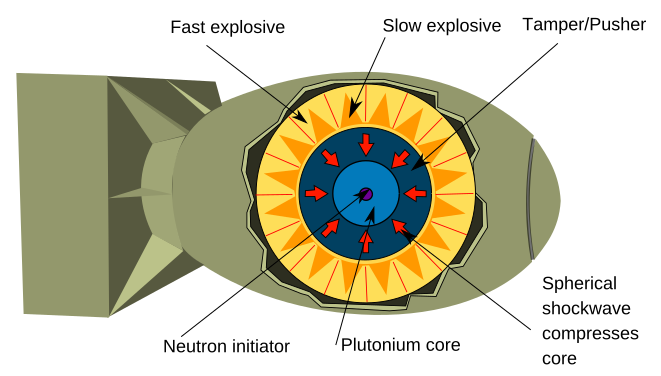
It's quite safe for it to sit inside this nuclear bomb, even though the fuel from a nuclear reactor is ultra dangerous and has to be cooled in a pool for a few decades until the little pellets are cool enough to be put into containers and buried deep in the earth.
The fuel that is used in nuclear bombs or power plants is not the same thing as the waste that has to be disposed of. The waste is significantly more dangerous.
The plutonium that's extracted for the bombs appears to become safe and can be stored inside the bomb, in silos, submarines and what not, with no effects to the people watching over them or the environment, unless someone angers it.
Once they decide to detonate one, they simply insert some cordite, or similar kind of ordinary explosive, which propels the plutonium bullet, into a disc like this below, except maybe a bit better machined set off the explosives, causing the plutonium core and neutron source to be suddenly under tremendous pressure..
Let me explain. Normally, neutron emission in these bombs is happening at a slow, steady pace. Since atoms are mostly empty space, it's likely that these neutrons won't collide with other nuclei. Even if they do collide, it's not likely to be a head on collision, so the full energy won't be transferred from the neutron to the nucleus.
When the bomb is detonated, however, the explosives compress the plutonium and the neutron source in the middle. This packs the plutonium atoms and neutron source tighter, because they're under very high pressure at this point. Now, a far higher percentage of neutrons will actually slam into nuclei in a head-on collision, breaking them apart. This releases a LOT of energy, and it also releases more neutrons. More neutrons means more collisions, which means more energy and more neutrons. That's the chain reaction that we talk about, and it's why nuclear weapons work.
Once this happens...anyone not wearing factor 10 billion will not have a very nice day and neither will the city you're in.
It's ok if the bullet just drops onto the disc, as that's not a problem. Even throwing the bullet full force at the disc, probably won't detonate the disc.
What?
What?
I said, detonate the disc.
What do you mean, what do I mean?
I mean, the bullet slams into the lead like disc and somehow it super fissions in a nano second, surely you can see how a disc like this can do that.
What do you mean the cordite explosives would blow up the bomb casing before these lead like metals had a chance to slam into each other?
Of course that won't happen.
Why?
Well, because it just won't and as you can see on any real nuclear bomb test videos , it works, so there.
The casing around the core (conventional explosives, plutonium, and neutron source) was very, very thick metal. It could withstand a lot of pressure. Also, it would only need to withstand the explosion long enough for the plutonium to go critical, which wouldn't take long, probably a few microseconds.
So remember. If you ever see something that looks like lead on your jaunts out, be careful it's not plutonium, don't just think it's lead - put on some marigolds before you pick it up and do not be throwing other pieces of lead at it to see if it detonates, as this is irresponsible. 
Radioactive isotopes needs to be concentrated before they can be used in bombs or power plants.
Hope that helps, let me know if you have any more questions.