Satellites and Temperatures ...

  • 54 Replies
  • 21737 Views
?

Thork

Satellites and Temperatures ...
« on: November 27, 2010, 02:03:26 PM »
Well I was having a little read about satellites (I enjoy Sci-fi), and like Star Wars allowing explosion noises, the story from NASA is ruined for me by inconsistencies. Today I would like to examine temperatures and the international space station.

We all remember the moon story, with the Saturn V Apollo vehicle coming back to earth. It was covered in heat shield tiles to compensate for the extreme heat on reentry. Apparently temperatures up to 2000 degrees centigrade. Wow. Hot. This is a combination of the friction of air and of course mostly down to the insane temperatures in the thermosphere. It is the same story with meteorites, apparently burning up on reentry even though they are made of rock!


Now we are told that satellites orbit earth in the vacuum of space in temperatures as low as 270 degrees C. About 3 degrees above absolute zero due to background radiation.

But here is where the story does not make sense. I want to consider the ISS (International Space Station). Its a super little hidey-hole above earth where Round Earth scientists can carry out all kinds of weird and wonderful experiments. Astronauts can even do space walks. But here in lies the problem.
NASA are quite adamant that the ISS orbits at
Quote
The station is maintained at an orbit between 278 km (173 mi) and 460 km (286 mi) altitude, and travels at an average speed of 27,743.8 km/h (17,239.2 mph), completing 15.7 orbits per day.
http://en.wikipedia.org/wiki/International_Space_Station

But consulting the temperatures of the atmosphere we find that
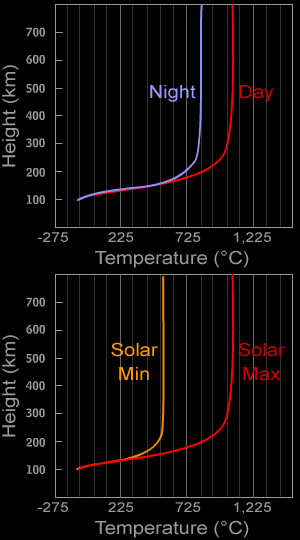
So even allowing for day/night differences the temperature at say 400Km above earth is between 800-1100 degrees centigrade at that altitude. And that's right. The ISS isn't in space, its actually floating through the thermosphere according to many sources. including NASA.
http://www.nasa.gov/worldbook/intspacestation_worldbook.html
Quote
The International Space Station orbits Earth at an altitude of about 250 miles (400 kilometers). The orbit extends from 52 degrees north latitude to 52 degrees south latitude.

So first off satellites aren't in space. They are in the upper atmosphere. Secondly they are being constantly subjected to 800+ degree temperatures (Static) whilst whistling around at 17,000 mph.

Remember those heat shields mentioned above on the Saturn to protect it from these temperatures. Now bearing in mind Aluminium melts at 659 degrees centigrade, and even iron at 1260 degrees centigrade, how plausible is this picture below?
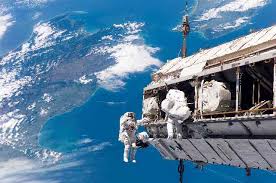


I am supposed to believe these men are travelling through the thermosphere at 17,000 mph in temperatures of over 800 degrees Centigrade in little space suits? Where Aluminium is a liquid. Gold is just about to melt. (1000 degrees).

And its not just the ISS.


Virtually all satellites are in this seriously hot region. In case anyone doubts the temperatures at these heights, here is another such example.
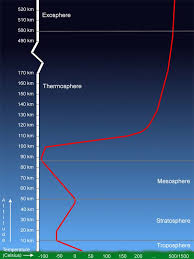
However NASA knowing this sounds ridiculous admit the ISS is in the thermosphere but claim these as the temperatures.
Quote
Without thermal controls, the temperature of the orbiting Space Station's Sun-facing side would soar to 250 degrees F (121 C), while thermometers on the dark side would plunge to minus 250 degrees F (-157 C). There might be a comfortable spot somewhere in the middle of the Station, but searching for it wouldn't be much fun!
http://science.nasa.gov/science-news/science-at-nasa/2001/ast21mar_1/
-157 to 121 degrees Centigrade? Where the hell did they get those numbers? It is permanently 500 degrees+ nearer 800 and sometimes over 1000 degrees.

Here is another site confirming the temperatures that every other source suggested.
http://www.windows2universe.org/earth/Atmosphere/thermosphere.html

It is just another example of NASA trying to make their silly space story seem plausible. So enough about satellites please Round Earthers. It really is just a work of fiction.
Quote
The thermosphere is a layer of Earth's atmosphere. The thermosphere is directly above the mesosphere and below the exosphere. It extends from about 90 km (56 miles) to between 500 and 1,000 km (311 to 621 miles) above our planet.

Temperatures climb sharply in the lower thermosphere (below 200 to 300 km altitude), then level off and hold fairly steady with increasing altitude above that height. Solar activity strongly influences temperature in the thermosphere. The thermosphere is typically about 200? C (360? F) hotter in the daytime than at night, and roughly 500? C (900? F) hotter when the Sun is very active than at other times. Temperatures in the upper thermosphere can range from about 500? C (932? F) to 2,000? C (3,632? F) or higher.

Also if satellites are not in space but still in the atmosphere, there is friction. So without propulsion how do they keep their speed up? We are told that they are in space so they don't need to be propelled, they just keep going in an orbit. But the atmosphere extends way above satellites. Why on earth is the world buying this story? Satellites don't exist!  >:(

*

markjo

  • Content Nazi
  • 45124
  • +90/-134
Re: Satellites and Temperatures ...
« Reply #1 on: November 27, 2010, 02:20:09 PM »
We all remember the moon story, with the Saturn V Apollo vehicle coming back to earth. It was covered in heat shield tiles to compensate for the extreme heat on reentry.

Apollo used ablative heat shields, not thermal tiles. 
Science is what happens when preconception meets verification.
Quote from: Robosteve
Besides, perhaps FET is a conspiracy too.
Quote from: bullhorn
It is just the way it is, you understanding it doesn't concern me.

?

Thork

Re: Satellites and Temperatures ...
« Reply #2 on: November 27, 2010, 02:21:10 PM »
We all remember the moon story, with the Saturn V Apollo vehicle coming back to earth. It was covered in heat shield tiles to compensate for the extreme heat on reentry.

Apollo used ablative heat shields, not thermal tiles. 
I don't think Apollo used either. :(

*

markjo

  • Content Nazi
  • 45124
  • +90/-134
Re: Satellites and Temperatures ...
« Reply #3 on: November 27, 2010, 02:32:39 PM »
We all remember the moon story, with the Saturn V Apollo vehicle coming back to earth. It was covered in heat shield tiles to compensate for the extreme heat on reentry.

Apollo used ablative heat shields, not thermal tiles. 
I don't think Apollo used either. :(

Quote from: http://www.bookrags.com/research/heat-shields-spsc-03/
The cone-shaped capsules of the early U.S. space program had heat shields attached to their base. These shields were designed to vaporize slowly duringre-entry. The materials used in the heat shield, as they vaporized, would carry excess heat away from the spacecraft and its crew. For example, the Mercury and Gemini capsules of the early 1960s were protected by heat shields made of silica-fiber resin, while the later Apollo capsules had shields made of phenolic epoxy resin, a form of plastic. Apollo heat shields were nearly 7 centimeters (2.7 inches) thick and weighed 1,360 kilograms (3,000 pounds).
Science is what happens when preconception meets verification.
Quote from: Robosteve
Besides, perhaps FET is a conspiracy too.
Quote from: bullhorn
It is just the way it is, you understanding it doesn't concern me.

?

klandri

  • 33
  • +0/-0
  • REB
Re: Satellites and Temperatures ...
« Reply #4 on: November 27, 2010, 02:33:59 PM »
There is friction, that is obvious, no one has ever tried to deny that. It is even counted on in some satellites which are timed to fall back to earth and burn to pieces after a pre-calculated amount of time. However keep in mind that the atmosphere is exceptionally thin at these heigths and therefore it is very little.
« Last Edit: November 27, 2010, 02:57:21 PM by klandri »
Isaac Newton anyone?

?

Thork

Re: Satellites and Temperatures ...
« Reply #5 on: November 27, 2010, 02:44:44 PM »
Yes, the main point of the argument that everyone seems to be delicately dancing around it the heat. As Klandri has alluded to there is also friction. At 17,000 mph that generates even more heat, that I didn't even bother to factor in. Also the "Space walkers" seem totally oblivious to the friction. Why are their chords not pulled tight? And how on earth are they withstanding the temperatures in the Thermosphere? In that picture, it is day. The temperatures are going to be closer to 1000 degrees centigrade not including friction. Rock melts there! And yet they whip out screw drivers that aren't glowing red and float about like they are in outer space. Its all just so mind-bendingly silly.

?

klandri

  • 33
  • +0/-0
  • REB
Re: Satellites and Temperatures ...
« Reply #6 on: November 27, 2010, 02:51:48 PM »
Ever seen a picture of an astronaut? If so you should notice their huge and incredibly bulky space suit. That is what protects them from the heat. In addition, at these heigths the friction is almost trivial, it is so little. Note that almost all the heat comes from infrared radiation. Satellites and space suits are white or shiny to make almost all of it bounce away. Try melting a mirror using a huge lens, or even comparing light and dark paper using a lens.
Isaac Newton anyone?

*

Tom Bishop

  • Flat Earth Believer
  • 18033
  • +6/-9
Re: Satellites and Temperatures ...
« Reply #7 on: November 27, 2010, 03:01:45 PM »
Ever seen a picture of an astronaut?

I have. They were bouncing up and down on the lunar surface with their visor up.
« Last Edit: November 27, 2010, 03:05:39 PM by Tom Bishop »

?

klandri

  • 33
  • +0/-0
  • REB
Re: Satellites and Temperatures ...
« Reply #8 on: November 27, 2010, 03:05:24 PM »
Ever seen a picture of an astronaut?

I have. They were bouncing up and down on the lunar surface with their visor up.

Link or some other proof/reference?
Isaac Newton anyone?

*

Tom Bishop

  • Flat Earth Believer
  • 18033
  • +6/-9
Re: Satellites and Temperatures ...
« Reply #9 on: November 27, 2010, 03:05:49 PM »
Ever seen a picture of an astronaut?

I have. They were bouncing up and down on the lunar surface with their visor up.

Link or some other proof/reference?

Here's one facing the sun with his visor up:


Another:

« Last Edit: November 27, 2010, 03:10:26 PM by Tom Bishop »

?

General Disarray

  • Official Member
  • 5032
  • +0/-0
  • Magic specialist
Re: Satellites and Temperatures ...
« Reply #10 on: November 27, 2010, 03:16:37 PM »
ITT: Thork takes yet another scientific principle, disregards a vital factor, says it doesn't make sense, and expects it all to prove somehing.
You don't want to make an enemy of me. I'm very powerful.

?

Thork

Re: Satellites and Temperatures ...
« Reply #11 on: November 27, 2010, 03:22:15 PM »
Ever seen a picture of an astronaut? If so you should notice their huge and incredibly bulky space suit. That is what protects them from the heat. In addition, at these heigths the friction is almost trivial, it is so little. Note that almost all the heat comes from infrared radiation. Satellites and space suits are white or shiny to make almost all of it bounce away. Try melting a mirror using a huge lens, or even comparing light and dark paper using a lens.
Those bulky space suits are able to handle 1000 degrees Centigrade? C'mon. And you forget they are travelling at 17,000 mph! Where are the flames?


And you are forgetting. NASA claim the temperatures are only up to 121 degrees centigrade. They know how silly this sounds. Yet at that altitude the thermosphere is close to 1000 degrees. And they are not in space! They are in the upper atmosphere. At 17,000 mph they are subject to the same conditions that vaporise meteors.

?

klandri

  • 33
  • +0/-0
  • REB
Re: Satellites and Temperatures ...
« Reply #12 on: November 27, 2010, 03:23:46 PM »
For Tom: The cooling system in the suit is sufficient to allow this for a few minutes. To use my earlier metaphor try burning paper with a magnifier glass (in a sunny summer day) in 4 seconds.

For Thork: They won't get to 1000°C because they are painted white. Meteors don't burn until they enter the mesosphere which only reaches to about 120km which is way below the ISS and all other satellites, at their height the friction is close to being irrelevant.
« Last Edit: November 27, 2010, 03:29:31 PM by klandri »
Isaac Newton anyone?

?

Thork

Re: Satellites and Temperatures ...
« Reply #13 on: November 27, 2010, 03:28:02 PM »
The cooling system in the suit is sufficient to allow this for a few minutes. To use my earlier metaphor try burning paper with a magnifier glass (in a sunny summer day) in 4 seconds.
They are wearing white suits with blue and red USA flag's on them. Not tin foil!. And space walks aren't a few minutes. The world record space walk was actually done on the ISS.
Quote
During the six-hour spacewalk, the cosmonauts will remove the Kontur scientific experiment, which studied remote object control capability for robotic arms, from the Zvezda service module
http://en.rian.ru/world/20101115/161350031.html

For Klandri:
They are in space for hours. Even the tools they use should get hot. So hot as to render them soft and useless. The space craft itsself has been up there for years. It will be at the ambient temperature. Every strut, solar panel, hinge, joint and panel will be as hot as the ambient air around it. It is not a vacuum. If it was, the thermosphere would not be hot. The air absorbs the radiation. That's what makes the thermosphere so hot. And that air touches every little part of the that craft and the space walkers. If the air can get that hot, and air isn't a great conductor, how hot are their tools, clothes, craft etc etc.
« Last Edit: November 27, 2010, 03:36:55 PM by Thork »

?

klandri

  • 33
  • +0/-0
  • REB
Re: Satellites and Temperatures ...
« Reply #14 on: November 27, 2010, 03:32:07 PM »
The cooling system in the suit is sufficient to allow this for a few minutes. To use my earlier metaphor try burning paper with a magnifier glass (in a sunny summer day) in 4 seconds.
They are wearing white suits with blue and red USA flag's on them. Not tin foil!. And space walks aren't a few minutes. The world record space walk was actually done on the ISS.
Quote
During the six-hour spacewalk, the cosmonauts will remove the Kontur scientific experiment, which studied remote object control capability for robotic arms, from the Zvezda service module
http://en.rian.ru/world/20101115/161350031.html

The visor up is only for a few minutes, that's what I meant. And in addition the difference between a perfectly white material and a reflecting one is only that the reflector bounces almost all the light regularly while the white one scatters it eliminating the picture/reflection.
Isaac Newton anyone?

?

wecl0me12

  • 142
  • +0/-0
Re: Satellites and Temperatures ...
« Reply #15 on: November 27, 2010, 03:33:03 PM »
From http://en.wikipedia.org/wiki/Thermosphere:

"Even though the temperature is so high, one would not feel warm in the thermosphere, because it is so near vacuum that there is not enough contact with the few atoms of gas to transfer much heat. "

That explains it.
round earther
Quote from:  topic#19384
Gravity as a force does not exist
Quote from: FAQ
Q: Why does g vary with altitude if the Earth simply accelerates up?

A: The celestial bodies have a slight gravitational pull.

?

klandri

  • 33
  • +0/-0
  • REB
Re: Satellites and Temperatures ...
« Reply #16 on: November 27, 2010, 03:34:19 PM »
For Tom: The cooling system in the suit is sufficient to allow this for a few minutes. To use my earlier metaphor try burning paper with a magnifier glass (in a sunny summer day) in 4 seconds.

For Thork: They won't get to 1000°C because they are painted white. Meteors don't burn until they enter the mesosphere which only reaches to about 120km which is way below the ISS and all other satellites, at their height the friction is close to being irrelevant. What welcome said is a better explanation of the same principle.
« Last Edit: November 27, 2010, 03:37:17 PM by klandri »
Isaac Newton anyone?

?

Thork

Re: Satellites and Temperatures ...
« Reply #17 on: November 27, 2010, 03:43:57 PM »
From http://en.wikipedia.org/wiki/Thermosphere:

"Even though the temperature is so high, one would not feel warm in the thermosphere, because it is so near vacuum that there is not enough contact with the few atoms of gas to transfer much heat. "

That explains it.
Who wrote that wiki? What a bunch of rubbish. If a thermometer says the temperature is 0 degrees, how do they arrive at a temperature of 1000 degrees, what are they measuring - those temps are static temps. Not dynamic ones. That is the ambient temperature. And what is more you are missing a vital part. If the sun's radiation can heat air molecules that high, it can heat a spacecraft that is the size of a 747. The radiation is intense enough to make air - a poor conductor that hot, but not metals?

PS - try heating some air with a magnifying glass on a hot day. Then see how powerful this radiation is.
« Last Edit: November 27, 2010, 03:46:02 PM by Thork »

?

Apollo1

  • 51
  • +0/-0
Re: Satellites and Temperatures ...
« Reply #18 on: November 27, 2010, 03:49:57 PM »
From http://en.wikipedia.org/wiki/Thermosphere:

"Even though the temperature is so high, one would not feel warm in the thermosphere, because it is so near vacuum that there is not enough contact with the few atoms of gas to transfer much heat. "

That explains it.
Who wrote that wiki? What a bunch of rubbish. If a thermometer says the temperature is 0 degrees, how do they arrive at a temperature of 1000 degrees, what are they measuring - those temps are static temps. Not dynamic ones. That is the ambient temperature. And what is more you are missing a vital part. If the sun's radiation can heat air molecules that high, it can heat a spacecraft that is the size of a 747. The radiation is intense enough to make air - a poor conductor that hot, but not metals?

PS - try heating some air with a magnifying glass on a hot day. Then see how powerful this radiation is.

Air temperature, however, is a measure of the kinetic energy of air molecules, not of the total energy stored by the air. Therefore, since the air is so thin within the thermosphere, such temperature values are not comparable to those of the troposphere or stratosphere. Although the measured temperature is very hot, the thermosphere would actually feel very cold to us because the total energy of only a few air molecules residing there would not be enough to transfer any appreciable heat to our skin.

http://www.ace.mmu.ac.uk/eae/atmosphere/older/Thermosphere.html

?

General Disarray

  • Official Member
  • 5032
  • +0/-0
  • Magic specialist
Re: Satellites and Temperatures ...
« Reply #19 on: November 27, 2010, 03:54:45 PM »
For reference, some of the factors being ignored here are the density of the atmosphere at that altitude, thermal conductivity, and in general how heat is transferred between objects.

Edit: Apollo beat me to it :)
« Last Edit: November 27, 2010, 03:56:31 PM by General Disarray »
You don't want to make an enemy of me. I'm very powerful.

?

Apollo1

  • 51
  • +0/-0
Re: Satellites and Temperatures ...
« Reply #20 on: November 27, 2010, 03:57:35 PM »
For reference, some of the factors being ignored here are the density of the atmosphere at that altitude, thermal conductivity, and in general how heat is transferred between objects.

how heat is transferred between objects being the most obvious, how he spent so much time putting together this info and then completely ignored this is amazing.   

?

General Disarray

  • Official Member
  • 5032
  • +0/-0
  • Magic specialist
Re: Satellites and Temperatures ...
« Reply #21 on: November 27, 2010, 03:59:42 PM »
For reference, some of the factors being ignored here are the density of the atmosphere at that altitude, thermal conductivity, and in general how heat is transferred between objects.

how heat is transferred between objects being the most obvious, how he spent so much time putting together this info and then completely ignored this is amazing.   

Lurk his other threads, thats pretty much all he does here. Now he will probably go into full denial mode.
You don't want to make an enemy of me. I'm very powerful.

?

Apollo1

  • 51
  • +0/-0
Re: Satellites and Temperatures ...
« Reply #22 on: November 27, 2010, 04:03:23 PM »
For reference, some of the factors being ignored here are the density of the atmosphere at that altitude, thermal conductivity, and in general how heat is transferred between objects.

how heat is transferred between objects being the most obvious, how he spent so much time putting together this info and then completely ignored this is amazing.   

Lurk his other threads, thats pretty much all he does here. Now he will probably go into full denial mode.

Why would one waste so much time like that? Surely he knows that the people reading the threads will easily see the enormous flaws?

?

General Disarray

  • Official Member
  • 5032
  • +0/-0
  • Magic specialist
Re: Satellites and Temperatures ...
« Reply #23 on: November 27, 2010, 04:08:55 PM »
He thinks he is teaching us science in his own way.
You don't want to make an enemy of me. I'm very powerful.

*

Ski

  • Planar Moderator
  • 8781
  • +1/-2
  • Homines, dum docent, dispenguin.
Re: Satellites and Temperatures ...
« Reply #24 on: November 27, 2010, 05:31:50 PM »
how heat is transferred between objects being the most obvious\

So heat isn't transferred in a vacuum?
"Never think you can turn over any old falsehood without a terrible squirming of the horrid little population that dwells under it." -O.W. Holmes "Truth forever on the scaffold, Wrong forever on the throne.."

?

General Disarray

  • Official Member
  • 5032
  • +0/-0
  • Magic specialist
Re: Satellites and Temperatures ...
« Reply #25 on: November 27, 2010, 05:43:53 PM »
how heat is transferred between objects being the most obvious\

So heat isn't transferred in a vacuum?

So you don't know how heat is transferred between objects?
You don't want to make an enemy of me. I'm very powerful.

*

Ski

  • Planar Moderator
  • 8781
  • +1/-2
  • Homines, dum docent, dispenguin.
Re: Satellites and Temperatures ...
« Reply #26 on: November 27, 2010, 05:56:59 PM »
No, I'm asserting that heat is transferred even in a vacuum. I'm not sure why you are asserting otherwise.
"Never think you can turn over any old falsehood without a terrible squirming of the horrid little population that dwells under it." -O.W. Holmes "Truth forever on the scaffold, Wrong forever on the throne.."

?

General Disarray

  • Official Member
  • 5032
  • +0/-0
  • Magic specialist
Re: Satellites and Temperatures ...
« Reply #27 on: November 27, 2010, 06:35:42 PM »
Who says I am asserting otherwise? I am asserting that the heat transferred by atmospheric particles is insignificant, not non-existent.

Quote from: http://en.wikipedia.org/wiki/Thermosphere
The highly diluted gas in this layer can reach 2,500 °C (4,530 °F) during the day. Even though the temperature is so high, one would not feel warm in the thermosphere, because it is so near vacuum that there is not enough contact with the few atoms of gas to transfer much heat. A normal thermometer would read significantly below 0 °C (32 °F), due to the energy lost by thermal radiation overtaking the energy acquired from the atmospheric gas by direct contact.
« Last Edit: November 27, 2010, 06:37:44 PM by General Disarray »
You don't want to make an enemy of me. I'm very powerful.

?

vhu9644

  • 1011
  • +0/-0
  • Round earth supporter
Re: Satellites and Temperatures ...
« Reply #28 on: November 28, 2010, 01:07:40 AM »
ok, why dont we do this thought experiment

we take a needle, and heat it to 1000 degrees centigrade, and do this with several thousand needles

then we take a white astronaut suit, protected and built for atmosperic conditions

i want you to touch the needle on the astronaut suit, then, take it off, and do this over and over again.

im pretty sure the little tip will not heat up the inside of the suit rapidly enough to kill the astronaut

this is like the air in thin athmosphere right? the needle tips representing contact points, (except the are a lot bigger, and a lot more compacted)  these suits are meant for these s conditions.  havent you seen the fingers in hot lead thing, the lead can be super hot, but if ou have something of low thermal conductivity like water vapor, you can survive in it

nasa has areogel and other stuff they can use to protect there astronauts, so they dont die

also check this website  http://members.tripod.com/atmosphere_guys/thermosphere.html
people i respect: Ski, Oracle, PizzaPlanet, Wendy

?

trig

  • 2240
  • +0/-0
Re: Satellites and Temperatures ...
« Reply #29 on: November 28, 2010, 12:48:30 PM »
Thork has spoken again as a true Flat Earther: if the data seems contradicting after a 15 second read, then it is proof of a flat Earth and of a Conspiracy.

Thermodynamics are a little more involved than just saying "1000 degrees? That is more than the melting point of aluminum!". There are a few ways to transfer energy: conduction, convection, radiation, mass transfer. There are a few ways to create thermal energy: chemical reactions, nuclear reactions. If you do not understand minimally each one of them you cannot even answer why immersion in air at 1 degree Celsius is just a little uncomfortable while water at 1 degree Celsius is fatal in minutes. Now, if you use your ignorance in an environment as strange to us as outer space you will most certainly come up with idiotic conclusions as those you reached.