Well I was having a little read about satellites (I enjoy Sci-fi), and like Star Wars allowing explosion noises, the story from NASA is ruined for me by inconsistencies. Today I would like to examine temperatures and the international space station.
We all remember the moon story, with the Saturn V Apollo vehicle coming back to earth. It was covered in heat shield tiles to compensate for the extreme heat on reentry. Apparently temperatures up to 2000 degrees centigrade. Wow. Hot. This is a combination of the friction of air and of course mostly down to the insane temperatures in the thermosphere. It is the same story with meteorites, apparently burning up on reentry even though they are made of rock!

Now we are told that satellites orbit earth in the vacuum of space in temperatures as low as 270 degrees C. About 3 degrees above absolute zero due to background radiation.
But here is where the story does not make sense. I want to consider the ISS (International Space Station). Its a super little hidey-hole above earth where Round Earth scientists can carry out all kinds of weird and wonderful experiments. Astronauts can even do space walks. But here in lies the problem.
NASA are quite adamant that the ISS orbits at
The station is maintained at an orbit between 278 km (173 mi) and 460 km (286 mi) altitude, and travels at an average speed of 27,743.8 km/h (17,239.2 mph), completing 15.7 orbits per day.
http://en.wikipedia.org/wiki/International_Space_StationBut consulting the temperatures of the atmosphere we find that
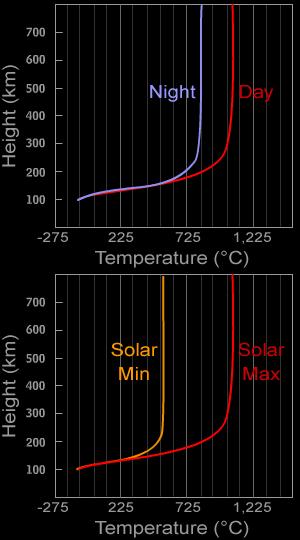
So even allowing for day/night differences the temperature at say 400Km above earth is between 800-1100 degrees centigrade at that altitude. And that's right. The ISS isn't in space, its actually floating through the thermosphere according to many sources. including NASA.
http://www.nasa.gov/worldbook/intspacestation_worldbook.htmlThe International Space Station orbits Earth at an altitude of about 250 miles (400 kilometers). The orbit extends from 52 degrees north latitude to 52 degrees south latitude.
So first off satellites aren't in space. They are in the upper atmosphere. Secondly they are being constantly subjected to 800+ degree temperatures (Static) whilst whistling around at 17,000 mph.
Remember those heat shields mentioned above on the Saturn to protect it from these temperatures. Now bearing in mind Aluminium melts at 659 degrees centigrade, and even iron at 1260 degrees centigrade, how plausible is this picture below?

I am supposed to believe these men are travelling through the thermosphere at 17,000 mph in temperatures of over 800 degrees Centigrade in little space suits? Where Aluminium is a liquid. Gold is just about to melt. (1000 degrees).
And its not just the ISS.

Virtually all satellites are in this seriously hot region. In case anyone doubts the temperatures at these heights, here is another such example.
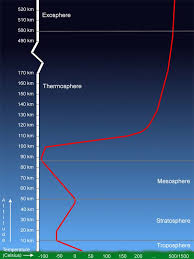
However NASA knowing this sounds ridiculous admit the ISS is in the thermosphere but claim these as the temperatures.
Without thermal controls, the temperature of the orbiting Space Station's Sun-facing side would soar to 250 degrees F (121 C), while thermometers on the dark side would plunge to minus 250 degrees F (-157 C). There might be a comfortable spot somewhere in the middle of the Station, but searching for it wouldn't be much fun!
http://science.nasa.gov/science-news/science-at-nasa/2001/ast21mar_1/-157 to 121 degrees Centigrade? Where the hell did they get those numbers? It is permanently 500 degrees+ nearer 800 and sometimes over 1000 degrees.
Here is another site confirming the temperatures that every other source suggested.
http://www.windows2universe.org/earth/Atmosphere/thermosphere.htmlIt is just another example of NASA trying to make their silly space story seem plausible. So enough about satellites please Round Earthers. It really is just a work of fiction.
The thermosphere is a layer of Earth's atmosphere. The thermosphere is directly above the mesosphere and below the exosphere. It extends from about 90 km (56 miles) to between 500 and 1,000 km (311 to 621 miles) above our planet.
Temperatures climb sharply in the lower thermosphere (below 200 to 300 km altitude), then level off and hold fairly steady with increasing altitude above that height. Solar activity strongly influences temperature in the thermosphere. The thermosphere is typically about 200? C (360? F) hotter in the daytime than at night, and roughly 500? C (900? F) hotter when the Sun is very active than at other times. Temperatures in the upper thermosphere can range from about 500? C (932? F) to 2,000? C (3,632? F) or higher.
Also if satellites are not in space but still in the atmosphere, there is friction. So without propulsion how do they keep their speed up? We are told that they are in space so they don't need to be propelled, they just keep going in an orbit. But the atmosphere extends way above satellites. Why on earth is the world buying this story? Satellites don't exist!
