The wheels can't "lock up" on scalloped roads.
And if you think that there's a problem with not turning, you're not thinking far enough out of the box.
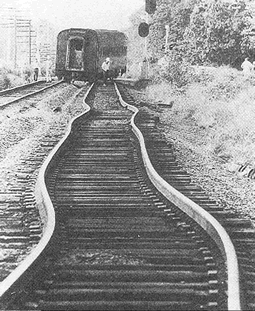
Our trains don't turn left or right, and they have significant problems screeching to a halt when a track is bent or when the constructor sees something on the tracks. Many lives have been lost from train catastrophes. If railroads were scalloped, or better yet sawtoothed, the constructor could stop at the drop of a hat. That's an instance where the shape of the tracks could have saved countless lives lost in train accidents.
As far as regular roads go, they could operate the same way as train networks do. Transformable roads, switches, and forks. If it were choreographed with enough engineering, there would probably be less annoying traffic in cities.(Try thinking about all of the things that cars need to do that trains don't and realize how, on a large scale, this would not work.)
You sure will stick to a bad idea to the end of time won't you.
d00gz is right on a number of points.
Examine your image:

Notice the two stress concentrators at the root of the gear and the root of the track. Yes CF reinforced polymers have incredible tensile strength, however, elongation at break is no where near steel. Brittle material plus stress riser = bad news. Next time a train goes by you watch how much the tracks deflect beneath the train. This same deflection will happen on an equivalent track cross section of CF. Also remember that CF reinforced polymers are incredibly weak between layers, so careful management is required.
CF resins would have no where near the wear characteristics of steel either, especially with sharp notches and points like that.
Also, the nice thing about round wheels and flat surfaces is that there is no upward component in a case where the wheels lock. The second that wheel locked the train would go airborne and derail. Not to mention the lack of vibration from that interface, and the lack of need to have the tracks timed cross rail between the tracks nor timed correctly between the wheel and track over thousands of miles.
Try sticking a rock in a gear train and watch how that monster fail pans out. What happens when something gets lodged in the track?
Our trains don't turn left or right, and they have significant problems screeching to a halt when a track is bent or when the constructor sees something on the tracks

Sure looks like they do. Good luck molding custom curved sections like above. Also research inertia and momentum.
A track built into the ground is static. It cannot bend.
Overall, monster fail on your part. Yeah it's out of the box, but like d00gz said, that in no way makes it better.