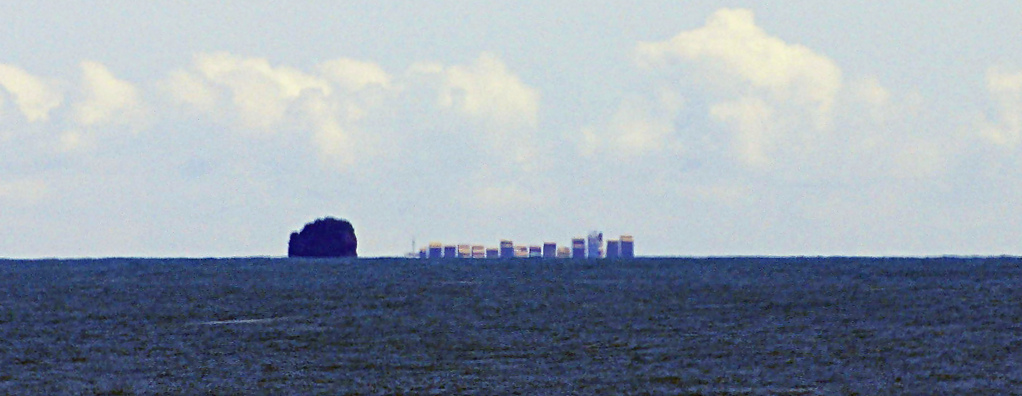
What about a telescope aimed at the horizon?

  • 615 Replies
  • 197327 Views
?

inquisitive

  • 5108
  • +0/-0
Re: What about a telescope aimed at the horizon?
« Reply #330 on: February 01, 2014, 11:49:09 AM »
We know the earth is round because of how broadcast tv and gps satellites work, they prove it.

We all know this, but I have to admit, seeing you attempt to derail every thread by bringing this up is a little irritating. The argument has lost any chance it might have had simply because you've made it acceptable to ignore it.
Yes, but that proves the earth is round, any other theories do not.

?

Novice

  • 91
  • +0/-0
Re: What about a telescope aimed at the horizon?
« Reply #331 on: February 01, 2014, 12:24:55 PM »

That is the thing.  The masts should reach the limit first as these parts of the ship are smaller than the hull.  The masts should become indistinguishable from the sky because they get to a point which they are smaller than the resolution our eyes can pick up.  Since the masts are smaller than the hull, this point should be reach before the hull.  Yet it is not.

Good point.

Most modern ships do not have masts, but a sizable structure and funnels on top of the hull. On a ship with masts, the masts will merge into one blob at distance and are usually highly contrasted against a washed-out sky. This may be the reason that masts can still be seen as masts after the hull has started 'disappearing'.

A telescope should bring the masts back into resolution as well as the hull.
"I should rather be right and stand alone than run with the multitude and be wrong." C. S. de Ford.

?

Novice

  • 91
  • +0/-0
Re: What about a telescope aimed at the horizon?
« Reply #332 on: February 01, 2014, 12:32:11 PM »

The horizon is a FLAT line.  So by saying it is over that line is saying the object is past your visibility.  The observer doesn't have to physically move forward to see past that line.  The lens brings the object closer to the observer.  That is what magnification is.  And when you magnify the object, it indeed DOES extend the horizon because it has brought it closer to you, making more distance visible.  What is there, is there, whether you can see it or not.  If you see a wall of water blocking something, it means there is something wrong with your settings on your visual aid or you need to point the dang thing at the object instead of the water.

Exactly.

We can go back to Rowbotham's experiments over a six-mile stretch of the Old Bedford canal in Cambridgeshire.

At a height above the water surface of 8 inches, where do the Earth-is-a-speck-hurtling-through-space people say that the 'horizon' is?

Simple question. Let's have a few answers.
"I should rather be right and stand alone than run with the multitude and be wrong." C. S. de Ford.

Re: What about a telescope aimed at the horizon?
« Reply #333 on: February 01, 2014, 12:55:30 PM »
The observer doesn't have to physically move forward to see past that line.

The laws of physics say the observer does have to move closer.  Think of looking over your neighbour's 1.5m fence from 30m distant and then from 1m away.  You'll see different stuff in his yard (closer to the fence).

Quote
The lens brings the object closer to the observer.

Nope.  It only enlarges the image of the object.  The object itself (obviously) stays where it is.  Think of your neighbour's fence again.  From 30m away, you won't be able to see his pooch sitting on the ground 2m from the base of the fence.  Nor will a telescope bring him into view.  Move up to the 1m distance though, and of course you'll see his pooch.

Hope this top-of-the-fence example helps with the horizon issue, as they're identical scenarios as far as the optical paths go.
That's because objects in the background of the fence move up visually as you get closer. The same thing happens with an optical device as it zooms.  The objects become less compressed.
« Last Edit: February 01, 2014, 01:06:01 PM by EarthIsASpaceship »

?

tappet

  • 2162
  • +0/-0
Re: What about a telescope aimed at the horizon?
« Reply #334 on: February 01, 2014, 01:11:17 PM »
So now with a half sunk ship being easy to see with the naked eye, a camera at 6ft zooming in a lighthouse from nothing and at no stage being half sunk should be impossible. Would you agree?
#ws" class="bbc_link" target="_blank" rel="noopener noreferrer">LightHouse Rosslare. Panasonic HC-V520 Zoom Test.
Both the ship and lighthouse in that video are not being zoomed in from nothing.  They're both visible at the very beginning, and at the midway point when the camera is again zoomed out completely.  Nothing is being restored, just enlarged.

Doing a google image search of "Stena Europe" will bring up images of that ship.  A little bit of the bottom appears to be cut off, but there also appears to be a bit of a mirage affecting things.

Anyway, the zoom is just enlarging what is already visible.
It is becoming obvious that you have never seen sinking ship effect .As Spank86 agreed sinking ship is easily and clearly seen with the naked eye. That may be the  only thing we agree on but I do believe he has seen sinking ship.

?

reofcourse

  • 131
  • +0/-0
Re: What about a telescope aimed at the horizon?
« Reply #335 on: February 01, 2014, 01:44:08 PM »
We can go back to Rowbotham's experiments over a six-mile stretch of the Old Bedford canal in Cambridgeshire.

Rowbotham is not interesting. It doesn't make a iota of difference what a guy two centuries ago thought about something when we can simply go out and see for ourselves. Simple facts do not depend on what somebody said. No matter what he speculated about the telescope restoring the view when you can grab a telescope and see for yourself that it doesn't.

?

Scintific Method

  • 1448
  • +0/-0
  • Trust, but verify.
Re: What about a telescope aimed at the horizon?
« Reply #336 on: February 01, 2014, 01:46:53 PM »
That's because objects in the background of the fence move up visually as you get closer. The same thing happens with an optical device as it zooms.  The objects become less compressed.

No, it doesn't. Please go and try this for yourself, so that you can see firsthand how wrong you are.


The horizon is a FLAT line.  So by saying it is over that line is saying the object is past your visibility.  The observer doesn't have to physically move forward to see past that line.  The lens brings the object closer to the observer.  That is what magnification is.  And when you magnify the object, it indeed DOES extend the horizon because it has brought it closer to you, making more distance visible.  What is there, is there, whether you can see it or not.  If you see a wall of water blocking something, it means there is something wrong with your settings on your visual aid or you need to point the dang thing at the object instead of the water.

Exactly.

We can go back to Rowbotham's experiments over a six-mile stretch of the Old Bedford canal in Cambridgeshire.

At a height above the water surface of 8 inches, where do the Earth-is-a-speck-hurtling-through-space people say that the 'horizon' is?

Simple question. Let's have a few answers.


This again...

At 8" above the water, Rowbotham's 'experiment' was almost certainly being affected by refraction caused by the temperature change that close to the surface of the water. Such refraction is a common occurrence so close to the surface of a body of water, and can cause light to follow the curvature exactly, making the earth appear flat, or even over-refract, causing the appearance of concavity. When this experiment was conducted properly, the following images were recorded and signed off as accurate by both FE and RE believers:


Please read the accompanying account to aid your understanding of what these images show: Wallace account of Bedford Level

To answer your question directly, however, in the absence of any refraction, the horizon from an elevation of 8" would be almost 1 mile away.
Quote from: jtelroy
...the FE'ers still found a way to deny it. Not with counter arguments. Not with proof of any kind. By simply denying it.

"Better to keep your mouth shut and be thought a fool, than to open it and remove all doubt."

?

Spank86

  • 578
  • +0/-0
Re: What about a telescope aimed at the horizon?
« Reply #337 on: February 01, 2014, 04:48:50 PM »
We have already agreed on this thread that the naked-eye observer has a different 'horizon' to that of a telescopically-enhanced observer at the same altitude.
no we havent.

Quite the opposite, in all the videos and pictures posted the horizon stays the same in relation to the objects near it. In none of them does t suddenly recede by more than the object is magnified.

?

Novice

  • 91
  • +0/-0
Re: What about a telescope aimed at the horizon?
« Reply #338 on: February 01, 2014, 05:05:14 PM »

Rowbotham is not interesting. It doesn't make a iota of difference what a guy two centuries ago thought about something when we can simply go out and see for ourselves. Simple facts do not depend on what somebody said. No matter what he speculated about the telescope restoring the view when you can grab a telescope and see for yourself that it doesn't.

This is the second awkward question that you have been unable to simply answer.

By your logic, we can disregard completely anything that Sir Isaac Newton said or did.
"I should rather be right and stand alone than run with the multitude and be wrong." C. S. de Ford.

?

Spank86

  • 578
  • +0/-0
Re: What about a telescope aimed at the horizon?
« Reply #339 on: February 01, 2014, 05:08:30 PM »

Rowbotham is not interesting. It doesn't make a iota of difference what a guy two centuries ago thought about something when we can simply go out and see for ourselves. Simple facts do not depend on what somebody said. No matter what he speculated about the telescope restoring the view when you can grab a telescope and see for yourself that it doesn't.

This is the second awkward question that you have been unable to simply answer.

By your logic, we can disregard completely anything that Sir Isaac Newton said or did.

you can ignore Newton... assuming you want to repeat his experiments that is.

Problem is you'll get the same answers. Feel free to posit an alternate explanation.

The difference is Newtons experiments DO yield the same results, Rowbothams do NOT (aside from a couple with obvious explanations for the discrepancies).

?

Novice

  • 91
  • +0/-0
Re: What about a telescope aimed at the horizon?
« Reply #340 on: February 01, 2014, 05:18:54 PM »

This again...

At 8" above the water, Rowbotham's 'experiment' was almost certainly being affected by refraction caused by the temperature change that close to the surface of the water. Such refraction is a common occurrence so close to the surface of a body of water, and can cause light to follow the curvature exactly, making the earth appear flat, or even over-refract, causing the appearance of concavity. When this experiment was conducted properly, the following images were recorded ...

To answer your question directly, however, in the absence of any refraction, the horizon from an elevation of 8" would be almost 1 mile away.

Thank you, at least you have answered the question, which others seem unwilling or unable to answer.

The diagram you posted was of another experiment that was conducted for a large wager between two men. The Rowbotham experiments I alluded to were where he watched a small barge recede fully six miles from him, over the horizon that you correctly state was about 1 mile from him.

So what he saw was due to refraction, in your opinion? Fair enough. He therefore saw fully five miles over the horizon, by whatever method.
"I should rather be right and stand alone than run with the multitude and be wrong." C. S. de Ford.

*

29silhouette

  • 3374
  • +0/-0
Re: What about a telescope aimed at the horizon?
« Reply #341 on: February 01, 2014, 05:19:12 PM »
Novice, Earthisaspaceship, I have a question for you given the following scenario.

Let's say you're about 200 meters from a structure.  There's a regular walk-through door that is open, and it's illuminated inside.

From 200 meters, you can only see a little bit of the inside, mainly a small section of the opposite wall, so you move up to 1 meter from the door, and now you can see much more of the interior.

Now if you're 200 meters away and have a telescope, and you zoom in so that the door takes up the entire eyepiece, are you (A) still seeing only that small section of the opposite wall because the images is merely enlarged, or are you (B) able to see the wider inside view such as when you were physically closer because the zoom is simulating being physically closer?

A or B?

A

A
Reason being that the glass lens magnifies the view.  It's like your eyes ARE physically there.  This is why the horizon is relative to what your eyes can see.

Are you two certain on "A", because the way you both are describing how magnification works, "B" would be the result.  I added the parts in italics to try and make sure it was clear.

?

Novice

  • 91
  • +0/-0
Re: What about a telescope aimed at the horizon?
« Reply #342 on: February 01, 2014, 05:22:04 PM »

Are you two certain on "A", because the way you both are describing how magnification works, "B" would be the result.  I added the parts in italics to try and make sure it was clear.

I just gave you my answer. I was not "describing how magnification works."
"I should rather be right and stand alone than run with the multitude and be wrong." C. S. de Ford.

*

29silhouette

  • 3374
  • +0/-0
Re: What about a telescope aimed at the horizon?
« Reply #343 on: February 01, 2014, 05:29:03 PM »
That's because objects in the background of the fence move up visually as you get closer. The same thing happens with an optical device as it zooms.  The objects become less compressed.
What about when I was viewing the hillside and bridge from a low elevation and they had apparently sunk toward the water line with the lower portion compressing? 

Would there have been a noticeable difference in compression between low power and high power zoom?

?

Scintific Method

  • 1448
  • +0/-0
  • Trust, but verify.
Re: What about a telescope aimed at the horizon?
« Reply #344 on: February 01, 2014, 05:49:15 PM »
The diagram you posted was of another experiment that was conducted for a large wager between two men.

...on the same stretch of water, at a height sufficient to avoid the refraction effects Rowbotham experienced, and with the outcome decided in favour of RE, by agreement of both the FE and RE referees.

So what he saw was due to refraction, in your opinion? Fair enough. He therefore saw fully five miles over the horizon, by whatever method.

Yes, it is possible to see many miles beyond the physical horizon under favourably refractive atmospheric conditions. This phenomenon is not unusual, and is quite well understood, to the point of being somewhat predictable (as I understand it, at least). The understanding of this phenomenon is also what led to the experiment I posted diagrams from being conducted much higher above the water, to minimise the influence of refraction on the results.
Quote from: jtelroy
...the FE'ers still found a way to deny it. Not with counter arguments. Not with proof of any kind. By simply denying it.

"Better to keep your mouth shut and be thought a fool, than to open it and remove all doubt."

*

29silhouette

  • 3374
  • +0/-0
Re: What about a telescope aimed at the horizon?
« Reply #345 on: February 01, 2014, 05:57:22 PM »
It is becoming obvious that you have never seen sinking ship effect .As Spank86 agreed sinking ship is easily and clearly seen with the naked eye. That may be the  only thing we agree on but I do believe he has seen sinking ship.
Oh but I have.  Several smaller craft over the last couple years.  A bridge, hillside, and structures due to elevation change.  Took pictures of the boats, hill, etc.  Posted them too.  Saw a major sea-level city half sunk below the horizon from 60 miles away and 2500ft elevation. 

Haven't had the opportunity to watch a major ship head to sea in a long time, but I'll catch that too sooner or later.

You on the other hand, claim to see this all the time, and that magnification isn't needed when someone posts a picture taken with some amount of magnification.  When do we get to see your 1x zoom photos of this?   You do see this all the time right?

?

Novice

  • 91
  • +0/-0
Re: What about a telescope aimed at the horizon?
« Reply #346 on: February 01, 2014, 05:58:09 PM »

Yes, it is possible to see many miles beyond the physical horizon under favourably refractive atmospheric conditions. This phenomenon is not unusual, and is quite well understood, ...

So could he have continued to view the boat, say, 20 miles past the horizon, in your opinion, if the straight part of the canal had been that long?

At what point would the boat have been out of sight because of the horizon 1 mile away?

"I should rather be right and stand alone than run with the multitude and be wrong." C. S. de Ford.

?

tappet

  • 2162
  • +0/-0
Re: What about a telescope aimed at the horizon?
« Reply #347 on: February 01, 2014, 06:12:52 PM »
It is becoming obvious that you have never seen sinking ship effect .As Spank86 agreed sinking ship is easily and clearly seen with the naked eye. That may be the  only thing we agree on but I do believe he has seen sinking ship.
Oh but I have.  Several smaller craft over the last couple years.  A bridge, hillside, and structures due to elevation change.  Took pictures of the boats, hill, etc.  Posted them too.  Saw a major sea-level city half sunk below the horizon from 60 miles away and 2500ft elevation. 

Haven't had the opportunity to watch a major ship head to sea in a long time, but I'll catch that too sooner or later.

You on the other hand, claim to see this all the time, and that magnification isn't needed when someone posts a picture taken with some amount of magnification.  When do we get to see your 1x zoom photos of this?   You do see this all the time right?
What you have posted is not sinking ship.
I have posted a picture of sinking ship before, not done by me though.
Why don't you just ask someone who has seen sinking ship if it matches the picture I put up. That way I don't have to waste my time getting a camera to take pictures for you to tell me they are not suitable.
Ask Spank86 what sinking ship looks like with the naked eye.

?

Scintific Method

  • 1448
  • +0/-0
  • Trust, but verify.
Re: What about a telescope aimed at the horizon?
« Reply #348 on: February 01, 2014, 06:50:21 PM »

Yes, it is possible to see many miles beyond the physical horizon under favourably refractive atmospheric conditions. This phenomenon is not unusual, and is quite well understood, ...

So could he have continued to view the boat, say, 20 miles past the horizon, in your opinion, if the straight part of the canal had been that long?

Hypothetically, as long as the conditions favoured a suitable amount of refraction, the boat would remain visible until some other atmospheric condition (haze, fog, dust, etc) rendered it invisible. This is assuming a sufficiently powerful 'scope and, as indicated, perfect refractive conditions. On a crystal clear day, 20 miles should be no problem.

At what point would the boat have been out of sight because of the horizon 1 mile away?

How tall was the boat? In the absence of refraction, the boat would begin to progressively disappear from the bottom up as soon as it passed beyond 1 mile (this phenomenon being commonly referred to as the 'sinking ship effect'). Depending on how tall it was above the water line, it would be completely concealed at some distance much further than 1 mile.
Quote from: jtelroy
...the FE'ers still found a way to deny it. Not with counter arguments. Not with proof of any kind. By simply denying it.

"Better to keep your mouth shut and be thought a fool, than to open it and remove all doubt."

*

Ski

  • Planar Moderator
  • 8781
  • +1/-2
  • Homines, dum docent, dispenguin.
Re: What about a telescope aimed at the horizon?
« Reply #349 on: February 01, 2014, 07:32:23 PM »
That's because objects in the background of the fence move up visually as you get closer. The same thing happens with an optical device as it zooms.  The objects become less compressed.
What about when I was viewing the hillside and bridge from a low elevation and they had apparently sunk toward the water line with the lower portion compressing? 

This compression is described precisely in ENaG. I, for one, love your pictures, even if we disagree about what is occurring or demonstrated in the photos.
"Never think you can turn over any old falsehood without a terrible squirming of the horrid little population that dwells under it." -O.W. Holmes "Truth forever on the scaffold, Wrong forever on the throne.."

*

29silhouette

  • 3374
  • +0/-0
Re: What about a telescope aimed at the horizon?
« Reply #350 on: February 01, 2014, 07:46:01 PM »

What you have posted is not sinking ship.
I have posted a picture of sinking ship before, not done by me though.
Why don't you just ask someone who has seen sinking ship if it matches the picture I put up. That way I don't have to waste my time getting a camera to take pictures for you to tell me they are not suitable.
Ask Spank86 what sinking ship looks like with the naked eye.
I posted a tug and barge that were 'sinking' as they traveled away.  You wanted glassy seas, well guess what.  The water acts basically like a mirror if it's perfectly calm.

I don't know what picture you put up.  I did a quick scroll through your posts and all I saw were videos, so I'm guessing it was a large ship 'sinking' on the horizon, similar to what I've seen, or other examples of a ship sinking on the horizon as seen with the naked eye, binoculars, telescope, whichever.

The same sinking ship effect one sees with the naked eye, just looks bigger and shows up much better on a computer screen with magnification, and it's not going to 'un-sink' with more magnification (which you seem to agree with, unless you've changed your views on it).

*

29silhouette

  • 3374
  • +0/-0
Re: What about a telescope aimed at the horizon?
« Reply #351 on: February 01, 2014, 07:55:18 PM »
This compression is described precisely in ENaG. I, for one, love your pictures, even if we disagree about what is occurring or demonstrated in the photos.
Thank you.  As I recall, there was an issue I had with the description in ENaG, which I brought up, but I don't think it was ever answered.  That was quite a while ago.  I'll have to go back through my post history to read up on it again.

I'm just curious to clarify whether 'Earthis' thinks that the 'compression' would 'uncompress' with increased magnification.

?

tappet

  • 2162
  • +0/-0
Re: What about a telescope aimed at the horizon?
« Reply #352 on: February 01, 2014, 08:44:40 PM »

What you have posted is not sinking ship.
I have posted a picture of sinking ship before, not done by me though.
Why don't you just ask someone who has seen sinking ship if it matches the picture I put up. That way I don't have to waste my time getting a camera to take pictures for you to tell me they are not suitable.
Ask Spank86 what sinking ship looks like with the naked eye.
I posted a tug and barge that were 'sinking' as they traveled away.  You wanted glassy seas, well guess what.  The water acts basically like a mirror if it's perfectly calm.

I don't know what picture you put up.  I did a quick scroll through your posts and all I saw were videos, so I'm guessing it was a large ship 'sinking' on the horizon, similar to what I've seen, or other examples of a ship sinking on the horizon as seen with the naked eye, binoculars, telescope, whichever.

The same sinking ship effect one sees with the naked eye, just looks bigger and shows up much better on a computer screen with magnification, and it's not going to 'un-sink' with more magnification (which you seem to agree with, unless you've changed your views on it).
When you see sinking ship with the naked eye it will look like this
http://upload.wikimedia.org/wikipedia/commons/e/e4/Aground_Tauranga_Pukehina_5_Oct_11_4.jpg
Yes you are correct I do agree the ship will not unsink with magnification. The issue I have is the distance from the shore that ships sink varies depending on conditions, wind , swell etc...
This I think is where you are not understanding me.
I am saying some times ships sink closer to the shore, some times ships sink further from the shore depending on the factors causing the effect.
I do not know diddly squat about camera's or photography but I have just purchased this
http://www.ebay.com.au/itm/360831732682?ssPageName=STRK:MEWNX:IT&_trksid=p3984.m1439.l2649
At the very least I might be able show you what I see as  sinking ship with zero zoom.

?

Scintific Method

  • 1448
  • +0/-0
  • Trust, but verify.
Re: What about a telescope aimed at the horizon?
« Reply #353 on: February 01, 2014, 09:47:06 PM »


I thought this might be the image to which you were referring tappet. You may recall that last time you posted it, I commented that, in my opinion at least, this shows an effect only possible on a round earth. Allow me to clarify: in this image, we see a well-defined horizon, with equally well-defined objects clearly appearing beyond said horizon (note: I say 'well-defined', not 'crisp', meaning that, while they are a little fuzzy, they are still easy to tell apart). On a flat earth, in the absence of any thus-far unknown properties of light, this image would be impossible. Why? Simple geometry: nothing on a flat earth could ever appear to be beyond the horizon, as the horizon would either be the limit of vision (in which case, anything beyond that distance is not visible), or the edge of the earth (in which case, there is nothing beyond that point other than empty space).

EarthIsASpaceship and Novice, I would be interested to see you prove that the distant objects seen here can be brought back from 'over the horizon' with magnification only. That is your assertion, is it not?
Quote from: jtelroy
...the FE'ers still found a way to deny it. Not with counter arguments. Not with proof of any kind. By simply denying it.

"Better to keep your mouth shut and be thought a fool, than to open it and remove all doubt."

?

reofcourse

  • 131
  • +0/-0
Re: What about a telescope aimed at the horizon?
« Reply #354 on: February 02, 2014, 01:56:32 AM »
This is the second awkward question that you have been unable to simply answer.

By your logic, we can disregard completely anything that Sir Isaac Newton said or did.

I simply can't see your point. I said it wasn't important to base your ideas on merely citing somebody because you can do the experiments yourself. Which of the Newtonian experiments you can't do yourself? As a child or student, in school, people normally repeat them. We don't disregard Newton because what he found was still valid today and you can substantiate it every single day again and again. We wouldn't disregard Rowbotham either, if his experiments and findings were of any repeatable experimental value. But as it happens, it can be disproved very easily, you only have to try.

As to the first one, I fail to remember what that was.
« Last Edit: February 02, 2014, 02:19:09 AM by reofcourse »

?

reofcourse

  • 131
  • +0/-0
Re: What about a telescope aimed at the horizon?
« Reply #355 on: February 02, 2014, 02:01:18 AM »
At what point would the boat have been out of sight because of the horizon 1 mile away?

If you want to make an experiment like that, with such a low altitude over the ground, then do it on land, not on water. It's more complicated to find such a flat area on land, of course, but that's the only way to do it reliably.

*

ausGeoff

  • 6091
  • +0/-0
Re: What about a telescope aimed at the horizon?
« Reply #356 on: February 02, 2014, 05:21:41 AM »

That's because objects in the background of the fence move up visually as you get closer. The same thing happens with an optical device as it zooms.  The objects become less compressed.


Of course they move up visually.  That's simply because you're moving closer to the fence, and at a distance of only 1m you can see over it.  At 30m distance, obviously you can't see over the fence, nor can you see the pooch.

It has nothing at all to do with any "optical devices" and relies solely on your varying line of site as you approach the fence.

*

JimmyTheCrab

  • 10340
  • +0/-5
Re: What about a telescope aimed at the horizon?
« Reply #357 on: February 02, 2014, 05:51:17 AM »
By your logic, we can disregard completely anything that Sir Isaac Newton said or did.
Scientific theories stand the test of time if they are useful.  Engineers use Newtonian physics to design cars, bridges, skyscrapers and a million other things every single day. They work; if they didn't people would disregard them.

On the other hand, we have Rowbotham - a 19th snake oil salesman who invented his own rules of perspective in an attempt to shoehorn reality into his own dogmatic worldview (or maybe he didn't really believe it, but the publicity helped with snake oil sales).  All we have from him is a series of shonky experiments whose result seemed dependent on who was carrying them out.  Inconclusive would be the kindest way to describe them.

Literally no surveyors or engineers use Rowbotham's made up crap because it doesn't work.
Quote from: mikeman7918
a single photon can pass through two sluts

Quote from: Chicken Fried Clucker
if Donald Trump stuck his penis in me after trying on clothes I would have that date and time burned in my head.

*

hoppy

  • Flat Earth Believer
  • 11852
  • +10/-5
Re: What about a telescope aimed at the horizon?
« Reply #358 on: February 02, 2014, 06:00:42 AM »
Tappett, that looks like a cool camera. The weather is finally nice in Maryland again. I might be able to get some shots today.
God is real.                                         
http://www.scribd.com/doc/9665708/Flat-Earth-Bible-02-of-10-The-Flat-Earth

*

ausGeoff

  • 6091
  • +0/-0
Re: What about a telescope aimed at the horizon?
« Reply #359 on: February 02, 2014, 07:15:38 AM »

By your logic, we can disregard completely anything that Sir Isaac Newton said or did.

This is a ludicrous response!  Are you serious?

ALL of Newton's laws of physics are easily replicable by any high school kid.  Did you not study science at school?

Not one of Rowbotham's bogus "experiments" can be replicated today—well, not honestly anyway, LOL.