Rowbotham's Perspective

  • 41 Replies
  • 13635 Views
?

Alex Tomasovich

  • 1030
  • +0/-0
Rowbotham's Perspective
« on: August 14, 2013, 11:30:07 AM »
The following is a summary of Rowbotham's perspective, using only quotes and logic. This should probably go in Information Repository, but I'm guessing a few FEers will get their panties in a twist and either debate this or ignore it. Mods, feel free to move at your pleasure.

Rowbotham's Perspective
Chapter 14 of Zetetic Astronomy

Quote from: Samuel Rowbotham, Zetetic Astronomy p. 203
"The smallest angle under which an object can be seen is upon an average, for different sights, the sixtieth part of a degree, or one minute in space; so that when an object is removed from the eye 3000 times its own diameter, it will only just be distinguishable; consequently the greatest distance at which we can behold an object like a shilling of an inch in diameter, is 3000 inches or 250 feet."
-- "Wonders of Science," by Mayhew, p. 357

The above may be called the law of perspective. It may be given in more formal language, as the following:. when any object or any part thereof is so far removed that its greatest diameter subtends at the eye of the observer, an angle of one minute or less of a degree, it is no longer visible.

From the above it follows:--

1.--That the larger the object the further will it require to go from the observer before it becomes invisible.

2.--The further any two bodies, or any two parts of the same body, are asunder, the further must they recede before they appear to converge to the same point.

3.--Any distinctive part of a receding body will be-come invisible before the whole or any larger part of the same body.
Quote from: Samuel Rowbotham, Zetetic Astronomy p. 204
if a similar disc is coloured black, except a segment of say one inch in depth at the lower edge, on moving it forward the lower segment will gradually disappear, as shown at A, B, and C, in diagram fig. 74. If the
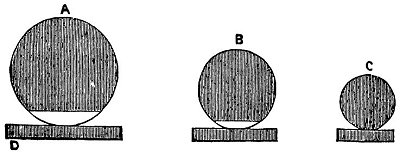

Fig. 74.

disc is allowed to rest on a board D, the effect is still more striking. The disc at C will appear perfectly round--the white segment having disappeared.
From these we can formulate the following rules for perspective:
  • Any object, or portion of an object, less than 1 arcminute in size will be indiscernible to the naked human eye. This will happen when its distance to size ratio is roughly 3000:1 (actual number is just shy of 3438:1)
  • A portion of a smaller object will vanish before the object as a whole vanishes.
  • If a portion of an object reaches this distance, but the object as a whole has not, the portion will disappear but leave the object as a whole unchanged.

(Rowbotham's list is slightly different--His first and second are similar to the point of being the same, so I have combined them (and added the metric he quoted). I moved his third into slot 2 and added a third of my own, stated by Rowbotham in his disk experiment.)

Rowbotham illustrates this with the following diagram. On the left are three objects, two of identical size with one above and one below eye-level, and a third
larger object above the eye-line. The two identical objects both will vanish at point H, as that's where they reach a size of less than 1 arcminute, but the larger one would still be visible and not vanish until it's gone on to W.

Quote from: Samuel Rowbotham, Zetetic Astronomy p. 207
The theory which affirms that all parallel lines converge to one and the same point on the eye-line, is an error. It is true only of lines equi-distant from the eye-line; lines more or less apart meet the eye-line at different distances, and the point at which they meet is that only where each forms the angle of one minute of a degree, or such other angular measure as may be decided upon as the vanishing point. This is the true law of perspective as shown by nature herself; any idea to the contrary is fallacious, and will deceive whoever may hold and apply it to practice.

In accordance with the above law of natural perspective, the following illustrations are important as representing actually observed phenomena. In a long row of lamps, standing on horizontal ground, the pedestals, if short, gradually diminish until at a distance of a few hundred yards they seem to disappear, and the upper and thinner parts of the lamp posts appear to touch the ground, as shown in the following diagram, fig. 77.
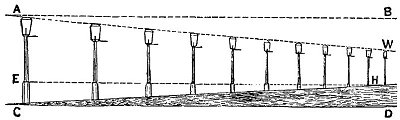

Fig. 77.
This is another way of saying the First Law of Perspective, that being that the distance at which an object will reach this is related to its size, specifically a ratio of roughly 3000:1. The diagram also agrees with the Third Law, that being that even though the lower portion of the lamp has vanished, the rest of the lamp still recedes until it's full distance is 3000 times its full length.

However, the diagram also breaks the First Law. The upper bulb of the lamp, in the diagram, is about the same height as the base pedestals. Thus, the upper bulb, having roughly the same size, should vanish at roughly the same point--that is, point H in the diagram.

Rowbotham further demonstrates these laws with a woman on a street, a train engine, a series of flags on a canal, and a lighthouse on a wall. All of these demonstrate more of the same thing, so I shall skip them and move onto the final part of the chapter: a vanishing ship.


Quote from: Samuel Rowbotham, Zetetic Astronomy p. 211
The hull is a distinctive part of a ship.

Ergo, the hull of a receding or outward bound ship must disappear before the whole, inclusive of the mast head.

To give the argument a more practical and nautical character it may be stated as follows:

That part of any receding body which is nearest to the surface upon which it moves, contracts, and becomes in-visible before the parts which are further away from such surface--as shown in figs. 63, 64, 65, 66, 67, 68, 69, and 70.

The hull of a ship is nearer to the water--the surface on which it moves--than the mast head.

Ergo, the hull of an outward bound ship must be the first to disappear.
Quote from: Samuel Rowbotham, Zetetic Astronomy p. 212
Those who believe that the earth is a globe have often sought to prove it to be so by quoting the fact that when the ship's hull has disappeared, if an observer ascends to a higher position the hull again becomes visible. But this, is logically premature; such a result arises simply from the fact that on raising his position the eye-line recedes further over the water before it forms the angle of one minute of a degree, and this includes and brings back the hull within the vanishing point
I feel the need to point out to Rowbotham the First Rule of Perspective: "Any object, or portion of an object, less than 1 arcminute in size will be indiscernible to the naked human eye. This will happen when its distance to size ratio is roughly 3000:1." Or, as Rowbotham himself puts it "That the larger the object the further will it require to go from the observer before it becomes invisible."

Rowbotham has suddenly switched from the vanishing point being determined by the size of the object to it being determined by the object's height above the horizon. According to this theory, a kite 6 inches across, if flown 2000 feet away at an altitude of 350 feet above the ground would remain visible even though its angular size is only .85 arcminutes--well below the vanishing size.

Hence his assumption that the size of an object is equal to its distance above eye-level is completely false, and the First Rule of Perspective, as stated by Rowbotham himself, is correct--that the vanishing point is determined by the size of the object.

And that concludes the chapter. Just to iterate, the Three Laws of Perspective, as proposed by Rowbotham, are:

  • Any object, or portion of an object, less than 1 arcminute in size will be indiscernible to the naked human eye. This will happen when its distance to size ratio is roughly 3000:1 (actual number is just shy of 3438:1)
  • A portion of a smaller object will vanish before the object as a whole vanishes.
  • If a portion of an object reaches this distance, but the object as a whole has not, the portion will disappear but leave the object as a whole unchanged.

*

markjo

  • Content Nazi
  • 45084
  • +87/-113
Re: Rowbotham's Perspective
« Reply #1 on: August 14, 2013, 07:53:33 PM »
Hence his assumption that the size of an object is equal to its distance above eye-level is completely false, and the First Rule of Perspective, as stated by Rowbotham himself, is correct--that the vanishing point is determined by the size of the object.
Actually, Rowbotham is confusing vanishing point with angular resolution.  They are completely different concepts.  Just because an object is too small to see does not mean that it is at the vanishing point.
Science is what happens when preconception meets verification.
Quote from: Robosteve
Besides, perhaps FET is a conspiracy too.
Quote from: bullhorn
It is just the way it is, you understanding it doesn't concern me.

*

Ski

  • Planar Moderator
  • 8781
  • +1/-2
  • Homines, dum docent, dispenguin.
Re: Rowbotham's Perspective
« Reply #2 on: August 14, 2013, 11:07:29 PM »
I don't think you're comprehending the material at hand, and it is leading you to many false assumptions. Particularly as it relates to objects distant (or near) the eye-line. It is too late to give you an answer with more substance.


And he isn't confusing the vanishing point with angular resolution. He simply states that an object of sufficiently small angular resolution will be come indiscernible, which no sane person disagrees with. I expect better of you, Markjo, though heaven knows why after all this time. You are both bastardizing the text and then bashing the straw men.

More on the morrow.
"Never think you can turn over any old falsehood without a terrible squirming of the horrid little population that dwells under it." -O.W. Holmes "Truth forever on the scaffold, Wrong forever on the throne.."

?

Scintific Method

  • 1448
  • +0/-0
  • Trust, but verify.
Re: Rowbotham's Perspective
« Reply #3 on: August 15, 2013, 02:32:46 AM »
This image:

got me thinking. Rowbotham's assertion is that classical perspective is wrong, because all things do not vanish at the same point. Well, as far as things becoming impossible to see with the naked eye, he's right. A tennis ball will 'vanish' well before a basket ball. However, this does not mean that classical perspective is wrong. Take a look at the following image:

The red arrow marks the classical 'vanishing point' for the lamp. When doing an illustration with realistic perspective, this is the point used as a reference. Note, it is not the point at which all objects become impossible to see. To follow on from Alex's point, the top and bottom portions of the lamp would become too small to see when they reached the yellow arrows, and the pole itself would become too small to see at the purple arrow (only in vertical terms, the pole being thinner than either the base or top would actually become indiscernible much sooner). As you should be able to see, these features become impossible to see when their visual size reaches ~1 minute of angle (which, for the purposes of this illustration, is when there is no white space left between the lines drawn from them to the reference point), well before the reference point (known in perspective drawing as the 'vanishing point').

One other thing I found while reading through this chapter was this statement:
Quote
The theory which affirms that all parallel lines converge to one and the same point on the eye-line, is an error. It is true only of lines equi-distant from the eye-line; lines more or less apart meet the eye-line at different distances...
The part I highlighted is demonstrably false (if you don't believe me, best go test it yourself), and being that it is the basis for the entire chapter, that pretty much leaves the whole thing without any kind of credibility.

Okay, sorry for rambling, but hopefully that clarifies the errors made by Rowbotham in this chapter.
Quote from: jtelroy
...the FE'ers still found a way to deny it. Not with counter arguments. Not with proof of any kind. By simply denying it.

"Better to keep your mouth shut and be thought a fool, than to open it and remove all doubt."

?

Alex Tomasovich

  • 1030
  • +0/-0
Re: Rowbotham's Perspective
« Reply #4 on: August 16, 2013, 09:15:19 AM »
I don't think you're comprehending the material at hand, and it is leading you to many false assumptions. Particularly as it relates to objects distant (or near) the eye-line. It is too late to give you an answer with more substance.


And he isn't confusing the vanishing point with angular resolution. He simply states that an object of sufficiently small angular resolution will be come indiscernible, which no sane person disagrees with. I expect better of you, Markjo, though heaven knows why after all this time. You are both bastardizing the text and then bashing the straw men.

More on the morrow.

Please inform me what I'm missing, then. Or does 'more on the morrow' mean something else?

*

Ski

  • Planar Moderator
  • 8781
  • +1/-2
  • Homines, dum docent, dispenguin.
Re: Rowbotham's Perspective
« Reply #5 on: August 16, 2013, 03:35:21 PM »
Quote from: Zetetic Astronomy
The theory which affirms that all parallel lines converge to one and the same point on the eye-line, is an error. It is true only of lines equi-distant from the eye-line; lines more or less apart meet the eye-line at different distances

This is the part which you are perpetually ignoring.
"Never think you can turn over any old falsehood without a terrible squirming of the horrid little population that dwells under it." -O.W. Holmes "Truth forever on the scaffold, Wrong forever on the throne.."

?

Alex Tomasovich

  • 1030
  • +0/-0
Re: Rowbotham's Perspective
« Reply #6 on: August 16, 2013, 03:46:41 PM »
Quote from: Zetetic Astronomy
The theory which affirms that all parallel lines converge to one and the same point on the eye-line, is an error. It is true only of lines equi-distant from the eye-line; lines more or less apart meet the eye-line at different distances

This is the part which you are perpetually ignoring.

I'm not ignoring it. I'm saying that has nothing to do with objects disappearing at certain distances. A 5-inch kite 500 feet above the ground will disappear at a much closer distance than a 50-foot building sitting on the ground. True, the kite will converge with the horizon at a much farther distance, but it'll vanish long before then.

You seem to be ignoring that an object 5' above your eyeline 50' away will appear the same height as an object 1' above your eyeline and 10' away (assuming both objects are visible, of course).

*

Ski

  • Planar Moderator
  • 8781
  • +1/-2
  • Homines, dum docent, dispenguin.
Re: Rowbotham's Perspective
« Reply #7 on: August 16, 2013, 03:52:55 PM »
What does that have to do with what I posted?   :-\
"Never think you can turn over any old falsehood without a terrible squirming of the horrid little population that dwells under it." -O.W. Holmes "Truth forever on the scaffold, Wrong forever on the throne.."

?

Alex Tomasovich

  • 1030
  • +0/-0
Re: Rowbotham's Perspective
« Reply #8 on: August 16, 2013, 03:58:09 PM »
What does that have to do with what I posted?   :-\
Do I really need to walk you though this? I couldn't make it more clear than the post I used to reply to your comment. You said I'm ignoring something, and I said that that particular part has nothing to do with objects vanishing due to the First Law of Perspective.

*

Ski

  • Planar Moderator
  • 8781
  • +1/-2
  • Homines, dum docent, dispenguin.
Re: Rowbotham's Perspective
« Reply #9 on: August 16, 2013, 04:10:27 PM »
We're discussing nothing related to size. I don't care that a kite may become indiscernible before a building   ???

Quote from: Zetetic Astronomy
The error in perspective, which is almost universally committed, consists in causing lines dissimilarly distant from the eye-line to converge to one and the same vanishing point. Whereas it is demonstrable that lines most distant from an eye-line must of necessity converge less rapidly, and must be carried further over the eye-line before they meet it at the angle one minute, which constitutes the vanishing point.
"Never think you can turn over any old falsehood without a terrible squirming of the horrid little population that dwells under it." -O.W. Holmes "Truth forever on the scaffold, Wrong forever on the throne.."

?

Alex Tomasovich

  • 1030
  • +0/-0
Re: Rowbotham's Perspective
« Reply #10 on: August 16, 2013, 04:29:20 PM »
We're discussing nothing related to size. I don't care that a kite may become indiscernible before a building   ???

Quote from: Zetetic Astronomy
The error in perspective, which is almost universally committed, consists in causing lines dissimilarly distant from the eye-line to converge to one and the same vanishing point. Whereas it is demonstrable that lines most distant from an eye-line must of necessity converge less rapidly, and must be carried further over the eye-line before they meet it at the angle one minute, which constitutes the vanishing point.

Yes, I understand that. Things higher above the horizon need to go farther before they appear on the horizon. This has nothing to do with when objects vanish, or how much of objects vanish when they move away from the observer.

?

Scintific Method

  • 1448
  • +0/-0
  • Trust, but verify.
Re: Rowbotham's Perspective
« Reply #11 on: August 16, 2013, 06:21:45 PM »
Quote from: Zetetic Astronomy
The theory which affirms that all parallel lines converge to one and the same point on the eye-line, is an error. It is true only of lines equi-distant from the eye-line; lines more or less apart meet the eye-line at different distances

This is the part which you are perpetually ignoring.

You must have missed the latter part of my post:

One other thing I found while reading through this chapter was this statement:
Quote
The theory which affirms that all parallel lines converge to one and the same point on the eye-line, is an error. It is true only of lines equi-distant from the eye-line; lines more or less apart meet the eye-line at different distances...
The part I highlighted is demonstrably false (if you don't believe me, best go test it yourself), and being that it is the basis for the entire chapter, that pretty much leaves the whole thing without any kind of credibility.

Also, this...

Quote from: Zetetic Astronomy
The error in perspective, which is almost universally committed, consists in causing lines dissimilarly distant from the eye-line to converge to one and the same vanishing point. Whereas it is demonstrable that lines most distant from an eye-line must of necessity converge less rapidly, and must be carried further over the eye-line before they meet it at the angle one minute, which constitutes the vanishing point.

...is utter stupidity. Rowbotham is saying that all lines must, when extended, intersect the eye line at one minute of angle (thank you for bolding the relevant part Ski). Rowbotham says this is demonstrable, but in fact it is demonstrably false. To see what I mean, stand so that you are looking along the wall of a building. If you extend the line of the top of that wall, at what angle does it meet the horizon (which will suffice as the eye line for this demonstration)? Yes, if you move sufficiently far from that building along a plane, there will come a point at which a line drawn from the base of the building to your eye, and a line drawn from the top of that building to your eye, will meet at your eye at one minute of angle.

Rowbotham simply got his reasoning back-to-front, making a complete fool of himself in the process. Unfortunately, there seem to be a number of people who cannot see this.
Quote from: jtelroy
...the FE'ers still found a way to deny it. Not with counter arguments. Not with proof of any kind. By simply denying it.

"Better to keep your mouth shut and be thought a fool, than to open it and remove all doubt."

*

Ski

  • Planar Moderator
  • 8781
  • +1/-2
  • Homines, dum docent, dispenguin.
Re: Rowbotham's Perspective
« Reply #12 on: August 19, 2013, 09:12:39 PM »
Objects near the eyeline are not receding to the same vanishing point as objects farther away from it because they are not equidistant with the eyeline. There is nothing nonsensical about it; it is confirmed by everyday experience.
"Never think you can turn over any old falsehood without a terrible squirming of the horrid little population that dwells under it." -O.W. Holmes "Truth forever on the scaffold, Wrong forever on the throne.."

?

Scintific Method

  • 1448
  • +0/-0
  • Trust, but verify.
Re: Rowbotham's Perspective
« Reply #13 on: August 20, 2013, 01:57:10 AM »
Objects near the eyeline are not receding to the same vanishing point as objects farther away from it because they are not equidistant with the eyeline. There is nothing nonsensical about it; it is confirmed by everyday experience.

So what you're saying is, if I stood at the base of a 50-storey building, then slowly backed away, the base of the building would recede to a different point than the top of the building? That sounds like what you're saying, because the bottom of the building is 6' below my eye line, while the top is 600' or so above it, so they are not equidistant from my eye line, so, according to you and Rowbotham, they should recede to different points, right?
Quote from: jtelroy
...the FE'ers still found a way to deny it. Not with counter arguments. Not with proof of any kind. By simply denying it.

"Better to keep your mouth shut and be thought a fool, than to open it and remove all doubt."

*

Ski

  • Planar Moderator
  • 8781
  • +1/-2
  • Homines, dum docent, dispenguin.
Re: Rowbotham's Perspective
« Reply #14 on: August 20, 2013, 09:43:25 PM »
Yes. The lines nearest the eyeline recede more acutely. See any number of the diagrams provided by Dr. Rowbotham or actual observation. 
"Never think you can turn over any old falsehood without a terrible squirming of the horrid little population that dwells under it." -O.W. Holmes "Truth forever on the scaffold, Wrong forever on the throne.."

?

Scintific Method

  • 1448
  • +0/-0
  • Trust, but verify.
Re: Rowbotham's Perspective
« Reply #15 on: August 20, 2013, 10:01:23 PM »
Yes. The lines nearest the eyeline recede more acutely. See any number of the diagrams provided by Dr. Rowbotham or actual observation.

Here's what you said:
Objects near the eyeline are not receding to the same vanishing point as objects farther away from it because they are not equidistant with the eyeline.

Rowbotham says:
Quote
The error in perspective, which is almost universally committed, consists in causing lines dissimilarly distant from the eye-line to converge to one and the same vanishing point. Whereas it is demonstrable that lines most distant from an eye-line must of necessity converge less rapidly, and must be carried further over the eye-line before they meet it at the angle one minute, which constitutes the vanishing point.

All that implies that the building in my example cannot recede to a single point, and yet, if you were to move far enough away from it, it would appear to be a single point. Explain.
Quote from: jtelroy
...the FE'ers still found a way to deny it. Not with counter arguments. Not with proof of any kind. By simply denying it.

"Better to keep your mouth shut and be thought a fool, than to open it and remove all doubt."

*

Ski

  • Planar Moderator
  • 8781
  • +1/-2
  • Homines, dum docent, dispenguin.
Re: Rowbotham's Perspective
« Reply #16 on: August 20, 2013, 10:04:21 PM »
The building would appear to be a single point because other parts of the building are becoming indistinguishable. I'm not sure what you're difficulty is, so I fear I may be doing a poor job of answering your question  ???
"Never think you can turn over any old falsehood without a terrible squirming of the horrid little population that dwells under it." -O.W. Holmes "Truth forever on the scaffold, Wrong forever on the throne.."

?

Scintific Method

  • 1448
  • +0/-0
  • Trust, but verify.
Re: Rowbotham's Perspective
« Reply #17 on: August 21, 2013, 01:57:38 AM »
The building would appear to be a single point because other parts of the building are becoming indistinguishable.

What parts are becoming indistinguishable? Windows and doors and antennae I can understand, having seen buildings at great distances myself, but what makes it appear to follow classical perspective so perfectly if that's not what it's actually doing?

It may also be helpful to re-read my earlier post on the lamp-post illustration from ENaG.

EDIT: I just wanted to add a note. The buildings I have seen at distance have been viewed from an elevated location, or have been elevated themselves; no intervening terrain.
« Last Edit: August 21, 2013, 04:46:25 AM by Scintific Method »
Quote from: jtelroy
...the FE'ers still found a way to deny it. Not with counter arguments. Not with proof of any kind. By simply denying it.

"Better to keep your mouth shut and be thought a fool, than to open it and remove all doubt."

*

Ski

  • Planar Moderator
  • 8781
  • +1/-2
  • Homines, dum docent, dispenguin.
Re: Rowbotham's Perspective
« Reply #18 on: August 21, 2013, 03:09:03 PM »
Any of the parts whose angular size as been reduced to sufficiently small size by perspective.   ???

And viewing them from the an elevated location or having them elevated moves their position as related to the eyeline. What is the rub?
"Never think you can turn over any old falsehood without a terrible squirming of the horrid little population that dwells under it." -O.W. Holmes "Truth forever on the scaffold, Wrong forever on the throne.."

?

Alex Tomasovich

  • 1030
  • +0/-0
Re: Rowbotham's Perspective
« Reply #19 on: August 21, 2013, 03:13:33 PM »
Any of the parts whose angular size as been reduced to sufficiently small size by perspective.   ???

And viewing them from the an elevated location or having them elevated moves their position as related to the eyeline. What is the rub?
What is the 'eyeline'? Is it parallel to the horizon, or is it the line from my eye to the object in question?

*

Ski

  • Planar Moderator
  • 8781
  • +1/-2
  • Homines, dum docent, dispenguin.
Re: Rowbotham's Perspective
« Reply #20 on: August 21, 2013, 03:26:31 PM »
The view from your eye to the horizon. It is the horizon.
"Never think you can turn over any old falsehood without a terrible squirming of the horrid little population that dwells under it." -O.W. Holmes "Truth forever on the scaffold, Wrong forever on the throne.."

?

Alex Tomasovich

  • 1030
  • +0/-0
Re: Rowbotham's Perspective
« Reply #21 on: August 21, 2013, 03:31:48 PM »
The view from your eye to the horizon. It is the horizon.
So a 5-inch kite 200 feet above the ground will be visible at a distance a 10-story building has vanished.

Got it.

*

Ski

  • Planar Moderator
  • 8781
  • +1/-2
  • Homines, dum docent, dispenguin.
Re: Rowbotham's Perspective
« Reply #22 on: August 21, 2013, 03:43:56 PM »
Why would it be?
"Never think you can turn over any old falsehood without a terrible squirming of the horrid little population that dwells under it." -O.W. Holmes "Truth forever on the scaffold, Wrong forever on the throne.."

?

Alex Tomasovich

  • 1030
  • +0/-0
Re: Rowbotham's Perspective
« Reply #23 on: August 21, 2013, 03:51:54 PM »
Why would it be?
Have you not read the work by the brilliant Dr. Rowbotham? "It is true only of lines equi-distant from the eye-line; lines more or less apart meet the eye-line at different distances." His figure 75 directly relates this with the 1-arcminute angle for something to vanish.

thus, a 5-inch kite, being 200 feet above the ground is farther from eye-line than the roof of a 10-story building. Thus, the building will vanish before the kite.

*

Ski

  • Planar Moderator
  • 8781
  • +1/-2
  • Homines, dum docent, dispenguin.
Re: Rowbotham's Perspective
« Reply #24 on: August 21, 2013, 03:54:14 PM »
I cannot tell if you're being deliberately obtuse or not...
"Never think you can turn over any old falsehood without a terrible squirming of the horrid little population that dwells under it." -O.W. Holmes "Truth forever on the scaffold, Wrong forever on the throne.."

?

Alex Tomasovich

  • 1030
  • +0/-0
Re: Rowbotham's Perspective
« Reply #25 on: August 21, 2013, 04:08:57 PM »
I cannot tell if you're being deliberately obtuse or not...
So you agree that a 5-inch kite 200 feet above the ground will be visible after a 10-story building has vanished. Good.

Now we can progress beyond this slight derailment and get back to the topic at hand: why this idea completely fails. For one, Rowbotham himself says the kite should vanish first because "the larger the object the further will it require to go from the observer before it becomes invisible." The building, being larger the kite, would vanish at a greater distance, not a smaller one.

For two, the quote used by Rowbotham in his paper says the kite should vanish first because "The smallest angle under which an object can be seen is upon an average, for different sights, the sixtieth part of a degree, or one minute in space; so that when an object is removed from the eye 3000 times its own diameter, it will only just be distinguishable; consequently the greatest distance at which we can behold an object like a shilling of an inch in diameter, is 3000 inches or 250 feet." The 5-inch kite would need to be removed only 1250 feet, whilst the building would need to be almost 57 miles away before it vanished.

*

Ski

  • Planar Moderator
  • 8781
  • +1/-2
  • Homines, dum docent, dispenguin.
Re: Rowbotham's Perspective
« Reply #26 on: August 21, 2013, 04:12:27 PM »
I cannot tell if you're being deliberately obtuse or not...
So you agree that a 5-inch kite 200 feet above the ground will be visible after a 10-story building has vanished. Good.

I'm not sure how many straw men you are going to continue to build to knock down, but I'll be happy to engage again when you actually read the text and start making sense.
"Never think you can turn over any old falsehood without a terrible squirming of the horrid little population that dwells under it." -O.W. Holmes "Truth forever on the scaffold, Wrong forever on the throne.."

?

Alex Tomasovich

  • 1030
  • +0/-0
Re: Rowbotham's Perspective
« Reply #27 on: August 21, 2013, 04:27:14 PM »
I cannot tell if you're being deliberately obtuse or not...
So you agree that a 5-inch kite 200 feet above the ground will be visible after a 10-story building has vanished. Good.

I'm not sure how many straw men you are going to continue to build to knock down, but I'll be happy to engage again when you actually read the text and start making sense.
So you don't agree that a 5-inch kite 200 feet above the ground will be visible after a 10-story building has vanished. I thought Rowbotham said that things farther from eye-line (parallel with the horizon, according to you) vanish at a greater distance.

*

Ski

  • Planar Moderator
  • 8781
  • +1/-2
  • Homines, dum docent, dispenguin.
Re: Rowbotham's Perspective
« Reply #28 on: August 21, 2013, 04:32:21 PM »
That's precisely what he didn't say. Perhaps you could read it again...
"Never think you can turn over any old falsehood without a terrible squirming of the horrid little population that dwells under it." -O.W. Holmes "Truth forever on the scaffold, Wrong forever on the throne.."

?

Alex Tomasovich

  • 1030
  • +0/-0
Re: Rowbotham's Perspective
« Reply #29 on: August 21, 2013, 04:33:59 PM »
That's precisely what he didn't say. Perhaps you could read it again...
Yeah, I've read it like 5 times now. Since you're so knowledgeable about it, then just share your enlightenment--quote Rowbotham for me, please.