You do realize how very little .2 degrees is right? And how far does the light have to go before being deflected that .2 degrees? A millimeter? A meter? A kilometer? You have to take these things into account. It seems, though, that since you're saying "if," that you don't have a real number, that is just a for instance and you actually have no idea how much the atmosphere deflects light.
The point was to illustrate that very small numbers can have large results. If the atmosphere deflects light 0.2 degrees at point A, then the modified path would be a great distance over 14,000 miles at point B, despite 0.2 degrees being a rather small number.
How large would the rim of 0.2 degrees of a pie chart be, if the pie chart had a radius of 14,000 miles?
Let's pretend that it is a 0.2 degree difference. The atmosphere is approximately 11 miles (the number may be off because there is no real boundary), but let's say it was 20 miles. If I had a circle with a radius of 20 miles, and I examined a 0.2 degree slice, the arc length would be 0.07 miles. That's 112 meters! This could not account for the sunrise or sunset in any way.
Snells Law bends the light downwards, hence the light would appear to set into the ground, when in reality it has not.
I don't think you understand how snells law works. When light hits a surface, you can draw two things from this point; a tangent to the surface, and a normal, which would be parallel to the tangent. When light is moving from one medium to a denser one, the angle between the path of the ray of light and the normal decreases. In other words, if a ray of light hit the surface of the atmosphere, it would bend towards the ground, and not up from it, causing it to seem more above us than it actually is.
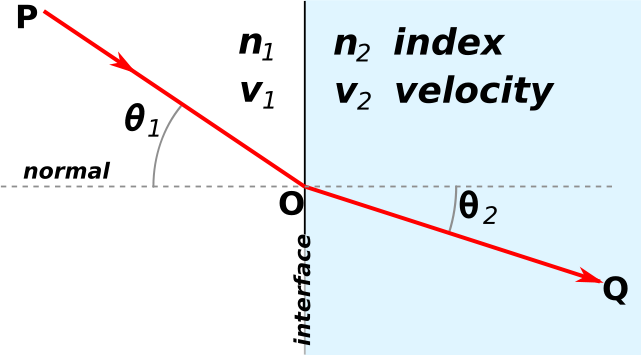
In that picture, the right side is the denser medium. If you rotate it 90 degrees, so that the left becomes the top, the you'll see why your argument makes no sense
Why are we flipping the diagram 90 degrees so that the left becomes the top? The sun's rays are coming in from the side during its setting. If the rays followed the path in your diagram, from left to right, they would appear to the observer that the sun was coming in closer to the ground than it really was.
Added some illustrations to the diagram:

Took away the upper right quadrant since we don't live in a column of air:

Sir, you are absolutely appalling. Let me show you why.

As you can see, there exists a normal which is 90 degrees (perpendicular) to the interface, the change in medium. The normal intersects the interface at the point which light passes through the interface. Obviously, in this case there is no change in medium yet. Therefore, light does not refract.

In this next picture, we see how light
properly refracts. The angle between the normal and the ray of light decreases because light is traveling slower. It is bending
down. The angle is decreased, and thus the perceived location of the sun is
higher. Because you have no regard for any understanding of physics whatsoever, you have chosen to throw the interface wherever you please and ignored the normal completely. If you alter the interface, the normal changes with the interface as it must always be perpendicular to it at the point where light changes mediums. Thus, the
direction to which light bends also changes. I certainly do hope you're not going to argue that Snell's Law is a lie, now that you know that you have been applying it incorrectly.

In this third picture, it is explained that we cannot have such an imaginary situation as you have described with your atrociously altered diagram. If light speeds up, it will travel at a greater angle to the normal than before. But it is not possible because no medium exists that can be any less dense than a medium containing absolutely nothing (vacuum). This is the only case in which the sun will appear "lower" than it actually is. Unfortunately for you, no such case exists.
You seem to have no disagreements about the original picture posted from Wikipedia:
If I re-align your picture to match the orientation of the original picture, you will find that your diagram contradicts what you have already appeared to have accepted as true, based on your support of the Snell's Law:

I have also done you a favour and re-labeled the Normal and Interface, something you have quickly forgotten about. But I must say, you probably haven't forgotten it at all. You simply don't know the concepts of physics as well as you think you do. If you're going to argue against my re-arrangement of your diagram, then I invite you to find another alignment of the diagram that fits your argument,
applying the proper concepts I have introduced to you above.
But if you are still not satisfied, here is the current picture being used in the Wikipedia article, conveniently already in the same orientation as your diagram:
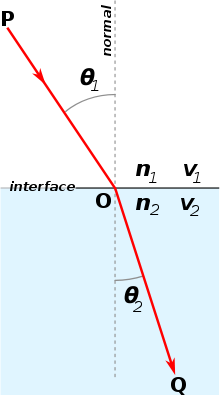
I also invite you to properly acquaint yourself with the concepts you claim to support your statements. If you are so blatantly wrong about Snell's Law, I can't begin to imagine what else you might be wrong about.