Why does a rock fall, according to FET?

  • 36 Replies
  • 8632 Views
*

skeptical scientist

  • 1285
  • +1/-0
  • -2 Flamebait
Re: Why does a rock fall, according to FET?
« Reply #30 on: December 23, 2009, 02:15:37 AM »
Edge effects are important in a peripheral region of the order of the thickness of the slab.
Are you talking about pressure or gravity, and what gave you that idea? This is not true, at least in the case of gravity. For the gravity of a wide thin disk, the contribution of the force due to mass at a distance r goes as 1/r, since the amount of mass at distance r is proportional to r, for r>>H, and gravity is a 1/r2 force. Thus for a point at distance z>>H from the edge, the gravitational force outwards should be roughly proportional to log(z) plus some constant, the force inwards should be roughly proportional to log(2R-z) plus the same constant, and the net force is roughly proportional to log(2R-z)-log(z)=log(2R/z-1). I'm not sure what your cutoff is for "important", but as this force depends only on the ratio of z to R, edge effects are important in a peripheral region of the order of some constant times the radius of the slab, not the thickness, so as the radius increases, so does the width of the region where edge effects matter.

Note also that this force tops out at something proportional to log(2R/H), very near the edge, and the outward force due to pressure on a small quantity of (ostensibly molten) rock is proportional to the thickness H (squared), but its dependence on R is bounded, so if the width of the slab is sufficiently large relative to its thickness, the gravitational force on each bit of rock is more than enough to overcome the outward force due to pressure, just as I claimed earlier. This is as we expect, since large gravitational fields tend to make heavy objects be closer to spherical, not further from it, which means it is highly unlikely that a wide flat pancake should respond to gravity by getting wider and thinner.

Forget for a moment the question of whether the Earth is flat. Do you still maintain that your argument shows that a flat disk of rock 6000 km thick and either infinite in width or else extremely wide relative to its thickness and experiencing normal Newtonian gravity cannot be stable?
-David
E pur si muove!

*

parsec

  • 6176
  • +0/-0
  • 206,265
Re: Why does a rock fall, according to FET?
« Reply #31 on: December 23, 2009, 02:29:55 AM »
you are mixing an infinitely high cylinder with a thin disk.

*

skeptical scientist

  • 1285
  • +1/-0
  • -2 Flamebait
Re: Why does a rock fall, according to FET?
« Reply #32 on: December 23, 2009, 10:36:54 AM »
you are mixing an infinitely high cylinder with a thin disk.
No, I'm not. Again, what gave you that idea? I assumed that R>>H, and the math describes a thin (relative to its width) very wide flat disk. If you think you see an error, please point it out, but don't make a general statement that basically amounts to "you're wrong" without anything to back it up. Where do you think I'm treating the gravity (or pressure) from a tall skinny cylinder as opposed to a flat wide one?
-David
E pur si muove!

*

parsec

  • 6176
  • +0/-0
  • 206,265
Re: Why does a rock fall, according to FET?
« Reply #33 on: December 23, 2009, 11:43:40 AM »
It is not I who has to explain to you where you made your error. You simply post some formulas out of the blue. For example, where do you come up with this statement:
This is not true, at least in the case of gravity. For the gravity of a wide thin disk, the contribution of the force due to mass at a
distance r goes as 1/r, since the amount of mass at distance r is proportional to r, for r>>H, and gravity is a 1/r2 force.

Then you go on 'deriving the following:
Thus for a point at distance z>>H from the edge, the gravitational force outwards should be roughly proportional to log(z) plus some constant, the force inwards should be roughly proportional to log(2R-z) plus the same constant, and the net force is roughly proportional to log(2R-z)-log(z)=log(2R/z-1). I'm not sure what your cutoff is for "important", but as this force depends only on the ratio of z to R, edge effects are important in a peripheral region of the order of some constant times the radius of the slab, not the thickness, so as the radius increases, so does the width of the region where edge effects matter.
Without going any further, why do you invoke the assumption z >> H ?! Surely you have no idea what you are talking about, since z measures the vertical coordinate perpendicular to the disks of the cylindar. Your assumption says for heights above the disk much higher than the thickness of the disk. But, why would we care for that region.

So, either present something meaningful with complete derivations or stop pretending like you understand what is discussed.

*

skeptical scientist

  • 1285
  • +1/-0
  • -2 Flamebait
Re: Why does a rock fall, according to FET?
« Reply #34 on: December 23, 2009, 05:18:12 PM »
I can use z to measure whatever I want to use it to measure, but now at least I see where you misunderstood me. I'll do a much longer and more careful derivation, which will hopefully be easier to understand. I'll refer to the various parts of the surface of the cylinder as the faces (the flat top and bottom) and the edge (the single long curved surface. I'm considering the force of gravity, from the cylinder, on a point inside the cylinder, midway between the two faces, at some (variable) distance d from the edge. I was using z to measure the distance from the edge, but I'll use d instead so there will be no confusion resulting from my choice of name.

Now, the acceleration due to gravity on a small bit of rock at the point (R-d, 0, 0) at distance d from the edge is given by the triple integral
where G is the gravitational constant, rho is the density of the disk (which I assume is uniform), and R and H are the radius and thickness of the disk. C is the cylinder {(x,y,z) : x2+y2?R, |z|?H/2}. This integral doesn't have a simple closed form solution, so I'll use a simple back-of-the-envelope technique to estimate it. It won't be exact, but it will be close, and have the right asymptotics (i.e. the ratio between the estimate and the true value, as a function of R, will be bounded for sufficiently large R).

Imagine the circle on the right in this image:
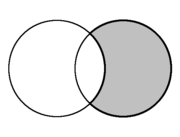
is a face-on view of the cylinder, and the point (R-d,0,0) is in the middle of the two overlapping circles. Then the force from the portion of the cylinder inside the intersection of the two circles exactly cancels by symmetry, so we can ignore it. The net acceleration due to gravity on a small bit of rock at the point (R-d, 0, 0) is the same as the acceleration due to gravity from the lune-shaped prism shaded gray. To estimate this force, we consider the force from the intersection of this prism and the spherical shell at distance r from (R-d,0,0), as a function of r.

Now the intersection of the prism and the spherical shell at distance r is going to be empty when r<d or r>2R-d, and when d?r?2R-d it is going to be some portion of a curved circular band of width H, cutting off at those points which are outside the prism. For most of the interval d?r?2R-d (assuming R>d>>H), it is going to contain some significant fraction of a full semicircle of arc, it's area (and therefore mass) will be roughly proportional to r (since the circumference of the full circle is 2?r). So the force from this band is proportional to 1/r, since we have mass proportional to r multiplied by a 1/r2 term due to the distance. The total force can then be estimated by the integral from d to 2R-d of 1/r dr, which is log(2R-d)-log(d)=log(2R/d-1), as I calculated before.

This derivation justifies my claim that edge effects are important in a peripheral region of the order of some constant times the radius of the slab, not the thickness, so as the radius increases, so does the width of the region where edge effects matter, and runs counter to your assertion that edge effects only matter in a region on the order of the thickness of the slab.

Furthermore, then a similar argument shows that when we are considering the force on a piece of rock at the exact edge of the cylinder (i.e. when d=0) then a similar estimation can be used to show that this force goes as ?(log(R)) (assuming the thickness H is constant). On the other hand, again assuming the thickness H is constant, if we imagine that the cylinder consists of two solid slabs sandwiching a liquid layer, each slab will have mass ?R2H?/2, and will thus produce an inward force on the molten layer of at most ?R2H?g/4. This is because the inward force due resulting from the mutual attraction of the two slabs is no greater than the weight of one slab if the other slab were replaced by an infinite plane of the same density and thickness (and thus exerted a constant gravitational field of strength g/2). This force is distributed over an area of ?R2, and thus the average pressure in the liquid layer is at most ?R2H?g/4?R2=H?g/4, which is independent of R. The pressure near the edges will be no greater than the average pressure, so the outward force due to pressure at the edge is O(1) (as a function of R), while the inward force due to gravity at the edge is ?(log(R)). For sufficiently large R, therefore, gravity overcomes pressure, so a sufficiently wide disk will not be unstable in the way you claimed. (It may, of course, be unstable in other ways.)

By the way, if you find such things more convincing, and have the software to do it, feel free to just compute the integral above and graph it as a function of R, and it will confirm what I derived using back-of-the-envelope style estimation techniques. In fact, you can compute exactly how large R has to be, relative to H, for the inward force from gravity to overcome the outward force from pressure.
-David
E pur si muove!

*

parsec

  • 6176
  • +0/-0
  • 206,265
Re: Why does a rock fall, according to FET?
« Reply #35 on: December 23, 2009, 11:50:52 PM »
Your formula is meaningless. How can edge effects be important at a distance of the order of the radius of the disk?  That would mean edge effects are important at the center of the disk. Also, for d = 0, the gravitational field strength diverges logarithmically. This is absurd. However, you are diluting the discussion.

Instead, let us not consider any matter flowing out of the Earth. Let us consider the following configuration:


We have an infinite layered slab with a liquid interior with thickness 2z1 and density ρ1 and solid layers 'above' it on both sides with thickness z2 and density ρ2.

By similar application of Gauss' Law, we can find the gravitational field, the gravitational potential and the total gravitational potential energy per unit are of this configuration. We give the end formula:

Ug/A = (4*π*G/3)*(ρ12*z13 + 3*ρ1*ρ2*(z12*z2 + z1*z22) + ρ22*z23].
(1)
This potential energy by itself has no meaning. We consider the change in the energy under the following process. Some solid with infinitesimal mass per unit area dm/A melts. This changes both of the thicknesses by:

dz1 = dm/(2*ρ1*A),
(2)
dz2 = -dm/(2*ρ2*A).
(3)

The minus sign in the last formula is because as the solid is melting, its thickness is decreasing. The factor of 2 is because the layers have total thicknesses of 2z. Finding the total differential of (1) and substituting from (2) and (3), we get the following formula:

dUg/A = 4*π*G*(ρ2 - ρ1)*z1*z2*dm/A.
(4)
I guess this is what you were implying to when you said the liquid, being less dense would make the whole system rise and increase its total potential energy. However, if ρ1 > ρ2, which, as I pointed out is the necessary condition for the melting temperature to decrease with pressure. Let us go on considering this case:

We also need to add the heat of melting:

dQ = L*dm.
(5)

Finally, the total change in energy in this process is:

dW = dUg + dQ,

dW/dm = L + 4*π*G*(ρ2 - ρ1)*z1*z2.
(6)
As long as this derivative is positive, the process we are considering is energetically unfavorable and the system is stable under this process. Of course, when ρ2 > ρ1, this is definitely positive. But, let us consider the opposite case.

Then, we need to have:
z2 >= L/(4*π*G*(ρ1 - ρ2)*z1).
(7)
At the same time, the total gravitational field strength at the surface of the cylinder is:

g0 = 4*π*G*(ρ1*z1 + ρ2*z2).
(8)

Eqn. (7) is a hyperbola in the 1st quadrant of the z1-z2 coordinate plane. Let us find the tangent of the line that has the same slope as the straight line given by eqn. (8), namely -ρ1/ ρ2. Without giving the algebra, this tangent is:

z2 = -(ρ1/ ρ2)*z1 + 2*Sqrt[L*ρ1/(4*π*G*(ρ1 - ρ2)*ρ2.
(9)
In order that we have a solution of these conditions, we must have the intercept of the line (8) be greater than the intercept of the tangent (9). This is possible only if:

(ρ1 - ρ2)/ρ1 >= 16*π*G*L*ρ2/g02.
(10)
The rhs of eqn. (10) contains the same constants as my previous discussion and has the order of magnitude estimate:

(ρ1 - ρ2)/ρ1 >= 10-4 - 10-3.
(11)
For water, for example (which has this anomaly) this difference is 0.08, so it is still stable.

In conclusion, when looking this kind of variation, it seems the slab should be stable. Someone should check the algebra again.
« Last Edit: December 23, 2009, 11:59:29 PM by parsec »

*

skeptical scientist

  • 1285
  • +1/-0
  • -2 Flamebait
Re: Why does a rock fall, according to FET?
« Reply #36 on: December 24, 2009, 01:43:44 AM »
Your formula is meaningless.
No, it isn't. Your claim that it is seems to be based on two misunderstandings, which I will now correct:
Quote
How can edge effects be important at a distance of the order of the radius of the disk?  That would mean edge effects are important at the center of the disk.
I never said that edge effects are important at a distance of the order of the radius of the disk.
[E]dge effects are important in a peripheral region of the order of some constant times the radius of the slab. [emphasis added]
In other words, depending on how great the influence of edge effects meets your criterion for "importance", edge effects may be important for something like the outer 10% of the disk. However, this is independent of R and H, and so for R>>H, this region is vastly bigger than the order of H band you claimed.

Quote
Also, for d = 0, the gravitational field strength diverges logarithmically. This is absurd.
Of course it doesn't. The formula I gave diverges at d=0, but I specifically said that it is valid when R>d>>H. It's behavior outside its domain of validity is irrelevant.

Quote
However, you are diluting the discussion.
We do seem to have gotten rather sidetracked. I seem to have spend quite a lot of time refuting your claim, made without evidence, that edge effects are only important in an outer band of width on the order of H. In accordance with the principle that claims made without evidence can be dismissed without evidence, I could have just dismissed that claim, but instead I chose to spend two paragraphs briefly sketching why it was invalid, which you chose to respond to with an ad hominem -  "stop pretending like you understand what is discussed" - and a demand for a complete derivation. Don't criticize me for providing the derivation you yourself demanded.

Quote
However, if ?1 > ?2, which, as I pointed out is the necessary condition for the melting temperature to decrease with pressure.
I don't know why you continue waste time on the possibility that ?1 > ?2. As I said when I first pointed out that there is a large potential barrier to melting rock:
The transition you consider: rock melting, and then squeezing out the sides may represent a reduction in overall energy, but don't forget that igneous rock expands when it melts, so that melting already represents a significant increase in gravitational potential energy, as two giant slabs of rock above and below the center are pushed outwards. [emphasis again added]
we should already have been considering what happens when ?1 < ?2, since igneous rock expands when it melts (as do most solids, water being one notable exception, and rather unusual in this regard).

Quote
In conclusion, when looking this kind of variation, it seems the slab should be stable. Someone should check the algebra again.
Well, I'm glad we finally agree on something. Personally, for a large finite slab, I suspect it would be unstable in a very different way: compressive forces parallel to the radius due to gravitational edge effects should make it buckle and fall in on itself to form something closer to a sphere, unless it is stronger than any known material, but I haven't bothered to do the calculations to back this up. (This, at least, is the type of instability we should expect, given the tendency of massive objects to pull themselves into a shape which closely approximates their geoid).

For an infinite slab, who knows: the standard equations of newtonian gravity aren't well equipped to deal with such objects. We want to say that horizontal forces due to gravity must be zero due to symmetry, but in actuality they are given by a divergent improper integral.

By the way, I see that some of the greek letters and inequlity symbols in my previous post seem to be showing up as question marks for me, and the rhos which show just fine in your post above have also turned into question marks when I quote them. Are you seeing question marks as well, or is that a display error on my end?
« Last Edit: December 24, 2009, 01:47:04 AM by skeptical scientist »
-David
E pur si muove!