I can use z to measure whatever I want to use it to measure, but now at least I see where you misunderstood me. I'll do a much longer and more careful derivation, which will hopefully be easier to understand. I'll refer to the various parts of the surface of the cylinder as the faces (the flat top and bottom) and the edge (the single long curved surface. I'm considering the force of gravity, from the cylinder, on a point inside the cylinder, midway between the two faces, at some (variable) distance d from the edge. I was using z to measure the distance from the edge, but I'll use d instead so there will be no confusion resulting from my choice of name.
Now, the acceleration due to gravity on a small bit of rock at the point (R-d, 0, 0) at distance d from the edge is given by the triple integral
where G is the gravitational constant, rho is the density of the disk (which I assume is uniform), and R and H are the radius and thickness of the disk. C is the cylinder {(x,y,z) : x
2+y
2?R, |z|?H/2}. This integral doesn't have a simple closed form solution, so I'll use a simple back-of-the-envelope technique to estimate it. It won't be exact, but it will be close, and have the right asymptotics (i.e. the ratio between the estimate and the true value, as a function of R, will be bounded for sufficiently large R).
Imagine the circle on the right in this image:
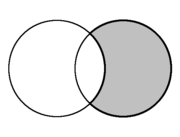
is a face-on view of the cylinder, and the point (R-d,0,0) is in the middle of the two overlapping circles. Then the force from the portion of the cylinder inside the intersection of the two circles exactly cancels by symmetry, so we can ignore it. The net acceleration due to gravity on a small bit of rock at the point (R-d, 0, 0) is the same as the acceleration due to gravity from the lune-shaped prism shaded gray. To estimate this force, we consider the force from the intersection of this prism and the spherical shell at distance r from (R-d,0,0), as a function of r.
Now the intersection of the prism and the spherical shell at distance r is going to be empty when r<d or r>2R-d, and when d?r?2R-d it is going to be some portion of a curved circular band of width H, cutting off at those points which are outside the prism. For most of the interval d?r?2R-d (assuming R>d>>H), it is going to contain some significant fraction of a full semicircle of arc, it's area (and therefore mass) will be roughly proportional to r (since the circumference of the full circle is 2?r). So the force from this band is proportional to 1/r, since we have mass proportional to r multiplied by a 1/r
2 term due to the distance. The total force can then be estimated by the integral from d to 2R-d of 1/r dr, which is log(2R-d)-log(d)=log(2R/d-1), as I calculated before.
This derivation justifies my claim that edge effects are important in a peripheral region of the order of some constant times the
radius of the slab, not the thickness, so as the radius increases, so does the width of the region where edge effects matter, and runs counter to your assertion that edge effects only matter in a region on the order of the thickness of the slab.
Furthermore, then a similar argument shows that when we are considering the force on a piece of rock at the exact edge of the cylinder (i.e. when d=0) then a similar estimation can be used to show that this force goes as ?(log(R)) (assuming the thickness H is constant). On the other hand, again assuming the thickness H is constant, if we imagine that the cylinder consists of two solid slabs sandwiching a liquid layer, each slab will have mass ?R
2H?/2, and will thus produce an inward force on the molten layer of at most ?R
2H?g/4. This is because the inward force due resulting from the mutual attraction of the two slabs is no greater than the weight of one slab if the other slab were replaced by an infinite plane of the same density and thickness (and thus exerted a constant gravitational field of strength g/2). This force is distributed over an area of ?R
2, and thus the average pressure in the liquid layer is at most ?R
2H?g/4?R
2=H?g/4, which is independent of R. The pressure near the edges will be no greater than the average pressure, so the outward force due to pressure at the edge is O(1) (as a function of R), while the inward force due to gravity at the edge is ?(log(R)). For sufficiently large R, therefore, gravity overcomes pressure, so a sufficiently wide disk will not be unstable in the way you claimed. (It may, of course, be unstable in other ways.)
By the way, if you find such things more convincing, and have the software to do it, feel free to just compute the integral above and graph it as a function of R, and it will confirm what I derived using back-of-the-envelope style estimation techniques. In fact, you can compute exactly how large R has to be, relative to H, for the inward force from gravity to overcome the outward force from pressure.