There is some confusion on this matter, and I want to clear it up.
According to the global world map, and even according to the Gleason map, London is clearly located much further north, while on my map they are at roughly the same latitude. How can both of these be possible?
First, let's diagnose the issue physically:

Here are the locations on my map. It's clearly visible that they are at roughly the same latitude. Istanbul appears to be slightly further north, but as I've said before, there may be minor shifts within the margin of error regarding the north point and the locations of the cities. We can consider the two to be at the same latitude.
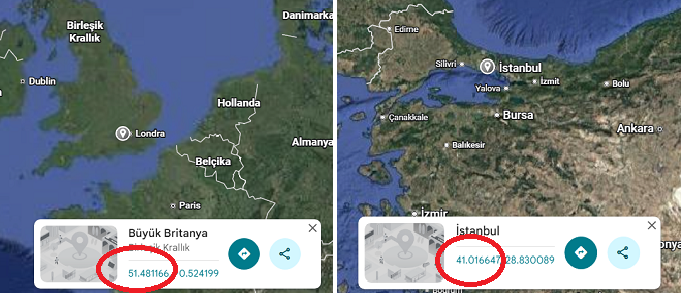
According to Google Maps, London is located at the 51st latitude, while Istanbul is at the 41st latitude. This means that, in terms of proximity to the North Point, London is 1,000 kilometers further north.
First, to understand how the solution to the problem appears logically, I compared the air temperatures of London and Istanbul with cities at their respective latitudes on Google Maps. Logically, cities at the same latitude should have similar climates. Yes, I know it varies depending on whether they are inland or coastal. I will take that into account. For example, I will compare both cities with coastal cities at same latitudes.
Calculation for London:
I chose Rotterdam from Europe. No need to choose more. They are considered to be at the same latitude, appear to be sufficiently far apart from each other, and their distances to the coast are roughly the same. Their climates should be approximately the same.
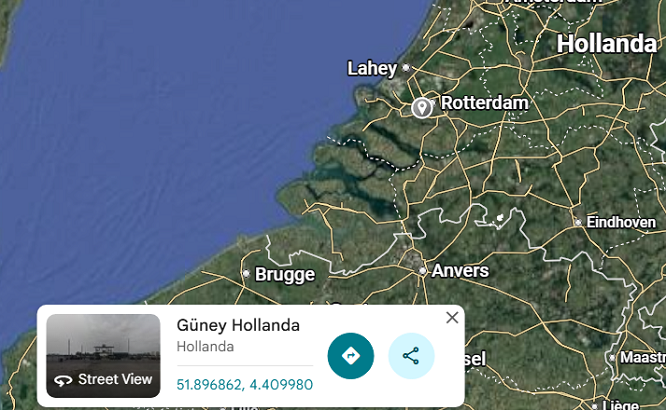
To have a second set of data, I need to select one city from the other side of Asia and two more cities from America.
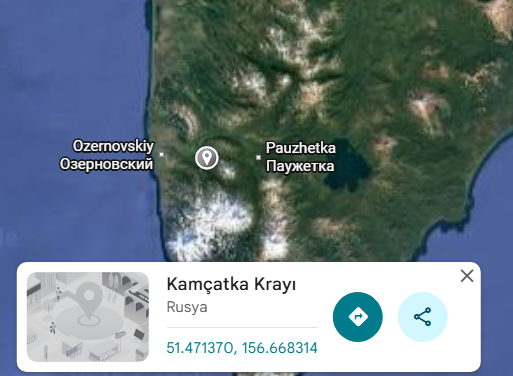
At the other end of Russia, in Kamchatka, two cities stand out. I eliminated one because it is a coastal city. It needs to be slightly inland, like London. That's why I chose Pauzhetka. I don't know if climate data for this location is available, but I hope it is. Japan is located further south, so I couldn't choose a city from there. Yes, it would have been nice if it were possible.
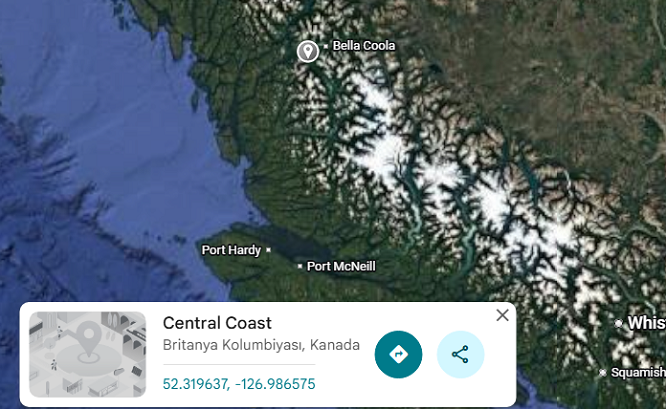
On the other side of America, in the western part, two cities in Canada are close to London in terms of latitude: Bella Coola and Port Hardy. The one above is at the 52nd latitude, the one below at the 50th. They are not at the same latitude. However, I chose Bella Coola because, like London, it is slightly inland.
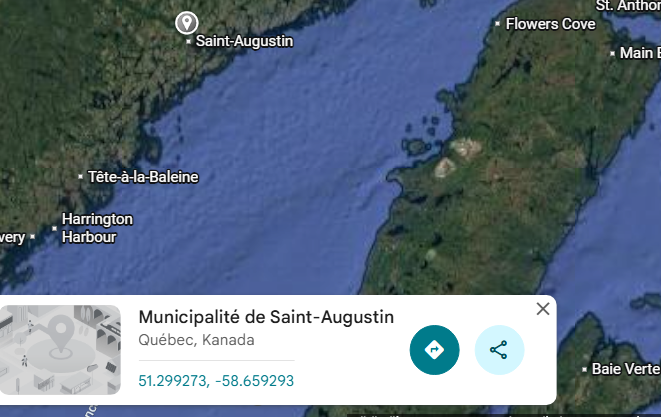
On the other side of Canada, Saint Augustin is a city at the same latitude as London.
Seeing this, one naturally wonders: How can this city, so close to Greenland and even to the Arctic Circle, and likely snow-covered for most of the year, be at the same latitude as London? Does that really make sense? We'll understand the situation shortly.
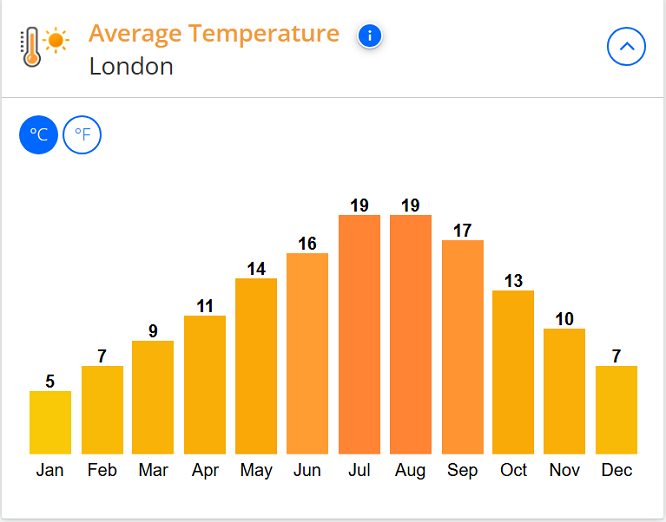
Most of these cities are much closer to the sea than London. Taking that into account, they would be expected to have either the same climate as London or a slightly milder one, wouldn't they? Let's take a look one by one.
London:
 Saint-Augustin, Quebec
I couldn't find any annual records for this settlement. It's probably a small place, so major websites don't pay attention to it. However, there is a weather forecast for the coming period, and even though it's only for a short time, it provides a strikingly revealing idea.
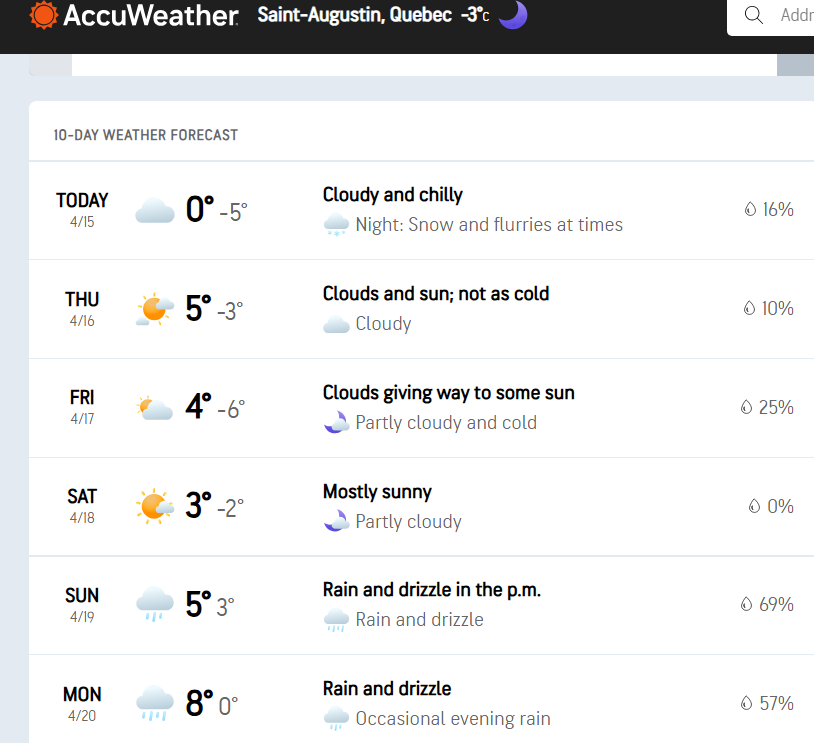
Did you see the nighttime temperatures? It's as if winter hasn't ended yet. It's still snowing, it seems. Oh no, it must still be snowing there.
Now let's take a look at London's weather forecast:
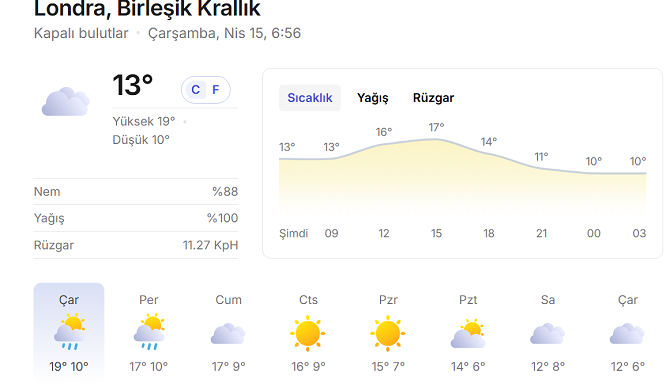
Voohoo! In London, some people must be daring enough to go into the sea at 19 degrees.
Did you see the difference? There's almost a full season difference between these two places.
You'd have to be retarded to think they are at the same latitude.
Now let's recall where London was on my map: Much further south, at the same latitude as Istanbul. So let's compare the weather with Istanbul as well. Let's take a look. Does London's weather resemble that of a city at the same latitude in Canada, or does it resemble Istanbul's?
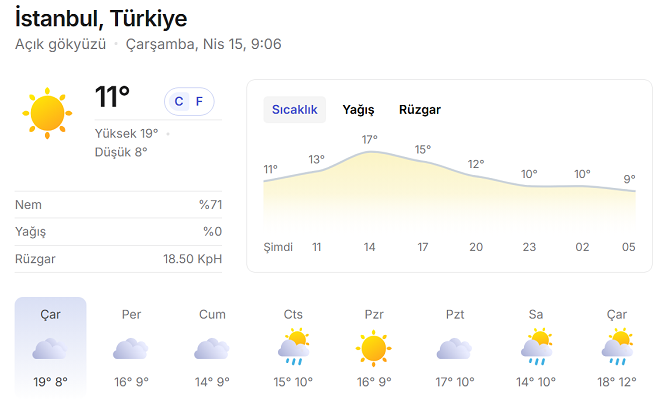
We know from annual averages that Istanbul is warmer than London. Because there's always an excuse in statistics. But in short-term weather forecasts, globalists have nowhere to hide, because holidaymakers must not be upset. Looking here, we see that London and Istanbul have roughly the same weather conditions for the coming period. I've said this many times before.
There's no need to examine the other cities. Just imagining that London is at the same latitude as Quebec City in Canada is absurd in itself. This is a complete map error.
So what do the globalists say about this?
You know the drill — they always have their excuses.
**EXCUSES**
Ocean winds
Warm water currents
Southern winds
You know how it goes — these southern winds and warm water currents only affect London, but when it comes to Barcelona, Istanbul, Amsterdam, etc., the breeze just stops.
This, like all other globalist lies, is something made up to fool idiots. They are clearly not at the same latitude. According to the weather, London is clearly impossible to be that far north.
I'll summarize the rest:
The temperature in Rotterdam is similar to London.
The temperature in Istanbul is similar to London.
The other side of Canada and the other side of Asia are completely disconnected from London. There is a serious seasonal difference between them.
So let me put it this way:
While London, Istanbul, and Rotterdam are experiencing spring and getting ready to enter summer, the places in Russia and Canada that should have the same climate as London still seem to be experiencing winter.
I'm asking those who have seen London. Could this place really be at the same latitude as Quebec, or have you lost your minds?
Anyway, let's do some calculations to solve the problem.
Here's what we'll do: There is no direct measure to compare the distance to the North Pole. But we can do this: By comparing flight times from some cities close to or beyond the North Pole to Istanbul and London (which appear close on my map), and comparing those times with the distances according to Google Maps, we can reach a conclusion.
You may not understand yet, but you will when I do it.
I don't have many options on my map. So I chose Yakutsk and Anchorage. Yakutsk seems a bit closer to Istanbul, and Anchorage seems a bit closer to London. But the distances are roughly the same. By treating these two cities, Anchorage and Yakutsk, as if they were the North Pole, we can compare flight times and reach a conclusion.
(Those who still don't understand don't have to read after this.)
Let's first determine the situation on Google Maps.
According to Google Maps, the distance between London and Anchorage is 7,190 kilometers.
According to Google Maps, the distance between Istanbul and Anchorage is 8,650 kilometers.
Comparing them: According to Google Maps, Istanbul is 20% farther from Anchorage than London is. This should create a significant difference in flight times.
As a reminder, on my map, the distances of these two cities to Anchorage were roughly the same.
Second, let's look at the situation with Yakutsk. I hope there is a flight from somewhere around there to London.
According to Google Maps, the distance between London and Yakutsk is 6,633 kilometers.
According to Google Maps, the distance between Istanbul and Yakutsk is 6,560 kilometers.
We won't examine this — Yakutsk is eliminated. Because on Google Maps, the distances from these two cities to Yakutsk are roughly the same, just like on my map. Since this won't create a difference, we will focus only on flights to Anchorage.
FLIGHT TIME ANALYSIS — LONDRA-ANCHORAGE-ISTANBULIn this section, we will examine the London–Anchorage and Istanbul–Anchorage flights, which are the same distance according to Wise's safest map in the world but have a 20% difference in distance according to Google Maps.
I've encountered enough frustrating data. There are no direct flights from London or Istanbul to Anchorage. And the planes follow a stupid route, landing in US and Canadian cities much further south (and actually farther away), and then from there they go to Anchorage.
Why wouldn't this city — the closest to the center of the world and ideal for a logistics hub — be a travel destination?
There's no rule that every study I do has to be absolutely successful.
In conclusion, I'm returning to climate similarity, and since London has no chance of having a climate similar to anywhere in Quebec or Kamchatka, I'm saying that London is actually much further south than shown on Google Maps, and I'm closing this annoying topic.