There is a misconception that after Rowbotham the Flat Earth model was always the monopole model. In the early 1900s, under Lady Blount's leadership, the Flat Earth movement sent associates to Antarctica. Their findings were documented in Lady Blount's science journal Earth Not a Globe Review (later shortened to Earth Review) and led the society to officially adopt the Bi-Polar model (See:
https://wiki.tfes.org/Bi-Polar_Model). The modern revival of Flat Earth has mostly failed to follow the initial research, instead depicting Rowbotham's original mid-1800's model.
Even so, the Monopole model has not been abolished from tfes.org. It remains viable because the Antarctic Midnight Sun can still occur under it. The modern Monopole model treats the sky as a magnifying dome that naturally accounts for seasons and the shifting shapes of daylight across the Earth:
When sunlight reaches the dome’s edge, we see in the video that it undergoes internal reflection around the entire perimeter. The dome’s optics can make sunlight seem to arrive from every side of the horizon to observers at points on Antarctica, creating a reflection in the South directly opposite of the darker northern area.
The rays do not travel in straight lines through the middle of the dome; they curve upward. This upward bending is exactly why daylight does not flood the entire flat plane at once. In the seasons dome video the area above the dark side of the dome is illuminated on its outer surface while the Earth below stays in shadow, showing that the light rays arc upward and exit through the opposite side of the dome rather than continuing straight down.
A striking demonstration of this curved-light behavior we can actually see in the sky is the Moon Tilt Illusion. Under straight-line geometry (as assumed in Round Earth theory), the illuminated portion of the Moon should always point directly at the Sun, just as a ball lit by a flashlight appears fully lit toward the light source no matter where the observer stands. Yet in reality the Sun's light follows a curved path across the sky, causing the Moon's bright side to point away from the Sun.
This mismatch is what the upward-curving rays of the magnifying dome predict. Viewing a straight line with rays that arc upwards would make the line appear to arc downwards to the observer, as the curved upward rays from the extremities of the line in proximity to the observer take a longer path to reach the observer's location, causing them to appear to droop instead of rise. Upwardly curved light emanating from a line in the sky as seen by an observer below would make the line appear to take a concave downward shape.
The effect that celestial lines are not straight was noted here by Professor Alan Myers of the University of Pennsylvania:
https://web.archive.org/web/20190516183015/http://www.upenn.edu/emeritus/essays/MyersMoon.html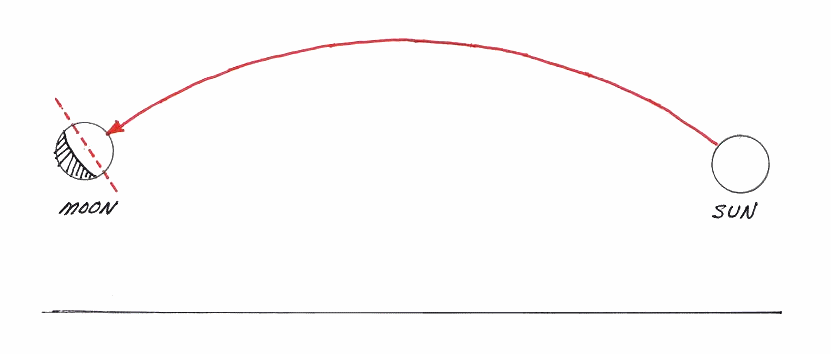
The Moon Tilt Illusion allows for alternative world models. This curving effect also occurs with other celestial phenomena such as the Milky Way and tails of comets. The fact that light is curving on a large scale in the sky does more than discredit the globe model; it brings us back to the drawing board on world models, which opens up many exciting possibilities for Flat Earth.
For more information on my study of these curving effects see:
https://wiki.tfes.org/Moon_Tilt_Illusionhttps://wiki.tfes.org/Celestial_Sphere