That's why I say that RE geocentrism works a lot better than FE geocentrism. FE falls apart when you look at star trails at the equator and in the southern hemisphere.
(Picture below)

Thank you for proving the flat Earth. Couldn't have done it without you.
You foolishly think this proves your argument, but it shows something quite different.
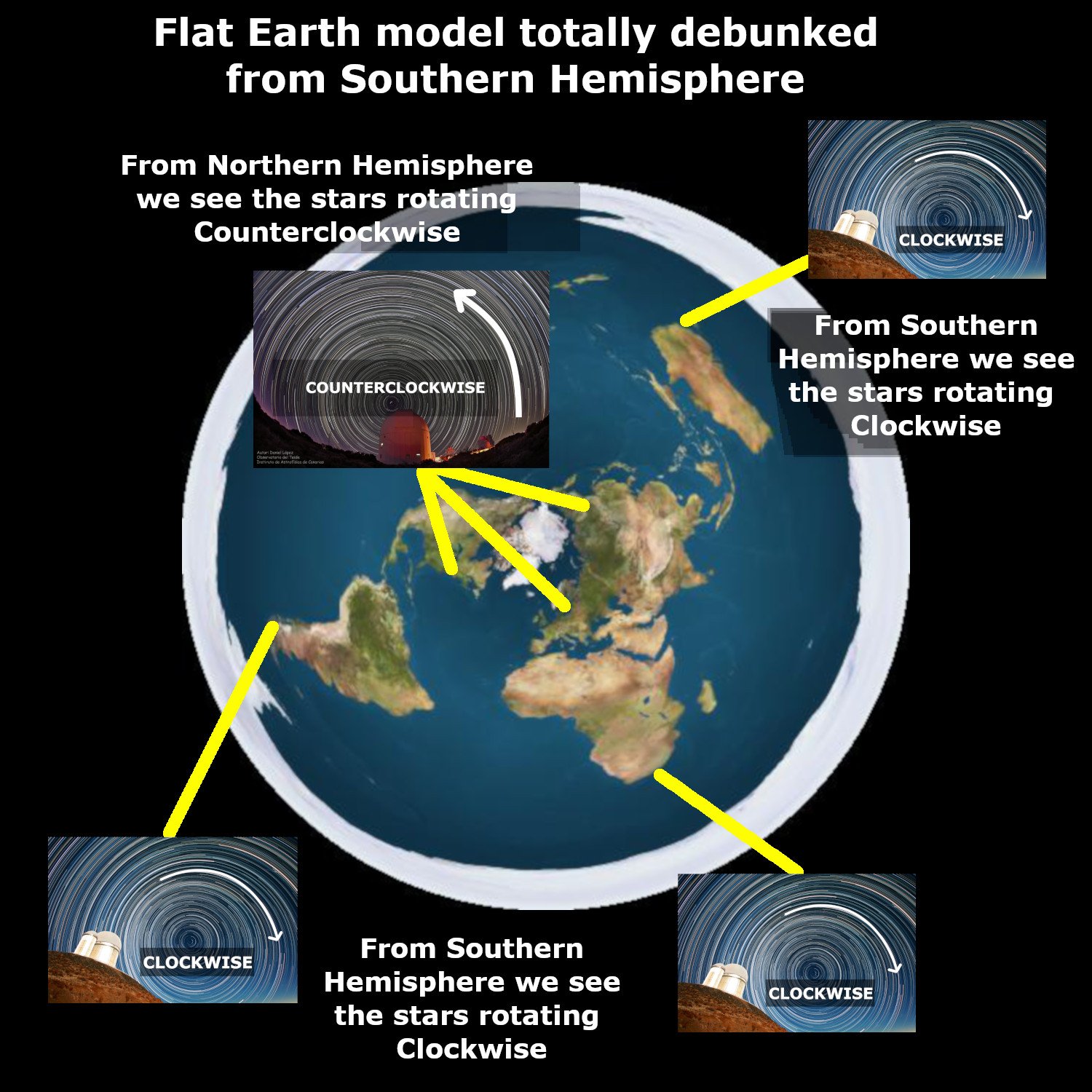
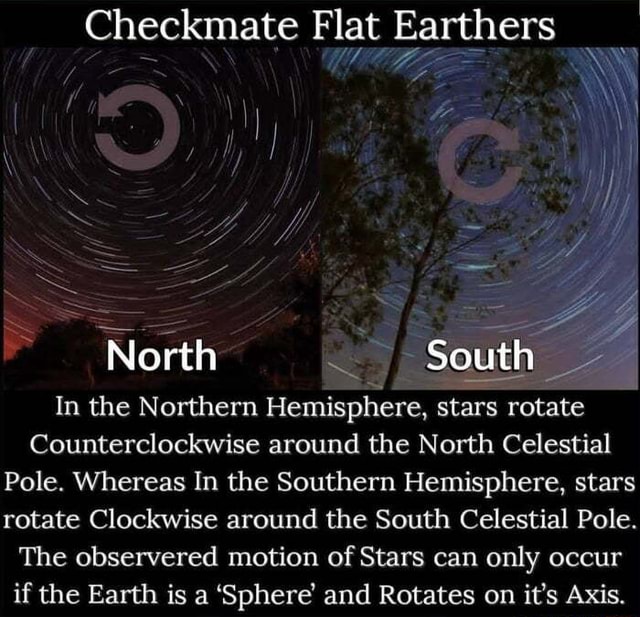
Like you, they think they have proven something. Oh no, the sky moves in opposite directions. Whatever shall we do?
Let's go back to the picture in question.
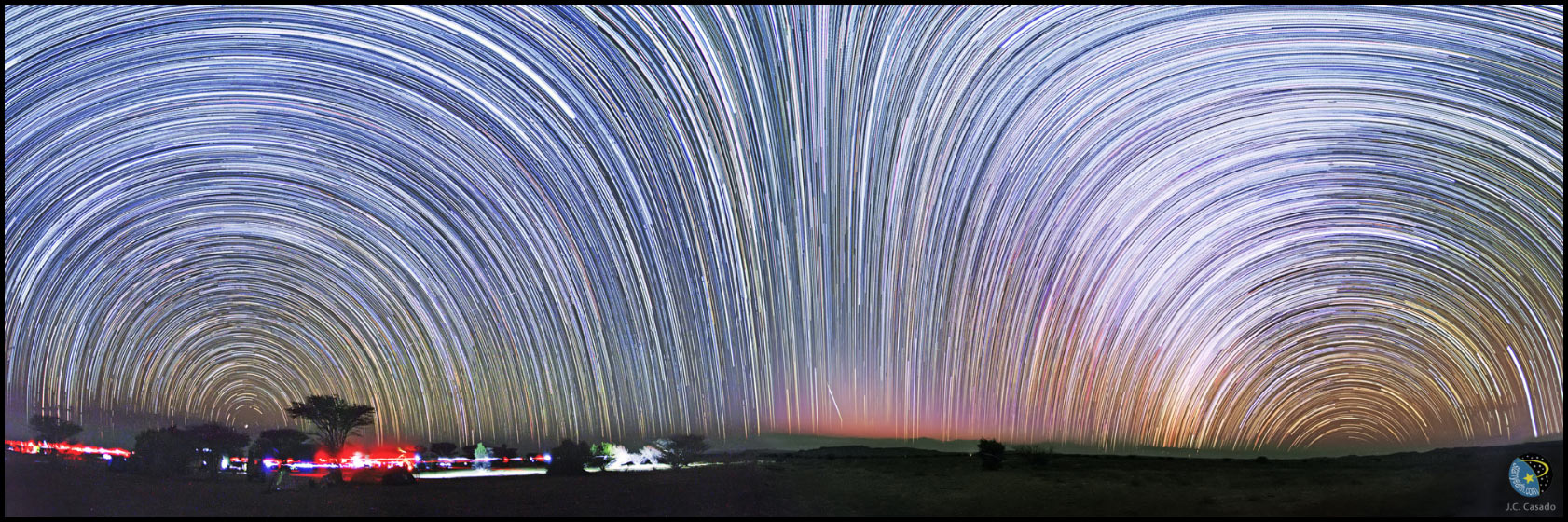
Look to the left and you can see a center. You can see a bullseye-like dot, correct? And I'm sure you're imagining drawing a circle in between two concentric circles like so.

And you probably stopped there, didn't you?
After all, Occam's Razor is (for once) on your side. Unlike where you reverse the entire motion of the stars to simulate Earth's supposed orbit which is not seen nor felt.
Even so, the lack of any center star in the southern hemisphere should give you pause. But no, of course it doesn't. Because what I'm gonna say next won't make any sense to you.

If you can't read my writing that says, «Objects in the sky sink due to distance (vanishing pt)» and «Two circles is the brain's attempt to reconcile an impossibly large circle using vanishing point»
You mentioned that you could see this image from the equator and southern hemisphere. But I noticed that you didn't mention anything about the northern hemisphere, did you? This is because the sky visually compresses in the southern hemisphere, allowing a few stars over a wide space to appear as a circle. But like the sun which has set, the stars in the southern... (strictly speaking, I should probably start calling this "outer") in the outer hemisphere cannot be seen as easily. The equator acts as a visual separator so the northern hemisphere has trouble seeing southern stars.
Some southern stars and constellations, like the Southern Cross, can be seen from the Northern Hemisphere, but only from specific southern locations, such as southern Florida or Texas, and during certain times of the year. Generally, the visibility of southern stars decreases the further north you are.
What did I say earlier?
Objects in the sky sink due to distance (vanishing pt)

Now this is poorly drawn but the point here is that the further outward you get, the lower (and higher) a particular southern constellation is in the sky, creating angular distortion.
It is particularly telling that they mentioned that this only happens during certain times of year. When I ask about northern stars in the southern hemisphere, I get doubletalk despite that you say you could see all this also in the southern hemisphere.
NASA says you can't see Polaris at all from southern hemisphere. But when I mention "farthest south Polaris can be seen," they say just south of the equator under ideal conditions. Either this is a very good picture, or it's a composite. But I'm not gonna call you out on it. Because, you see, the reason you see two sets of stars is because you are seeing a full circle (half sunk into the ground due the angle and distance) of the northern hemisphere but actually only seeing a partial circle for the outer hemisphere, and your brain is closing the gap.

Now I think he made this circle too big, but the point is, the Southern Cross would have to be northern of its supposed position to be seen from Texas. Basically his point and mine is that there is a difference between visual and actual stars. In the equator, some stars appear to go up and down. Do stars actually go into or out of the Earth? No, that's an absurdity. Rather our view of the stars is based on screwy angles.