As always, I have the real experts on my side.
Dr. Luis Alvarez, Nobel prize winner
"Nobel Prize winning scientist Dr. Luis Alvarez was given the task of x-raying the pyramids at Giza to find hidden chambers. Using naturally occurring cosmic rays, his scheme was to place spark chambers, standard equipment in the high-energy particle physics of this time, beneath the second pyramid of Chephren in a known chamber. By measuring the counting rate of the cosmic rays in different directions the detector would reveal the existence of any void in the overlaying rock structure.
Alvarez and his team were about to use space age technology to look inside the oldest building in the world.
Dr. Luis Alvarez recommended using cosmic rays to x-ray all the pyramids in the Giza Plateau.
Archaeologist and author Ahmed Fakhry was his liaison in Egypt.
Their work continued until the Six-Day War in June 1967."

Preparing to X-ray the pyramids with Egyptologist Ahmed Fakhry and team leader Jerry Anderson, Berkeley, 1966.
"The results were ASTONISHING. The cosmic rays could not penetrate the water saturated limestone blocks of the pyramids."

"The x-ray team in front of the Great Pyramid. Alvarez is on the left."
In 1974, a massive 1 million dollar project was launched by the National Science Foundation in the U.S. to locate hidden chambers in the Giza pyramids.

(setting up the x-ray equipment in the Great Pyramid)
"In 1974, apparently unaware of the pyramid x-raying of Alvarez, the National Science Foundation launched another attempt to x-ray the pyramids.
This time the results were published.
The limestone rocks were too saturated with water to allow penetration by cosmic rays."
The search had to be abandoned because the electro-magnetic sounder equipment could not penetrate the limestone rocks due to their high water content.
(Electromagnetic Sounder Experiments at the Pyramids of Giza. p. iii).
http://www.ldolphin.org/egypt/egypt1/index.htmlElectromagnetic Sounder Experiments at the Pyramids of Giza
Stanford University
During its autumn 1974 electromagnetic sounder experiments the joint Egyptian-American research team established that high attenuation due to high water content in the limestone of the Giza area precluded many practical applications of radio-frequency sounding for archaeological purposes in that area.
The 10-MHz transmitter and antenna were carried
100 m up the south face of Cheops' pyramid, and placed by the air shaft from the King's chamber:
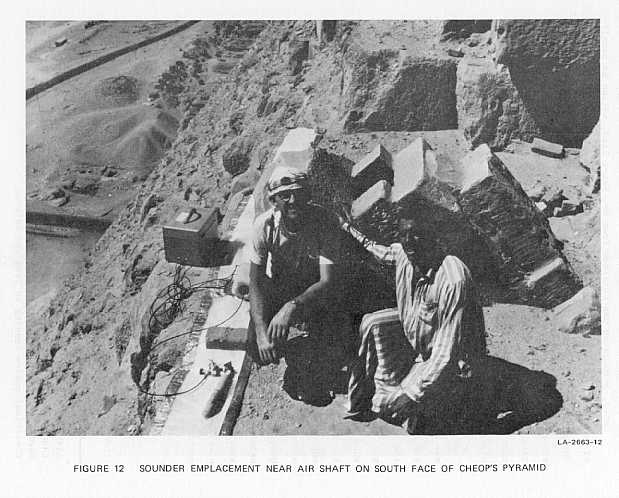
Even when the receiving antenna in the portable receiver was placed next to the air shaft on the south wall of the King's chamber, no sounder signals could be heard through the intervening 50 m of rock.
“We can clearly see the pristine condition and the details of the perforations of the exoskeleton, this means that the sea creature must have been petrified in recent times.” -Sherif El Morsy
https://www.gigalresearch.com/uk/Menkara-petrified-shallow-marine-creature.php“During one of the documentations of the ancient coastline, I almost tripped with a block of the second level of a temple,” said Mr. Morsy in an article published on the website Gigal Research. “To my surprise, the bump on the top surface of the block that almost tripped me was in fact a exoskeleton of a fossil of what appears to be a echinoid (sea urchin) which are marine creatures that live in relatively shallow waters.”
Archaeologist Sherif El Morsy, who has worked extensively on the Giza plateau for over two decades, and his colleague Antoine Gigal, were the ones who made the discovery of this controversial fossil, which backs up studies and theories that the Pyramids of Giza and the mighty Sphinx were once submerged under the sea.
According to El Morsy, the flooding, was quite significant, peaking at about 75 meters above current sea level and creating a coastline spanning to the Khafra enclosure near the Sphinx at the temple of Menkare.
A convincing clue proving that the Giza plateau was once covered by the sea is being studied, along with other evidence of erosion due to saturation by deep water of the surface of the plateau. An echinoid (a type of sea urchin or shallow marine creature) petrified in “recent times” has been found embedded upright in the upper surface of a block adjoining the Menkaura pyramid and within the ancient intertidal range.
Madison boulder near Conway, New Hampshire, measures 90 by 40 by 38 feet, and weighs 10,000 tons. Unlike the bedrock beneath, it is composed of granite.
"In many places of the world, and especially in the north, large boulders are found in a position which proves that a great force must have lifted them up and carried them long distances before depositing them where they are found today. They are of an entirely different mineral composition than the local rocks, but are akin to formations many miles away. Thus, occasionally an erratic boulder of granite perches on top of a high ridge of dolerite, whereas the nearest outcrops of granite lie far away. These erratic boulders may weigh as much as ten thousand tons, about as much as one hundred thirty thousand people."
"In Britain and Germany are found many such boulders brought across the sea from Norway. Boulders from Finland have been swept over Poland, the site of Moscow, and as far as the River Don. Often they are frighteningly piled up.
Huge blocks from Canada and Labrador lie strewn over North America. Some are plain GIGANTIC.
An erratic boulder in Warren County, Ohio, covers ¾ acre and weighs 13,500 tons (the load of a large cargo ship). And near Malmö, southern Sweden, is a mass of chalk stone 1,000 feet wide, up to 200 feet thick and THREE MILES LONG!"


Given these undeniable proofs that the Gizeh pyramid was actually submerged under the Mediterranean Sea, mainstream scientists have sought to find a possible explanation.
The first of these attempts was to claim that the tsunami generated by the explosion of the Santorini volcano reached the shores of Egypt. However, the studies which have been carried out show that the height of the initial wave was only 28 meters in height; moreover, the northern coastline of Crete would have blocked the tsunami from reaching Egypt.
https://academic.oup.com/gji/article/186/2/665/589033https://www.mdpi.com/2077-1312/3/3/745/htmhttps://theconversation.com/santorini-eruption-new-theory-says-pyroclastic-flows-caused-devastating-bronze-age-tsunamis-68368“Crete's northern coastline would have acted like a 250 kilometer long breakwater that absorbed and reflected much of the tsunami's energy back into the Aegean. This would have significantly reduced the amount of wave energy able to escape into the open waters of the Mediterranean Sea.”
The sea surge lasted long enough for sea urchins to embed themselves on the rocks on some of the temples
The only possible cause of the huge sea surge could have been a sudden pole shift (heliocentrical theory).