You're using math based on assumptions.
You're first of all assuming a horizontal space comparable to RE systems. Since FE ppl are not mainstream science, I will wager not one of them have given measurements of the Earth. But it should be wider in the southern hemisphere than the north. For example, do we know the horizontal distance of the arctic rim (i.e. the "South Pole)? No, we do not.
Do we know that the visible space ahead of us is based on the math you just did? No we do not.
We do not know even that there is not some sort of Truman-show screen all around us.
We do not know that we can actually
see objects as high up as the Van Allen belt. It could actually be that the night sky is superimposed (in this case, projected by holograph).

Or whether there even is a Van Allen belt. For the sake of argument, I'll humor you.
In actual fact, we do not know much of anything, except that we cannot view trees, planes, mountains, rivers, or anything beyond certain horizontal distance. So again, you're extrapolating based on math in your head.
Have a pie. It's blueberry, I think. Could be blackberry tho. Or boysenberry. Or a mix of fruits.

Fact: from the tiny circle around yourself, using only math to extrapolate, you can be sure of... absolutely nothing. In much the same as blind people feeling an elephant can be sure only of the parts.
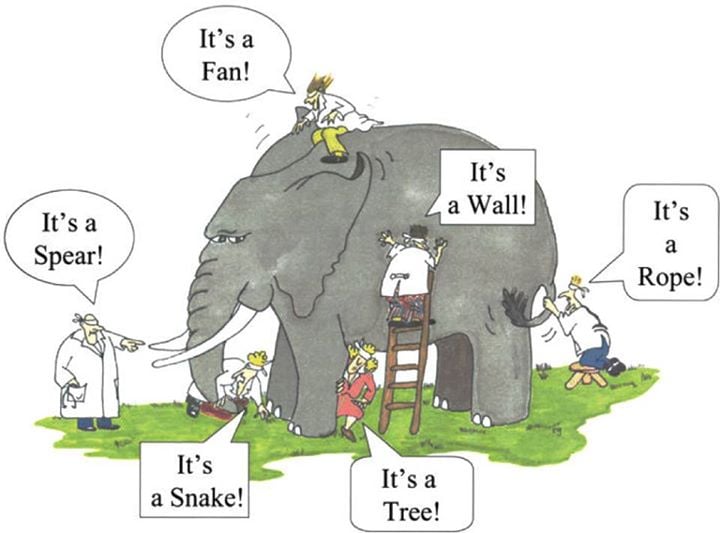
It was six men of Indostan,
To learning much inclined,
Who went to see the Elephant
(Though all of them were blind),
That each by observation
Might satisfy his mind.
The First approach’d the Elephant,
And happening to fall
Against his broad and sturdy side,
At once began to bawl:
“God bless me! but the Elephant
Is very like a wall!”
The Second, feeling of the tusk,
Cried, “Ho! what have we here
So very round and smooth and sharp?
To me ’tis mighty clear,
This wonder of an Elephant
Is very like a spear!”
The Third approach’d the animal,
And happening to take
The squirming trunk within his hands,
Thus boldly up and spake:
“I see,” quoth he, “the Elephant
Is very like a snake!”
The Fourth reached out an eager hand,
And felt about the knee:
“What most this wondrous beast is like
Is mighty plain,” quoth he,
“‘Tis clear enough the Elephant
Is very like a tree!”
The Fifth, who chanced to touch the ear,
Said— “E’en the blindest man
Can tell what this resembles most;
Deny the fact who can,
This marvel of an Elephant
Is very like a fan!”
The Sixth no sooner had begun
About the beast to grope,
Then, seizing on the swinging tail
That fell within his scope,
“I see,” quoth he, “the Elephant
Is very like a rope!”
And so these men of Indostan
Disputed loud and long,
Each in his own opinion
Exceeding stiff and strong,
Though each was partly in the right,
And all were in the wrong!
MORAL,
So, oft in theologic wars
The disputants, I ween,
Rail on in utter ignorance
Of what each other mean;
And prate about an Elephant
Not one of them has seen!
We are only sure of our own truth. We cannot be sure whether anyone else is right about their own observations.
However, it does look like you just threw numbers at a wall, hoping something would stick. Especially since you switched from miles to inches. We're gonna do this in reverse.
https://www.omnicalculator.com/math/right-triangle-side-angleHere's an alternate theory. The furthest proven horizontal line of sight on record is 443 km (273 mi).
By plugging all this information into a computer and cross- referencing it to a map of the world, we can determine the line of sight from Mt. Dankova in Kyrgyzstan to Hindu Tagh in China, is the longest sightline on earth at a whopping 538 km. Now that is only theoretical, as it has never been proven by photograph. The furthest photographed sightline in the world is 443 km, from Pic de Finestrelles in the Spanish Pyrenees to Pic Gaspard in the French Alps, almost 100x further than what can be seen driving along the prairies and staring at the horizon.
But let's use timezones as the real indicator. We are able to see the sun across eight timezones (at least, which would make it absolutely huge). Alternate theory: we are actually only seeing within our own timezone, which is why multiple versions of the sun appear for roughly 12 hours and sun doesn't appear long or huge. Timezone is roughly 675 to 1035 miles wide.
I used b and angle alpha to calculate. We're solving for a, while c and the other angles are mostly irrelevant. Just how high up is the sun?

By this estimate, the sun is instead far below the Van Allen belt.
https://scied.ucar.edu/learning-zone/atmosphere/layers-earths-atmosphere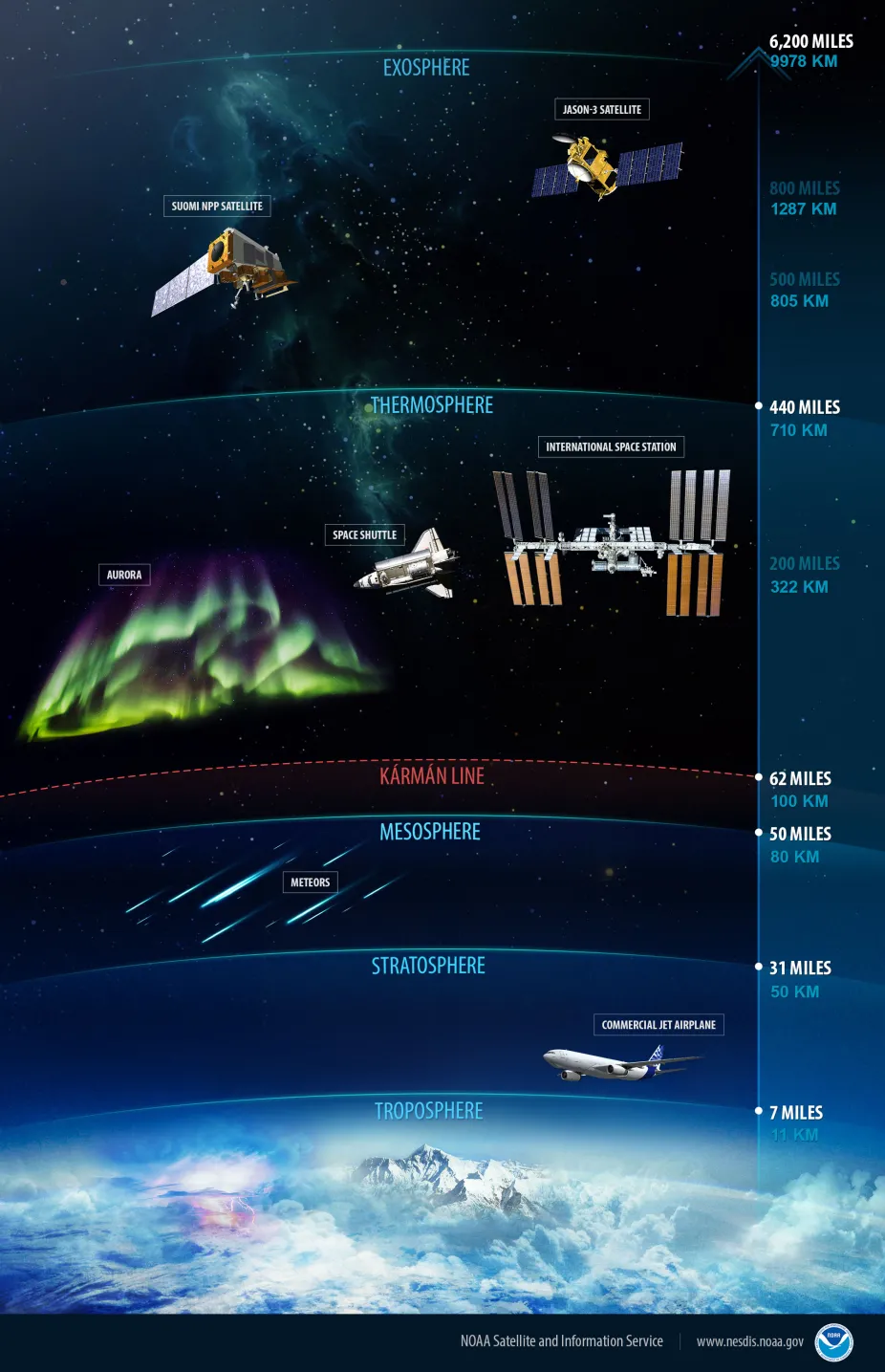
Within the Karman Line.

Or it's just above where the stratosphere ends. Considering no real aircrafts fly up that high, this is as good a guess as any (going with the Karman Line though). This is what I mean by it being impossible to extrapolate anything about the Earth from pure math. It's could be as much as 33 miles up to 50+ miles. It's unlikely that it's beyond the Karman Line though.