Why should a mile of curve over 600 miles hinder road building?
The distance from Richmond to San Antonia is nearly double that.
Notice how you make absolutely no attempt to address the question that was asked?
And instead you deflect yet again?
I want you to imagine a pipe that is supposed to go straight across
No.
Instead of asking me to imagine things with no basis in reality, stick to the example you already made.
Lets go to a hypothetical.
I live on a sphere, where I have made a region perfectly level.
I now want to lay down a road.
So I follow the standard road building practices, laying down the bed material and so on, all the way up to the layer of Asphalt on top.
In another location, there is a hill, with a gentle slope of 1 in 100 at most.
I do the same to that hill, just without the levelling.
What is trying to make any of these structures break?
I miscalculated, because of the stupid 8 inch per mile thing.
Why do you keep using such crap then?
Again, the formula is h=d^2/2R?
If you want to use that simple idea it is 8 inches per mile squared.
Again it doesn't take a genius to realise 8 inches per mile is a straight line.
And the d^2/2R is an approximation.
An approximation based upon the fact that for small angles, cos(x) = 1 - x^2/2.
The more accurate version is r*(1-cos(d/r))
This actually presents two contradictory problems.
Nope, just the one consistent one, you failing at basic math.
First, we still don't have 5280 ft hills of water at midpoint (you will always lose this argument due to the shape of water).
Quite the opposite.
The fact that we observe objects which are above water, from a position that is above water, yet the water blocks the view, shows beyond any doubt that we do have water curving.
Your argument here can boil down to:
"EARTH IS FLAT!! WATER FLAT!!! WATER NO CURVE CAUSE WATER FLAT!!!"
You don't have anything to demonstrate that water is flat. You don't have any explanation for how this allegedly flat water blocks the view.
All you can do is repeat your pathetic assertion.
And second, the curvature would no longer look like this...
No, if we follow your ridiculous BS, it would look more like this:

Notice how it is a triangle, not a curve?
Because you are saying for each mile there is a constant drop of 8 inches.
Yet even after that has been pointed out, you keep repeating it.
Conversely, if we accept the 8 inches per mile squared, you end up with something more like this:

See how the curve matches the circle much better than your straight line?
The one presenting the fake sphere here is you.
You are presenting a sphere, which for some reason has a great circle follow a straight line.
So don't call it the fake sphere we present. It is the fake sphere YOU present.
And you keep presenting it because you fail at basic math.
I discounted core to surface because we want any circumference that is outside the distance from core to surface.
Just what do you mean by this?
It is so unclear it isn't funny.
Perhaps you can try drawing a diagram, like this one:
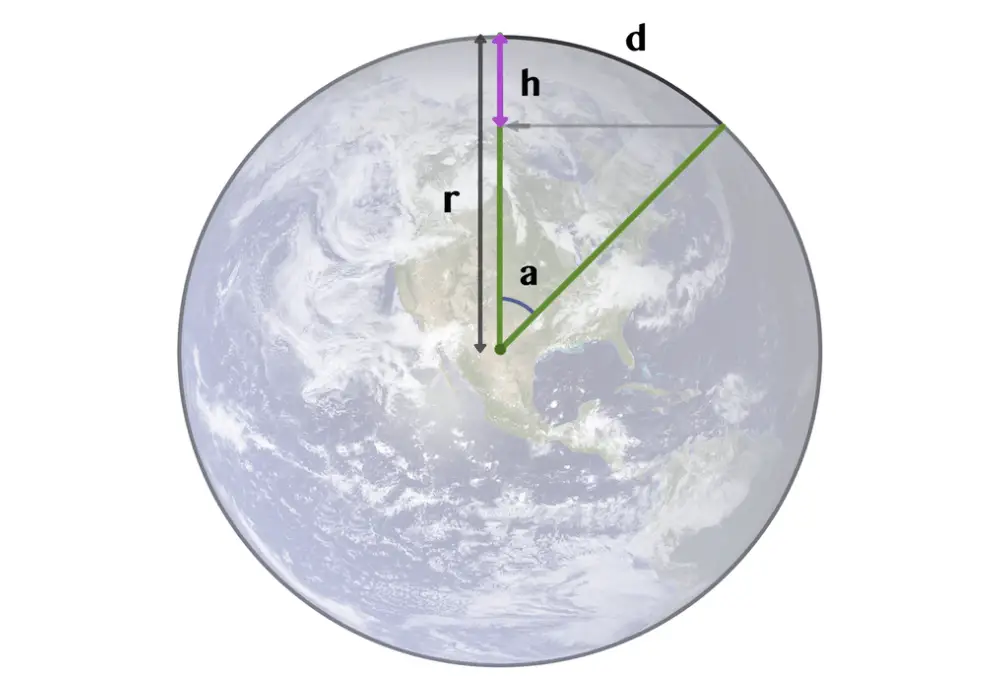
Notice how it defines terms to avoid ambiguity?
d is the distance along the surface. Not a horizontal distance.
a is the angle subtended.
h is the vertical distance measured from the starting point straight down, until it meets a hypothetical straight line starting at this vertical line and going to the point on the surface with this line at right angles to the vertical line?
So what is h?
Well, first we find a:
a = d/r (assuming we are using radians, if you want to use degrees it is d*360/(2*pi*r))
Then we note that h = r-r*cos(a) = r*(1-cos(a))
So that means h=r*(1-cos(d/r))
But that uses trig which is hard. Is there a way to simplify it?
Well we can take the small x approximation for cos:
cos(x)~=1-x^2/2 for small values of x.
So that gives us:
h=r*(1-(1-(d/r)^2/2))
h=r*(1-1+d^2/(2*r^2))
h=r*d^2/(2*r^2)
h=d^2/(2*r)
And hey, would you look at that, d^2/2r, just like I have said many times.
And putting in some basic substitutions, you get ~ 8 inches per mile SQUARED!
Notice the key part: SQUARED!!!
Ignoring that and pretending it is a straight line just further demonstrates your dishonesty.
In a real sphere (which we don't have!) we have a 560 mile curvature, or 1 mile of curve every 14 miles.
Now try actually drawing what you are suggesting.
Here, I'll do it for you:

Do you understand the difference between a curve and a straight line?
Because you don't seem to.
You also yet again fail at basic math.
How did you get 560 miles?
Your "core to surface" is simply the radius. i.e. 7920/2 = 3960.
diameter - radius = radius.
So that should simply be 3960 archaic units.
Not 560.
So you appear to just pull that number from literally no where.
You then fail again at basic math, but using the entire diameter, to reach the peak in the centre, to claim it is 1 mile for every 14 miles.
If you correct just for that, then going from the mid point to the edge, would be those "560 BS" which means you should have ended up with 1 BS ever 7 archaic units.
And if you did the math above correctly, you would end up with 1 mile per mile. (a drop of 3960 archaic units, over a distance of 3960 archaic units).
But this would put parts of Earth outside the atmosphere as calculated!
Then stop with such shit calculations.
Try to actually do basic math correctly.
Try to understand the difference between a curve and a straight line.
Your idea of a round Earth is a triangle.