Sorry for this little interruption of your trolling rodent lives (since i've already left this thread)...
Since you're still here...
Below is from one of several posts that make the same assertions. Let's consider them:
Although planet-like, the comets do not display retrograde motion, *Tycho* argued that the stations and retrogradations that we see in the motion of the planets must really be theirs rather than due to the motion of the earth as Copernicus claims:
This is now known not to be correct.
Some terminology:
In addition to apparent retrograde motion, caused by the motion of the earth in its orbit, a few comets are actually have retrograde orbits - they orbit the sun in the opposite direction of most everything else in the solar system.
Because he had no optical equipment which would allow him to see any objects dimmer than naked-eye, Tyco could observe only the brightest comets while they are in the brightest part of their orbits. Comets are brightest when they are relatively close to the sun, which means they are also moving at their fastest. Fast-moving comets in prograde orbits will give an apparent retrograde motion when they pass between earth and sun. This is the cause of apparent retrograde motion of the inner planets Mercury and Venus. When comets move more slowly than earth in its orbit (i.e. when they are distant from the sun, which is most of the time) they can also exhibit apparent retrograde motion, but they are generally too dim to see without a telescope. Apparently he simply did not see and record the motion of any comets exhibiting retrograde motion (real or apparent), which is not too surprising given this would be most common when they're dim, and rare for ones bright enough to see.
_"In addition the two comets which were carried near the opposition of the sun showed clearly enough that the earth does not in fact revolve annually, since the motion of the earth did not detract in any way from their regular and established motion, as happens to the planets which Copernicus believes move backward because of the motion of the earth" (VII, 130). In short, if the earth revolved annually around the sun, why would the comets not also display retrograde motion?"_
Which two comets? It's apparent that Tyco simply did not have an opportunity to observe a comet during any apparent retrograde portion of its orbit. As noted, it's not too difficult to understand why...
It is very difficult to understand why are you so sure that Tycho was an idiot, and that your HC friends (NASA shills) are not.
You actually portray Tycho (the greatest astronomer of all time) as an idiot, don't you?
So, since you are so sure that he was an idiot, then you should be able to provide for us one single relevant quote written in the last 400 years by some famous astronomer or physicist who actually attacked the very core of Tycho's argument claiming that Tycho's assertion ("comets don't display retrograde motion") doesn't hold water (isn't tenable). If you can't do that, then we will be compelled to conclude that you are the first famous astronomer in the whole world who opposed Tycho's argument on this "core" basis in last 400 years. As we saw earlier, the author of that paper from which i took description of Tycho's argument, claims something totally different than you, he claims that in Tycho's system comets should display retrograde motion (as well as in HC system), that is to say : if they don't display retrograde motion then Tycho's argument can't serve as the verification of Tycho's system, and falsification of Copernicus system.
Which comet? This one :
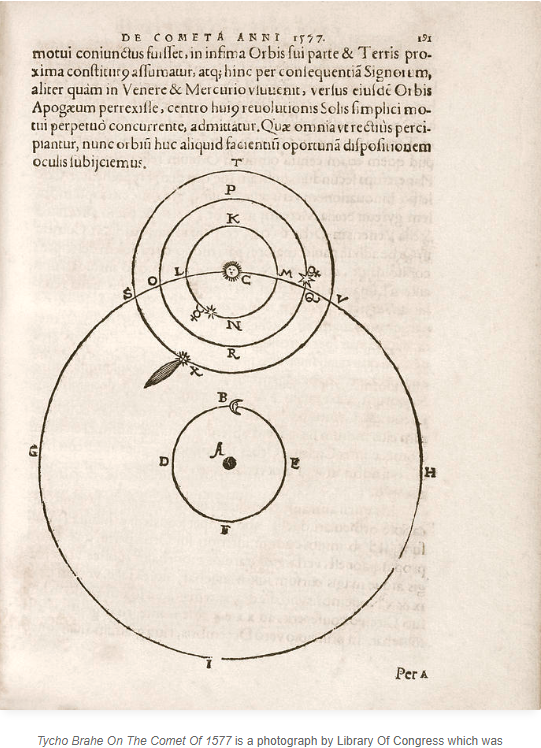
The great comet of 1577 (official name :
C/1577 V1), all i can find about it's trajectory is that this comet was beyond Venus, which is in accordance with these portion of your quote above :
Fast-moving comets in prograde orbits will give an apparent retrograde motion when they pass between earth and sun. This is the cause of apparent retrograde motion of the inner planets Mercury and Venus, isn't it?
A quick reminder :Although planet-like, the comets do not display retrograde motion, *Tycho* argued that the stations and retrogradations that we see in the motion of the planets must really be theirs rather than due to the motion of the earth as Copernicus claims:
_"In addition the two comets which were carried near the opposition of the sun showed clearly enough that the earth does not in fact revolve annually, since the motion of the earth did not detract in any way from their regular and established motion, as happens to the planets which Copernicus believes move backward because of the motion of the earth" (VII, 130).
In short, if the earth revolved annually around the sun, why would the comets not also display retrograde motion?"_
Your attempt of refuting Tycho's argument boils down to arguing that comets do display retrograde motion.
However, the author from whose book this excerpt is taken, doesn't share your opinion, since he proceeds (right after the paragraph above) with the following words (counter-"argument") :
Tycho's argument is not entirely consistent: in his system no less than
Copernicus's the stations and retrogradations of bodies revolving around
the sun are due to the position of the observer on earth, which is either
stationary while the sun is not (geoheliocentrism), or in motion while the
sun is immobile (heliocentrism). Therefore comets that revolved like the
planets around the sun would be expected to display retrograde motion
in both systems.He is obviously talking about one special hypothetical case in which comets revolve like planets around the sun.
1. How does such special hypothetical scenario is capable of disproving Tycho's argument?
2. How come that the author doesn't use your "counter-argument"? Maybe because if it was the case (if you were right) then it would be certainly the most elegant way of refutation of Tycho's argument, wouldn't it?
The author continues like this :
Nevertheless,
Tycho clearly believed that his argument from the behavior of comets was forceful (definite in expression or action). In a letter to
Magini, professor of mathematics at Bologna, dated 1590,
Tycho described his arguments about comets. The Copernican system, he proclaimed, with its
"triple motion of the earth will be unquestionably refuted, not simply theologically and physically, but even mathematically, even though Copernicus hoped that he had proposed to mathematicians sufficiently mathematical statements to which they could not object" (VII, 295).
Tycho was especially proud to announce a refutation of Copernicus on his own ground, responding to the latter's remark in the preface to
De revolutionibus that "
mathematics is written for mathematicians."