In bullshit you trust
No, we don't trust in you.
Of course not, you trust in you, and you were George Carlin's main topic, also! How come?
I answered your question many times, but since you are full of shit, you will continue to pretend that i didn't!
So, the next time when you put forward for umpteenth time in a row, your famous idiotic question i will simply direct you to this very post. O.K.?
And the post goes like this :

To acknowledge the existence of air drag in front of the rocket while, at the same time, deny the existence of the opposite air displacement exerted by the exhaust plume below it - is an utter contradiction in terms and a crude offense to common sense. If this were to be true (that "rockets do not push against air"), this would mean that the formidable, explosive thrust of a rocket's exhaust plume does not encounter any air resistance - a preposterous and outlandish contention, if there ever was one. Instead, as the NASA quackery goes, we are asked to believe that rockets are propelled solely by the "recoil force" generated by the rapid expulsion of fuel mass from rocket tanks. If this were true, we should all hover above our toilet seats when stricken with explosive diarrhea - yet I doubt that anyone has ever had the (mixed) fortune of experiencing such a thrill.
This means that, if this were to be the case (that rockets move due to "recoil action/reaction")- more than half of any rocket's fuel mass would have to be ejected at that speed - as illustrated in this diagram:
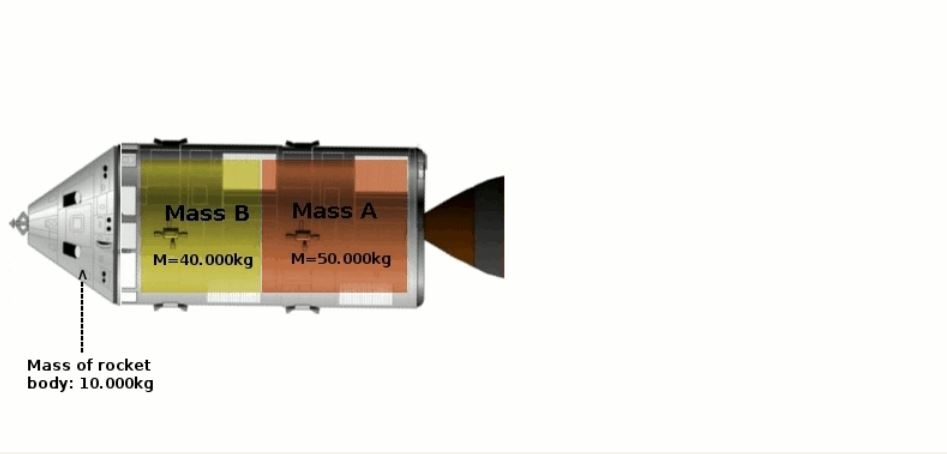
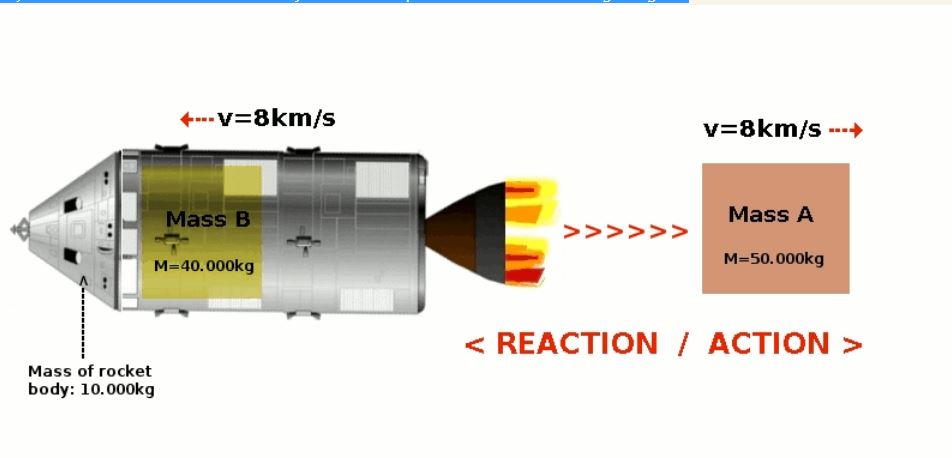
Of course, this is not the case - and would be quite impossible to do.
Why do you think it's not the case? Which part do you think is impossible?
Seriously? lol
Yet, this is basically how NASA 'explains' how their spacecrafts are propelled through air and vacuum. Please note that I have respectfully observed Newton's Third Law in my above diagram. I think our poor friend Isaac is rolling and howling in his grave - seeing how NASA is abusing / distorting his laws in order to fool the world. Sadly, most people seem to keep buying into their shameless skullduggery.
One interesting question for Rabinoz who "knows" how to think for himself (out of the box) :
If exhaust velocity of let's say Ariane 5 rocket is 2,7 km/s, then why don't we see 2,7 km long exhaust trail behind Ariana 5 rocket right after lift off???
Exhaust trail behind Ariana 5 rocket :
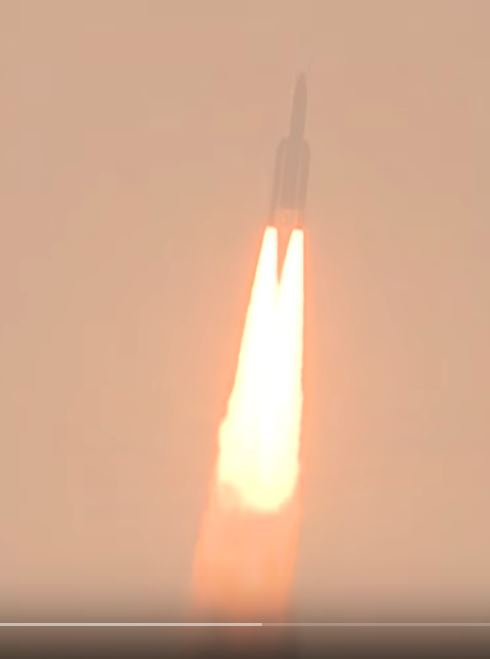
Why? Why have you arbitrarily choosen "2.7km" as the length of the exhaust trail you want to see? Just because that's the number you saw for the exhaust velocity and it's now stuck in your head? Maybe the trail of hot but not flaming gases is a couple of km long, you just can't see it.
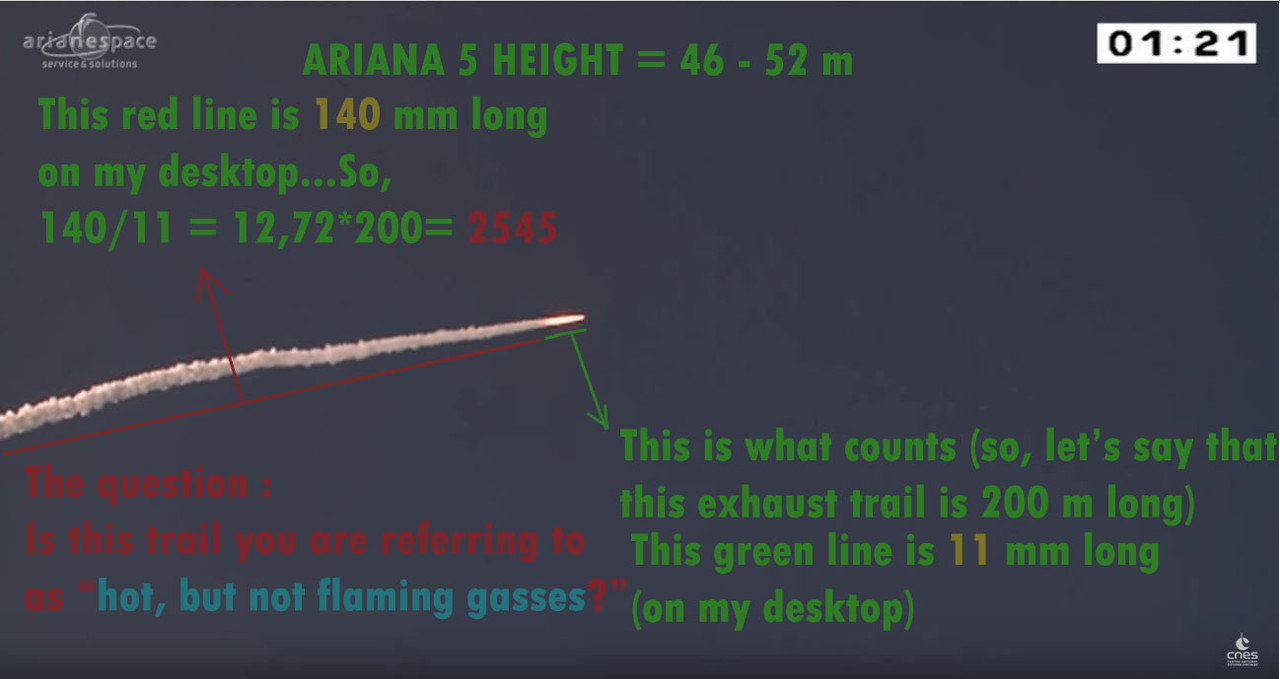
Again:
What force is acting on the gas that is exiting the rocket to make it go in a particular direction and what is the other body involved in this interaction?
The Expansion produces
THRUST FORCE!
What law disables rockets (via expansion) from doing any useful work in a vacuum?
Free expansion!What makes "the difference" between the Expansion and Free expansion?
Density of air/vacuum! Why?
Resistance!What it means?
It means that there is resistance in the air because the air is dense, hence : the air is the second body!On the other hand, there is no resistance in a vacuum, hence : the second body is missing!Was this helpful in a sense that now you are ready to admit that there is no error in the following explanation :
Newton's Third Law - Identifying Action and Reaction Force Pairs
A force is a push or a pull that acts upon an object as a results of its
interaction with
another object. Forces result from
interactions!
"When one body exerts a force on a second body, the second body simultaneously exerts a force equal in magnitude and opposite in direction on the first body."
You still haven't watched this video :
https://www.dailymotion.com/video/x7ga9h2No, the “second body” isn't the gases...in a rocket launch...the rocket (engine) is the “first body” applying force (expelled gases) to a second body (ground, then atmosphere).. which “pushes back” with equal and opposite force.. on the first body (rocket) forcing it to go up..
what happens in a REAL and INFINITE vacuum, where there is no “second body” to act upon???
THE ROCKET (ENGINE) = FIRST BODY
THRUST FORCE = EXPELLED GASSES
GROUND/ATMOSPHERE =
SECOND BODYTHE PROBLEM No 1. If the speed of dissipation (velocity of gas expansion in a vacuum) is equal or greater than exhaust velocity of a rocket, then thrust efficiency is ZERO.
THE PROBLEM No 2 : What kind of a rocket could provide enough thrust, so that it can fly for 8,25 hours continually, pushing itself off of their own ejected gasses? After liftoff, it takes about 10 minutes before the main rocket stages burn out (depends on the rocket used). After that, the spacecraft is in zero G. The trip from the surface to low Earth orbit is a matter of about 10 minutes under thrust.
THE PROBLEM No 3 : As the rocket climbs ever higher, it will have to exponentially increase its output/thrust (and, of course, its fuel consumption), in order to keep going - and combating the pull of gravity which, contrary to public belief, does NOT decrease exponentially with altitude. Now, remember: NASA tells us that their rockets perform below max efficiency at sea level, at optimal efficiency somewhat higher in the atmosphere (as the rocket pressure equalizes with the external air pressure) and then start losing efficiency again as they ascend into ever thinner air.
Note: NASA says so - not me.THE PROBLEM No 4 : To attain the so-called escape velocity of 11km/s with "recoil power" only, this is what NASA's rockets would have to do: they'd have to shoot out from behind their rockets, all at once (like a bullet from a gun) a mass equal to the mass of the vessel itself - at a velocity of 11km/s. This means that, if this were to be the case (that rockets move due to "recoil action/reaction")- more than half of any rocket's fuel mass would have to be ejected at that speed.
Let's try once again :1. When a rocket's combustion chamber is filled with accelerated gas opening the nozzle to expel the gasses into the vacuum of space does not generate a force against the ship. This is due to the principle of
free expansion.
2. No amount of combustion or pressure inside the space ship can move the ship until that combustive force or pressure is exchanged with some object, entity, or field
outside of the ship (a space ship is a
closed system).
3. Based on 1 and 2 there is no way to move the ship by releasing gas and no way to move the ship by keeping the gas inside. A space ship cannot generate force with a gas based propulsion system. Space rockets are the stuff of fantasies not science or physics.
4. Any liquid exposed to a vacuum is immediately converted to gas and any gas is immediately spread out into the void. So any combustion would have to take place in a sealed container and hence not in a vacuum in the strict sense.
5. Contrary to known rocket's trajectories, they need to end up going seven miles per second away from the center of gravity (center of gravity = center of the earth)! (see
reply #270)
Regarding the possibility of opening one side of a container, exposing it to the vacuum, while combusting gasses inside the container. In this case we have to consider that combustion can't occur anywhere near the opening because any liquids in that area are being instantly converted to gas by the vacuum and spread out into the void via
free expansion. When combustion occurs at the far side of the container
the force is going to push the remaining liquid out before it can be combusted. This seems like a terribly inefficient use of fuel as the combustion itself is forcing unspent fuel into space.
Another problem is that gas enters a vacuum at an average speed of about
2,000 meters a second. A 25 meter long Saturn 5 stage 2 fuel tank with over 1,000,000 liters of fuel would have it's contents drained in about 1/100 of a second if exposed to the vacuum of space.
Well, consider this: no honest scientists will deny that, when opening a valve between two containers (one containing air at high pressure - and the other only vacuum) the pressures in the two containers will equalize in a fraction of a second, the vacuum container 'sucking' the air to itself with tremendous, almost explosive force.
Imagine now the high pressure emitted by any rocket from its (always open) nozzle. As it enters the vacuum of outer space, the very same - almost explosively rapid - pressure equalization is bound to occur. The rocket will be emptied of all of its pressurized fuel in a flash - by the overwhelmingly superior power of the vacuum itself. No matter how powerful the rocket (propelled by any fuel known to man / and designed to perform in our 0,001 atmosphere) - the very laws of physics will not allow it to ascend any further into the void of space. It will haplessly tumble back to Earth.
In Summary1. Without free expansion the rocket exhaust will push against space. And off we go!
2. Objects don't accelerate unless they exchange energy with some other object/field. There are no objects or fields in space (I regard them to be so small/weak as to be virtually non-existent).
SIMPLE QUESTION FOR JackBlack and Rabinoz :
If exhaust velocity of let's say Ariane 5 rocket is 2,7 km/s, then why don't we see 2,7 km long exhaust trail behind Ariana 5 rocket right after lift off???