This means the maximum aberration you should ever get is atan(v/c).
Now, your own references indicate that you get an aberration of ~20 arc seconds.
The tan of 20 arc seconds gives us 0.00009696273=v/c.
That means v=0.00009696273*c=~0.00009696273*300000000=29088.8209577 m/s=~29 km/s.
Happy now?
So you have stellar aberration giving a minimum velocity of roughly 29 km/s, and MM giving a maximum velocity of less than 5 km/s.
This is an impossibility. 29 km/s is not less than 5 km/s.
This means the aether model is wrong.
(As a side note, this is also one way to calculate the distance to the sun. Assuming Earth orbits the sun, with a period matching the year, in a roughly circular orbit, then with the velocity obtained from stellar aberration we can calculate the circumference of Earth's orbit and thus the radius (distance to the sun).)
1. STELLAR ABERRATION - REVERSE ENGINEERING - THE DISTORTION OF SCIENCE AT IT'S BEST :
It was chiefly therefore Curiosity that tempted me (being then at Kew, where the Instrument was fixed) to prepare for observing the Star on December 17th, when having adjusted the Instrument as usual, I perceived that it passed a little more Southerly this Day than when it was observed before. James Bradley, 1727
Bradley’s interpretation, based on the Newtonian corpuscular concept of light, accounted quite well for the basic phenomenon of stellar aberration, but it requires us to believe that the velocity of light is remarkably constant from all sources in all circumstances. Indeed, commenting on the concordance between the speed of light inferred from aberration and from Roemer’s method based on the Sun’s light reflected from Jupiter’s moons,
Bradley wrote :
These different Methods of finding the Velocity of Light thus agreeing, we may reasonably conclude, not only that these Phaenomena are owing to the Causes to which they have been ascribed; but also, that Light is propagated (in the same Medium) with the same Velocity after it hath been reflected as before; for this will be the Consequence, if we allow that the Light of the Sun is propagated with the same Velocity, before it is reflected, as the Light of the fixt Stars. And I imagine this will scarce be questioned, if it can be made appear that the Velocity of the Light of all the fixt Stars is equal, and that their Light moves or is propagated through equal Spaces in equal Times, at all Distances from them: both which points (as I apprehend) are sufficiently proved from the apparent alteration of the Declination of Stars of different Lustre; for that is not sensibly different in such Stars as seem near together, though they appear of very different Magnitudes. And whatever their Situations are, I find the same Velocity of Light from my Observations of small Stars of the fifth or sixth, as from those of the second and third Magnitude, which in all Probability are placed at very different Distances from us. Now, let's see what "concordance" (between the speed of light inferred from aberration and from Roemer’s method based on the Sun’s light reflected from Jupiter’s moons) are we talking about here :
As i have proven in my reply #138 :
https://www.theflatearthsociety.org/forum/index.php?topic=78424.msg2121710#msg2121710 :
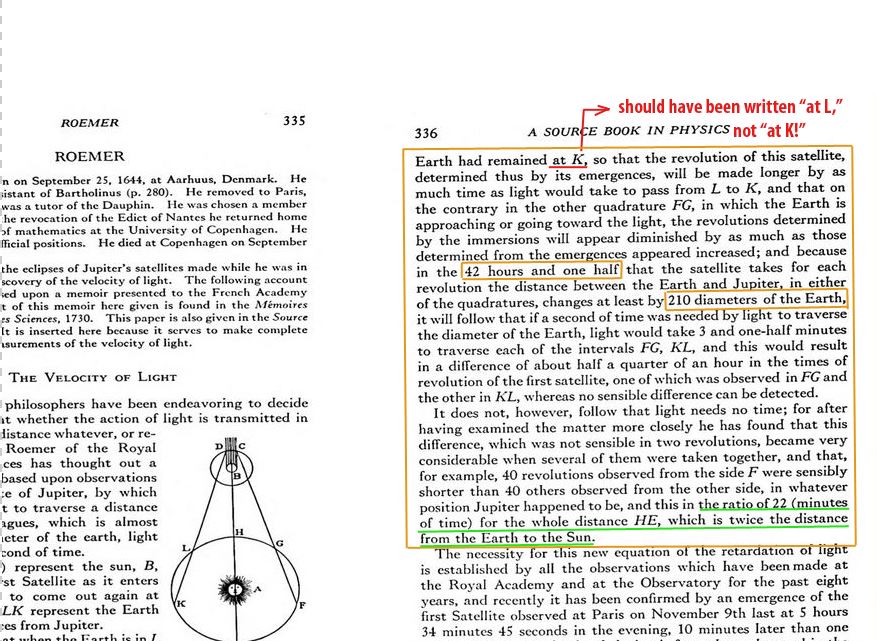
Ole Roemer's estimation for the speed of light (133 672 km/s) is in accordance with 88 223 522 km (the distance to the sun according to Ole Roemer's contemporaries Wendelin (1635) and Horrocks (1639) : 14000 earth's radii).
This estimation (88 000 000 km) for the distance to the sun delivers 18 km/s for the alleged speed of the earth.
However, if this alleged earth's orbital speed were true and 133 000 km/s (Roemer's estimation for the speed of light) were also true, then these two numbers (earth's orbital speed (18km/s) and Roemer's speed of light (133 000 km/s)) wouldn't match Bradley's 20,6'' stellar aberration.
So, what we have to do now (after Bradley discovered 20,6'' stellar aberration) in order to achieve (artificially produce) above mentioned alleged "concordance" (between the speed of light inferred from aberration and from Roemer’s method based on the Sun’s light reflected from Jupiter’s moons)?
First solution :If we want to preserve Wendelin's and Horrocks estimation for the distance to the sun (88 000 000 km) then in order to achieve concordance between earth's orbital speed and the speed of light (so to preserve Bradley's 20,6'' aberration), we have to increase the value for the speed of light from 133 000 km/s to 180 000 km/s, but it means that we have to decrease Roemers 11 minutes for almost full 3 minutes (instead of 660 sec, we would have to say that Roemer was off for 171 seconds), which is too much.
Second solution :If we accept Cassini's estimation (138 880 000 km), then we have to increase Roemer's estimation for the speed of light more than twice (from 133 672 km/s to 270 650 km/s), but in this case we will have to decrease Roemer's 11 minutes for 24 seconds less than in the first case, and that sounds somewhat better.
If (in a due time) it turns out that the speed of light is greater we will simply accommodate it by widening earth's orbit and decreasing Roemer's 11 minutes to a greater extent or the other way around : we will narrowing earth's orbit and decrease Roemer's 11 minutes to a lesser extent.
So, for example :
If it turned out that the speed of light is 250 000 km/s then earth's orbital speed would be 25 km/s (the distance to the sun would be 125 500 000 km), and Roemer's time would be 502 seconds.
If it turned out that the speed of light is 300 000 km/s then earth's orbital speed will be 30 km/s (the distance to the sun would be 150 000 000 km), and Roemer's time would be 500 seconds.
30 000 m / 300 000 000 m = 0,0001 (ctg) = 0,005729 * 3600 = 20,6''
25 000 m / 250 000 000 m = 0,0001 (ctg) = 0,005729 * 3600 = 20,6''
etc...
REVERSE ENGINEERING AT IT'S BEST !!!Now, it's time to recall the following excerpt from
Gerrard Hickson's book "Kings dethroned" :
"The 18.64 miles is wrong, because the 93,000,000 is wrong, because neither Encke nor Gill obtained any measurement of the sun’s distance whatever; and the whole affair is nothing more than a playful piece of arithmetic, where the distance of the sun is first presumed to be known; from that the Velocity of the earth per second is worked out by simple division, and then the result is worked up again by multiplication to the original figure, “93,000,000,” and the astronomer then says that is the distance to the sun.
That is why it is absurd.
Finally the sun’s distance as 93,000,000 miles is said to be justified by the “Velocity of Light.” The Velocity of Light was measured by an arrangement of wheels and revolving mirrors in the year 1882 at the Washington Monument, U.S.A., and calculated to be 186,414 miles a second. N.B.— Experiments had been made on several previous occasions, with somewhat similar results, but Professor Newcomb’s result obtained in 1882, is the accepted figure.
Taking up this figure, astronomers recalled that in the 17th century Ole Roemer had conceived the hypothesis that light took nearly 8 1/2 minutes to travel from the sun to the earth, and so they multiplied his 8 1/2 minutes by Newcomb’s (SEE THE DIAGRAM BELOW) 186,414, and said, in effect — “there you are again— the distance of the sun is 93,000,000 miles.”
It is so simple ; but we are not so simple as to believe it....."
ESPECIALLY IF WE HAVE IN MIND THAT IN THE 17th CENTURY OLE ROEMER HAD NOT CONCEIVED THE HYPOTHESIS THAT LIGHT TOOK NEARLY 8 1/2 MINUTES TO TRAVEL FROM THE SUN TO THE EARTH, SINCE THE TRUTH IS THAT HE CONCEIVED THE HYPOTHESIS THAT LIGHT TOOK FULL 11 MINUTES TO TRAVEL FROM THE SUN TO THE EARTH!!!THE QUESTION :
WHO WAS THE FIRST ONE WHO DETERMINED THE DISTANCE TO THE SUN?THE ANSWER :
THE SAME GUY WHO FIRST MEASURED THE EXACT SPEED OF LIGHT!!!FOR WHOM THE BELLS RING???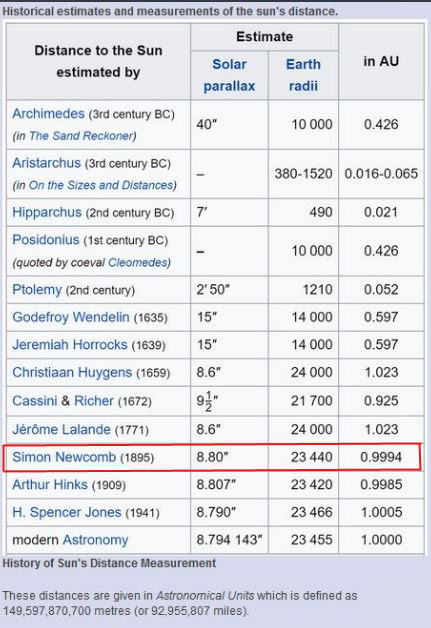 2.
2. The speed of the Earth / the speed of light = the angle of stellar aberration / the size of a radian,
where a radian is the angle in a circle / 2 π = 360 * 3600 / 6.28318531 = 206264.806, or
the speed of the Earth / the speed of light = the angle in seconds of arc / 206264.806
Using the 20 arc-seconds observed by Bradley (the total change in stellar positions was 40 arc-seconds, but half of that is when the star goes one way, when we are on one side of our orbit, and half is when the star goes the other way, when we are on the other side of our orbit) in this equation, we find that the orbital velocity of the Earth is approximately one ten-thousandth of the speed of light. Given our present knowledge of the speed of light (186,400 miles or 300,000 kilometers per second), the Earth's orbital velocity is hence measured as 18 1/2 miles or 30 kilometers per second.
If we accept the Copernican viewpoint and its unavoidable
extrapolations with regard to the structure of the universe, we
have to accept the consequences. Then we cannot hold on to the
picture of a simple sun- centered cosmos, of which not even
Newton was fully convinced, but which
Bradley and Molyneuxtook for granted.
If they accept— as all the textbooks still do!—Bradley's “proof” of the Copernican
truth, then their cosmological extrapolations of that truth clash
with a not-yet developed simple heliocentrism; that is to say, with
the model of an earth orbiting a spatially unmoved sun.
The other way around, when holding on to their galactic
conjectures, they are at a loss how to account for a steady 20”.5
stellar aberration. For in that scheme our earth, dragged along by
the sun, joins in this minor star's 250 km/sec revolution around
the center of the Milky Way.
If, for instance, in March we indeed
would be moving parallel to the sun's motion, our velocity would
become 250+30 = 280 km/sec, and in September 250-30 = 220
km/sec. The “aberration of starlight,” according to post-
Copernican doctrine, depends on the ratio of the velocity of the
earth to the speed of light. As that velocity changes the ratio
changes. Hence Bradley's 20”.496 should change, too. But it does
not. Therefore, there is truly a fly in this astronomical ointment,
paraded and promoted as a truth.3. Airy put water in the telescope to test Bradley's claim that the moving Earth
caused aberration; he saw no change in aberration angle with the water
added. This was termed a ‘failure’, since Bradley’s theory of receiver motion
predicted a change with the index of refraction – n.
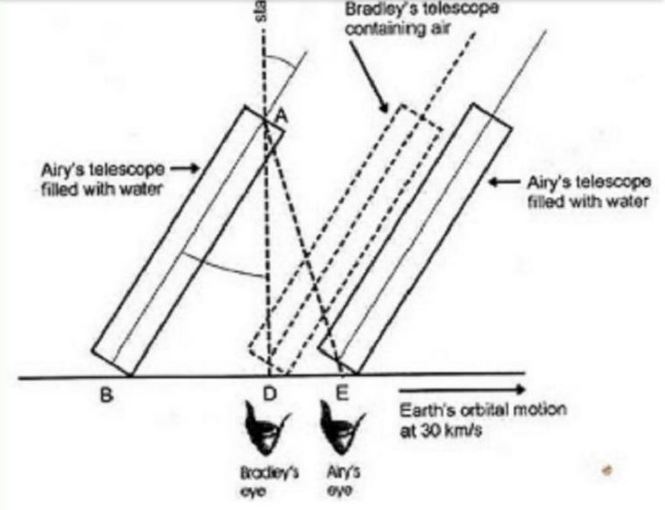
Bradley analysis – dashed lines above : The middle telescope is tilted to see
the aberrated starlight. When light moves through the telescope from A to D
the Earth – and telescope - move from B to D . This determines the aberration
angle of tilt , arc tan( BD/AD).
Airy analysis – solid lines above: With water added (left telescope), the light
travels the distance AD through the telescope slower, at ¾ of c.
So the telescope travels further at the Earth’s orbital speed, a distance BE, and
the aberration is now greater, arc sin( AD/BE ). Nice theory, but fails to
predict the actual result, shown in the right telescope – there’s NO CHANGE
in the tilting required!
The Earth’s motion as cause of aberration is simply refuted by Airy’s test – the
‘failure’ to increase aberration with water as the telescope medium, instead of
air.
Airy’s failure is in reality a ‘success’ for GC prediction and the ALFA model,
where the flexible aether ‘s sidereal rotation explains the result. The deflection
occurs in transit due to the sideways aether flow. The light path is bent in
space, before entering the telescope, while the Earth is at rest.
GC ALFA analysis : There are no D and E distances, since the Earth is
motionless. The light beam in water just travels slower, at ¾ of c, from A to B,
but there’s no sideways motion. So no additional tilting is needed….. Airy’s
test is a success – for GC and the ALFA model!
CONCLUSION: The deflection of starlight known as stellar aberration is NOT due
to the Earth’s motion, but is an external bending of light before reaching the
telescope.
4. As for MMX itself, the common interpretation by Special Relativity theorists is that the experiment yielded a “null” result. Yes, if you are looking for fringe shifts in the interferometer that coincide with an Earth moving around the sun at 30km/sec, I guess one would be predisposed to conclude that the results of MMX were “null.”
But the truth is, in the technical sense of the term, the results of MMX were anything but “null.” Null means zero, but MMX did not register a zero ether drift. It measured one-sixth to one-tenth of the 30km/sec that the Earth was supposedly moving around the sun. Here are Michelson’s own words:
“Considering the motion of the Earth in its orbit only, this displacement should be 2D v^2/V^2
= 2D × 10^-8. The distance D was about eleven meters, or 2 × 10^7 wavelengths of yellow light;
hence, the displacement to be expected was 0.4 fringe. The actual displacement was certainly less
than the twentieth part of this, and probably less than the fortieth part. But since the displacement
is proportional to the square of the velocity, the relative velocity of the Earth and the ether is probably
less than one-sixth the Earth’s orbital velocity, and certainly less than one-fourth”
(A. A. Michelson and E. W. Morley, “On the Relative Motion of the Earth and the Luminiferous Ether,” Art. xxxvi, The American Journal of Science, eds. James D and Edward S. Dana, No. 203, vol. xxxiv, November 1887, p. 341.)
So was the case for every interferometer experiment performed for the next 80 years until the 1960s –
a small ether drift that was a fraction of 30km/sec. This was a conundrum for Einstein and his followers, since the Special Theory of Relativity, which was invented to answer MMX, claimed that there was NO ether at all in space – none, nada, zilch, zero.
In fact, Einstein said that if there was any ether in space, then his theory is nullified.He said, “If Michelson-Morley is wrong, then Relativity is wrong.” - Einstein: The Life and Times, p. 107.
So Einstein simply dismissed the fractional ether drift of MMX as a mere artifact.But the sad fact is, scientifically speaking, artifacts would not have appeared in all the dozens of interferometer experiments performed over the next 80 years.“Artifacts” are posited only because modern interpreters are bound to the Copernican Principle, by their own admission.
Interestingly enough, Michelson preformed another interferometer experiment with Gale in 1925 (MGX),
but this one was designed to measure the rotation of the Earth, not a revolution around the sun. Lo and
behold, Michelson found an ether drift that was near 100% of a 24 hour rotation period. So, whereas
MMX measured 0.1% of a 365-day revolution around the sun, MGX measured a 99% of a 24-hour
rotation, simply by using the measured ether drift.
This presents quite a problem for the heliocentric camp, for the interferometers measure a rotation but
not a revolution. But heliocentrism must have both, otherwise it is falsified!
Conversely, geocentrism needs only one, the rotation, since if the star field is rotating around a fixed
Earth we would expect to see a near 100% ether drift against the Earth, which is precisely what the 1925
MGX showed. But since there is no revolution of the Earth in the geocentric system, this answers why the
1887 MMX did not produce anywhere near a 30km/sec ether drift. The facts speak for themselves. On a
purely scientific basis, there is absolutely no reason why a motionless Earth cannot be used to explain
both MMX and MGX!
5. Because of the resolution limits, the Sagnac experiment could never have hoped to detect the rotation of the earth, anymore than the MM experiment could have detected the rotation of its own apparatus. What the Sagnac experiment did, however, unequivocally demonstrate was that there was a precedent for the optical detection of rotary
motion.
But relativists, including Einstein, largely discarded this fact for nearly three decades.
An open-loop Sagnac effect (dt= 2A?/c2) is today well established for the paths of electromagnetic signals around the planet: employing the GPS satellite relay system, delays have been measured by clocks on the order of fractions of microseconds in the W-E transmission with respect to the E-W transmission.So, an open-loop Sagnac effect proves that there is a rotational motion of an aether around the stationary earth.
Why?
Because an open-loop Sagnac effect can be the consequence of earth's rotation within stationary aether or it can be the result of the rotation of an aether around the stationary earth.
Since all interferometry experiments which were designed to detect earth's orbital motion yielded too small fringe shifts (hence "null result"), then there is no way that an open-loop Sagnac effect can be ascribed to the alleged earth's rotational motion, and instead it must be assigned to the rotation of an aether around the stationary earth.
Case closed!