Please explain in detail, if you can, how it would look much different.
The horizon is nice and sharp, clearly an edge.
If Earth was flat there shouldn't be this nice clear edge.
Really? Have you ever even tried to calculate how thick that "non-clear edge" might be?
According that "Metabunk Earth's Curve Horizon, Bulge, Drop, and Hidden Calculator", much favoured by globularists,
from 2 m elevation the horizon on the ball would be only 0.04° below eye-level! That wouldn't show in a photo like I showed.
Instead you should be able to see much further, seeing the shore on the other side.
But even in the clearest air (and where do we ever get "the clearest air" with all the pollution these days?) there is a finite limit to visibility.
Contrary to popular belief, the atmosphere wouldn't be a problem as without gravity there is nothing to hold it to Earth and keep it pressurised so it would have just flown away or spilled over the edge. If you magically contain it, then the air would scatter the light resulting in a blur instead of a nice clear horizon.
But, my point above is that this "blur instead of a nice clear horizon" would really be too narrow to show on the photo that I showed.
So just how would the horizon differ?
PS: Imagine nice big tall fluffy clouds that can be dark underneath disappearing into the horizon. So we see the dark underside or the white sides of those on the horizon?
Maybe there's a clue there?
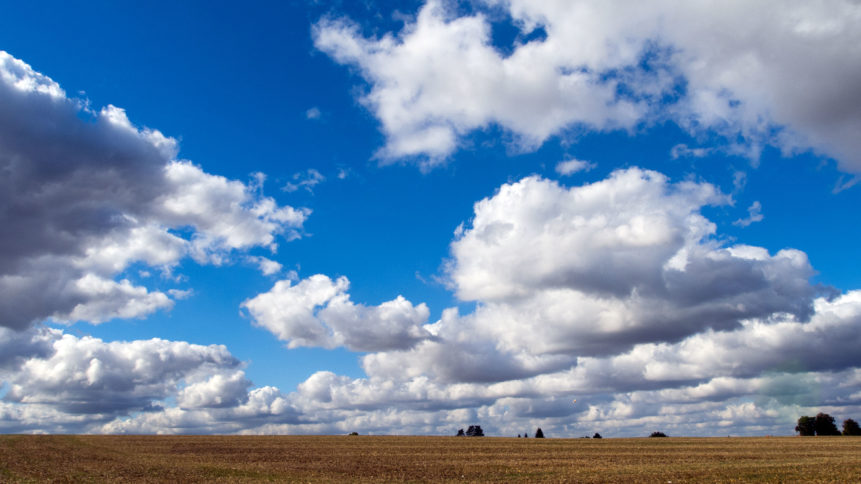
Blue sky and white clouds above the dry field in summer. |
The dyed-in-the-wool flat-earther,
Phuket Word can always be relied on the provide very good evidence:
Flat Earth  Proof - Clouds on Horizon by Phuket Word Proof - Clouds on Horizon by Phuket Word
Clouds on horizon are flat earth proof of no curvature but perspective (  really ?). really ?).
We do not see the bottoms of clouds on the horizon.
We see the sides due to perspective the earth's not being flat!. |
We would see the dark undersides of clouds past the horizon were the earth flat - but we do not, we see the sides! Sorry I could not get better photos.