Bad Astronomy

  • 60 Replies
  • 13982 Views
?

Tom Bishop

Bad Astronomy
« Reply #30 on: January 08, 2007, 05:50:07 PM »
For more proof that the earth is flat please read "A hundred proofs the Earth is not a Globe" by William Carpenter.

?

Kwaun Se

  • 109
  • +0/-0
Bad Astronomy
« Reply #31 on: January 08, 2007, 05:51:27 PM »
They only LOOK flat. That's an observation that was actually disporven and led to the creation of a round earth, the sailboat. Ptolmey, if that's how you spell his name, saw a boat going off in the horizon, but it didn't match a flat earth, or something like that, so he made the first globe.

?

GeoGuy

Bad Astronomy
« Reply #32 on: January 08, 2007, 05:54:46 PM »
Well I am sorry to say that Ptolemy was sorely mistaken.

?

Kwaun Se

  • 109
  • +0/-0
Bad Astronomy
« Reply #33 on: January 08, 2007, 05:56:45 PM »
... You need serious mental help. Really you do. How can you not accept this. Your theory holds no value anywhere, is discredited by everyone, and can't be proven without a giant global conspiracy, and that even with that still has several holes.

Bad Astronomy
« Reply #34 on: January 08, 2007, 06:08:51 PM »
Once again the FE'ers have convoluted the issue.  This theory is like a cult, teaching you to think in a circle and jump around to every little thing.  Why doesnt someone go back to the beginning of this thread and READ the original post!
ts no accident Kennedy Space Center is where it is, and always remember you're walking on the 2nd floor when you're at Disney World.

?

Curious

  • 413
  • +0/-0
Bad Astronomy
« Reply #35 on: January 08, 2007, 06:11:50 PM »
Quote from: "GeoGuy"
Well I am sorry to say that Ptolemy was sorely mistaken.


Well, you should be sorry to say such a thing.  Glad you apologized. : )

?

Kwaun Se

  • 109
  • +0/-0
Bad Astronomy
« Reply #36 on: January 08, 2007, 07:00:06 PM »
Because they know they are wrong.

?

FastEddy

  • 79
  • +0/-0
Bad Astronomy
« Reply #37 on: January 08, 2007, 07:06:16 PM »
Quote from: "GeoGuy"
Well I am sorry to say that Ptolemy was sorely mistaken.

In what way, and why. You can't just go around making opinionated statements without some evidence backing you up.

And saying 'But it looks flat' isn't evidence. Its an incorrect observation you mistakenly take to be fact.

?

GeoGuy

Bad Astronomy
« Reply #38 on: January 08, 2007, 07:17:01 PM »
He was mistaken in thinking he observed a ship 'sink' below the horizon (although, as he was not the first to discover this effect, it isn't entirely relevant).

?

Tom Bishop

Bad Astronomy
« Reply #39 on: January 08, 2007, 07:17:07 PM »
The adage of a boat disappearing hull first over the horizon is an old wives tale. In reality the boat disappears gradually as it is obscured by the atmosphere. Some claim to perceive the boat disappearing from the hull up because of an optical illusion caused by a merging of ocean and sky.

Besides, even in the RE model a person can really only see 20 miles in either direction. With a supposed circumference of 24900 miles, the viewer would not be able to discern the world's curvature from a boat 20 miles out.

?

Big N

  • 192
  • +0/-0
Bad Astronomy
« Reply #40 on: January 08, 2007, 07:29:18 PM »
Wow, I'm flattered that so many people are rallying behind my thread here.

To try to bring this discussion back to what the thread originally was about, I did post somewhere on the General Discussion forum a link to a site that explains how to use parallax measurement so even you yourself can measure how far away the stars are. I just can't remember which thread I posted that link in. One day I'll find it, though, and remind the flat earthers how they have no excuse not to do the measurements themselves.

EDIT:
Oh found it. It was actually earlier on in this thread: Measuring Distances Using Parallax

Try it out.
It's quite remarkable really that both Israel and Palestine have no qualms about slaughtering the crap out of each other - but they are perfectly willing to work together jovially and hide a secret that wouldn't make much difference to the world. -rdethgy

Bad Astronomy
« Reply #41 on: January 08, 2007, 08:47:18 PM »
Quote
The adage of a boat disappearing hull first over the horizon is an old wives tale. In reality the boat disappears gradually as it is obscured by the atmosphere. Some claim to perceive the boat disappearing from the hull up because of an optical illusion caused by a merging of ocean and sky.

Besides, even in the RE model a person can really only see 20 miles in either direction. With a supposed circumference of 24900 miles, the viewer would not be able to discern the world's curvature from a boat 20 miles out.


It is quite obvious that you either live under a rock, or you have never been to the beach and looked out at a boat going over the horizon.  This is not the 6th century anymore!! We arent superstitious pagans, we live in the 21st century!  I still can't wrap my mind around people who believe this stuff.
ts no accident Kennedy Space Center is where it is, and always remember you're walking on the 2nd floor when you're at Disney World.

Bad Astronomy
« Reply #42 on: January 09, 2007, 04:52:11 PM »
Dont let it die!
ts no accident Kennedy Space Center is where it is, and always remember you're walking on the 2nd floor when you're at Disney World.

*

EvilToothpaste

  • 2461
  • +0/-0
  • The Reverse Engineer
Bad Astronomy
« Reply #43 on: January 09, 2007, 05:07:57 PM »
Quote from: "Tom Bishop"
Besides, even in the RE model a person can really only see 20 miles in either direction. With a supposed circumference of 24900 miles, the viewer would not be able to discern the world's curvature from a boat 20 miles out.


If you honestly calculate the curvature of the Earth (say, how many feet drop for every mile you go out from an observer), it is pretty significant over 20 miles.   In the FAQ there is a link to a book that does the calculation.  

Well I can't find the webpage anymore, but I'll do the calculations for you, and post the derivation and results.

?

Tom Bishop

Bad Astronomy
« Reply #44 on: January 09, 2007, 06:14:40 PM »
Quote from: "EvilToothpaste"
Quote from: "Tom Bishop"
Besides, even in the RE model a person can really only see 20 miles in either direction. With a supposed circumference of 24900 miles, the viewer would not be able to discern the world's curvature from a boat 20 miles out.


If you honestly calculate the curvature of the Earth (say, how many feet drop for every mile you go out from an observer), it is pretty significant over 20 miles.   In the FAQ there is a link to a book that does the calculation.  

Well I can't find the webpage anymore, but I'll do the calculations for you, and post the derivation and results.


If the curvature of the earth at 20 miles is as significant as you say it it, look at this large image of this ocean horizon and compare its curvature with a ruler. The picture shows a vast tract of water, probably well over one hundred miles in length. Pixel for pixel, the horizon is completely flat.

http://www.sethwhite.org/images/summit2004/summit%20camp/sunset%203.jpg

I'm not affiliated in any way with this sethwhite.org, so don't try to claim I "photoshopped it flat."

*

EvilToothpaste

  • 2461
  • +0/-0
  • The Reverse Engineer
Bad Astronomy
« Reply #45 on: January 09, 2007, 07:12:38 PM »
Updated:  I used the diameter in place of the radius.  

Quote from: "EvilToothpaste"
Quote from: "Tom Bishop"
Besides, even in the RE model a person can really only see 20 miles in either direction. With a supposed circumference of 24900 miles, the viewer would not be able to discern the world's curvature from a boat 20 miles out.


If you honestly calculate the curvature of the Earth (say, how many feet drop for every mile you go out from an observer), it is pretty significant over 20 miles.   In the FAQ there is a link to a book that does the calculation.  

Well I can't find the webpage anymore, but I'll do the calculations for you, and post the derivation and results.


Here it is:
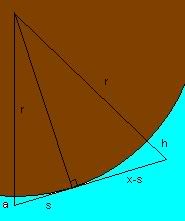


So here you have a diagram of an observer looking tangentially to the surface.  (observer is at bottom left, looking right along 'x')  

a: height of observer (assume 10 feet)
x: line-of-sight of observer
s: line-of-sight distance from observer to surface horizon
r: radius of spherical earth (8000 miles; a little large, but nice and pretty)
h: height an object must be in order to be seen by observer

Pythagoras tells us, for the left triangle:
(1)
r^2 +s^2 = (r + a)^2                

and for the right:
(2)
r^2 + (x - s)^2 = (r + h)^2      

For first (1) equation, solve for 's' and plug into second (2) equation.   Then solve second equation for 'h'.  (I used Mathmatica: i have the file if you want it)

Thus we can get a list of h (in feet, for your convinience) for every mile up to 20:

6.70
4.05
2.07
0.747
0.0841
0.0809
0.738
2.05
4.03
6.67
9.97
13.9
18.5
23.8
29.8
36.3
43.6
51.5
60.1
69.3

So at 20 miles, any object on your line of sight with the horizon (assuming a perfectly spherical surface) is 70 feet from the  calm ocean surface.

?

sodapop112

  • 264
  • +0/-0
Bad Astronomy
« Reply #46 on: January 09, 2007, 07:18:12 PM »
wow i can do all of thouse numbers in my head
he kinds of equations that they have now are the kinds of equations you would get in an approximation scheme to some underlying theory, but nobody knows what the underlying theory is.

discover magazine

*

EvilToothpaste

  • 2461
  • +0/-0
  • The Reverse Engineer
Bad Astronomy
« Reply #47 on: January 09, 2007, 07:24:52 PM »
Quote from: "Tom Bishop"
If the curvature of the earth at 20 miles is as significant as you say it it, look at this large image of this ocean horizon and compare its curvature with a ruler. The picture shows a vast tract of water, probably well over one hundred miles in length. Pixel for pixel, the horizon is completely flat.


Yes, the horizon is going to be pretty damn flat.  Keep in mind that the RE is actually spherical and not just round.  Meaning everything is going to drop off the same amount 360 degrees around you.  My calculations above are in a vertical plane, perpendicular to the surface.  You can't see the drop off because you can't see through the Earth.  So that tangent point I calculated (actually 5.5 miles away at 10 feet altitude) translates equally 360 degrees around you (assuming no landmasses).  Which in turn makes a pretty damn flat horizon.

You have to think about scale, and the incredible differences between your height and the diameter of the RE.  You are about six feet tall.  The Earth is about 42,000,000 feet in diameter.  

6;
42,000,000.

One is not going to see any curvature until a significant altitude is reached.

?

Curious

  • 413
  • +0/-0
Bad Astronomy
« Reply #48 on: January 09, 2007, 08:06:53 PM »
Quote from: "Tom Bishop"
Quote from: "EvilToothpaste"
Quote from: "Tom Bishop"
Besides, even in the RE model a person can really only see 20 miles in either direction. With a supposed circumference of 24900 miles, the viewer would not be able to discern the world's curvature from a boat 20 miles out.


If you honestly calculate the curvature of the Earth (say, how many feet drop for every mile you go out from an observer), it is pretty significant over 20 miles.   In the FAQ there is a link to a book that does the calculation.  

Well I can't find the webpage anymore, but I'll do the calculations for you, and post the derivation and results.


If the curvature of the earth at 20 miles is as significant as you say it it, look at this large image of this ocean horizon and compare its curvature with a ruler. The picture shows a vast tract of water, probably well over one hundred miles in length. Pixel for pixel, the horizon is completely flat.

http://www.sethwhite.org/images/summit2004/summit%20camp/sunset%203.jpg

I'm not affiliated in any way with this sethwhite.org, so don't try to claim I "photoshopped it flat."

I suggest you get a better monitor, because on my flat screen, I can easily see the rise in the middle when I place a flat edge along the image.

Your's is about the fifth time someone has posted a similar image, and all of them have had the same result.  I have even tried this in real life looking out over the pacific, and with much less effect looking at the rim of the grand canyon (less reliable, but I checked anyway).  I've even held a straight edge up to an airline window.  Same thing.  the arc is subtle, but there.

?

Tom Bishop

Bad Astronomy
« Reply #49 on: January 09, 2007, 09:28:47 PM »
Quote
the arc is subtle, but there


You may need to correct the pin balance on your monitor, because it's absolutely flat for me, without any trace of a bulge. For visualization here is an resized version of the scene with a one pixel black line which runs along the horizon. You will notice that there is no bulge.


According to Eviltoothpaste's amature equations, the ocean falls 70 feet every 20 miles due to curvature of the earth. If this horizon scene is one hundred miles long then the ocean should have dropped 350 feet. That's the height of a 35 story building. This should have created a significant bulge.

?

dantheman40k

  • 541
  • +0/-0
Bad Astronomy
« Reply #50 on: January 09, 2007, 11:24:50 PM »
Quote from: "Tom Bishop"
Quote
the arc is subtle, but there


You may need to correct the pin balance on your monitor, because it's absolutely flat for me, without any trace of a bulge. For visualization here is an resized version of the scene with a one pixel black line which runs along the horizon. You will notice that there is no bulge.


According to Eviltoothpaste's amature equations, the ocean falls 70 feet every 20 miles due to curvature of the earth. If this horizon scene is one hundred miles long then the ocean should have dropped 350 feet. That's the height of a 35 story building. This should have created a significant bulge.


That picture is fake.
FE Pwnage Archive

http://theflatearthsociety.org/forum/index.php?topic=8101.0


The Engineer is still a douchebag


.

*

EvilToothpaste

  • 2461
  • +0/-0
  • The Reverse Engineer
Bad Astronomy
« Reply #51 on: January 10, 2007, 12:50:15 AM »
Quote from: "Tom Bishop"
According to Eviltoothpaste's amature equations, the ocean falls 70 feet every 20 miles due to curvature of the earth. If this horizon scene is one hundred miles long then the ocean should have dropped 350 feet. That's the height of a 35 story building. This should have created a significant bulge.


Amature equations?  Before you go slinging mud you should mathematically prove those equations wrong (you can not).  

You should also understand what they mean before you take the toilet paper and run with it:  

They apply ONLY to declination straight out from an observers' line-of-sight.  Let me give you the Sesame Street description:  A sailboat floating directly away from you into the sunset.  Not left to right across the horizon.  They do not apply to the curvature of the horizon.

?

mikanch

  • 36
  • +0/-0
Bad Astronomy
« Reply #52 on: January 10, 2007, 02:18:10 AM »
screw the pictures, FEs say those can be digitally modified and then they bring them as proofs... what a buch of retards...

Quote from: "GeoGuy"
Every question asked in this thread is answered in Samuel Rowbotham's Earth not a Globe.


geoguy, do you really belive this crap? you're a lot dumber that I thought.

"Another phenomenon supposed to prove rotundity, is thought to be the fact that Polaris, or the north polar star sinks to the horizon as the traveller approaches the equator, on passing which it becomes invisible. This is a conclusion fully as premature and illogical as that involved in the several cases already alluded to. It is an ordinary effect of perspective for an object to appear lower and lower as the observer goes farther and farther away from it. Let any one try the experiment of looking at a light-house, church spire, monument, gas lamp, or other elevated object, from a distance of only a few yards, and notice the angle at which it is observed. On going farther away, the angle under which it is seen will diminish, and the object will appear lower and lower as the distance of the observer increases, until, at a certain point, the line of sight to the object, and the apparently uprising surface of the earth upon or over which it stands, will converge to the angle which constitutes the "vanishing point" or the horizon; beyond which it will be invisible."

this Samuel Rowbotham probably didn't travel much, or he did but never took a look at the nightsky.

then how come who lives on the northern emisphere can't see stars that people living on the southern one can? if this is true, why people living (for example) in sydney, australia, can't see the polaris?

Bad Astronomy
« Reply #53 on: January 10, 2007, 06:32:25 AM »
Quote
Another phenomenon supposed to prove rotundity, is thought to be the fact that Polaris, or the north polar star sinks to the horizon as the traveller approaches the equator, on passing which it becomes invisible. This is a conclusion fully as premature and illogical as that involved in the several cases already alluded to. It is an ordinary effect of perspective for an object to appear lower and lower as the observer goes farther and farther away from it.


Wha? Huh?  This Rowboat guy is comparing apples and oranges.  Yeah, things look lower and lower when you go away from something when your on the ground, Duh.  But we're talking about stars here, things in the SKY!  Its above us, if we really do live on a FLAT disk, and Polaris is in the center above the north pole, it should be easily observed everywhere on the disk.  All 360 degrees of it.  It will never sink out of sight if we're on a flat disk.
ts no accident Kennedy Space Center is where it is, and always remember you're walking on the 2nd floor when you're at Disney World.

Bad Astronomy
« Reply #54 on: January 10, 2007, 06:40:43 AM »
I hate math.
quot;But being poor, I have only my dreams. I spread my dreams under your feet. Tread softly, Because you tread on my dreams."
Equilibrium

?

Curious

  • 413
  • +0/-0
Bad Astronomy
« Reply #55 on: January 10, 2007, 09:49:13 AM »
Quote from: "Tom Bishop"
Quote
the arc is subtle, but there


You may need to correct the pin balance on your monitor, because it's absolutely flat for me, without any trace of a bulge. For visualization here is an resized version of the scene with a one pixel black line which runs along the horizon. You will notice that there is no bulge.


According to Eviltoothpaste's amature equations, the ocean falls 70 feet every 20 miles due to curvature of the earth. If this horizon scene is one hundred miles long then the ocean should have dropped 350 feet. That's the height of a 35 story building. This should have created a significant bulge.


And if anyone cares to see, all they have to do is save your image locally, open it in paint, zoom to about 200%, and look near the sun, there are clearly "water" pixels above your line.  

So thanks, you have succeded in proving the curve of the earth.

?

Curious

  • 413
  • +0/-0
Bad Astronomy
« Reply #56 on: January 10, 2007, 09:53:44 AM »
Quote from: "Tom Bishop"
Quote
the arc is subtle, but there


You may need to correct the pin balance on your monitor, because it's absolutely flat for me, without any trace of a bulge. For visualization here is an resized version of the scene with a one pixel black line which runs along the horizon. You will notice that there is no bulge.


According to Eviltoothpaste's amature equations, the ocean falls 70 feet every 20 miles due to curvature of the earth. If this horizon scene is one hundred miles long then the ocean should have dropped 350 feet. That's the height of a 35 story building. This should have created a significant bulge.


Besides, a 350 foot difference in an image of more than 528000 feet is less than .067%, not an easily seen difference.

?

Kwaun Se

  • 109
  • +0/-0
Bad Astronomy
« Reply #57 on: January 10, 2007, 09:58:45 AM »
Why are you bothering with that nonsense? Just use space photos, because they are not part of a conspiracy of any kind. And there goes teh FE arguement yet again.

?

Big N

  • 192
  • +0/-0
Bad Astronomy
« Reply #58 on: January 10, 2007, 02:51:08 PM »
Seriously, all those pictures of the horizon need to stop.

A lot of things depend on the camera you use, the angle of the camera, the position of the sun, and the quality of the air. Light refracts in air causing a lot of optical effects that can make something look curved or straight, or it can make it seem like the hull of ship disappears before its mast disappears (hmm, that one sounds familiar).

Pictures of horizons, and even going out to look at a horizon yourself is worthless on either side of the argument.
It's quite remarkable really that both Israel and Palestine have no qualms about slaughtering the crap out of each other - but they are perfectly willing to work together jovially and hide a secret that wouldn't make much difference to the world. -rdethgy

*

EvilToothpaste

  • 2461
  • +0/-0
  • The Reverse Engineer
Bad Astronomy
« Reply #59 on: January 10, 2007, 05:19:03 PM »
Quote from: "Big N"
Pictures of horizons, and even going out to look at a horizon yourself is worthless on either side of the argument.


Finally, a fellow comes along that understands.  We have to find some other way of gathering evidence to prove our ideas.  If I see another photograph of anything I'm going to flip out.  

It's as if no one in these forums listens to anyone else.  The same things are written over and over and over and over again, with a few mild insults strewn in between.  

The only threads that have anything interesting to say die out, without either side knowing any result.  The person arguing gets stuck on what he can't prove wrong, so he says nothing.  

If we plan on getting anywhere with all this then we have to stick to a topic, to a single idea.  

Thank you, and good luck.