Updated: I used the diameter in place of the radius.
Besides, even in the RE model a person can really only see 20 miles in either direction. With a supposed circumference of 24900 miles, the viewer would not be able to discern the world's curvature from a boat 20 miles out.
If you honestly calculate the curvature of the Earth (say, how many feet drop for every mile you go out from an observer), it is pretty significant over 20 miles. In the FAQ there is a link to a book that does the calculation.
Well I can't find the webpage anymore, but I'll do the calculations for you, and post the derivation and results.
Here it is:
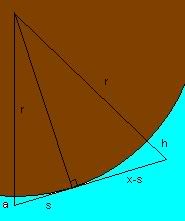
So here you have a diagram of an observer looking tangentially to the surface. (observer is at bottom left, looking right along 'x')
a: height of observer (assume 10 feet)
x: line-of-sight of observer
s: line-of-sight distance from observer to surface horizon
r: radius of spherical earth (8000 miles; a little large, but nice and pretty)
h: height an object must be in order to be seen by observer
Pythagoras tells us, for the left triangle:
(1)
r^2 +s^2 = (r + a)^2
and for the right:
(2)
r^2 + (x - s)^2 = (r + h)^2
For first (1) equation, solve for 's' and plug into second (2) equation. Then solve second equation for 'h'. (I used Mathmatica: i have the file if you want it)
Thus we can get a list of h (in feet, for your convinience) for every mile up to 20:
6.70
4.05
2.07
0.747
0.0841
0.0809
0.738
2.05
4.03
6.67
9.97
13.9
18.5
23.8
29.8
36.3
43.6
51.5
60.1
69.3
So at 20 miles, any object on your line of sight with the horizon (assuming a perfectly spherical surface) is 70 feet from the calm ocean surface.