...orbits are predictable.
Right, but predicted locations are approximate.
How much error there is depends on the age of the orbital elements and the height of the satellite, presuming no active steering is being done (for the ISS, this happens every few weeks to months). Elements for many satellites are updated daily.
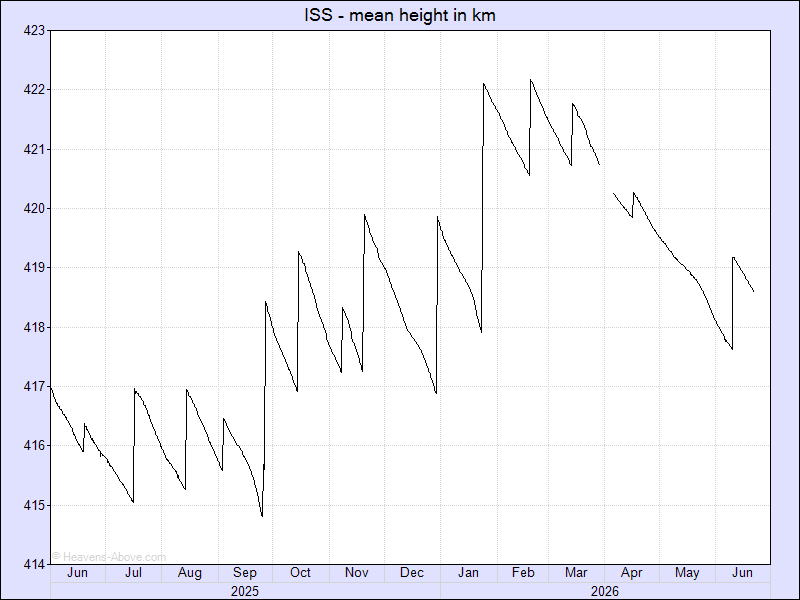
When its orbit isn't being actively changed, elements for the ISS that are less than a couple of days old are accurate to a small fraction of a degree. The ISS needs to be actively boosted more often than typical satellites because its orbit is fairly low, and it has a
lot of surface area.
Further, the only information one has to go by is its elevation and direction when first visible, its peak elevation and direction, and its direction when disappearing:

That depends on where you get your predictions from, and what you ask for.
Heavens Above can provide predictions for satellite passes which include star charts like this example of the ISS from Kansas City, KS on 2017 July 23:

You can zoom in for better than 1 second time resolution and shows fainter stars, like this:

If I were trying to see the ISS through a telescope on this pass, I'd probably sight in next to the star it will pass at 22:33:34, and wait for it, with an accurate time source. With a little experience, even with a fully manual telescope, it's possible to follow the ISS once you pick it up.
Again, these figures are approximate. Being even a fraction of a degree off would lead to failure to capture it.
If you're using the most recent orbital elements (HA includes the epoch of the elements in its displays), this will be quite accurate. I've used this technique to pick a location to watch the ISS pass in front of the moon close to its center; a friend saw the same pass just barely graze the moon - as predicted - from her home just a few miles away. The accuracy is quite good.
But even if you magically manage to orient your telescope correctly, since the ISS travels at high speeds, it would only be visible for a split second. Using a telescope that inverts image orientation (e.g., refractor telescopes) would complicate the effort further.
Newtonian reflectors, with the eyepiece on the side, can be even more disorienting. Once you get used to the image orientation, tracking isn't hard to do and the movements become second nature.
You just aim at the right spot and start shooting.
Shooting? We're talking about viewing the ISS with a telescope, not about taking a picture of it through the telescope, which, BTW, would add much more difficulty to the effort.
Yes and no. If you pre-focus on a relatively bright star, then move to the spot you want to 'ambush' the satellite, you can start recording video a second or so before the pass and you'll probably get it. If you want stills, setting the camera for multiple rapid exposures will also most likely work. With a bit of practice and a good time source, there's a realistic possibility of getting it in a single shot.
Did you know that there's a huge difference between "incredibly difficult" and "completely impossible"?
That difference is the generally result of experience, planning, preparation and sometimes more than just a bit of luck.
Also, telescope quality matters. Some telescopes can be electronically aimed at a particular location with a high degree of accuracy, but these tend to be very expensive. So since it's virtually impossible to view the ISS without these and since some cannot afford them, some are unable to view the ISS via telescope; neutrino's claim that "Anyone can see this." is thus false.
Yes and no. If they tried, most people could probably find a local amateur astronomer that already has a suitable telescope and can either already do this, or is willing to try something new. The problem is that it does take some knowledge, preparation, and effort to see satellites like the ISS through a telescope. Based on the attitude of most flat-earth proponents here, knowledge, preparation, and effort are the last things most of them seem to be interested in; they're more into uncritically watching youtube videos (as long as whatever they purport to show is "against the mainstream"), thinking up "reasons the earth can't possibly be round" without actually testing them, simply pontificating about something they they heard somewhere, or reading actual explanations and completely misinterpreting them.
In principle, almost anyone
can, with some effort, see the ISS through a telescope. It's just that too many people
won't because they simply can't be bothered to put effort into anything that might not confirm what they already want to believe. Or they know full well what they'll see if they succeed, and don't want to deal with the fact that they
have seen it.