jack, please come to your senses.
Your derivation has been shown to be a total piece of thrash.
Based on your derivation, you made some claims, which are totally refuted by these mainstream papers.
And you are still completely unable to show these calculations and what the orbital Sagnac is meant to be.
That isn't surprising considering this paper has NOTHING TO DO WITH THE SAGNAC EFFECT.Shooting light to the moon has to do with the behavior of light like GPS.
The lunar laser ranging experiment is an astronomical version of the Sagnac experiment.
However, G. Sagnac used the fringe-shift method to measure indirectly light travel time;
while Dr. Daniel Gezari uses clocks to measure directly light travel time in both directions.
Please note the orbital sagnac shows up in these measurements.
Now, because of the vast distance, if you are correct, you should see 1/365 of the rotational sagnac in the measurements and that will show up on this vast distance.
So, if you are correct, then we should see your 1/365 conclusions in the measurements. Guess what. We do not.
That means you are wrong.
Your derivation is not even a joke, it is totally useless and worthless.
Dr. Daniel Gezari must calculate the Sagnac in order to fully account for the shooting of the laser to the mirror on the moon and back.
Calculations performed at the NASA Goddard Space Flight Center by Dr. Daniel Gezari:
https://arxiv.org/vc/arxiv/papers/0912/0912.3934v1.pdfPlease note the theoretical orbital sagnac shows up in these calculations, but is not picked up/registered/recorded by GPS satellites.
Motion of the Earth-Moon system in orbit around the Sun would average out in a two-way measurement, and only appear as a small (∼3 m/s) second-order residual.
Because of the two-way averaging, the orbital Sagnac effect registered is smaller than usual, however it is not 1/365 of the rotational Sagnac effect, in fact even in the diluted form permitted by the two-way averaging calculation, it represents a significant percentage of the rotational Sagnac effect.
This calculations were done by none other than Dr. Daniel Gezari (CalTech, Goddard Space Flight Center).
For instance, the Earth’s full 30 km/s orbital velocity along the line-of-sight would produce a second-order residual velocity of only ~3 m/s, so we cannot preclude the possibility that some part of the 8.4 m /s difference between coand c measured here is a real second-order residual due to motion of the Earth-Moon system relative to an absolute frame.
3/8.4 = 0.357
1/365 = 0.00274
0.357/0.00274 = 130.3
A total and direct refutation of your failed derivation.
Instead they treat Earth's orbit as translationSee how little you know about the Sagnac?


The Sagnac effect is not due to rotation, but instead is a linear effect due to a true anisotropic light speed in a moving frame.
In 1938 Ives showed by analysis that the measured Sagnac effect would be unchanged if the Sagnac phase detector were moved along a cord of a hexagon-shaped light path rather than rotating the entire structure. Thus, he showed the effect could be induced without rotation or acceleration."
See how easy it is to refute your claims?
For non-aether based models, which instead obey relativity, the orbital Sagnac effect, with the orbit considered as a translation would equal 0, as translations do not produce it, You have just been shown that you are wrong: the Sagnac effect applies equally well to translational motion as well.
Furthermore, STR has nothing to do with the Sagnac.
The Sagnac effect is far larger than the effect forecast by relativity theory.
STR has no possible function in explaining the Sagnac effect.
The Sagnac effect is a non-relativistic effect.
COMPARISON OF THE SAGNAC EFFECT WITH SPECIAL RELATIVITY, starts on page 7, calculations/formulas on page 8
http://www.naturalphilosophy.org/pdf/ebooks/Kelly-TimeandtheSpeedofLight.pdfpage 8
Because many investigators claim that the
Sagnac effect is made explicable by using the
Theory of Special Relativity, a comparison of
that theory with the actual test results is given
below. It will be shown that the effects
calculated under these two theories are of very
different orders of magnitude, and that
therefore the Special Theory is of no value in
trying to explain the effect.
Thus the Sagnac effect is far larger than any
purely Relativistic effect. For example,
considering the data in the Pogany test (8 ),
where the rim of the disc was moving with a
velocity of 25 m/s, the ratio dtS/dtR is about
1.5 x 10^7. Any attempt to explain the Sagnac
as a Relativistic effect is thus useless, as it is
smaller by a factor of 10^7.
Referring back to equation (I), consider a disc
of radius one kilometre. In this case a fringe
shift of one fringe is achieved with a velocity
at the perimeter of the disc of 0.013m/s. This
is an extremely low velocity, being less than
lm per minute. In this case the Sagnac effect
would be 50 billion times larger than the
calculated effect under the Relativity Theory.
Post (1967) shows that the two (Sagnac and STR) are of very different orders of magnitude. He says that the dilation factor to be applied under SR is “indistinguishable with presently available equipment” and “is still one order smaller than the Doppler correction, which occurs when observing fringe shifts” in the Sagnac tests. He also points out that the Doppler effect “is v/c times smaller than the effect one wants to observe." Here Post states that the effect forecast by SR, for the time dilation aboard a moving object, is far smaller than the effect to be observed in a Sagnac test.
You have no clue as to what the Sagnac means.
The following paper was published by the BULLETIN OF THE AMERICAN PHYSICAL SOCIETY, one of the most prestigious journal in the world.
It thrashes your piece of shit derivation.
C.C. Su, "A Local-ether model of propagation of electromagnetic wave," in Bull. Am. Phys. Soc., vol. 45, no. 1, p. 637, Mar. 2000 (Minneapolis, Minnesota).
http://www.ee.nthu.edu.tw/ccsu/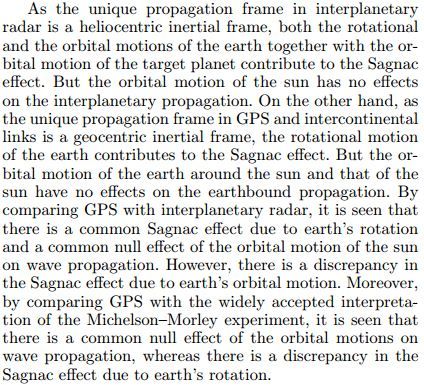
 Both the rotational and the orbital motions of the earth together with the orbital
motion of the target planet contribute to the Sagnac
effect. But the orbital motion of the sun has no effects
on the interplanetary propagation. On the other hand, as
the unique propagation frame in GPS and intercontinental
links is a geocentric inertial frame, the rotational motion
of the earth contributes to the Sagnac effect.
But the orbital
motion of the earth around the sun and that of the
sun have no effects on the earthbound propagation. By
comparing GPS with interplanetary radar, it is seen that
there is a common Sagnac effect due to earth’s rotation
and a common null effect of the orbital motion of the sun
on wave propagation.
However, there is a discrepancy in
the Sagnac effect due to earth’s orbital motion. Moreover,
by comparing GPS with the widely accepted interpretation
of the Michelson–Morley experiment, it is seen that
there is a common null effect of the orbital motions on
wave propagation, whereas there is a discrepancy in the
Sagnac effect due to earth’s rotation.
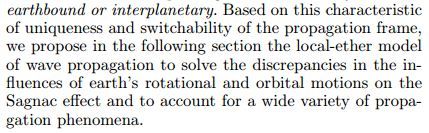
Based on this characteristic of uniqueness and switchability of the propagation frame,
we propose in the following section the local-ether model
of wave propagation
to solve the discrepancies in the in-
fluences of earth’s rotational and orbital motions on the
Sagnac effect and to account for a wide variety of propagation
phenomena.
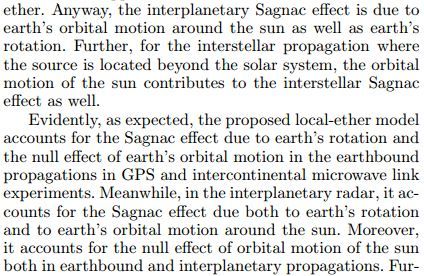
Anyway, the interplanetary Sagnac effect is due to
earth’s orbital motion around the sun as well as earth’s
rotation. Further, for the interstellar propagation where
the source is located beyond the solar system, the orbital
motion of the sun contributes to the interstellar Sagnac
effect as well.
Evidently, as expected, the proposed local-ether model
accounts for the Sagnac effect due to earth’s rotation and
the null effect of earth’s orbital motion in the earthbound
propagations in GPS and intercontinental microwave link
experiments. Meanwhile, in the interplanetary radar, it accounts
for the Sagnac effect due both to earth’s rotation
and to earth’s orbital motion around the sun.
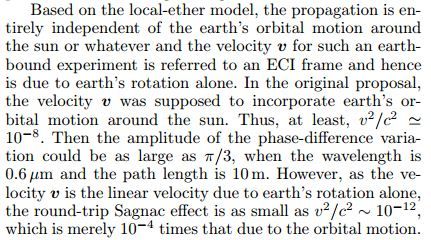
Based on the local-ether model, the propagation is entirely
independent of the earth’s orbital motion around
the sun or whatever and the velocity v for such an earthbound
experiment is referred to an ECI frame and hence
is due to earth’s rotation alone. In the original proposal,
the velocity v was supposed to incorporate earth’s orbital
motion around the sun. Thus, at least, v
2/c
2=~ 10
-8. Then the amplitude of the phase-difference variation
could be as large as π/3, when the wavelength is
0.6 µm and the path length is 10 m. However, as the velocity
v is the linear velocity due to earth’s rotation alone,
the round-trip Sagnac effect is as small as v
2/c
2∼ 10
-12 which is merely 10
-4 times that due to the orbital motion.
The Sagnac effect is a FIRST ORDER effect in v/c.
Even in the round-trip nature of the Sagnac effect, as it was applied in the Michelson-Morley experiment, thus becoming a second order effect within that context,
we can see that the ORBITAL SAGNAC IS 10,000 TIMES GREATER than the rotational Sagnac effect.Three papers written by some of the best physicists in the world today, Dr. Daniel Gezari and Dr. C.C. Su, which directly contradict your failed/miserable derivation.
It is as simple as this.
Please read:
In the original proposal,
the velocity v was supposed to incorporate earth’s orbital
motion around the sun.
Thus, at least, v2/c2
=~ 10-8. Then the amplitude of the phase-difference variation
could be as large as π/3, when the wavelength is
0.6 µm and the path length is 10 m. However, as the velocity
v is the linear velocity due to earth’s rotation alone,
the round-trip Sagnac effect is as small as v2/c2∼ 10-12 which is merely 10-4 times that due to the orbital motion.THE ORBITAL SAGNAC, EVEN IN THE CONTEXT OF THE ROUND TRIP MM EXPERIMENT, IS 10,000 TIMES GREATER THAN THE ROTATIONAL SAGNAC.
A total refutation of your failed piece of garbage analysis.
Both the IOP journal and the APS agree with me.
They published the fact that the orbital Sagnac is much larger than the rotational Sagnac, and that it is missing.
Then, they accepted the local aether model, since the missing orbital Sagnac has to be explained.
It is as simple as this.
Please mail your piece of shit derivation to the BULLETIN OF THE AMERICAN PHYSICAL SOCIETY or EUROPHYSICS LETTERS JOURNAL, and see if they will publish it.
Until then, the above referenced papers thrash your piece of shit analysis.