Distances in the universe

  • 614 Replies
  • 134709 Views
*

JackBlack

  • 26157
  • +51/-79
Re: Distances in the universe
« Reply #570 on: May 11, 2017, 04:25:46 AM »
You are demanding of your readers to believe in the impossible.
No. That would be you.
You are demanding everyone believe that 2 different (in magnitude) forces can act on the ends of a massless rope.
That is physically impossible.

You have constructed your own little universe, your own reality, where two different persons, of different strengths, are to pull with the very same forces on both ends of the rope.
Again, a massless rope requires it, just as if they were puling directly on each other.

But those two persons will always pull with a different force, no matter what you say.
Only when the rope has a mass.

In my simple example we have boat X pulling with 200 N, while the second boat will exert a force of 350 N.
Yes, your simple, physically impossible example. The only way for that to work is if the rope has a mass and thus has a net force of 150 N.

Using your analysis we reach the point where 200 = 350.

A contradiction.
And using yours we get 200=550.
A contradiction.

I claim this situation is impossible, so it isn't a problem for me.
You claim it is possible, so it is a problem for you.

My equations, by contrast, work just fine.
No. They don't.
The reach a claim that 200=550.
A contradiction.

And there you go throwing Netwon's third law out the window.
By Newton's third law, the force X is applying (-200 N) must be equal and opposite the force the rope is applying (350 N + 200 N).
i.e. 250=550.
Is that possible?
Certainly not.
As such, your analysis results in a direct violation of Newton's third law of motion.

Nothing was thrown out the window jack.
Yes it was.
You have the rope and boat X, 2 entities, which according to Newton's third law of motion have an action-reaction pair existing between them.
For this to hold the force applied by one must be equal and opposite the force applied by the other.
In your case, the force applied by one is -200 N. The force applied by the other is 550 N.
Thus you need 200 N to equal 550 N. If it doesn't, you have violated Newton's third law.

What are the forces acting on the left end side of the rope?
-200 and -350.
Yes, and that is another contradiction.
You have X applying a force of -200 N to the rope, yet the rope magically receives a force of -550 N.
Does -200=-550? No. So yet again, a contradiction.

Your analysis is full of them.

These equations do not lie jack.
That is right. These equations do not lie.
Your analysis requires 200=550.
It does not. Thus your analysis is wrong.

But the only place this can come from is boat X.
Boat X is applying a force of -200 N to the rope.
Thus your analysis requires -200 N (the force X is applying to the rope)is equal to-200 N -350 N (the force the rope is receiving from X).
i.e. -200=-550.
Is that possible?
Certainly not.

As such, your situation is entirely impossible.

No such thing happened.
But it did. You have X applying a force of -200 N, but the rope is receiving a force of -550 N.

The only way out is to admit your analysis is wrong, either the force on the rope from X is -200 N, and thus there is a net force on the rope, or X is actually pulling on the rope with a force of -550 N.

Repeating the same refuted bullshit again and again won't make it right.

You need to tell us how X can apply a force of -550 N to a rope, when it is only applying (pulling on it) with a force of -200 N.
You need to tell us how 200=550.

Each and every force is being taken into account, using Newton's third law.
And you throw in some magic forces as well.

By hypothesis, the forces applied by the two boats will differ in magnitude, the very case your own analysis cannot handle.
Yes, as my analysis is a massless rope approximation, which is only valid when the forces are so close the difference can be neglected and the mass of the rope can be neglected.

If you have a massless rope, the tension MUST remain constant throughout and thus the forces on each end MUST be equal, i.e. A=-B.
So it isn't surprising that my massless rope approximation has all the requirements for the massless rope approximation.

Meanwhile, your analysis only works when the 2 forces are 0.

HAD THERE BEEN ANY CONTRADICTIONS, THE FINAL NET FORCE ON THE ROPE EQUATION WOULD HAVE REFLECTED ANY POSSIBLE INCONSISTENCIES.
And the correct analysis does give that. You have a force of A+B.
If A is -200 N and B is 350 N, then the final net force on the rope will be 150 N.

You can add all sorts of bullshit to it without getting any inconsistencies in the net force on the rope.
You can also add them in to change it so you do get net forces on the rope.

For example, with your bullshit analysis, just appropriately add 100 N to every term (either as plus or minus)
Then you have this:
The net force on boat X is (200 N + 350 N + 100 N)=650 N.
The net force on boat Y is (-200 N -350 N -100 N)=-650 N.
The net force on the rope is (200 N + 350 N + 100 N)-(200 N + 350 N + 100 N)=0N.

Does that mean that analysis is correct?
No. It has a magic extra force thrown in, just like yours.


If they are not, then there will be a net force on the string and the string will be accelerated.
Guess what?
My equations have different forces applied at each end, and the net force on the string will be zero.
Yes, completely contradicting reality. If you have 2 forces acting on a rope which do not add to 0, there will be a net force on the rope. There is no way around that.

You have to apply Newton's third law AT BOTH ENDS OF THE ROPE.
This is what you are missing.
No. I'm not.
At one end (X's end), force on rope from X=A.
Force on X from Rope=B.
Thus A=-B.

Force on rope from Y=B.
Force on Y from rope=A.
Thus A=-B.

No contradiction at all.

You tried the BS with the massless rope before it did not work out, it won't work now either.
No. Now instead of using a massless rope, I am using a real rope with mass, to show the net force quite explicitly when they 2 forces are different.

The tension in a rope HAS TO vary across its length in reality, but this is overlooked in modern physics.
Which is only possible for a rope with mass, where the rope can have a net force on it.

Look at the tension in your rope?
On the left it is 550 N, on the right it is 550 N.
Does that look different? No.
Can it change at all? No.
Your analysis dictates that there will NEVER be any net force on any rope, making it completely impossible to move ropes, and it requires the tension is constant.

On the other hand, my analysis works fine (the one with the mass of the rope).
The tension on the left side is 200 N, the tension on the right side is 350 N.
The net force on the rope is 150 N.

No problem at all.

So it is assumed the mass of a rope is negligible, and using the massless approximation won't cause too big of an error.

Do you understand these basic things?
Do you?
The massless approximation requires that the difference in forces is negligible and the mass of the rope is negligible.
If the difference in forces are significant it will require the rope's mass to be considered.

This is as yet an unaccounted for problem in modern physics.
No. It is easily accounted for.
I did it a simple way.
You are the one that seems unable to account for it.

Certainly the rope HAS TO TRANSMIT BOTH FORCES APPLIED AT EACH END, SINCE THE NET FORCES, IN THE CORRRECT ANALYSIS WORK OUT FINE.
Only if the tension remains constant, requiring the forces at each end to be equal, in which case my massless rope approximation (the correct one), works fine.
On the other hand, if the forces differ then the tension in the rope will vary and the rope will thus not carry both forces all the way across the rope, it will only carry the weaker of the 2. The other will be spread out across the rope to accelerate the rope.

If Henry VIII and Queen Elizabeth I would be pulling, each located at one end of that rope, would those forces be the same? Certainly not.
For a massless rope, it must be.
Here is a better question for you:
If Henry VIII and Queen Elizabeth I would be pulling, each located at one end of that rope, would the rope be massless? Certainly not.


Forces A and B can never be the same.
But they have to be equal in magnitude (or be close enough that the differences negligible) for the massless rope approximation to hold. Otherwise it produces a net force on the rope and you need to consider the acceleration of the rope.

*

rabinoz

  • 26528
  • +0/-0
  • Real Earth Believer
Re: Distances in the universe
« Reply #571 on: May 11, 2017, 04:44:29 AM »
rabinoz, you are dreaming.
We are talking here about AN INVERTED CATENARY.
Who is talking about "AN INVERTED CATENARY"? I never mentioned it!

The rope falls into a catenary.

Try again.

*

rabinoz

  • 26528
  • +0/-0
  • Real Earth Believer
Re: Distances in the universe
« Reply #572 on: May 11, 2017, 05:15:55 AM »
This means that the two people cannot pull with different forces.
On a lake, two men situated in two boats, SURE THEY CAN.

Primer for men and ropes

You are on land now. Totally different situation, where now we have to deal with friction.

You don't like it on land, well we'll put our men into boats!

We want to examine the situation with a massless rope and unequal forces applied to each end.
Now, I (we) have claimed that this is an impossible situation, but let's
hypothesise a system with unequal forces, a massless rope and a mass in the middle of the rope
and then test if the zero mass case is valid.

With mass M in the middle, the system is now quite amenable to analysis as follows:
Now with a mass dividing the rope, the forces applied by the men can be different.
Any difference in the forces is applied to the Mass, which can accelerate.

The Strong man applies a force B to the right-hand end of the rope, so the tension all along the right hand rope is TR[/b] and
the Weak man applies a force A to the left-hand end of the rope, so the tension all along the left hand rope is  TL[/b].
Hence TR = A and TL = B.

So the nett force applied to the mass is given by TR - TL so FM = B - A

Now, with a nett force applied to the mass, it must accelerate with aM = FM/M

Clearly as M is decreased, the acceleration aM increases and as M -> 0, aM -> ∞.

Hence our initial hypothesis that the forces are unequal must be invalid
and B = A note that B is not the force that strong man is capable of, but the force he is actually applying.

If the strong man tries to pull any harder, presumably he must wind in rope
and the weak man must let the rope slip through his hands, but the strong man cannot put any more tension on the rope that the weak man is capable of pulling.

But the force the weak man applies, the tension in the rope and the force the strong man actually is able to apply are all equal.
« Last Edit: July 07, 2017, 12:00:46 AM by rabinoz »

*

sandokhan

  • Flat Earth Sultan
  • Flat Earth Scientist
  • 7272
  • +7/-15
Re: Distances in the universe
« Reply #573 on: May 11, 2017, 05:25:43 AM »
I always save the best for the last, as my readers know by now.

Jack, you have made a grievous error: a terrible mistake.

And this time it will prove to be fatal for your presentation, that is, for RE side.


Everything comes down to this: in the example featuring the two boats on a lake, connected by a rope, are forces A and B different, or are they the same? Can a rope transmit forces which are different in magnitude?

Certainly any two persons in the world will apply forces of a different magnitude to each end of the rope, but it seems the RE have a hard time understanding this.


But jack has offered us a way out of this quandary.

Note the situation you are trying to model, the gravitational attraction between the 2 objects.
This force is given by the equation:
F=GMm/r^2.
This will be the same for each body, they must be EXACTLY the same.

There is no turning back now.

Jack has just told us that IF the equation F=GMm/r^2 is correct, they THE FORCES APPLIED MUST BE THE SAME.

BUT, IF THAT EQUATION TURNS OUT TO BE INCORRECT, THE FORCES APPLIED MUST BE DIFFERENT.


It is as simple as this.

Everything that we have discussed here comes down to this argument.


Should there be a way to prove that F=GMm/r^2 is blatantly false, then we would have at our disposal the most direct demonstration, that the forces on both ends of the rope must be different in magnitude.


Let us remember jack's statement:

Note the situation you are trying to model, the gravitational attraction between the 2 objects.
This force is given by the equation:
F=GMm/r^2.
This will be the same for each body, they must be EXACTLY the same.


DEPALMA SPINNING BALL EXPERIMENT

Dr. Bruce DePalma, MIT and Harvard

One day, one of the greatest experimental physicists of the 20th century was asked a simple question, by one of his students:

If there was any difference in gravitational effect on a rotating object versus a non-rotating object?

After an extensive search in the literature, no evidence could be found that the experiment had been performed before.

This became one of the most celebrated experiments in modern physics: the spinning ball experiment.


"Conceptually, the experiment could not have been much cheaper, or easier to carry out:

Two 1-inch steel balls (like those found in every pinball machine in America ...) were positioned at the business end of an ordinary power drill; one ball was in a cup attached to the drill's motor shaft, so it spun -- at a very high rate of speed; the other ball was in an identical cup, attached by a bracket to the stationary drill casing, adjusted so that it was level with the first ball.

The experiment consisted of positioning the drill vertically, cups "up," and pressing the drill switch on the motor.

The drill motor (and its associated cup, containing one of the steel balls) rapidly spun up to approximately 27,000 RPM. The cup attached to the side of the drill (with the second steel ball inside it ...) was not rotating ....

When the drill motor had attained its maximum speed, DePalma (or, more often, Ed Delvers, his assistant ...) would shove the drill into the air with a fast, upward motion -- suddenly stopping the drill it in mid-flight. This would, of course, cause both 1-inch pinballs to fly out of their retaining cups in the same upward direction -- the "spinning ball" (hence the name ...) and the non-spinning ball, right beside it.

DePalma, from his years spent working with Dr. Herald Edgerton at MIT -- the famed inventor of "stroboscopic photography" -- was an expert in such stop-motion photography as well. By positioning Delvers against a gridded black background, in a darkened laboratory (below), and then illluminating the two upward-flying steel balls with a powerful strobe light, DePalma was able to take time-exposure photographs with the camera's shutter open, the "pinballs" only illuminated (at 60 times per second) by the strobe's periodic flash ....

The result was a striking "stroboscopic, time-lapse photograph" of the parabolic arc of both steel balls -- flying upward and then downward under Earth's gravitational acceleration (below)."


Looked at even casually, one can instantly see in the resulting time-lapse image (above) that the two pinballs did NOT fly along identical parabolic arcs (as they should have); unmistakably, the steel ball that was rotating (at ~27,000 rpm) flew higher ... and fell faster ... than the companion ball that was not rotating!

An experimental result in direct violation of everything physicists have thought they've known about both Newton's Laws and Einstein's Relativity ... for almost (in the case of Newton ...) three full centuries!


Dr. Bruce DePalma graduated from the Massachusetts Institute of Technology in 1958. He attended graduate school in Electrical Engineering and Physics at M.I.T. and Harvard University. At M.I.T. he was a lecturer in Photographic Science in the Laboratory of Dr. Harold Edgerton and directed 3-D color photographic research for Dr. Edwin Land of Polaroid Corporation.


The results of the Spinning Ball Experiment were published in the British Scientific Research Association Journal in 1976. This experiment was also outlined personally by DePalma to Dr. Edward Purcell, one of the most eminent experimental physicists from Harvard at that time. According to DePalma, Purcell, after contemplating the experiment for several minutes, remarked "This will change everything."


The only difference was that one ball was rotating 27,000 times per minute and the other was stationary. The rotating ball traveled higher and then descended faster than its counterpart, which violated all known laws of physics.

The only explanation for this effect is that both balls are drawing energy into themselves from an unseen source, and the rotating ball is thus “soaking up” more of this energy than its counterpart – energy that would normally exist as gravity, moving down into the earth.

With the addition of torsion-field research we can see that the spinning ball was able to harness naturally spiraling torsion waves in its environment, which gave it an additional supply of energy.


A ball spinning at 27,000 RPM and a non-spinning ball were catapulted side-by-side with equal momentum and projection angle. In defiance of all who reject the ether as unrealistic, the spinning ball actually weighed less, and traveled higher than its non-spinning counterpart. Those who attribute this to an aerodynamic or atmospheric effect, please note that it works just as well in a vacuum. Also note, this effect has since been verified by other researchers. The decrease in weight of the spinning ball - anti-gravity - can explain why the spinning object goes higher and falls faster than the identical non-rotating control. Current thinking is that there is no special interaction between rotation and gravity. The behavior of rotating objects is simply the addition of ether energy to whatever motion the rotating object is making.


The law of universal gravitation totally violated: FOR THE SAME MASS OF THE STEEL BALLS, AND THE SAME SUPPOSED LAW OF ATTRACTIVE GRAVITY, THE ROTATING BALL WEIGHED LESS AND TRAVELED HIGHER THAN THE NON-ROTATING BALL.


More experiments performed by Dr. Bruce DePalma, one of the America's greatest physicists of the 20th century:

A prime example of this is provided by the spinning ball experiments of Bruce DePalma.

He projected two metal balls upwards inside a vacuum container, one spinning at some 20,000 rpm and the other non-spinning, and observed any differences.
He discovered that the spinning ball moved higher and further and also fell faster than the non-spinning one.


Back in the 70's Bruce Depalma did a series of tests involving spinning objects. In his published findings he goes on to describe that a ball spun at a high rate of speed will actually travel higher (sometimes 20% higher) and fall faster then a ball that is not spinning. Now of course the balls are identical and launched at the same trajectory. This test was also done in a vacuum to go on and prove that drag couldn't have an effect on it.


DePalma’s experiment with steel balls in 1972 showed that certain physical properties of an object are radically altered—both its mass and inertia—if it is rotated. According to DePalma, rotation produces a force field, specifically around the main axis of the rotating object, that he measured and called a torsion field or spin field. Time-lapse stroboscopic photographs revealed that the steel ball rotating at ~27,000 rpm flew higher and fell faster than the companion ball that was not rotating. DePalma had since conducted experiments on “bodies in rotation” including massive objects (e.g., over 30 lbs), spinning at very high velocities (~7600 revolutions/minute).


BIEFELD-BROWN EFFECT

"In 1955 and 1956 Townsend Brown made two trips to Paris where he conducted tests of his electrokinetic apparatus and electrogravitic vacuum chamber tests in collaboration with the French aeronautical company Société National de Construction Aeronautiques du Sud Ouest (S.N.C.A.S.O.) . He was invited there by Jacques Cornillon, the company’s U.S. technical representative. The project was named Project Montgolfier in honor of the two French brother inventors who performed early aircraft flights. The project continued for several years until the company changed ownership resulting in a final report which was written up in 1959.

Details of the Project Montgolfier experiments remained a closely guarded secret for many years until Jacques Cornillon courageously decided to make them public prior to his death in July 2008. Brown’s proposal, the project’s top secret final report, and an assortment of revealing diagrams and photos are posted on the Cornillon website at:


https://web.archive.org/web/20140110041712/http://projetmontgolfier.info/

https://web.archive.org/web/20131025082102/http://projetmontgolfier.info/TT_Brown_Proposal.html

https://web.archive.org/web/20130522083124/http://projetmontgolfier.info/uploads/Section_3__Final_Report.pdf
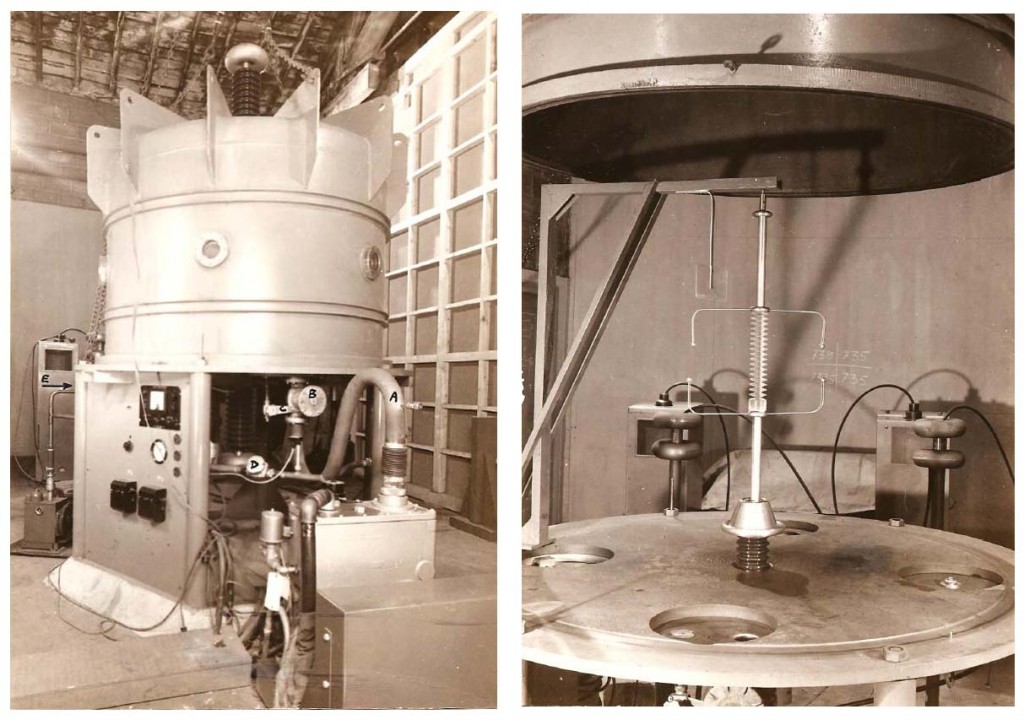


The report says that under high vacuum conditions the discs always moved in the direction of the positive pole, regardless of the polarity on the outboard wire.

These vacuum chamber experiments were a decisive milestone in that they demonstrated beyond a doubt that electrogravitic propulsion was a real physical phenomenon.

PAGE 26 OF THE FINAL REPORT FULLY DESCRIBES THE OBSERVED BIEFELD BROWN EFFECT IN FULL VACUUM CHAMBER

When the DISK SHAPED CAPACITOR WAS USED, the total deviation/movement was A FULL 30 DEGREES (deviation totale du systeme 30 degre).


BIEFELD-BROWN EFFECT FULL DETAILS/VIDEOS:

https://www.theflatearthsociety.org/forum/index.php?topic=30499.msg1852363#msg1852363

Thomas Townsend Brown, the greatest American physicist of the 20th century:

http://ttbrown.com/defying_gravity/preface.html
« Last Edit: May 11, 2017, 05:30:14 AM by sandokhan »

*

rabinoz

  • 26528
  • +0/-0
  • Real Earth Believer
Re: Distances in the universe
« Reply #574 on: May 11, 2017, 05:27:40 AM »
marlin and the reel example

In your example, the marlin cannot break free.

Thus we have a situation entirely similar to this: a large boat is pulling on a smaller boat, the rope being tied to the second, smaller boat.

Boat X (the large boat) is pulling only with 200 N (certainly it could pull with a much larger force).

Boat Y (the smaller boat) is exerting a force of 350 N on the rope.
The tension in the line is limited to 200 N so the marlin (or boat Y) cannot apply more that 200 N tension to the line.

You seem to totally ignore the fact the fisherman or man in boat X cannot apply a tension of more than 200 N to the line, either due to the drag limiting reel of the capability of the man in boat X.

Quote from: sandokhan
<<< same old invalid argument >>>

You really should do some elementary courses if statics.

*

sandokhan

  • Flat Earth Sultan
  • Flat Earth Scientist
  • 7272
  • +7/-15
Re: Distances in the universe
« Reply #575 on: May 11, 2017, 05:33:49 AM »
No problem.

Here is a simple example, using two boats, where the forces applied on each end of the rope are 200N and respectively 350N.

https://www.theflatearthsociety.org/forum/index.php?topic=70349.msg1908947#msg1908947

*

rabinoz

  • 26528
  • +0/-0
  • Real Earth Believer
Re: Distances in the universe
« Reply #576 on: May 11, 2017, 05:38:21 AM »
I always save the best for the last, as my readers know by now.

Jack, you have made a grievious error: a terrible mistake.

And this time it will prove to be fatal for your presentation, that is, for RE side.

Everything comes down to this: in the example featuring the two boats on a lake, connected by a rope, are forces A and B different, or are they are same? Can a rope transmit forces which are different in magnitude?

Certainly any two persons in the world will apply forces of a different magnitude to each end of the rope, but it seems the RE have a hard time understanding this.

You ask "Can a rope transmit forces which are different in magnitude?" No, hence |B| = |A| and the man in boat B cannot apply all the force he is capable of.

"Certainly any two persons in the world" are capable of applying" forces of a different magnitude to each end of the rope".
That is true.
But, here the forces are constrained to be equal, not by the men's capabilities, but because one force is simply the reaction force to the other.

It's just as if a man is pulling in a rope anchored to a brick wall.

The brick wall can sustain much more force that the man can apply, but the reaction force is constrained to be exactly equal to the force the man actually applies.

There is no significant difference here.

*

sandokhan

  • Flat Earth Sultan
  • Flat Earth Scientist
  • 7272
  • +7/-15
Re: Distances in the universe
« Reply #577 on: May 11, 2017, 05:42:39 AM »
rabinoz, it is too late now for your useless commentaries.

I have discovered the fatal flaw in jack's bizarre arguments.

Here is what he wrote:

Note the situation you are trying to model, the gravitational attraction between the 2 objects.
This force is given by the equation:
F=GMm/r^2.
This will be the same for each body, they must be EXACTLY the same.


Should this law prove to be false, then the rope must transmit TWO DIFFERENT FORCES.

It is as simple as this.

Jack has just offered us a way out of this quandary, where we argue back and forth.

Now we have a precise way to prove who is right.


https://www.theflatearthsociety.org/forum/index.php?topic=70349.msg1909009#msg1909009

*

rabinoz

  • 26528
  • +0/-0
  • Real Earth Believer
Re: Distances in the universe
« Reply #578 on: May 11, 2017, 05:46:16 AM »
No problem.

Here is a simple example, using two boats, where the forces applied on each end of the rope are 200N and respectively 350N.

https://www.theflatearthsociety.org/forum/index.php?topic=70349.msg1908947#msg1908947
Again, that starts with an invalid hypothesis. If the tug applies a force of 200 N, that is the force on the tow-rope and the boat being towed cannot apply a bigger force.

My 4WD (in low range) has a towing capability (at low speed, on a solid surface) of 1 tonne force (purely guessed), but my caravan only needs 200 kg force to pull it.
What is the force on the tow-bar? 200 kg force of course! NOT 1 tonne force.

Same thing, being in water does not change things.

?

Canadabear

  • 2525
  • +0/-0
Re: Distances in the universe
« Reply #579 on: May 11, 2017, 05:46:41 AM »
No problem.

Here is a simple example, using two boats, where the forces applied on each end of the rope are 200N and respectively 350N.

https://www.theflatearthsociety.org/forum/index.php?topic=70349.msg1908947#msg1908947

that is not an example that is repeating your wrong assumption.

and example would be the documentation of an real experiment.

but you don't have that.

*

rabinoz

  • 26528
  • +0/-0
  • Real Earth Believer
Re: Distances in the universe
« Reply #580 on: May 11, 2017, 05:48:19 AM »
rabinoz, it is too late now for your useless commentaries.

I have discovered the fatal flaw in jack's bizarre arguments.

Here is what he wrote:

Note the situation you are trying to model, the gravitational attraction between the 2 objects.

That's quite independent of the matter we are discussing!

Bye bye.

*

sandokhan

  • Flat Earth Sultan
  • Flat Earth Scientist
  • 7272
  • +7/-15
Re: Distances in the universe
« Reply #581 on: May 11, 2017, 05:54:10 AM »
No independence at all.

The following comment on gravity was made by jack just the other day. Right here.

Responding to my assertion that the forces at both ends must be different.


You cannot turn back now.


Everything comes down to this: in the example featuring the two boats on a lake, connected by a rope, are forces A and B different, or are they the same? Can a rope transmit forces which are different in magnitude?

Certainly any two persons in the world will apply forces of a different magnitude to each end of the rope, but it seems the RE have a hard time understanding this.


But jack has offered us a way out of this quandary.

Quote from: JackBlack on May 10, 2017, 03:37:11 PM
Note the situation you are trying to model, the gravitational attraction between the 2 objects.
This force is given by the equation:
F=GMm/r^2.
This will be the same for each body, they must be EXACTLY the same.


There is no turning back now.

Jack has just told us that IF the equation F=GMm/r^2 is correct, they THE FORCES APPLIED MUST BE THE SAME.

BUT, IF THAT EQUATION TURNS OUT TO BE INCORRECT, THE FORCES APPLIED MUST BE DIFFERENT.


It is as simple as this.

Everything that we have discussed here comes down to this argument.


Should there be a way to prove that F=GMm/r^2 is blatantly false, then we would have at our disposal the most direct demonstration, that the forces on both ends of the rope must be different in magnitude.


Let us remember jack's statement:

Note the situation you are trying to model, the gravitational attraction between the 2 objects.
This force is given by the equation:
F=GMm/r^2.
This will be the same for each body, they must be EXACTLY the same.


The following two classic experiments prove that the law described above by jack is blatantly false:

https://www.theflatearthsociety.org/forum/index.php?topic=70349.msg1909009#msg1909009

Which means that the rope must be transmitting two forces.

*

Babushka

  • 169
  • +0/-0
  • I can cook minute rice in 58 seconds
Re: Distances in the universe
« Reply #582 on: May 11, 2017, 07:30:32 AM »
Well, of course the rope is transmitting two forces, if force A is on one side and force B on the other. Even if the person on one side pulls at a force of 100n and the person on the other pulls at a force of 200n, forces A and B will be the same, and the rope will not move. As a result, the boats will move towards each other at the same rate.

Force A: 100n-200n
Force B: 200n-100n
l-100nl=l100nl

Whether the forces of the two people are the same or different, the rope will not move as long as they pull at the same rate, and the rope remains completely taught.
I can communicate with vegetables, but only after hitting up some bath salts

https://runt-of-the-web.com/wordpress/wp-content/uploads/2016/04/baby-taxidermy.jpg

*

Pezevenk

  • 15914
  • +50/-57
  • Militant aporfyrodrakonist
Re: Distances in the universe
« Reply #583 on: May 11, 2017, 08:05:47 AM »
Sandokhan, this is bizarre. You've got all these people explaining to you why you're wrong, and what they're saying makes perfect sense. Why are you still insisting that you're right?

Are you still unable to understand how two people can apply the same force onto something? Do you agree that two people pushing each other's hands are applying the same force? What is your disagreement with Rab's example? Do you not see that you haven't convinced anyone at all?
Member of the BOTD for Anti Fascism and Racism

It is not a scientific fact, it is a scientific fuck!
-Intikam

Read a bit psicology and stick your imo to where it comes from
-Intikam (again)

*

sandokhan

  • Flat Earth Sultan
  • Flat Earth Scientist
  • 7272
  • +7/-15
Re: Distances in the universe
« Reply #584 on: May 11, 2017, 11:29:27 AM »
Well, of course the rope is transmitting two forces, if force A is on one side and force B on the other. Even if the person on one side pulls at a force of 100n and the person on the other pulls at a force of 200n, forces A and B will be the same, and the rope will not move. As a result, the boats will move towards each other at the same rate.

Force A: 100n-200n
Force B: 200n-100n
l-100nl=l100nl

Whether the forces of the two people are the same or different, the rope will not move as long as they pull at the same rate, and the rope remains completely taught.

Exactly.

forces A and B will be the same

You mean the net forces will be the same.


Why are you still insisting that you're right?

Because your beliefs (all of the RE) will be put to the most diffficult test yet.

Quote from: JackBlack on May 10, 2017, 03:37:11 PM
Note the situation you are trying to model, the gravitational attraction between the 2 objects.
This force is given by the equation:
F=GMm/r^2.
This will be the same for each body, they must be EXACTLY the same.


There is no turning back now.

Jack has just told us that IF the equation F=GMm/r^2 is correct, they THE FORCES APPLIED MUST BE THE SAME.

BUT, IF THAT EQUATION TURNS OUT TO BE INCORRECT, THE FORCES APPLIED MUST BE DIFFERENT.


It is as simple as this.

Everything that we have discussed here comes down to this argument.


Should there be a way to prove that F=GMm/r^2 is blatantly false, then we would have at our disposal the most direct demonstration, that the forces on both ends of the rope must be different in magnitude.


Let us remember jack's statement:

Note the situation you are trying to model, the gravitational attraction between the 2 objects.
This force is given by the equation:
F=GMm/r^2.
This will be the same for each body, they must be EXACTLY the same.


The following two classic experiments prove that the law described above by jack is blatantly false:

https://www.theflatearthsociety.org/forum/index.php?topic=70349.msg1909009#msg1909009

Which means that the rope must be transmitting two forces.

*

Babushka

  • 169
  • +0/-0
  • I can cook minute rice in 58 seconds
Re: Distances in the universe
« Reply #585 on: May 11, 2017, 11:34:28 AM »
No need for the copy pasta, we already read it, no need to repeat yourself
I can communicate with vegetables, but only after hitting up some bath salts

https://runt-of-the-web.com/wordpress/wp-content/uploads/2016/04/baby-taxidermy.jpg

?

Canadabear

  • 2525
  • +0/-0
Re: Distances in the universe
« Reply #586 on: May 11, 2017, 11:36:55 AM »
No need for the copy pasta, we already read it, no need to repeat yourself

sandy thinks that if he repeats it often enough it will be accepted.

but ignoring facts does not change facts.

like sandy ignores the facts of reality

*

Pezevenk

  • 15914
  • +50/-57
  • Militant aporfyrodrakonist
Re: Distances in the universe
« Reply #587 on: May 11, 2017, 12:07:46 PM »
Quote
Because your beliefs (all of the RE) will be put to the most diffficult test yet.

But everyone can see you're wrong except of you, nothing is challenged. Are you under the impression you can never be wrong?
Member of the BOTD for Anti Fascism and Racism

It is not a scientific fact, it is a scientific fuck!
-Intikam

Read a bit psicology and stick your imo to where it comes from
-Intikam (again)

*

sandokhan

  • Flat Earth Sultan
  • Flat Earth Scientist
  • 7272
  • +7/-15
Re: Distances in the universe
« Reply #588 on: May 11, 2017, 12:52:13 PM »
Why are you still insisting that you're right?


Because of this.

A letter to Bentley:

“That gravity should be innate, inherent, and essential to matter, so that one body can act upon another at a distance through a vacuum without the mediation of anything else, by and through which their action and force may be conveyed from one to another, is to me so great an absurdity that I believe no man, who has in philosophical matters a competent faculty of thinking, can ever fall into it.


Newton (or the group of people who wrote the works attributed to him) considered the attraction concept "so great an absurdity".

He believed it is totally incorrect.


Instead he thought the following hypothesis is the cause of terrestrial gravity.

4. When two bodies moving towards one another come near together, I suppose the aether between them to grow rarer than before, and the spaces of its graduated rarity to extend further from the superficies of the bodies towards one another; and this, by reason that the aether cannot move and play up and down so freely in the strait passage between the bodies, as it could before they came so near together.

5. Now, from the fourth supposition it follows, that when two bodies approaching one another come so near together as to make the aether between them begin to rarefy, they will begin to have a reluctance from being brought nearer together, and an endeavour to recede from one another; which reluctance and endeavour will increase as they come nearer together, because thereby they cause the interjacent aether to rarefy more and more. But at length, when they come so near together that the excess of pressure of the external aether which surrounds the bodies, above that of the rarefied aether, which is between them, is so great as to overcome the reluctance which the bodies have from being brought together; then will that excess of pressure drive them with violence together, and make them adhere strongly to one another, as was said in the second supposition.

(Newton letter to Boyle, 1679)


?

Canadabear

  • 2525
  • +0/-0
Re: Distances in the universe
« Reply #589 on: May 11, 2017, 01:07:32 PM »
Why are you still insisting that you're right?


Because of this.

A letter to Bentley:

“That gravity should be innate, inherent, and essential to matter, so that one body can act upon another at a distance through a vacuum without the mediation of anything else, by and through which their action and force may be conveyed from one to another, is to me so great an absurdity that I believe no man, who has in philosophical matters a competent faculty of thinking, can ever fall into it.


Newton (or the group of people who wrote the works attributed to him) considered the attraction concept "so great an absurdity".

He believed it is totally incorrect.


Instead he thought the following hypothesis is the cause of terrestrial gravity.

4. When two bodies moving towards one another come near together, I suppose the aether between them to grow rarer than before, and the spaces of its graduated rarity to extend further from the superficies of the bodies towards one another; and this, by reason that the aether cannot move and play up and down so freely in the strait passage between the bodies, as it could before they came so near together.

5. Now, from the fourth supposition it follows, that when two bodies approaching one another come so near together as to make the aether between them begin to rarefy, they will begin to have a reluctance from being brought nearer together, and an endeavour to recede from one another; which reluctance and endeavour will increase as they come nearer together, because thereby they cause the interjacent aether to rarefy more and more. But at length, when they come so near together that the excess of pressure of the external aether which surrounds the bodies, above that of the rarefied aether, which is between them, is so great as to overcome the reluctance which the bodies have from being brought together; then will that excess of pressure drive them with violence together, and make them adhere strongly to one another, as was said in the second supposition.

(Newton letter to Boyle, 1679)

really? you base your complete believe in the shape of the world and the reality on that on sentence from Newton.

Thousand of scientists have proven that he was correct and that sentence is false.

*

sandokhan

  • Flat Earth Sultan
  • Flat Earth Scientist
  • 7272
  • +7/-15
Re: Distances in the universe
« Reply #590 on: May 11, 2017, 01:37:34 PM »
You haven't done your homework on Newton.

'In asserting that he was not making an hypothesis regarding the nature of the gravitational force, Newton was inviting trouble. The Courtesans correctly saw his gravitational force as an hypothesis. That Newton denied this by adhering to a restricted concept of hypothesis deepened the confusion. For Newton believed that his philosophical system gave certain truth, hence the term hypothesis had no place within it since an hypothesis was a mere assumption used to establish a probable truth. In explaining why he rejects the use of hypothesis Newton says

“...and the reason of my making exception to the word, was to prevent the prevalence of a term, which might be prejudicial to true philosophy.”

Huygens rejected this notion of a “true philosophy” interpreted as the philosophy leading to an absolute certain truth. For Huygens an hypothesis demonstrated by induction and deduction was a probable truth, but for Newton, an hypothesis was an absurd notion. He dealt only in truth itself, so an hypothesis was a notion he rejected.

Newton’s method of philosophy is usually either not clearly stated, or when clearly stated,
inconsistent with his practice. It purports to derive principles from experiments rendered general by induction, but we never explicitly find this procedure in his work. The method was to perform experiments and then formulate hypothesis or preliminary causes from the experiments. After a suitable mathematical proof was obtained with its apparent certainty, the theory was restructured and all references to the specific details of the experiments were removed. This accounts for the ambiguous references to magnetic experiments which we find in the Principia. The method had the major flaw that with the experiments removed and the physical model suppressed the resulting theory lost its intelligibility as a physical explanation. Hence it became merely a set of geometrical propositions.

Others who employ the use of the term hypothesis properly face the absurd situation that they are labeling their own system false by doing so, because Newton claims all hypotheses are feigned or pretended truths. The result is insulting, since Newton characterizes all systems other than his own as false, and merely pretending to seek the truth, while being fundamentally incapable of ever achieving it.

His bullheaded response has been debated as to its meaning for many years. Yet, it is difficult to see how it can be construed otherwise than as an insult. Newton seems to be saying that all of his hypotheses are true, because he does not present false ones. Further, because he only deals in truth, he has no need of the concept of an hypothesis, which is a false assumption. Thus for Newton all hypotheses in his system are true, because he never presents a false one."

Here is what Newton wrote in the Principia:

“In attractions, I briefly demonstrate the thing after this manner. Suppose an obstacle is
interposed to hinder the meeting of any two bodies A, B, attracting one the other: then if either body, as A, is more attracted towards the other body B, than that other body B is towards the first body A, the obstacle will be more strongly urged by the pressure of the body A than by the pressure of the body B, and therefore will not remain in equilibrium: but the stronger pressure will prevail, and will make the system of the two bodies, together with the obstacle, to move directly towards the parts on which B lies; and in free spaces, to go forwards in infinitum with a motion continually accelerated; which is absurd and contrary to the first law.”

The Cartesians immediately recognized that Newton’s gravity relied on the principle of action and reaction with the new conception that the action occurred at a distance. So for them the new gravitational force was merely the old concept of occult force and hidden qualities in a new form. While the principle of action and reaction was not vulnerable, because the Cartesian vortex relied upon the notion of a communication of motion, through action and reaction of impact. The idea of action at a distance by attraction, however, was a vulnerable idea.

If you are wondering, dear reader, what all this has to do with magnetism, the answer is as follows. Newton’s experimental basis for his principal of universal gravitation is magnetism. Where Gilbert saw magnetism as the universal force of nature, Newton substituted gravity. He sees magnetic attraction as a force analogous to gravity. His procedure is inductive. He performs experiments, and then inductively derives laws of mechanical action. But, he does not reveal this in the final presentation of the Principia. The inductive procedure is suppressed, leaving only the mathematical laws and the deductions derived from them. This leads to the Cartesian criticism that his system has no physics.

Huygens dismissed the attraction idea:

”Concerning the cause of the flux given by M. Newton, I am by no means satisfied [by it], nor by all the other theories that he builds upon his principle of attraction, which to me seems absurd, as I have already mentioned in the addition to the Discourse on Gravity. And I have often wondered how he could have given himself all the trouble of making such a number of investigations and difficult calculations that have no other foundation than this very principle."


Leibnitz certainly understood, probably better than any other critics of Newton’s theory, that the Newtonian gravity was a form of magnetic attraction described in terms of a mathematical law. His own theory of gravity clearly shows the role of magnetism in the conception of gravity. Leibnitz did not hide the connection, he made it explicit.
« Last Edit: May 11, 2017, 01:40:08 PM by sandokhan »

*

Pezevenk

  • 15914
  • +50/-57
  • Militant aporfyrodrakonist
Re: Distances in the universe
« Reply #591 on: May 11, 2017, 02:10:08 PM »
Why are you still insisting that you're right?


Because of this.

A letter to Bentley:


1) Τhis has nothing to do with the issue at hand, which is ropes and boats.
2) You've said this again many times in the past. But really, no one cares what Newton's subjective opinion on the subject was ages ago, when it's obvious scientific knowledge has advanced a LOT from then. That is, if you're not quoting out of context.
Member of the BOTD for Anti Fascism and Racism

It is not a scientific fact, it is a scientific fuck!
-Intikam

Read a bit psicology and stick your imo to where it comes from
-Intikam (again)

*

rabinoz

  • 26528
  • +0/-0
  • Real Earth Believer
Re: Distances in the universe
« Reply #592 on: May 11, 2017, 02:19:02 PM »
You haven't done your homework on Newton.

May I remind you again that the topic is
Distances in the universe
If you want a thread in gravitation and other bizarre things from Sandokhanian Physics go and make you own thread(s).

In the meantime, noting the actual topic "Distances in the universe", please answer:
What is the distance to the moon, planets, sun and closest stars on your theory?
If you have no idea, please just be honest and say so!


Now, get off this thread!

*

Babushka

  • 169
  • +0/-0
  • I can cook minute rice in 58 seconds
Re: Distances in the universe
« Reply #593 on: May 11, 2017, 02:39:37 PM »
Thanks for that, but we're in the middle of a discussion about two boats and a rope.

And Sandy, we're talking about two people pulling on a rope, not the force of gravity on objects A and B as you are referencing.
I can communicate with vegetables, but only after hitting up some bath salts

https://runt-of-the-web.com/wordpress/wp-content/uploads/2016/04/baby-taxidermy.jpg

*

sandokhan

  • Flat Earth Sultan
  • Flat Earth Scientist
  • 7272
  • +7/-15
Re: Distances in the universe
« Reply #594 on: May 11, 2017, 02:47:21 PM »
we're talking about two people pulling on a rope, not the force of gravity on objects A and B as you are referencing.

Not anymore.

Your friend jack has made sure of that.

Quote from: JackBlack on May 10, 2017, 03:37:11 PM
Note the situation you are trying to model, the gravitational attraction between the 2 objects.
This force is given by the equation:
F=GMm/r^2.
This will be the same for each body, they must be EXACTLY the same.


There is no turning back now.

Jack has just told us that IF the equation F=GMm/r^2 is correct, they THE FORCES APPLIED MUST BE THE SAME.

BUT, IF THAT EQUATION TURNS OUT TO BE INCORRECT, THE FORCES APPLIED MUST BE DIFFERENT.


What should be of utmost importance to the RE is the fact that both Huygens and Leibniz rejected the concept of "attraction".

Huygens dismissed the attraction idea:

”Concerning the cause of the flux given by M. Newton, I am by no means satisfied [by it], nor by all the other theories that he builds upon his principle of attraction, which to me seems absurd, as I have already mentioned in the addition to the Discourse on Gravity. And I have often wondered how he could have given himself all the trouble of making such a number of investigations and difficult calculations that have no other foundation than this very principle."

*

JackBlack

  • 26157
  • +51/-79
Re: Distances in the universe
« Reply #595 on: May 11, 2017, 02:54:18 PM »
Well, of course the rope is transmitting two forces, if force A is on one side and force B on the other. Even if the person on one side pulls at a force of 100n and the person on the other pulls at a force of 200n, forces A and B will be the same, and the rope will not move. As a result, the boats will move towards each other at the same rate.

Force A: 100n-200n
Force B: 200n-100n
l-100nl=l100nl

Whether the forces of the two people are the same or different, the rope will not move as long as they pull at the same rate, and the rope remains completely taught.
By the laws of motion (specifically Newton's third law in this case), if you have no net force on the rope, such that it can be modelled as a massless rope, it is physically impossible for 2 people to pull on the same rope, making it taught, and have them be applying a different force.
It is effectively the same as them just pulling directly against each other, the rope is just acting as a link.

If one person pulls with a force of -100 N and the other with a force of 200 N there will be a net force of 100 N on the rope and thus it will move towards one of them more than it will move towards the other.

*

JackBlack

  • 26157
  • +51/-79
Re: Sandokhans BS ideas and how they relate to boats and ropes
« Reply #596 on: May 11, 2017, 03:02:02 PM »
I always save the best for the last, as my readers know by now.
You mean you keep trying to come up with more and more pathetic excuses.

Jack, you have made a grievous error: a terrible mistake.
Really? You are yet to point out a single problem with what I have said.
I assume this is just another blatant lie from you to pretend you aren't completely wrong.

Everything comes down to this: in the example featuring the two boats on a lake, connected by a rope, are forces A and B different, or are they the same? Can a rope transmit forces which are different in magnitude?
And like I said, it comes down to if the rope is massless and thus has a constant tension, or it has a mass and thus the tension can vary along its length.
Then you also get issues like delay in propagation of tension across the rope.
But at steady state, a massless rope must have the same magnitude force applied at each end.

I gave you the case for a rope with mass where the tension can vary.
I am only discussing the steady state so there will be no need for the force to propagate along the rope.

Let me ask you this:
In an example featuring 2 boats on a lake, connected by 2 people, are the people pulling with equal and opposite forces?

Certainly any two persons in the world will apply forces of a different magnitude to each end of the rope, but it seems the RE have a hard time understanding this.

Jack has just told us that IF the equation F=GMm/r^2 is correct, they THE FORCES APPLIED MUST BE THE SAME.
Yes, such as for any 2 masses held together by gravity.
If you notice even your BS claims about other things like the Casmir effect has the same kind of result. It is a mutual force. The 2 forces have the same origin and thus are equal and opposite in magnitude.

BUT, IF THAT EQUATION TURNS OUT TO BE INCORRECT, THE FORCES APPLIED MUST BE DIFFERENT.
No. Do you not understand logic at all?
You just committed the logical fallacy of denying the  antecedent.
Perhaps this is a simpler example for you to understand:
If it is a cat, it is a mammal.
Thus according to you, if it isn't a cat it isn't a mammal.

Does that sound right to you?
Because last time I checked there were plenty of mammals that weren't cats.

Similarly, you can have 2 forces produced by something other than gravity which are equal and opposite.
For example, electrostatics, magnetism, the Casmir effect or 2 people pulling on each other.

It is as simple as this.
Everything that we have discussed here comes down to this argument.
In that case you fail massively and may as well just give up and admit defeat now, as that argument is pure bullshit based upon a massive logical fallacy equivalent to saying dogs can't be mammals because they aren't cats.

Should there be a way to prove that F=GMm/r^2 is blatantly false, then we would have at our disposal the most direct demonstration, that the forces on both ends of the rope must be different in magnitude.
And this is not the place for that.
First deal with the forces on the rope, then we can move on to other areas you are ignorant in.

So if you wish to discuss them, first admit you were wrong about the forces in this situation and that our analysis is correct.

(Especially as I have already pointed out the pure bullshit in those claims before, or did you forget?)

No problem.
Here is a simple example, using two boats, where the forces applied on each end of the rope are 200N and respectively 350N.
And once again, you are just making up physically impossible situations.

Prove that such a situation can actually exist, making sure the massless rope approximation can hold and the system is at steady state.

Just making up numbers is not proving an example, not when you are trying to show something is possible.

Certainly any two persons in the world will apply forces of a different magnitude to each end of the rope, but it seems the RE have a hard time understanding this.
And certainly any rope in the real world will have a mass.
As such, the massless rope approximation will be just an approximation and in reality the tension will vary across the rope and there will be a net force on the rope.

The only way you will get a situation where the rope has a force of 200 N at one end and 350 N at the other is if the rope is very heavy or is experiencing some serious drag.

But jack has offered us a way out of this quandary.
That's right. I did. By using an approximation which takes into consideration the mass of the rope, allowing the tension to be different at each end and allowing a net force to act on the rope.
Problem solved.

You sure do seem to like repeating the same refuted nonsensical bullshit.

Because of this.
A letter to Bentley:
“That gravity should be innate, inherent, and essential to matter, so that one body can act upon another at a distance through a vacuum without the mediation of anything else, by and through which their action and force may be conveyed from one to another, is to me so great an absurdity that I believe no man, who has in philosophical matters a competent faculty of thinking, can ever fall into it.
And of course, you emphasis the wrong part.
Here is the key part people didn't like:
Quote
one body can act upon another at a distance through a vacuum without the mediation of anything else

They didn't like the idea of "spooky" action at a distance, where doing something here could potentially change something heaps far away with nothing to carry that change.
But we have a solution to that. Particle physics tries it with gravitons, but I prefer the simpler idea of distortion of space time. The very fabric of space time is the thing that provides the mediation between them.

The other key part that they disliked was that this action at a distance was meant to be instantaneous.

So no, they didn't find gravity absurd, they found action at a distance to be absurd.

But again, this is just getting off topic.
Stop trying to hide from your blatant mistakes concerning ropes and boats and forces and the laws of motion.

*

JackBlack

  • 26157
  • +51/-79
Re: Distances in the universe
« Reply #597 on: May 11, 2017, 03:03:06 PM »
You haven't done your homework on Newton.

May I remind you again that the topic is
Distances in the universe
If you want a thread in gravitation and other bizarre things from Sandokhanian Physics go and make you own thread(s).

In the meantime, noting the actual topic "Distances in the universe", please answer:
What is the distance to the moon, planets, sun and closest stars on your theory?
If you have no idea, please just be honest and say so!


Now, get off this thread!
To be fair, one of the key objects seemed to be what holds it all together which can act as such great distances.

And when gravity was explained, Sandy jumped to his "double forces of I'm a moron".

So that part at least is somewhat related.

The crap on Newton isn't though and is just him trying to hide is failure.
As is the stuff on the catenary.

*

rabinoz

  • 26528
  • +0/-0
  • Real Earth Believer
Re: Distances in the universe
« Reply #598 on: May 11, 2017, 03:04:43 PM »
we're talking about two people pulling on a rope, not the force of gravity on objects A and B as you are referencing.

Not anymore.

Your friend jack has made sure of that.

No, you made sure of that, with just a word from Jack who mentioned gravitation!
;D Like a red rag to a bull isn't it! ;D

In the meantime, noting the actual topic "Distances in the universe", please answer:
What is the distance to the moon, planets, sun and closest stars on your theory?
If you have no idea, please just be honest and say so!

And I will take "no answer" as meaning
that you haven't a clue on the "distance to the moon, planets, sun and closest stars"

*

Babushka

  • 169
  • +0/-0
  • I can cook minute rice in 58 seconds
Re: Distances in the universe
« Reply #599 on: May 11, 2017, 05:57:41 PM »
Yeah I don't know how we got into gravity, which has little to nothing to do with this problem...
I can communicate with vegetables, but only after hitting up some bath salts

https://runt-of-the-web.com/wordpress/wp-content/uploads/2016/04/baby-taxidermy.jpg