I always save the best for the last, as my readers know by now.
Jack, you have made a grievous error: a terrible mistake.
And this time it will prove to be fatal for your presentation, that is, for RE side.
Everything comes down to this: in the example featuring the two boats on a lake, connected by a rope, are forces A and B different, or are they the same? Can a rope transmit forces which are different in magnitude?
Certainly any two persons in the world will apply forces of a different magnitude to each end of the rope, but it seems the RE have a hard time understanding this.
But jack has offered us a way out of this quandary.
Note the situation you are trying to model, the gravitational attraction between the 2 objects.
This force is given by the equation:
F=GMm/r^2.
This will be the same for each body, they must be EXACTLY the same.
There is no turning back now.
Jack has just told us that IF the equation F=GMm/r^2 is correct, they THE FORCES APPLIED MUST BE THE SAME.
BUT, IF THAT EQUATION TURNS OUT TO BE INCORRECT, THE FORCES APPLIED MUST BE DIFFERENT.
It is as simple as this.
Everything that we have discussed here comes down to this argument.
Should there be a way to prove that F=GMm/r^2 is blatantly false, then we would have at our disposal the most direct demonstration, that the forces on both ends of the rope must be different in magnitude.
Let us remember jack's statement:
Note the situation you are trying to model, the gravitational attraction between the 2 objects.
This force is given by the equation:
F=GMm/r^2.
This will be the same for each body, they must be EXACTLY the same.DEPALMA SPINNING BALL EXPERIMENT
Dr. Bruce DePalma, MIT and Harvard
One day, one of the greatest experimental physicists of the 20th century was asked a simple question, by one of his students:
If there was any difference in gravitational effect on a rotating object versus a non-rotating object?
After an extensive search in the literature, no evidence could be found that the experiment had been performed before.
This became one of the most celebrated experiments in modern physics: the spinning ball experiment.
"Conceptually, the experiment could not have been much cheaper, or easier to carry out:
Two 1-inch steel balls (like those found in every pinball machine in America ...) were positioned at the business end of an ordinary power drill; one ball was in a cup attached to the drill's motor shaft, so it spun -- at a very high rate of speed; the other ball was in an identical cup, attached by a bracket to the stationary drill casing, adjusted so that it was level with the first ball.
The experiment consisted of positioning the drill vertically, cups "up," and pressing the drill switch on the motor.
The drill motor (and its associated cup, containing one of the steel balls) rapidly spun up to approximately 27,000 RPM. The cup attached to the side of the drill (with the second steel ball inside it ...) was not rotating ....
When the drill motor had attained its maximum speed, DePalma (or, more often, Ed Delvers, his assistant ...) would shove the drill into the air with a fast, upward motion -- suddenly stopping the drill it in mid-flight. This would, of course, cause both 1-inch pinballs to fly out of their retaining cups in the same upward direction -- the "spinning ball" (hence the name ...) and the non-spinning ball, right beside it.
DePalma, from his years spent working with Dr. Herald Edgerton at MIT -- the famed inventor of "stroboscopic photography" -- was an expert in such stop-motion photography as well. By positioning Delvers against a gridded black background, in a darkened laboratory (below), and then illluminating the two upward-flying steel balls with a powerful strobe light, DePalma was able to take time-exposure photographs with the camera's shutter open, the "pinballs" only illuminated (at 60 times per second) by the strobe's periodic flash ....
The result was a striking "stroboscopic, time-lapse photograph" of the parabolic arc of both steel balls -- flying upward and then downward under Earth's gravitational acceleration (below)."

Looked at even casually, one can instantly see in the resulting time-lapse image (above) that the two pinballs did NOT fly along identical parabolic arcs (as they should have); unmistakably, the steel ball that was rotating (at ~27,000 rpm) flew higher ... and fell faster ... than the companion ball that was not rotating!
An experimental result in direct violation of everything physicists have thought they've known about both Newton's Laws and Einstein's Relativity ... for almost (in the case of Newton ...) three full centuries!
Dr. Bruce DePalma graduated from the Massachusetts Institute of Technology in 1958. He attended graduate school in Electrical Engineering and Physics at M.I.T. and Harvard University. At M.I.T. he was a lecturer in Photographic Science in the Laboratory of Dr. Harold Edgerton and directed 3-D color photographic research for Dr. Edwin Land of Polaroid Corporation.
The results of the Spinning Ball Experiment were published in the British Scientific Research Association Journal in 1976. This experiment was also outlined personally by DePalma to Dr. Edward Purcell, one of the most eminent experimental physicists from Harvard at that time. According to DePalma, Purcell, after contemplating the experiment for several minutes, remarked "This will change everything."
The only difference was that one ball was rotating 27,000 times per minute and the other was stationary. The rotating ball traveled higher and then descended faster than its counterpart, which violated all known laws of physics.
The only explanation for this effect is that both balls are drawing energy into themselves from an unseen source, and the rotating ball is thus “soaking up” more of this energy than its counterpart – energy that would normally exist as gravity, moving down into the earth.
With the addition of torsion-field research we can see that the spinning ball was able to harness naturally spiraling torsion waves in its environment, which gave it an additional supply of energy.
A ball spinning at 27,000 RPM and a non-spinning ball were catapulted side-by-side with equal momentum and projection angle. In defiance of all who reject the ether as unrealistic, the spinning ball actually weighed less, and traveled higher than its non-spinning counterpart. Those who attribute this to an aerodynamic or atmospheric effect, please note that it works just as well in a vacuum. Also note, this effect has since been verified by other researchers. The decrease in weight of the spinning ball - anti-gravity - can explain why the spinning object goes higher and falls faster than the identical non-rotating control. Current thinking is that there is no special interaction between rotation and gravity. The behavior of rotating objects is simply the addition of ether energy to whatever motion the rotating object is making.
The law of universal gravitation totally violated: FOR THE SAME MASS OF THE STEEL BALLS, AND THE SAME SUPPOSED LAW OF ATTRACTIVE GRAVITY, THE ROTATING BALL WEIGHED LESS AND TRAVELED HIGHER THAN THE NON-ROTATING BALL.
More experiments performed by Dr. Bruce DePalma, one of the America's greatest physicists of the 20th century:
A prime example of this is provided by the spinning ball experiments of Bruce DePalma.
He projected two metal balls upwards inside a vacuum container, one spinning at some 20,000 rpm and the other non-spinning, and observed any differences.
He discovered that the spinning ball moved higher and further and also fell faster than the non-spinning one.

Back in the 70's Bruce Depalma did a series of tests involving spinning objects. In his published findings he goes on to describe that a ball spun at a high rate of speed will actually travel higher (sometimes 20% higher) and fall faster then a ball that is not spinning. Now of course the balls are identical and launched at the same trajectory. This test was also done in a vacuum to go on and prove that drag couldn't have an effect on it.
DePalma’s experiment with steel balls in 1972 showed that certain physical properties of an object are radically altered—both its mass and inertia—if it is rotated. According to DePalma, rotation produces a force field, specifically around the main axis of the rotating object, that he measured and called a torsion field or spin field. Time-lapse stroboscopic photographs revealed that the steel ball rotating at ~27,000 rpm flew higher and fell faster than the companion ball that was not rotating. DePalma had since conducted experiments on “bodies in rotation” including massive objects (e.g., over 30 lbs), spinning at very high velocities (~7600 revolutions/minute).
BIEFELD-BROWN EFFECT
"In 1955 and 1956 Townsend Brown made two trips to Paris where he conducted tests of his electrokinetic apparatus and electrogravitic vacuum chamber tests in collaboration with the French aeronautical company Société National de Construction Aeronautiques du Sud Ouest (S.N.C.A.S.O.) . He was invited there by Jacques Cornillon, the company’s U.S. technical representative. The project was named Project Montgolfier in honor of the two French brother inventors who performed early aircraft flights. The project continued for several years until the company changed ownership resulting in a final report which was written up in 1959.
Details of the Project Montgolfier experiments remained a closely guarded secret for many years until Jacques Cornillon courageously decided to make them public prior to his death in July 2008. Brown’s proposal, the project’s top secret final report, and an assortment of revealing diagrams and photos are posted on the Cornillon website at:
https://web.archive.org/web/20140110041712/http://projetmontgolfier.info/https://web.archive.org/web/20131025082102/http://projetmontgolfier.info/TT_Brown_Proposal.htmlhttps://web.archive.org/web/20130522083124/http://projetmontgolfier.info/uploads/Section_3__Final_Report.pdf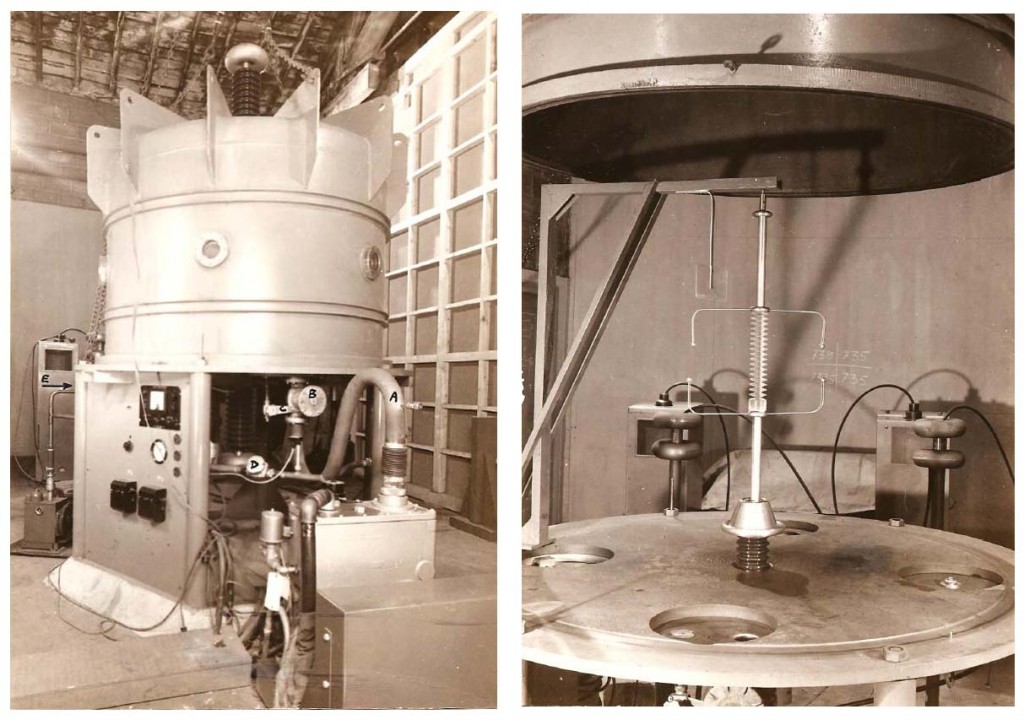
The report says that under high vacuum conditions the discs always moved in the direction of the positive pole, regardless of the polarity on the outboard wire.
These vacuum chamber experiments were a decisive milestone in that they demonstrated beyond a doubt that electrogravitic propulsion was a real physical phenomenon.
PAGE 26 OF THE FINAL REPORT FULLY DESCRIBES THE OBSERVED BIEFELD BROWN EFFECT IN FULL VACUUM CHAMBER
When the DISK SHAPED CAPACITOR WAS USED, the total deviation/movement was A FULL 30 DEGREES (deviation totale du systeme 30 degre).
BIEFELD-BROWN EFFECT FULL DETAILS/VIDEOS:
https://www.theflatearthsociety.org/forum/index.php?topic=30499.msg1852363#msg1852363Thomas Townsend Brown, the greatest American physicist of the 20th century:
http://ttbrown.com/defying_gravity/preface.html