The sun, right triangles, and the problem with perspective

  • 36 Replies
  • 8310 Views
*

Jonny B Smart

  • 691
  • +0/-0
The sun, right triangles, and the problem with perspective
« on: April 13, 2017, 08:32:02 PM »
We hear all the time the argument that the disappearance of the sun is caused by perspective-- "fading to the vanishing point."

 To demonstrate this, I have seen examples of things like long hallways. The problem that these arguments fail to understand is the altitude of the sun.  These long always have a ceiling height of 10 feet or so. However, the sun is supposed to be about 3000 miles up. The extremely high altitude of the sun in this model means that perspective could not work.

The reason that perspective appears to us is that the angular distance between the bottom and top of an object shrinks as it gets further away from us.  The easiest way to understand this is with a right triangle. Imagine that your eye and the distant object form a right triangle. The bottom of the right triangle is at the distance between you and the bottom of the object. The height of the object is also the height of the right triangle, and the long side of the right triangle (hypotenuse) is the distance between your eye and the top of the object. The closer an object is to you, the more you have to move your eye up and down to see the top and the bottom.  The further away way it is, the less you have to move your up-and-down to see the top and the bottom. The same is true for large and small objects. Large objects require lots of up-and-down movement to see the top and bottom, and small objects require only a little bit of up-and-down movement to see top and bottom. This is why our brain interprets distant objects as being small.

 The problem that this presents for the sun on a flat earth is that the 3000 mile altitude means that the sun has to be really really really far away before the angle gets noticeably low. If the sun is 3000 miles in the air and above a point 3000 miles away from me, then I will be looking at the sun had a 45° angle. At about 5100 miles, the sun is at 30°. At 10,000 miles away, the sun is still at 17°. At 30,000 miles away, the sun is still out about 6°. At 50,000 miles, the sun would still be at 3.5°.  At 100,000 miles, the sun would still be up 1.7°. At 1,000,000 miles, the sun is still at 0.17°. Somehow the earth would have to be big Enough to accommodate the sun being 1,000,000 miles away for perspective to bring the sun down to the horizon. That just gets it to the horizon. That still doesn't get it below the horizon.

Nope. Just nope.
« Last Edit: April 13, 2017, 09:46:20 PM by Jonny B Smart »
"Science is real."
--They Might Be Giants

?

Semnomic

  • 172
  • +0/-0
Re: The sun, right triangles, and the problem with perspective
« Reply #1 on: April 13, 2017, 09:46:53 PM »
We hear all the time the argument that the disappearance of the sun is caused by perspective-- "fading to the vanishing point."

 To demonstrate this, I have seen examples of things like long hallways. The problem that these arguments fail to understand is the altitude of the sun.  These long always have a ceiling height of 10 feet or so. However, the sun is supposed to be about 3000 miles up. The extremely high altitude of the sun in this model means that perspective could not work.

The reason that perspective works is that the angular distance between the bottom and top of an object shrinks as it gets further away from us.  The easiest way to understand this is with a right triangle. Imagine that your eye and the distant object form a right triangle. The bottom of the right triangle is at the distance between you and the bottom of the object. The height of the object is also the height of the right triangle, and the long side of the right triangle (hypotenuse) is the distance between your eye and the top of the object. The closer an object is to you, the more you have to move your eye up and down to see the top and the bottom.  The further away way it is, the less you have to move your up-and-down to see the top and the bottom. The same is true for large and small objects. Large objects require lots of up-and-down movement to see the top and bottom, and small objects require only a little bit of up-and-down movement to see top and bottom. This is why our brain interprets distant objects as being small.

 The problem is that this presents for the sun on a flat earth is that that 3000 mile altitude means that the sun has to be really really really far away before the angle gets noticeably low. If the sun is 3000 miles in the air and 3000 miles away horizontally from me, then I will be looking at the sun had a 45° angle. At about 5100 miles, the sun is at 30°. At 10,000 miles away, the sun is still at 17°. At 30,000 miles away, the sun is still out about 6°. At 50,000 miles, the sun would still be at 3.5°.  At 100,000 miles, the sun would still be up 1.7°. At 1,000,000 miles, the sun is still at 0.17°. Somehow the earth would have to be big Enough to accommodate the sun being 1,000,000 miles away for perspective to bring the sun down to the horizon. That just gets it to the horizon. That still doesn't get it below the horizon.

Nope. Just nope.

Also on similar topic, the FE suns path follows a ring that basically matches our equator, they need to do this to explain SOME things including heat/tropics etc.

Problem based on your deg measurements for FE is when the sun is NOT overhead on equator (late afternoon/early morning) and its ROASTING hot, that measurement to the sun is equal to places on earth that are MUCH colder.

Look inwards and outwards from suns ring path and picture the distance light has to travel to various location OFF the equator. Got to think in 3D so i hope you understand what im saying.


?

Silicon

  • 609
  • +0/-0
Re: The sun, right triangles, and the problem with perspective
« Reply #2 on: April 13, 2017, 11:47:32 PM »
We hear all the time the argument that the disappearance of the sun is caused by perspective-- "fading to the vanishing point."

 To demonstrate this, I have seen examples of things like long hallways. The problem that these arguments fail to understand is the altitude of the sun.  These long always have a ceiling height of 10 feet or so. However, the sun is supposed to be about 3000 miles up. The extremely high altitude of the sun in this model means that perspective could not work.

The reason that perspective appears to us is that the angular distance between the bottom and top of an object shrinks as it gets further away from us.  The easiest way to understand this is with a right triangle. Imagine that your eye and the distant object form a right triangle. The bottom of the right triangle is at the distance between you and the bottom of the object. The height of the object is also the height of the right triangle, and the long side of the right triangle (hypotenuse) is the distance between your eye and the top of the object. The closer an object is to you, the more you have to move your eye up and down to see the top and the bottom.  The further away way it is, the less you have to move your up-and-down to see the top and the bottom. The same is true for large and small objects. Large objects require lots of up-and-down movement to see the top and bottom, and small objects require only a little bit of up-and-down movement to see top and bottom. This is why our brain interprets distant objects as being small.

 The problem that this presents for the sun on a flat earth is that the 3000 mile altitude means that the sun has to be really really really far away before the angle gets noticeably low. If the sun is 3000 miles in the air and above a point 3000 miles away from me, then I will be looking at the sun had a 45° angle. At about 5100 miles, the sun is at 30°. At 10,000 miles away, the sun is still at 17°. At 30,000 miles away, the sun is still out about 6°. At 50,000 miles, the sun would still be at 3.5°.  At 100,000 miles, the sun would still be up 1.7°. At 1,000,000 miles, the sun is still at 0.17°. Somehow the earth would have to be big Enough to accommodate the sun being 1,000,000 miles away for perspective to bring the sun down to the horizon. That just gets it to the horizon. That still doesn't get it below the horizon.

Nope. Just nope.

You're trying to calculate visual angles (perspective of the person) using a side profile 2d diagram.  Your method is wrong.

Try again.

*

rabinoz

  • 26528
  • +0/-0
  • Real Earth Believer
Re: The sun, right triangles, and the problem with perspective
« Reply #3 on: April 14, 2017, 12:14:17 AM »

You're trying to calculate visual angles (perspective of the person) using a side profile 2d diagram.  Your method is wrong.

Try again.
OK, YOU show us how to do it!

On your flat earth what would the
  • visual angle of the sun (apparent size) be when it is 14,000 km away.

  • visual angle of the sun above the horizon be when it is 14,000 km away.
You might find this information right from the "horse's mouth", useful! In Zetetic Astronomy, CHAPTER XIV, page 202, 203 we find:
Quote from: Rowbotham
In the first place it is easily demonstrable that, as shown in the following diagrams, fig. 71, lines which are equi-distant.

FIG. 71.
"The range of the eye, or diameter of the field of vision, is 110°; consequently this is the largest angle under which an object can be seen. The range of vision is from 110° to 1° . . . . The smallest angle under which an object can be seen is upon an average, for different sights, the sixtieth part of a degree, or one minute in space; so that when an object is removed from the eye 3000 times its own diameter, it will only just be distinguishable; consequently the greatest distance at which we can behold an object like a shilling of an inch in diameter, is 3000 inches or 250 feet."

The above may be called the law of perspective. It may be given in more formal language, as the following: when any object or any part thereof is so far removed that its greatest diameter subtends at the eye of the observer, an angle of one minute or less of a degree, it is no longer visible.
Oh, look! Rowbotham seems to be "using a side profile 2d diagram", naughty, naughty!

This so-called "Law of Perspective" is more-or-less agreement with modern findings on the resolution of the human eye.

So now, Silicon, maybe you can tell us where the above statement by Rowbotham is wrong!

?

Silicon

  • 609
  • +0/-0
Re: The sun, right triangles, and the problem with perspective
« Reply #4 on: April 14, 2017, 12:27:40 AM »
Go paste your side profile right triangles on top of this image.  Do you see the problem?  I think we're done here.


*

JackSchitt

  • 423
  • +0/-0
Re: The sun, right triangles, and the problem with perspective
« Reply #5 on: April 14, 2017, 12:31:40 AM »

You're trying to calculate visual angles (perspective of the person) using a side profile 2d diagram.  Your method is wrong.

Try again.

Does he realise, that's why triangles are so helpful to us?
"Religion is the opium of the people"
Karl Marx

“It's better to keep your mouth shut and appear stupid than open it and remove all doubt”

*

JackSchitt

  • 423
  • +0/-0
Re: The sun, right triangles, and the problem with perspective
« Reply #6 on: April 14, 2017, 12:32:56 AM »
Go paste your side profile right triangles on top of this image.  Do you see the problem?  I think we're done here.


I can see a way he can do it, granted the camera angle it's very helpful but a right angle triangle can be drawn over to illustrate our point, I just lack the tools on my phone to do it on here.
"Religion is the opium of the people"
Karl Marx

“It's better to keep your mouth shut and appear stupid than open it and remove all doubt”

?

Semnomic

  • 172
  • +0/-0
Re: The sun, right triangles, and the problem with perspective
« Reply #7 on: April 14, 2017, 12:52:26 AM »
We hear all the time the argument that the disappearance of the sun is caused by perspective-- "fading to the vanishing point."

 To demonstrate this, I have seen examples of things like long hallways. The problem that these arguments fail to understand is the altitude of the sun.  These long always have a ceiling height of 10 feet or so. However, the sun is supposed to be about 3000 miles up. The extremely high altitude of the sun in this model means that perspective could not work.

The reason that perspective appears to us is that the angular distance between the bottom and top of an object shrinks as it gets further away from us.  The easiest way to understand this is with a right triangle. Imagine that your eye and the distant object form a right triangle. The bottom of the right triangle is at the distance between you and the bottom of the object. The height of the object is also the height of the right triangle, and the long side of the right triangle (hypotenuse) is the distance between your eye and the top of the object. The closer an object is to you, the more you have to move your eye up and down to see the top and the bottom.  The further away way it is, the less you have to move your up-and-down to see the top and the bottom. The same is true for large and small objects. Large objects require lots of up-and-down movement to see the top and bottom, and small objects require only a little bit of up-and-down movement to see top and bottom. This is why our brain interprets distant objects as being small.

 The problem that this presents for the sun on a flat earth is that the 3000 mile altitude means that the sun has to be really really really far away before the angle gets noticeably low. If the sun is 3000 miles in the air and above a point 3000 miles away from me, then I will be looking at the sun had a 45° angle. At about 5100 miles, the sun is at 30°. At 10,000 miles away, the sun is still at 17°. At 30,000 miles away, the sun is still out about 6°. At 50,000 miles, the sun would still be at 3.5°.  At 100,000 miles, the sun would still be up 1.7°. At 1,000,000 miles, the sun is still at 0.17°. Somehow the earth would have to be big Enough to accommodate the sun being 1,000,000 miles away for perspective to bring the sun down to the horizon. That just gets it to the horizon. That still doesn't get it below the horizon.

Nope. Just nope.

You're trying to calculate visual angles (perspective of the person) using a side profile 2d diagram.  Your method is wrong.

Try again.


2D ? yes its a D2 problem we know the height and we know when the FE sun should "go down below horizon" because FE people have drawn maps with a sun/shadow that rolls around FE  the angle is pretty much constant for FE sunset.

You can get the correct angle very quickly by simply using the radius of the "sun beam" "Height of sun" and using Pythagoras to get distance between eye and sun OR the actual angle.

OP underestimated this angle, he was likely thinking about the Diameter of FE but at most the viewer will only ever be 1/4 of FE's diameter away from a sunset no matter where you are on FE.

30 deg+ no matter where you are is a fair number.

You do have an out you can LOWER the height of sun but that will lead to other problems :) 


*

rabinoz

  • 26528
  • +0/-0
  • Real Earth Believer
Re: The sun, right triangles, and the problem with perspective
« Reply #8 on: April 14, 2017, 12:59:10 AM »
Go paste your side profile right triangles on top of this image.  Do you see the problem?  I think we're done here.
Bye bye, then.

?

Semnomic

  • 172
  • +0/-0
Re: The sun, right triangles, and the problem with perspective
« Reply #9 on: April 14, 2017, 01:23:08 AM »
We hear all the time the argument that the disappearance of the sun is caused by perspective-- "fading to the vanishing point."

 To demonstrate this, I have seen examples of things like long hallways. The problem that these arguments fail to understand is the altitude of the sun.  These long always have a ceiling height of 10 feet or so. However, the sun is supposed to be about 3000 miles up. The extremely high altitude of the sun in this model means that perspective could not work.

The reason that perspective appears to us is that the angular distance between the bottom and top of an object shrinks as it gets further away from us.  The easiest way to understand this is with a right triangle. Imagine that your eye and the distant object form a right triangle. The bottom of the right triangle is at the distance between you and the bottom of the object. The height of the object is also the height of the right triangle, and the long side of the right triangle (hypotenuse) is the distance between your eye and the top of the object. The closer an object is to you, the more you have to move your eye up and down to see the top and the bottom.  The further away way it is, the less you have to move your up-and-down to see the top and the bottom. The same is true for large and small objects. Large objects require lots of up-and-down movement to see the top and bottom, and small objects require only a little bit of up-and-down movement to see top and bottom. This is why our brain interprets distant objects as being small.

 The problem that this presents for the sun on a flat earth is that the 3000 mile altitude means that the sun has to be really really really far away before the angle gets noticeably low. If the sun is 3000 miles in the air and above a point 3000 miles away from me, then I will be looking at the sun had a 45° angle. At about 5100 miles, the sun is at 30°. At 10,000 miles away, the sun is still at 17°. At 30,000 miles away, the sun is still out about 6°. At 50,000 miles, the sun would still be at 3.5°.  At 100,000 miles, the sun would still be up 1.7°. At 1,000,000 miles, the sun is still at 0.17°. Somehow the earth would have to be big Enough to accommodate the sun being 1,000,000 miles away for perspective to bring the sun down to the horizon. That just gets it to the horizon. That still doesn't get it below the horizon.

Nope. Just nope.

The FE'ers have made this very simple for you,
FE has a height for sun
FE sun has a cone of light pointing down and its a constant diameter.
anyone on edge of that cone of light is looking at a sunset or sunrise,
the diameter of cone is 1/4 of FE diameter (constant as its always spanning half of FE at all times)

so you can get the angle of the sun by using height of FE sun and 1/4 of the Diameter of Flat Earth.

30% is a good estimate.

Use FE map to prove FE sunsets impossible with constants provided by FE'ers   :)
Also FE sun does not cover 50% of FE at all times it looks more like 25/30 % of FE is lit by sun torch, on BE its 50% lit at all times :) 

*

JackBlack

  • 26157
  • +51/-79
Re: The sun, right triangles, and the problem with perspective
« Reply #10 on: April 14, 2017, 03:21:03 AM »
You're trying to calculate visual angles (perspective of the person) using a side profile 2d diagram.  Your method is wrong.

Try again.
Yes, he is calculating the angle to the sun.
His method is correct.
If you wish to disagree, point out what is wrong with it.

Try again.

Go paste your side profile right triangles on top of this image.  Do you see the problem?  I think we're done here.
But they don't go onto the image, that is now a 3D problem and a projection problem.
The triangles are used to determine the angles of/to objects.
If you were to draw then in that image, it would have to be distorted due to perspective as well, and every one would go straight to the viewer.
You don't stick them on the brick wall.

Try again.

If you are done and realise your error, that is fine.

*

rabinoz

  • 26528
  • +0/-0
  • Real Earth Believer
Re: The sun, right triangles, and the problem with perspective
« Reply #11 on: April 14, 2017, 04:28:09 AM »
Go paste your side profile right triangles on top of this image.  Do you see the problem?  I think we're done here.


Yes, I see at least part of the problem! You give us an image grossly distorted by a very wide-angle lens.
The lines are not straight and perspective guide-lines would always be straight.

You might well say "I think we're done here" and run away for being so devious!

Try again with a realistic photograph!

And come back and show us how it should be done!

*

JackSchitt

  • 423
  • +0/-0
Re: The sun, right triangles, and the problem with perspective
« Reply #12 on: April 14, 2017, 04:41:11 AM »
T
Go paste your side profile right triangles on top of this image.  Do you see the problem?  I think we're done here.


Yes, I see at least part of the problem! You give us an image grossly distorted by a very wide-angle lens.
The lines are not straight and perspective guide-lines would always be straight.

You might well say "I think we're done here" and run away for being so devious!

Try again with a realistic photograph!

And come back and show us how it should be done!
To be fair we probably could draw something that resembles a triangle and still be semi correct
"Religion is the opium of the people"
Karl Marx

“It's better to keep your mouth shut and appear stupid than open it and remove all doubt”

*

Jonny B Smart

  • 691
  • +0/-0
Re: The sun, right triangles, and the problem with perspective
« Reply #13 on: April 14, 2017, 06:47:28 AM »
I brought up the angles produced by the ridiculous distances to point out that they won't fit on a flat Earth model.

Some people may not like the math, but there's an easy way to figure out he same thing: make a drawing where one inch = 1,000 miles. American paper is 11 inches long, so that would be 11,000 miles at that scale. Measure three inches up the short side, then draw a line from that point to the opposite corner making a right triangle with sides of three inches and 11 inches (length of the hypotenuse not necessary here). The angle formed is the angle that a 3,000 mile-high Sun would be if it were 11,000 miles away. Keep in mind that if we had a flat Earth, then someone could see the sun at the same angle at the same time from 11,000 miles the other side of wherever is directly below the sun--meaning they are 22,000 miles from where you are. If you want a much lower angle (closer to setting), you need a much bigger piece of paper. Try 30 inches long and three inches up. That's a pretty low angle, but at that angle of the sun would have to be 30,000 miles away. Someone on the other side of that viewing at the same angle (for example there's sunrise compared your sunset at the same time) would have to be 60,000 miles away.

 Can anyone draw a model of the earth that allows two people to view the sun from 60,000 miles apart while on the surface that is consistent with other known distances such as flight travel times?

No.
"Science is real."
--They Might Be Giants

?

Piesigma

  • 59
  • +0/-0
Re: The sun, right triangles, and the problem with perspective
« Reply #14 on: April 14, 2017, 06:57:16 AM »
Go paste your side profile right triangles on top of this image.  Do you see the problem?  I think we're done here.


Note that the two images of the brick wall are not the same from Case 1 to Case 2 but I don't see why that matters.  Can you explain the problem now?


*

JackSchitt

  • 423
  • +0/-0
Re: The sun, right triangles, and the problem with perspective
« Reply #15 on: April 14, 2017, 07:06:53 AM »
Where's your perspective now?
"Religion is the opium of the people"
Karl Marx

“It's better to keep your mouth shut and appear stupid than open it and remove all doubt”

*

Jonny B Smart

  • 691
  • +0/-0
Re: The sun, right triangles, and the problem with perspective
« Reply #16 on: April 14, 2017, 07:43:08 AM »
Go paste your side profile right triangles on top of this image.  Do you see the problem?  I think we're done here.


If this is an attempt to simulate perspective on a flat Earth, it is a very odd angle. We are supposed to be on the ground looking across a plane (right?). Things are above that plane. Stick your camera flat on that wall (to be "on the plane") with a pole sticking out of the wall (altitude of the Sun). That's the right point of view, and the wall, pole, and your line of sight to the top of the pole form your triangle. If you slide that pole away from the camera, the near angle gets lower and lower, but it never reaches zero. The ratio of the pole height to the distance away from the pole gives you the tangent of that angle.

Here's a fun fact: The angular diameter of the Sun is about 0.5 degrees. (http://astronomy.swin.edu.au/cosmos/A/Angular+Diameter)
That makes the angular radius about 0.25 degrees. Using a little trigonometry: 3000 / (tan 0.25) = 687,000 miles. For the sun to appear to be sitting on the horizon using perspective only, it would have to be 687,000 miles away.

Of course, perspective should also make the Sun shrink substantially (but it doesn't, so...)
"Science is real."
--They Might Be Giants

?

Silicon

  • 609
  • +0/-0
Re: The sun, right triangles, and the problem with perspective
« Reply #17 on: April 14, 2017, 09:48:04 AM »
Your method is wrong.  JUST ADMIT IT!

« Last Edit: April 14, 2017, 10:05:19 AM by Silicon »

*

JackSchitt

  • 423
  • +0/-0
Re: The sun, right triangles, and the problem with perspective
« Reply #18 on: April 14, 2017, 10:14:52 AM »
Right ok mate, learn full perspective, don't research a specific flat earth idea as that will be geared towards proving flat earth, so that method is likely to be wrong, take basic knowledge and apply it.
"Religion is the opium of the people"
Karl Marx

“It's better to keep your mouth shut and appear stupid than open it and remove all doubt”

*

Novarus

  • 372
  • +0/-0
Re: The sun, right triangles, and the problem with perspective
« Reply #19 on: April 14, 2017, 01:04:35 PM »
Your method is wrong.  JUST ADMIT IT!


He starts off by telling us he doesn't have the numbers to back up his claims - "I don't know how high the sun is" at 0.43, so he has no concrete mathematical basis for this argument.
He also gives us a hint at his own perspective (heh) when he concocted this theory - "it makes you start to doubt, but I know it's wrong!" at 1.46.


Sorry, but just drawing lines with a vanishing point at the horizon doesn't stop the fact that the little circle that's meant to represent the sun still drops BELOW the horizon in that big proofy diagram at 2.40 and again at 3.32.
Even with the perspective lines, where is the sun supposed to go once it hits the vanishing point?
And If it traces a circle over the earth, we should see it describe a large arc of a flattened ellipse, reversing direction before reaching maximum distance from the observer, and the continue going along the same circular track in the sky. With these perspective lines, as any middle school art student could tell you, such a circular path has to stay on the same side of the vanishing point.


Especially damaging is the "photo of reality" he shows at 2.51 to support his view - no single line above his yellow horizon line ever goes below or even touches the yellow horizon line. This literally makes no sense when you are talking about an object that appears to recede below the horizon.
He uses this photo that was taken at, maybe, a 45 degree angle from "straight on" and slaps it over a diagram shown from a 90 degree, "straight on" perspective to show how it's wrong.
This would be the equivalent of me taking a picture of the Empire State building at ground level, overlaying it on a picture if the New York skyline and claiming that the building in question was actually a pyramid, because it clearly looks different in my photo.
The crowning jewel is that at 3.30, when demonstrating his perspective proof, the puts the sun on a line below the horizon - this line is not in line with the vanishing point he so graciously provided, so the sun would have to reach thay point, cross it, and continue on its path - this is completely incompatible with his explanation of the motion of the sun if it's orbit is parallel with the plane of the Flat Earth. Either it has a different vanishing point and is not parallel or it is not on a straight line path - these are the options here. His diagrams illustrate this beautifully.

He also seems to forget to follow his own lines and make the sun shrink as it follows it's perspective lines into the distance. Again - middle school art class.
And before you bring up the atmospheric projection thing, there really needs to be some consensus on the height of the sun, it's orbital characteristics, the speed of light and the refractive qualities of the atmosphere before that argument is made.

At 4.15, he basically ends up proving our point.
"Look at these lines! They're parallel!"
Well done, p-brane, they are - and I think you will notice in that picture of those lovely rows of flowers that at no point do any if the rows touch or go past each other. Even if that were an infinite field of flowers, none of those rows would ever touch or cross each other, let alone your "z-axis" - so if the Sun is on a parallel path to the Earth, then the only way it would meet the horizon would be if both the Earth and the Sun's path were infinite.

The rails in this photo, for example:
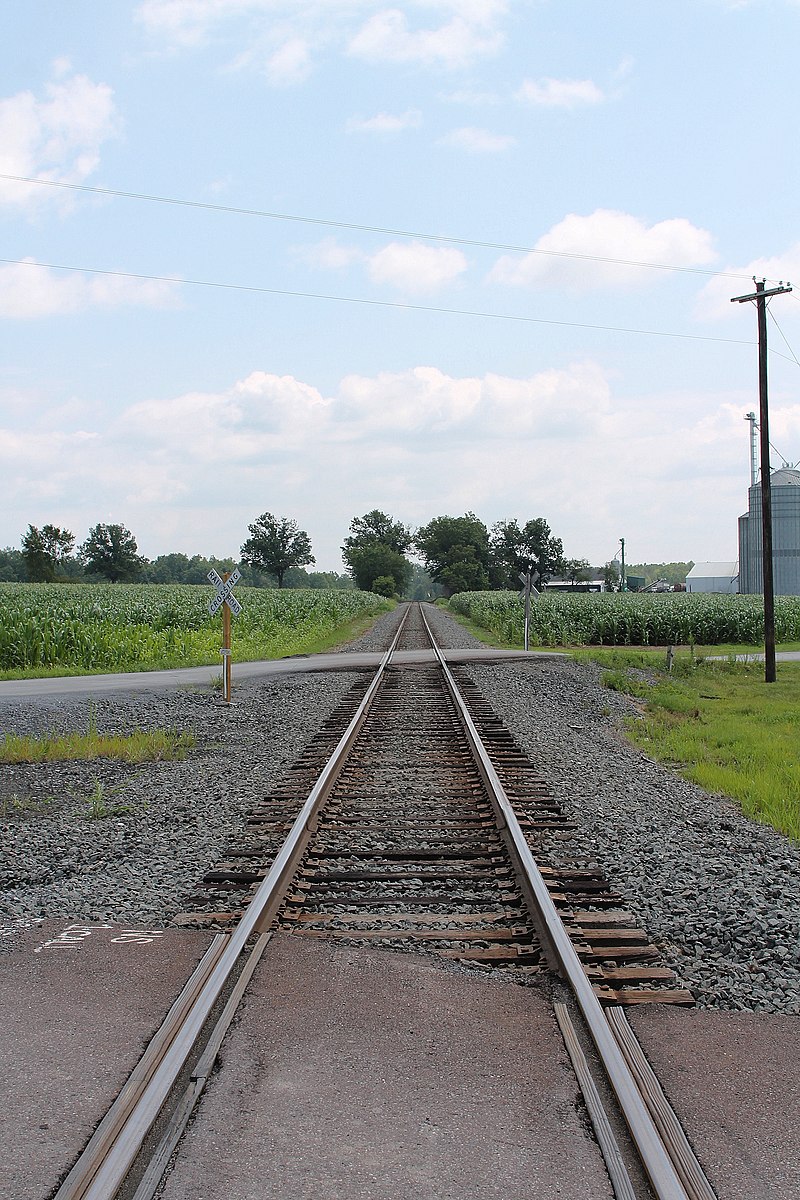

They don't touch at the vanishing point and then keep going, crossing over and continuing away from the observer on the same lines.
If you want to employ a vanishing point at the horizon, you have to treat it as such - a convergence at infinity. It is a limit - a theoretical end point where, if you extended those lines are far as they would go were they just lines on a plane [i.e. forever] they would meet.

The rest of the video is more or less a sequence of these overlaid diagrams that succumb to the exact problem that he sats the creator of the original diagram had: his diagram doesn't represent perspective accurately.
At 6.50, he says the spherical proponents "don't understand perspective! They don't get it!"
Sorry, love, but I'm fairly sure there's far more that you don't understand about perspective - you even made a video about how little you get it.

My favourite part, though, is a comment (that I will try and post a screenshot of as soon as my phone starts to co-operate) addressed to user setecordas from p-brane himself, stating that "the sun is immune to the type of perspective most of is are familiar with."
...you mean it doesn't follow the conventional laws of perspective that you based your entire argument on? Oh. Ok, so nothing you said actually meant anything? Not even the picture with all the pretty flowers?
This makes me sad.

So no, I will not just be admitting it works until you admit the Sun is a giant, phosphorescent fried egg in the sky being pushed around by the headless ghost of Lucille Ball every day.
As I can see, both arguments are just as mathematical as each other.
Only the ignorant choose to ignore opposing views.
Fight for your belief, don't run away.
It's the only way anyone can take you seriously.

*

Jonny B Smart

  • 691
  • +0/-0
Re: The sun, right triangles, and the problem with perspective
« Reply #20 on: April 14, 2017, 03:19:05 PM »
Your method is wrong.  JUST ADMIT IT!


I am sorry, but your video is terribly wrong. The person who made it is confusing real world 3-D perspective with simulated perspective in 2-D drawings. Also, the person is switching back-and-forth between  different kinds of perspective depending on which one suits his agenda. The photograph that he shows with the parallel lines on the outside of the building is his worst example of this. That photograph is taken at an odd angle so it maximizes the convergence at the vanishing point. He then overlays a two dimensional perspective on top of that--mixing and confusing different perspectives and angles. He also uses an example of a very short building (compared to the supposed altitude of the Sun).
"Science is real."
--They Might Be Giants

?

Silicon

  • 609
  • +0/-0
Re: The sun, right triangles, and the problem with perspective
« Reply #21 on: April 14, 2017, 03:46:08 PM »
The initial method has been destroyed.  I know its hard to let go but it's time to move on.

*

JackBlack

  • 26157
  • +51/-79
Re: The sun, right triangles, and the problem with perspective
« Reply #22 on: April 14, 2017, 04:06:47 PM »
Your method is wrong.  JUST ADMIT IT!
No. It isn't.
It is correct.
If you think it is wrong, explain WHY. Don't just link to some BS youtube video.
Seriously, it starts off with 1.5 minutes of just pointing why FE is BS.

This is one way to accurately make perspective drawings, where the angle corresponds to the height in the image.
When then object is nice and close it has a large angle of elevation and thus appears high.
When it is much further away, it has a much smaller angle, and thus appears low.

You can't use a perspective drawing/photo to then try to measure the angle by constructing a right angle triangle.
If you want to use a perspective drawing, you need to just measure the height as that gives you the angle straight away.
This is because in your perspective drawing, the height is not the same at all distances. Instead, as you go further back in the drawing, an equal height appears smaller.

Also note that the vanishing point is infinitely far away. The sun never reaches that.
Also note that objects don't remain the same size.
His picture needed 4 lines, 1 to show the ground. 1 to show the centre of the sun (which is somewhat optional), 1 to show the highest point of the sun and one to show the lowest.
They are all parallel when taking an orthographic side view.
But with a perspective view, they all appear to converge.

That means the sun doesn't set, instead it shrinks to a tiny point at infinite distance.

In the video, he shows a picture of a wall, with straight lines on it, then cuts the wall so he can bend the lines and have them meet much earlier than they should.
Also, this actually further backs up the OP.
Look at how far away the sun needs to be to get it low, even close to the horizon.
If you scaled that to your BS flat Earth it would need to be much further away than the edge of Earth.

Of course, he blatantly lies with his representation, cutting the wall, bringing the vanishing point much closer, rather than off at infinite distance like it should be, and then plots the sun travelling the same distance in the photo, not taking perspective into account.
For him to do this honestly, he would put circles on the wall to show where the sun would be, making sure they are equally spaced.
He also chose a rather poor wall to do this as it shows his dishonesty.
You can see vertical rails, which are quite likely to be spaced equally, such that there is the same distance between each one (If you object to this, I will dismiss the entire wall, demanding you first prove that they are actually parallel rails that are equal width).
You can't see the left most rail in the picture used with the sun, it would be further to the left of the sun at 12 pm. The next rail along (the first one you see) is at 2 pm. Then the next one is at 3 pm.
That means in order for this picture to represent reality, the sun would need to travel twice as fast between 2 and 3 than it does between 12 and 1.
And this trend continues. At 4pm, it is 2 rails down (i.e. 2 more than it was at 3), meaning the sun has sped up, again. Then when it finally reaches the vanishing point (at least if it was done honestly) it would have travelled infinite distance.

So no, that perspective BS isn't how it works.

The initial method stands strong, your BS has been destroyed. You are the one who needs to move on, preferably to reality.

*

rabinoz

  • 26528
  • +0/-0
  • Real Earth Believer
Re: The sun, right triangles, and the problem with perspective
« Reply #23 on: April 14, 2017, 04:57:01 PM »
Your method is wrong.  JUST ADMIT IT!
Not likely!

Read my words!
THE HORIZON IS NOT THE VANISHING POINT!
Look!
These buildings are way further than the horizon and have not vanished.

Toronto as seen across lake Ontario from Olcott Beach, NY; evening 18th July EST, by Ad Meskens
Now those buildings are 64.5 km and way past the horizon, but clearly have not vanished.

Ships further away than the horizon do not "vanish":
]
Ship partly below horizon, Mathias Kp
Towers further away than the horizon do not "vanish":

Turning Torso (190m tall) - seen from 25km - 50km
More towers "not vanishing":

FLAT EARTH - EXPERIMENT - TELESCOPE, Alex Chertnik
You do not have to rely on those videos. Go out and check it yourself, a telescope helps.

And finally the sun further than the horizon does not "vanish"!
           
And if you claim that the sun in those photos is not further away than the horizon. At sunset the FE sun has to be around 14,000 km away, and from near sea-level the horizon is easily shown to be only a few kilometres away.

So, I repeat:
THE HORIZON IS NOT THE VANISHING POINT!
Yes, Silicon, your method is quite wrong.  JUST ADMIT IT!

Do yourself a favour and file your
Flat Earth Indoctrination 101 and silly Flat Earth YouTube videos by Pea Brain or whoever he is
in your circular filing cabinet - the one one the floor under your desk!
« Last Edit: September 20, 2017, 07:19:03 PM by rabinoz »

*

JackBlack

  • 26157
  • +51/-79
Re: The sun, right triangles, and the problem with perspective
« Reply #24 on: April 14, 2017, 05:02:19 PM »
Here, I was even nice and made a more honest picture.

A key thing with this is that it is using the bricks to set the spacing to be the same between the different times.

Sure, it is ignoring the fact the sun would curve off that straight line path, and actually stay closer to the observer in your FE model, but I don't care as it is already bad enough for you without me making it even more accurate to make it worse, and it would be harder to do.


Happy, got anything to say about that? Or do you accept that your BS is refuted?

?

Piesigma

  • 59
  • +0/-0
Re: The sun, right triangles, and the problem with perspective
« Reply #25 on: April 14, 2017, 05:36:37 PM »
Your method is wrong.  JUST ADMIT IT!


It seems p-brane left out a very important detail regarding the sun's apparent size and this "perspective" effect in the video. 

This picture helps to illustrate my point:


Case 1:  How Perspective Works (assuming the Earth to be a flat plane and the Sun 3000 miles high)

Notice how in the video p-brane doesn't bother to take into account that the sun should be changing angular size if its position in the sky is approaching the vanishing point as it moves away from the observer?

Follow the two perspective lines that trace the sun's apparent size in Case 1 as it moves toward this flat earth horizon and you can see that it must get smaller in size in order to converge to a visual vanishing point.
 
By "visual vanishing point" I'm referring to the vanishing point an artist such as a painter might use to depict a perspective and horizon not a vanishing point in the sense of a horizon being infinitely far away on a flat plane.

Case 2: How Perspective Doesn't Work (Flat Earth Fantasy)

This is what we should observe on a rotating round earth model.
 
Q: For the flat earth model as used in p-brane’s video, how is the sun's angular size (apparent size) not subject to following these same perspective lines to the visual vanishing point as depicted in Case 2?
   
In other words, why would we observe the sun stay practically the same size as it recedes in Case 2 on a flat earth (with the sun 3000 miles high and traversing the sky) if perspective is what makes an object shrink in size to the visual vanishing point as the object recedes from the observer?

We don’t just get to count the motion of the object and ignore its apparent size when saying an object is subject to perspective that we can perceptibly observe.  If lines visually converging is how we describe the effect of perspective then it applies to the object just as well as the space/distance between any two objects.

*

Jonny B Smart

  • 691
  • +0/-0
Re: The sun, right triangles, and the problem with perspective
« Reply #26 on: April 14, 2017, 07:32:33 PM »
It seems that right triangle geometry is a legitimate source of understanding cording to flat earth proponents:

http://www.theflatearthsociety.org/tiki/tiki-index.php?page=Distance+to+the+Sun

If they can use it, it seems that I could, too.
"Science is real."
--They Might Be Giants

?

Silicon

  • 609
  • +0/-0
Re: The sun, right triangles, and the problem with perspective
« Reply #27 on: April 16, 2017, 04:16:29 PM »
Your method is wrong.  JUST ADMIT IT!


In other words, why would we observe the sun stay practically the same size as it recedes in Case 2 on a flat earth (with the sun 3000 miles high and traversing the sky) if perspective is what makes an object shrink in size to the visual vanishing point as the object recedes from the observer?


The sun emits light, it does not reflect it, there is a difference.  So all of RAB's building, and ships behind the curve does not apply.  There is the long explanation for what is really happening in these cases but the simplest way you know, is because of the 'supposed' curve itself.  Think about it.  He is showing you videos of 190 M buildings hidden behind a curve under 30 miles away at sea level.  If this were true then being 19 miles in the air should reveal enormous drop off in terms of curvature, and the horizon would make an extreme drop from eye level.  There is no way around this. They try to have it both ways however, dozens of amateur balloons, rockets, and other video always show the flat horizon at eye level, no matter how high you go. 

Now the sun is magnified at ground level as it recedes into the distance, due to atmosphere conditions which shows little to no shrinkage.  A common example of this is pictures or observing vehicle traffic.  You will notice the lights the furtherest away are larger than those closer to the observer and often times the left and right lights blend together.

There are plenty of videos available showing the sun does shrink as it recedes away.  Mostly these are timelapses from dry areas, or in higher altitudes. 

Just my opinion. Keep asking questions and good luck.

*

JackSchitt

  • 423
  • +0/-0
Re: The sun, right triangles, and the problem with perspective
« Reply #28 on: April 16, 2017, 04:29:33 PM »
I'll be honest, I've never seen the sun shrink as it goes away, I can see why that would be visible on a camera due to flare on the lense, but from my own eyes, I have only ever seen it dissappear bottom first.
"Religion is the opium of the people"
Karl Marx

“It's better to keep your mouth shut and appear stupid than open it and remove all doubt”

*

rabinoz

  • 26528
  • +0/-0
  • Real Earth Believer
Re: The sun, right triangles, and the problem with perspective
« Reply #29 on: April 16, 2017, 06:20:57 PM »
The sun emits light, it does not reflect it, there is a difference.  So all of RAB's building, and ships behind the curve does not apply.
Rubbish! Reflected light and emitted light are all light leaving the surface of the object. The only difference is in the intensity.

But if you want reflected light, the moon appears to do exactly the same thing.

The following photos show the moon at quite different altitudes, and all almost the same size!


(1) Date: May 24, 2016 19:36 EAST
Moon at Alt 6.3°, Az 107.7°,  size  0.52°
   

(2) Date: May 24, 2016 at 20:16 EAST
Moon at Alt 14.5°, Az 103.6°,  size  0.52°
   

(3) Date: May 24, 2016 at 20:57 EAST
Moon at Alt 23.1°, Az  99.6°,  size  0.52°
   

(4) Date: May 25, 2016 at 06:46 EAST
Moon at Alt 26.5°, Az  262.1°,  size  0.50°


(5) Date: May 24, 2016 at 22:16 EAST
Moon at Alt 37.8°, Az  92.7°,  size  0.52°
   

(6)Date: June 21, 2016 at 23:12  EAST
Strawberry Moon+1 at Alt 67.1°, Azm 70.8°, size 0.53°
   

(7) Date: May 19, 2016 at 22:08 EAST
Moon at Alt 71.5°, Azm 0.1°,  size  0.52°
   

(8)Date: June 20, 2016 at 23:38 EAST
Strawberry Full Moon - at Alt 80.2°, Azm 23.4°, size  0.52x°


I suppose I did not need to show so many photos, but some are completely unable to accept the most solid evidence!

The moon stays (almost) the same size from rising (well 6.3°) to virtually overhead (at an Altitude of 80.2°).

Any explanations as to how this might be possible with the flat earth model of the moon's motion?

Quote from: Silicon
There is the long explanation for what is really happening in these cases but the simplest way you know, is because of the 'supposed' curve itself.  Think about it.  He is showing you videos of 190 M buildings hidden behind a curve under 30 miles away at sea level.  If this were true then being 19 miles in the air should reveal enormous drop off in terms of curvature, and the horizon would make an extreme drop from eye level.
Where did the "19 miles in the air" come from? But, that's no problem!
From 19 miles high the horizon would be almost 390 miles away and the angle down to the horizon about 5.6° below eye-level.
Show me any balloon photos where you could measure that sort of angle.

Quote from: Silicon
  There is no way around this. They try to have it both ways however, dozens of amateur balloons, rockets, and other video always shows the flat horizon at eye level, no matter how high you go. 
Show me photos from this sort of altitude that "shows the flat horizon at eye level". None I have seen have lenses that do not distort.

Quote from: Silicon
Now the sun is magnified at ground level as it recedes into the distance, due to atmosphere conditions which shows little to no shrinkage.  A common example of this is pictures or observing vehicle traffic.  You will notice the lights the furtherest away are larger than those closer to the observer and often times the left and right lights blend together.
No, you claim without any foundation that
"the sun is magnified at ground level as it recedes into the distance, due to atmosphere conditions which shows little to no shrinkage"

Then you try to use glare as the excuse! Glare causes a "fuzz" around the light, in clear conditions, the setting sun does not show that!
           

Quote from: Silicon
There are plenty of videos available showing the sun does shrink as it recedes away.  Mostly these are timelapses from dry areas, or in higher altitudes. 

Just my opinion. Keep asking questions and good luck.
So first you explain why the sun does not shrink, then claim evidence that it does?

Would you please show these "videos available showing the sun does shrink as it recedes away" and please don't thry to palm off any with glare making the sun look bigger when it is brighter!
Metabunk, Time Lapse Video of Sunset
This sort of thing! It's not on YouTube, just a link to a ".mov" file.