Or have you studied http://heiwaco.com/moontravelw1.htm#F9 ? Just copy/paste what you do not understand.
I look forward to explain everything to you.
This:
If anything freefalls from 180 000 m altitude, ignoring air friction, it will reach 50.000 m altitude at 1 598 m/s hypersonic speed after 163 seconds (or only 157 seconds in the alternative trajectory - it goes faster than gravity can accelerate it!!). Imagine that. It will hit ground after another 30 seconds.
What happens to the booster in free fall if you don't ignore air friction (along with a reentry burn and a landing burn)?
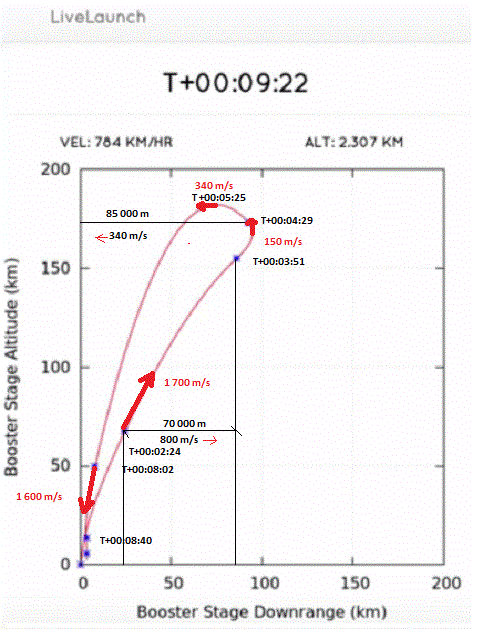
Source -
http://heiwaco.com/moontravelw1.htm#OTThanks for asking. As you know - as a typical example - the first booster stage goes to ~70 000 m altitude under own
nine (!) engines at full power (where it separates from the second stage at
T 2.25 after lift-off) and is then catapulted up into space at 180 000 m altitude at
T 5.25.
Some rocket engines are then fired to push the boster back towards above the start point - the
boost back burn. The booster is 85 000 m downrange from landing.
Then the booster stage drops down - free fall! From
space! 180 000 m altitude! It has vertical,downward speed ~1 600 m/s at 50 000 m altitude which, is reduced by an
entry burn! If not it will crash after 30 seconds.
There is no air friction above 50 000 m altitude as there is no air there (I hope you agree). The booster is dropping down from 180 000 m altitude and, at 50 000 m altitude, the
entry burn must be done at
T 8.02 to reduce vertical, free fall hypersonic speed. To do so, the booster must be absolutely vertical to avoid flying backwards away from landing zone. During the entry burn the booster rocket however continues downwards/backwards at hypersonic speed. Imagine landing like that!
After the entry burn, the booster continues to drop, speed increases again again due to gravity. Air friction will reduce the increase in speed, but then at
T 8.40 a rocket engine fires a
landing burn ... the empty rocket stops at
T 9.22 ... where it started! No fuel is left. A perfect landing!
I estimate 50-70 tons of fuel are used to produce the forces to boost back, at entry and landing. I cannot understand how it can be done at the right times/locations/durations/directions while travelling backwards at hypersonic space. IMO the rocket is not not stable going backwards, so it will wobble out of course and ... miss the target and ... crash.
So the whole thing is a hoax.