Except for the part where we were supposedly bouncing lasers off the moon almost a decade before the first supposed moon landing. Think about what you say before you say it.
Yes, you really should "Think about what you say before you say it", but you never learn!Perhaps
you are simply ignorant about science?
Yes, the first laser pulse reflected from the moon was in 1962, but if you look into it, you will find a dramatic improvement in accuracy since the corner reflectors were installed.
You can read a bit about it in:
Reminescenses of Early Work at MIT and ESRIN 1963-1974But these early experiments needed very high power and comparatively long pulse lengths (around 1 ms in the 1962 MIT case), so could not achieve very high accuracy. I could not find much of the accuracy of this one, bit a later one (still without corner reflectors) described in
On page 1687: 3 .1. Accuracy of Distance Measurement
This accuracy is limited by several factors:
(a) The duration of the pulse emitted by the laser, that is, about 50 nsec. This time interval corresponds to an uncertainty of 15 m in the distance.
From: Moon Distance Measurement by Laser
And have a look at:
May 9, 1962: Laser beam first used to measure distance to the moon
In 1962, laser technology was a new and exciting science. Lasers produce a light that is intense, coherent, and monochromatic. The beam of light emitted by a laser is also extremely narrow. It would be impossible to bounce a flashlight beam off the moon, as the light disperses too much to travel any distance. But a laser beam is so narrow that it can make the roughly 239,000 mile journey to the moon and still be detected back on Earth. The first time this was done, MIT scientists using a ruby laser to bounce a light beam off the moon in a series of pulses, estimated that its area on the moon's surface was just four miles in diameter. Later they were able to reduce this to under 2 1/2 miles.
From
Cosmeo View Today In History EventsThe later measurements with the corner reflectors have achieved millimeter accuracy, enough to determine that the Moon is spiraling away from Earth at a rate of 3.8 cm per year - a figure unexpectedly high.
This is the improvement in precision of measurement from the first retro-reflectors:
In the early days one of the biggest challenges was discerning returning photons from "stray" photons. MLRS would fire 1014 or 1015 photons to the moon and only about 10 or so returned to the photodetector, so being able to verify them was absolutely essential. "We devised a four-filter system," says Peter Shelus, senior research scientist at UT-Austin's Center for Space Research and member of the MLRS team. "First, we opened the detector to the sky just before we thought the photons were due back - about 2.5 seconds later. Second, we used a pinhole aperture only a few arc seconds in diameter to look at a very small part of the surface of the moon. The third filter was spectral -- we fired red light from the ruby laser or green from neodymium and looked for those wavelengths coming back in. The fourth filter was mathematical to neutralize noise in the photodetector."
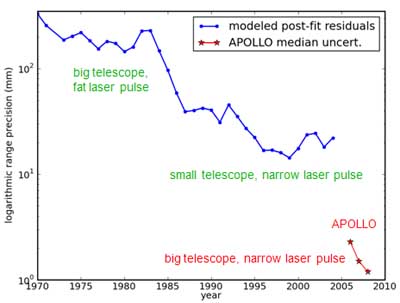 Figure 4.
From:
Lunar laser ranging: 40 years of high-level scienceSo sure, laser moon distance measurements were made as early as 1962, but there has been a dramatic improvement in accuracy since corner reflectors were installed.
Finally how do you reconcile the 239,000 miles or so measured by a number of methods with FE "a bit over 3,000 miles" purely guessed?
I am sure, Mr Jroa that you are quite aware of these facts, but present your rubbish claims
simply to disrupt the debate! You should realise that it
simply makes you look ignorant, but if that's the impression you want to leave, keep it up! It's working perfectly.