orifiel, c'est vrai, que vous êtes fille?
You never proved a single point or variable or even provided for reasoning of the variables.Here are the established facts of science:
Poincare did prove that the three body is not integrable.
What occurred during further experimentation was a shock. Poincare discovered that even in some of the smallest approximations some orbits behaved in an erratic unstable manner. His calculations showed that even a minute gravitational pull from a third body might cause a planet to wobble and fly out of orbit all together.And the equations of motion of the RE orbital mechanics, posted earlier, are much more complicated/complex than the set of equations describing the three body problem.
KAM theory has been proven, and is one of the greatest achievements of 20th century mathemtics.
Sussman and Wisdom's 1992 integration of the entire solar system displayed a disturbing dependence on the timestep of the integration (measurement of the Lyapunov time).
Thus, different researchers who draw their initial conditions from the same ephemeris at different times can find vastly different Lyapunov timescales.
Wayne Hayes, UC Irvine
These are true facts of science.
Jack Wisdom (MIT): It is not possible to exclude the possibility that the orbit of the Earth will suddenly exhibit similar wild excursions in eccentricity.
The exponential divergence of chaotic trajectories precludes long-term prediction given the limited knowledge of the state of our solar system.
Let us take a closer look the chaotic dynamics of planetary formation; thus, a clear indication that the initial conditions cannot be predicted with accuracy (as we have seen, a mere 15 meters difference in the data will have catastrophic consequences upon the calculations).
OFFICIAL SCIENCE INFORMATION
Four stages of planetary formation
Initial stage: condensation and growth of grains in the hot nebular disk
Early stage: growth of grains to kilometer-sized planetesimals
Middle stage: agglomeration of planetesimals
Late stage: protoplanets
For the crucial stages, the initial and early stages, prediction becomes practically impossible.
As if this wasn't enough, we have absolute proof that in the age of modern man planet Earth underwent sudden pole shifts (heliocentrical version), thus making null and void any integration of the solar system/Lyapunov exponents calculations which do not take into account such variations of the system's parameters:
http://www.theflatearthsociety.org/forum/index.php?topic=30499.msg1635693#msg1635693http://www.theflatearthsociety.org/forum/index.php?topic=30499.msg1546053#msg1546053kibitzer, I told you that you do not understand the theory of nonlinear differential equations.
The Lorenz butterfly effect HAS NOTHING TO DO WITH COMPUTING POWER.
It is an analytical result, established well before the advent of modern computing.
It doesn't matter what kind of "modern" computing device you will use: you will get THE SAME RESULTS.
Let me show you what sensitive dependence on initial conditions means, using one of the most famous examples: the Lorenz attractor butterfly effect.
In 1961, Lorenz was running a numerical computer model to redo a weather prediction from the middle of the previous run as a shortcut. He entered the initial condition 0.506 from the printout instead of entering the full precision 0.506127 value. The result was a completely different weather scenario.
Can you understand now Kibitzer? It has everything to do with the dependence of the sensitivity of the initial conditions of a set of nonlinear ordinary differential equations.
These equations lead directly and conclusively to homoclinic tangles; moreover, since the initial conditions cannot be known at all, with any degree of precision, it means that this set of equations cannot be used at all to describe any orbits of any planets.
And I have proven that the date of March 21, assigned as the date of the spring equinox for the year 325 AD, is completely false, thus providing a direct proof that the RE orbital equations are pure garbage.
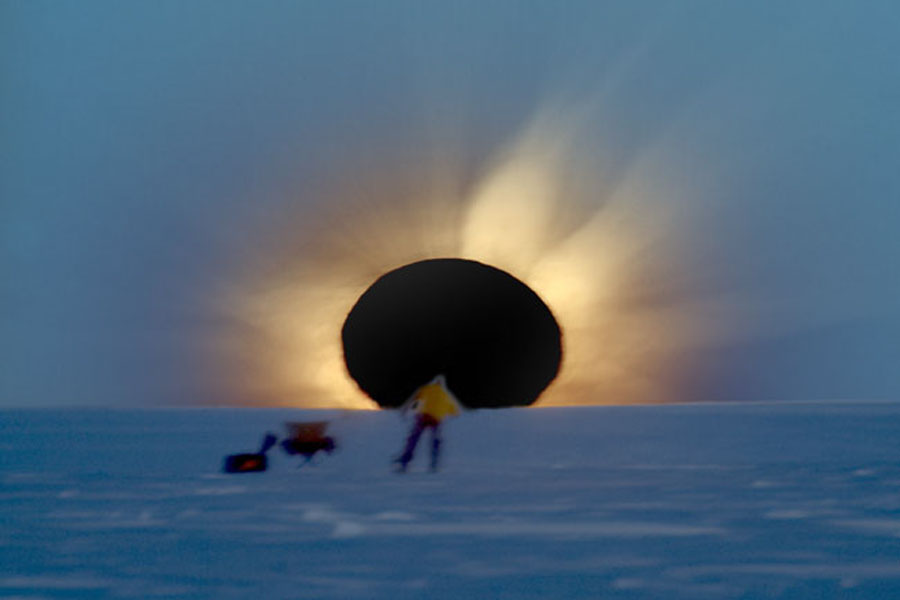
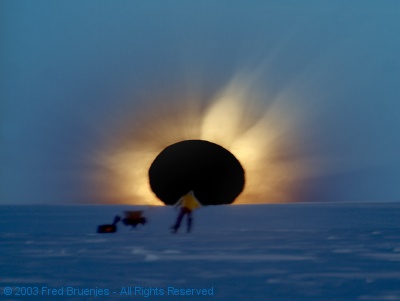
The photographs taken in Antarctica by Fred Bruenjes, during the November 2003 total solar eclipse show us that the Moon COULD NOT POSSIBLY cause the solar eclipse.
 http://www.moonglow.net/eclipse/2003nov23/
Moreover, these photographs show and prove that the Sun does not orbit at an altitude of 3000 miles, that it does not have a 32 mile diameter, and that it does rise and set, which brings to our attention the precession subject.
2) Why does the solar eclipse happen ONLY during a New Moon if it is unrelated?I have explained this several times: when the VERY FIRST SET OF ECLIPSES OCCURRED, the Moon and the Sun were at the spring equinox position, each on an opposite side of the two FE semicircles. When the Black Sun first covered the Sun (a solar eclipse), the Moon was located on the opposite side of the FE map (what we call a New Moon today).
In the new radical chronology, we can explain why there are no astronomical/historical records for the 1662 March 20 total solar eclipse:
The Bundahishn (the most fantastic treatise in pre-Flood cosmology and astronomy) tells that at a certain time in the past, the Earth had 24 hour a day light, coming from two Suns (the visible Sun and our present Moon) and that there were no solar or lunar eclipses.
Then, the Black Sun and its companion (the heavenly body which does bring about now the lunar eclipse) caused the first solar and lunar eclipses, in a cosmic catastrophe which is still recalled in various legends around the world.
Aborigines of the New World: “the Sun and the moon had equal light in the past."
At the other end of the world the Japanese asserted the same: the Nihongi Chronicle says that in the past "the radiance of the moon was next to that of the sun in splendor."
Traditions of many peoples maintain that the Moon lost a large part of its light and became much dimmer than it had been in earlier ages.
The memory of a world without a moon lives in oral tradition among the Indians. The Indians of the Bogota highlands in the eastern Cordilleras of Colombia relate some of their tribal reminiscences to the time before there was a moon. "In the earliest times, when the moon was not yet in the heavens," say the tribesmen of Chibchas.
Traditions of diverse peoples offer corroborative testimony to the effect that in a very early age, but still in the memory of mankind, no moon accompanied the Earth.
At 12:00 o'clock on March 20, 1662, the year 1 in the new radical chronology timeline, this is what happened (as recorded in the Bundahishn):
"The evil spirit [Ahriman] went toward the luminaries." "He stood upon one-third of the inside of the sky, and he sprang,
like a snake, out of the sky down to the earth." It was the day of the vernal equinox. "He rushed in at noon," and "the sky was shattered and frightened." "Like a fly, he rushed out upon the whole creation, and he injured the world and made it dark at midday as though it were in dark night. And noxious creatures were diffused by him over the earth, biting and venomous, such as the snake, scorpion, frog, and lizard, so that not so much as the point of a needle remained free from noxious creatures."
This is what the people all over the flat earth could see at that time (the drawing, of course, is not to scale):

Those who have a problem with SIMULTANEOUS SOLAR/LUNAR ECLIPSES should read the following:
From America, Christopher Columbus also wrote to the king and the queen of Spain about the simultaneous eclipses:
This that I have said is what I have heard. What I know is that the year 94 I sailed in 24 degrees to the west in 9 hours, and it could not be mistake because there were eclipses: the sun was in Libra and the moon in Ariete.
http://www.mgar.net/docs/colon4.htmEsto que yo he dicho es lo que he oído. Lo que yo sé es que el ańo de 94 navegué en 24° al Poniente en término de nueve horas, y no pudo haber yerro porque hubo eclipses: el sol estaba en Libra y la luna en Ariete.
Now, "Columbus" is NOT describing a selenelion (both the Sun and the eclipsed Moon can be observed at the same time in the RE theory): he used the words "hubo eclipses" (were eclipses), there were a solar and a lunar eclipse occurring at the same time.
3) Why is the "black" part of the Sun the same angular size of the Moon - always - therefore predicted in advance?The Black Sun, the Sun, the Moon, and the Shadow Moon have the SAME DIAMETER, that's why.
The Moon has astonishing synchronicity with the Sun. When the Sun is at its lowest and weakest in mid-winter, the Moon is at its highest and brightest, and the reverse occurs in mid-summer. Both set at the same point on the horizon at the equinoxes and at the opposite point at the solstices. What are the chances that the Moon would naturally find an orbit so perfect that it would cover the Sun at an eclipse and appear from Earth to be the same size? What are chances that the alignments would be so perfect at the equinoxes and solstices?
Farouk El Baz,
NASA
Who Parked Our Moon?
"Undoubtedly the greatest mystery concerning our Moon is how it came to be there in the first place. Prior to the Apollo missions, one serious theory as to the Moon’s origin was that it broke off of the Earth eons ago. Although no one could positively locate where on Earth it originated, many speculated the loss of material explained the huge gouge in the Earth, which forms the Pacific Ocean. However, this idea was discarded when it was found that there is little similarity between the composition of our world and the Moon.
A more recent theory had the Moon created out of space debris left over from the creation of the Earth. This concept proved untenable in light of current gravitational theory, which indicates that one large object will accumulate all loose material, leaving none for the formation of another large body. It is now generally accepted that the Moon originated elsewhere and entered the Earth’s gravitational field at some point in the distant past.
Here theories diverge — one stating that the Moon was originally a planet which collided with the Earth creating debris which combined forming the Moon while another states the Moon, while wandering through our solar system, was captured and pulled into orbit by Earth’s gravity. Neither of these theories are especially compelling because of the lack of evidence that neither the Earth nor the Moon seem to have been physically disrupted by a past close encounter. There is no debris in space indicating a past collision and it does not appear that the Earth and the Moon developed during the same time period.
As for the “capture” theory, even scientist Isaac Asimov, well known for his works of fiction, has written, “It’s too big to have been captured by the Earth. The chances of such a capture having been effected and the Moon then having taken up nearly circular orbit around our Earth are too small to make such an eventuality credible.”
Asimov was right to consider the Moon’s orbit — it is not only nearly a perfect circle, but stationary, one side always facing the Earth with only the slightest variation. As far as we know, it’s the only natural satellite with such an orbit.
This circular orbit is especially odd considering that the Moon’s center of mass lies more than a mile closer to the Earth than its geometric center. This fact alone should produce an unstable, wobbly orbit, much as a ball with its mass off center will not roll in a straight line. Additionally, almost all of the other satellites in our solar system orbit in the plane of their planet’s equator. Not so the Moon, whose orbit lies strangely nearer the Earth’s orbit around the Sun or inclined to the Earth’s ecliptic by more than five degrees. Add to this the fact that the Moon’s bulge — located on the side facing away from Earth — thus negating the idea that it was caused by the Earth’s gravitational pull — makes for an off-balanced world.
It seems impossible that such an oddity could naturally fall into such a precise and circular orbit. It is a fascinating conundrum as articulated by science writer William Roy Shelton, who wrote, “It is important to remember that something had to put the Moon at or near its present circular pattern around the Earth. Just as an Apollo spacecraft circling the Earth every 90 minutes while 100 miles high has to have a velocity of roughly 18,000 miles per hour to stay in orbit, so something had to give the Moon the precisely required velocity for its weight and altitude … The point—and it is one seldom noted in considering the origin of the Moon — is that it is extremely unlikely that any object would just stumble into the right combination of factors required to stay in orbit. ‘Something’ had to put the Moon at its altitude, on its course and at its speed. The question is: what was that ‘something’?”
If the precise and stationary orbit of the Moon is seen as sheer coincidence, is it also coincidence that the Moon is at just the right distance from the Earth to completely cover the Sun during an eclipse? While the diameter of the Moon is a mere 2,160 miles against the Sun’s gigantic 864,000 miles, it is nevertheless in just the proper position to block out all but the Sun’s flaming corona when it moves between the Sun and the Earth.
Asimov explained: “There is no astronomical reason why the Moon and the Sun should fit so well. It is the sheerest of coincidences, and only the Earth among all the planets is blessed in this fashion.” "
ISS/ATLANTIS SOLAR/LUNAR TRANSIT VIDEOS/PHOTOGRAPHS:
http://forum.tfes.org/index.php?topic=3838.msg81131#msg81131