Not seeing the sun over great distances.

  • 42 Replies
  • 10439 Views
?

Agnotology

  • 87
  • +0/-0
Not seeing the sun over great distances.
« on: February 21, 2015, 09:01:23 PM »
I have read the wiki on this, but a special scenario popped into my mind.

The Mauna Kea Observatories were picked for their location in regards to proximity to the equator, low humiditiy, good weather, and elevation (9300 feet above sea level)

On the ground, I can understand our inability to see beyond the horizon, especially on the beach. the nearby water causes high humidity day or night, obscuring your view regardless of telescopes or any other viewing aid.

But above the clouds, and nearly 2 miles up, the large majority of these things no longer pose an issue. secondly, there is nothing to get in the way of continuously viewing the sun. The nearest peak the the dormant volcano of Haleakalu at 10,000ft is 50 miles away and only 700 feet above the point of our view, and only obstructing a small view to the northwest. All remaining peaks are either south or not as tall as Haleakalu, so they will not interefere with the viewing. .
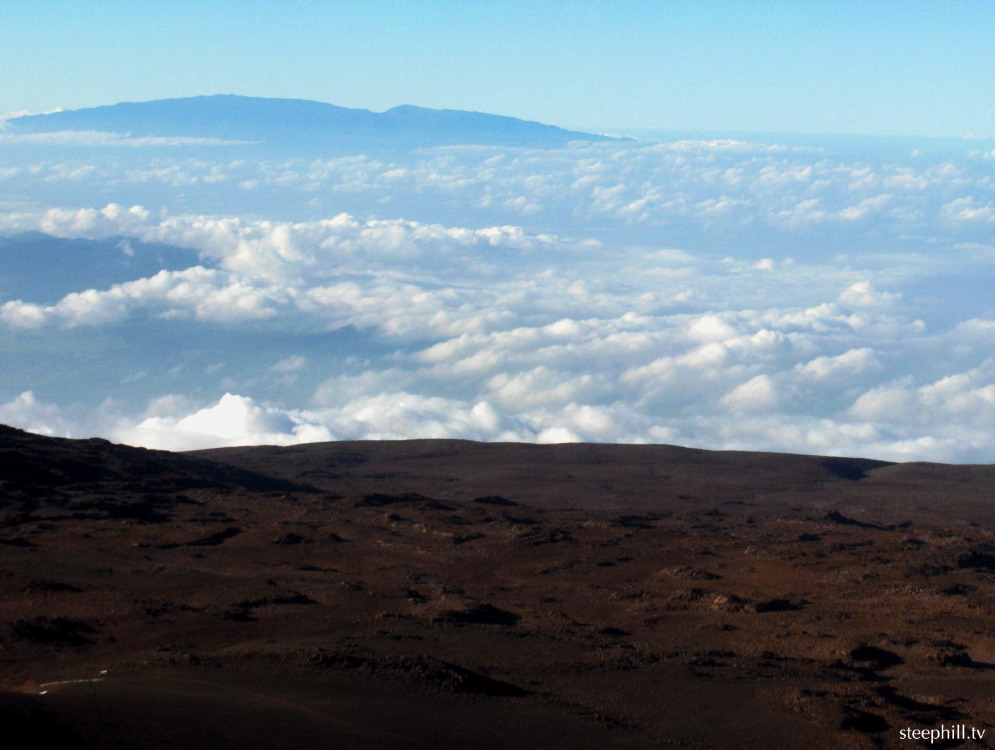
At 3000 miles away, the nearest mountain that could possibility interfere with this is Mount McKinley aka Denali, at 20,322 feet. However, this will never come into play as the "shadow" cast by Haleakalu would dwarf even mount everest, being in excess of 42,000 feet. On the other side of the world on the equator is the Democratic Republic of the Congo, 11,000 miles away, and the furthest point the sun would drift on average, the shadow of Haleakalu would only become 154,000 feet tall.... less than 30 miles. So, 2970 miles above the "shadow" cast by Haleakalu, would be our sun.

The human eyes, in absolute darkness with no light pollution (won't touch that.... because.... yeah) a human can see the glimmer of a candle from 30 miles away.
(source) http://www.livescience.com/33895-human-eye.html | You can also specifically search for the data regarding this experiment, I had it but failed at copy pasta.

Using an 8"  telescope with a with x50 magnification, we now can see a candle from 400x further (12,000 miles). But wait! that also means the candle has become 400x dimmer. Good thing we aren't looking for a candle halfway across the world.

Ok, I couldn't be bothered to do the numbers myself so I just accepted the internet. Regardless, the point is more or less there.
quick numbers
200w incandescent lightbulb at 1 ft = 2.2 lumens per square inch
Sun at 3000 or 93 million miles away = 155,000,000 lumens per square inch in direct sunlight at the earth's surface
Looking for something that is in the neighborhood of 70,000,000 times brighter than a 200w lightbulb that is one foot away from you.
Scale it in a bit further maybe? the object that we are looking for is going to be 400x dimmer through that telescope, or 175,000 brighter when viewed through the telescope than the 200w incandescent lightbulb from 1 foot away.

Feel free to apply an absurdly high refraction index to that by the way.

Using the above methods, the sun would be easy to track in the sky in a FE theory.


Of course, we can eliminate all that by seeing it with an infrared telescope. Clouds don't really pose an issue to those. And even if they did, you would only need to not have a major storm between your vantage point and the coast of alaska (you are already above all cumulus, stratocumulos, and stratus clouds)  at that point, you are above the 40,000 feet mark that most cumulonimbus clouds adhere to. Not to mention the further north you go, the lower the max cloud ceiling apart from Noctilucent clouds.

In FET, the point of the equator in the DCR that is due north of Hawaii is 11,000 miles away. At that point, the sun would be 2,970 miles above that point. Scaling that back to Haleakalu, the sun would be visible 13.5 miles above it's peak at it's point furthest away, or 12.7 degrees above the peak of Haleakalu


Bendy light theorists --- need a number on how much light diverges from its original course. why? If light bends in any direction, the sun will still be visible. If the light bends downards, the light that would have passed over my head on the top of Mauna Kea would become at eye level. If it goes bends up, the light that would have hit the side of the mountain would reach my eye. Ditto for bending left or right.

Spotlighters - The sun would take more of an oval shape the further it went away, especially over the extreme distances we get to play with in this.

May refine as more finite data comes in.

EDIT 1: added info regarding where the sun would appear in the sky relative to Haleakalu and the spotlighters, also, due to not caring about the diagonal, add 11% to any distances shown.
EDIT:2 added approximate degree of angling.
« Last Edit: February 21, 2015, 09:29:37 PM by Agnotology »

*

Son of Orospu

  • Jura's b*tch and proud of it!
  • 37800
  • +1/-0
  • I have artificial intelligence
Re: Not seeing the sun over great distances.
« Reply #1 on: February 21, 2015, 09:13:03 PM »
The mountain ridge in the distance has almost disappeared.  Are you trying to present evidence that light can not travel infinitely through air? 

?

Agnotology

  • 87
  • +0/-0
Re: Not seeing the sun over great distances.
« Reply #2 on: February 21, 2015, 09:20:30 PM »
The mountain ridge in the distance has almost disappeared.  Are you trying to present evidence that light can not travel infinitely through air?

The volcano ridge in the distance of 50 miles is rather clear. That other ridge you are seeing to the right is the horizon. I promise its not curving.  ;D

I am presenting evidence that the sun's light should be observable at the location given.
« Last Edit: February 21, 2015, 09:25:03 PM by Agnotology »

*

Son of Orospu

  • Jura's b*tch and proud of it!
  • 37800
  • +1/-0
  • I have artificial intelligence
Re: Not seeing the sun over great distances.
« Reply #3 on: February 21, 2015, 09:38:26 PM »
The ridge is almost completely faded away.  Probably another 10 miles and you would not be able to see it at all. 

*

sokarul

  • 19303
  • +1/-1
  • Extra Racist
Re: Not seeing the sun over great distances.
« Reply #4 on: February 21, 2015, 09:56:55 PM »
The ridge is almost completely faded away.  Probably another 10 miles and you would not be able to see it at all.
Are you saying the sun can't be seen from 200 miles away?
ANNIHILATOR OF  SHIFTER

It's no slur if it's fact.

?

Agnotology

  • 87
  • +0/-0
Re: Not seeing the sun over great distances.
« Reply #5 on: February 21, 2015, 09:58:19 PM »
The ridge is almost completely faded away.  Probably another 10 miles and you would not be able to see it at all.

I would say the only fading I am seeing on that ridge would be the white balance from the clouds creeping up the side. Why would the dark tip become light as you look further down?

*

Son of Orospu

  • Jura's b*tch and proud of it!
  • 37800
  • +1/-0
  • I have artificial intelligence
Re: Not seeing the sun over great distances.
« Reply #6 on: February 21, 2015, 10:03:18 PM »
The ridge is almost completely faded away.  Probably another 10 miles and you would not be able to see it at all.
Are you saying the sun can't be seen from 200 miles away?

It would depend on the conditions of the air for that 200 miles, would it not?  I have seen fog so dense that you could not see headlights on the road that are 200 feet away.  The sun was not visible either at the time even though it was day. 

?

Agnotology

  • 87
  • +0/-0
Re: Not seeing the sun over great distances.
« Reply #7 on: February 21, 2015, 10:05:32 PM »
The ridge is almost completely faded away.  Probably another 10 miles and you would not be able to see it at all.
Are you saying the sun can't be seen from 200 miles away?

It would depend on the conditions of the air for that 200 miles, would it not?  I have seen fog so dense that you could not see headlights on the road that are 200 feet away.  The sun was not visible either at the time even though it was day.

doesn't sound like a very safe way to operate an automobile in fog.... looking for the sun above and what all....

however, we are above the constraints of fog for this.

*

Son of Orospu

  • Jura's b*tch and proud of it!
  • 37800
  • +1/-0
  • I have artificial intelligence
Re: Not seeing the sun over great distances.
« Reply #8 on: February 21, 2015, 10:06:19 PM »
The ridge is almost completely faded away.  Probably another 10 miles and you would not be able to see it at all.

I would say the only fading I am seeing on that ridge would be the white balance from the clouds creeping up the side. Why would the dark tip become light as you look further down?

Why is the white balance not affecting the ground at the bottom of the picture, then? 

?

Agnotology

  • 87
  • +0/-0
Re: Not seeing the sun over great distances.
« Reply #9 on: February 21, 2015, 10:08:15 PM »
The ridge is almost completely faded away.  Probably another 10 miles and you would not be able to see it at all.

I would say the only fading I am seeing on that ridge would be the white balance from the clouds creeping up the side. Why would the dark tip become light as you look further down?

Why is the white balance not affecting the ground at the bottom of the picture, then?

closer edge, sharper detail. no clouds nearby the actual point in question, some distance away there are clouds though. However, zoom in enough on it and you will see the edge gradually goes from black to white. ctrl + mousewheel forward. 

Besides illustrative purposes, that picture's only purpose is to show the two volanoes above cloud cover. I would assume jumping at the picture means you didn't read the statement? Should I assume you have no comments that pertain to the actual topic at hand?
« Last Edit: February 21, 2015, 10:11:40 PM by Agnotology »

*

Son of Orospu

  • Jura's b*tch and proud of it!
  • 37800
  • +1/-0
  • I have artificial intelligence
Re: Not seeing the sun over great distances.
« Reply #10 on: February 21, 2015, 10:12:22 PM »
If you can barely see a mountain ridge that is only 50 miles away, then why would you expect to see the sun, which is, while being brighter, much farther away? 

?

Agnotology

  • 87
  • +0/-0
Re: Not seeing the sun over great distances.
« Reply #11 on: February 21, 2015, 10:46:18 PM »
If you can barely see a mountain ridge that is only 50 miles away, then why would you expect to see the sun, which is, while being brighter, much farther away?

relative brightness sir! which is in text above. How far away on a dark night do you think a candle is visible? Would you agree that if a candle or a light bulb is visible at Y distance, a light twice as bright in terms of lumens, would be visible at twice the distance? 

*

Son of Orospu

  • Jura's b*tch and proud of it!
  • 37800
  • +1/-0
  • I have artificial intelligence
Re: Not seeing the sun over great distances.
« Reply #12 on: February 21, 2015, 10:56:03 PM »
Several things affect the distance at which a light can be seen.  The frequency of the light is one that comes immediately to mind. 

?

Agnotology

  • 87
  • +0/-0
Re: Not seeing the sun over great distances.
« Reply #13 on: February 21, 2015, 11:08:45 PM »
Several things affect the distance at which a light can be seen.  The frequency of the light is one that comes immediately to mind.

I assume by frequency, you mean hertz. That is correct. We are working within the spectrum of light that we can see, and if that does not work for you, we can go to infrared.

*

Son of Orospu

  • Jura's b*tch and proud of it!
  • 37800
  • +1/-0
  • I have artificial intelligence
Re: Not seeing the sun over great distances.
« Reply #14 on: February 21, 2015, 11:21:13 PM »
Several things affect the distance at which a light can be seen.  The frequency of the light is one that comes immediately to mind.

I assume by frequency, you mean hertz. That is correct. We are working within the spectrum of light that we can see, and if that does not work for you, we can go to infrared.

Hertz is a unit of measure, while frequency is a concept, and since I did not specify any quantities, then it would not really make sense to say Hertz in place of frequency. 

It would sort of be like me saying that I live 15 distances from my work.  That would not really make sense, now would it? 

?

Agnotology

  • 87
  • +0/-0
Re: Not seeing the sun over great distances.
« Reply #15 on: February 21, 2015, 11:39:20 PM »
Several things affect the distance at which a light can be seen.  The frequency of the light is one that comes immediately to mind.

I assume by frequency, you mean hertz. That is correct. We are working within the spectrum of light that we can see, and if that does not work for you, we can go to infrared.

Hertz is a unit of measure, while frequency is a concept, and since I did not specify any quantities, then it would not really make sense to say Hertz in place of frequency. 

It would sort of be like me saying that I live 15 distances from my work.  That would not really make sense, now would it?

It would actually, if you described what 1 distance was.

You mentioned frequency, I asked if you meant frequency in terms of the unit of frequency used to describe the frequency of the wavelengths of light. Hertz.

You could have meant frequency in terms of how often the light was on. Light bulbs are usually in a socket, affixed to some form of button to turn them on and off.


Edit:

I apologize, I am off to bed. I was hoping you would have taken a more direct route with whatever you hoped to get at, but instead I am getting one liners asking questions that seem to be slowly making their way to some form of a point that is escaping me, can't see the trees for the forest and all that.
« Last Edit: February 21, 2015, 11:42:46 PM by Agnotology »

*

JimmyTheCrab

  • 10340
  • +0/-5
Re: Not seeing the sun over great distances.
« Reply #16 on: February 22, 2015, 02:49:53 AM »
I apologize, I am off to bed. I was hoping you would have taken a more direct route with whatever you hoped to get at, but instead I am getting one liners asking questions that seem to be slowly making their way to some form of a point that is escaping me, can't see the trees for the forest and all that.
Welcome to jroa's world  ::)

First of all you get some stock one liners he has pre-prepared, usually in the form of passive-aggressive rhetoric:

Quote
Are you trying to present evidence that light can not travel infinitely through air?

Then he introduces some bland, irrelevant anecdote that doesn't illustrate anything:

Quote
I have seen fog so dense that you could not see headlights on the road that are 200 feet away.

Then he will try to turn the thread into a pedantic debate over semantics:

Quote
Hertz is a unit of measure, while frequency is a concept, and since I did not specify any quantities, then it would not really make sense to say Hertz in place of frequency.

Rinse and repeat.

I've no idea what he gets out of this, as he never even seems to enjoy it. I guess it's an addiction, like smoking.
Quote from: mikeman7918
a single photon can pass through two sluts

Quote from: Chicken Fried Clucker
if Donald Trump stuck his penis in me after trying on clothes I would have that date and time burned in my head.

*

Dinosaur Neil

  • 3177
  • +0/-0
Re: Not seeing the sun over great distances.
« Reply #17 on: February 22, 2015, 04:14:46 AM »
The ridge is almost completely faded away.  Probably another 10 miles and you would not be able to see it at all.
Are you saying the sun can't be seen from 200 miles away?

It would depend on the conditions of the air for that 200 miles, would it not?  I have seen fog so dense that you could not see headlights on the road that are 200 feet away.  The sun was not visible either at the time even though it was day.

You persistently claim that objects beyond the horizon can't be seen because of atmospheric hazing when the air visibility on a given day is greater than the distance to the object. And when challenged on it you fall silent, until another thread where you can cite atmospheric haze comes up, and then you just hope people don't remember your argument being destroyed previously.
Your haze theory doesn't stand up to observation.
Founder member of the League Of Scientific Gentlemen and Mademoiselles des Connaissances.
I am pompous, self-righteous, thin skinned, and smug.

?

gpssjim

  • 514
  • +0/-0
Re: Not seeing the sun over great distances.
« Reply #18 on: February 22, 2015, 08:34:20 AM »
The ridge is almost completely faded away.  Probably another 10 miles and you would not be able to see it at all.
Are you saying the sun can't be seen from 200 miles away?

It would depend on the conditions of the air for that 200 miles, would it not?  I have seen fog so dense that you could not see headlights on the road that are 200 feet away.  The sun was not visible either at the time even though it was day.

You persistently claim that objects beyond the horizon can't be seen because of atmospheric hazing when the air visibility on a given day is greater than the distance to the object. And when challenged on it you fall silent, until another thread where you can cite atmospheric haze comes up, and then you just hope people don't remember your argument being destroyed previously.
Your haze theory doesn't stand up to observation.
jroa is in a haze.  He is obsessed with obscurity.  Some childhood trauma I suspect, or perhaps a vision problem.  For him the world is as fuzzy as his brain. 

*

JRoweSkeptic

  • Flat Earth Believer
  • 5407
  • +0/-0
  • DET Developer
Re: Not seeing the sun over great distances.
« Reply #19 on: February 22, 2015, 08:41:11 AM »
haze exists. even nasa has to believe in it. their made up hubble takes such clear pictures because, as they say, it is outside the atmosphere and so uninterfered with. obviously the photos are just clearer because they can fake them more easily, but you either have to admit nasa are liars, or admit that the atmosphere reduces visibility. in which case, it is obvious that the more atmosphere is in the way, the more visibility will be reduced.
try harder.
http://fet.wikia.com
dualearththeory.proboards.com/
On the sister site if you want to talk.

?

gpssjim

  • 514
  • +0/-0
Re: Not seeing the sun over great distances.
« Reply #20 on: February 22, 2015, 08:51:06 AM »
haze exists. even nasa has to believe in it. their made up hubble takes such clear pictures because, as they say, it is outside the atmosphere and so uninterfered with. obviously the photos are just clearer because they can fake them more easily, but you either have to admit nasa are liars, or admit that the atmosphere reduces visibility. in which case, it is obvious that the more atmosphere is in the way, the more visibility will be reduced.
try harder.
Very good, you are starting to make progress.  You accept that haze exists and is one reason to put a telescope in orbit.  You got half way to the truth, which is great, good job!  But sadly you are still confused about how haze only has an impact on visibility when it is in fact hazy.  You don't seem to be able to comprehend what 'On a clear day' means.  Make sure you get enough sleep, it will help you think more clearly.

*

JRoweSkeptic

  • Flat Earth Believer
  • 5407
  • +0/-0
  • DET Developer
Re: Not seeing the sun over great distances.
« Reply #21 on: February 22, 2015, 08:53:10 AM »
haze exists. even nasa has to believe in it. their made up hubble takes such clear pictures because, as they say, it is outside the atmosphere and so uninterfered with. obviously the photos are just clearer because they can fake them more easily, but you either have to admit nasa are liars, or admit that the atmosphere reduces visibility. in which case, it is obvious that the more atmosphere is in the way, the more visibility will be reduced.
try harder.
Very good, you are starting to make progress.  You accept that haze exists and is one reason to put a telescope in orbit.  You got half way to the truth, which is great, good job!  But sadly you are still confused about how haze only has an impact on visibility when it is in fact hazy.  You don't seem to be able to comprehend what 'On a clear day' means.  Make sure you get enough sleep, it will help you think more clearly.
you are the ones who deny the presence of haze. if a clear day was all it took, why would nasa spend millions to supposedly send their 'telescope' to orbit?
your resort to personal attacks shows you have no logical recourse. you are wrong.
http://fet.wikia.com
dualearththeory.proboards.com/
On the sister site if you want to talk.

?

gpssjim

  • 514
  • +0/-0
Re: Not seeing the sun over great distances.
« Reply #22 on: February 22, 2015, 09:01:52 AM »
haze exists. even nasa has to believe in it. their made up hubble takes such clear pictures because, as they say, it is outside the atmosphere and so uninterfered with. obviously the photos are just clearer because they can fake them more easily, but you either have to admit nasa are liars, or admit that the atmosphere reduces visibility. in which case, it is obvious that the more atmosphere is in the way, the more visibility will be reduced.
try harder.
Very good, you are starting to make progress.  You accept that haze exists and is one reason to put a telescope in orbit.  You got half way to the truth, which is great, good job!  But sadly you are still confused about how haze only has an impact on visibility when it is in fact hazy.  You don't seem to be able to comprehend what 'On a clear day' means.  Make sure you get enough sleep, it will help you think more clearly.
you are the ones who deny the presence of haze. if a clear day was all it took, why would nasa spend millions to supposedly send their 'telescope' to orbit?
your resort to personal attacks shows you have no logical recourse. you are wrong.
If you can see 100's of miles on a clear day, then you should be able to see 100's of miles on a clear day.  That is not too hard to comprehend, is it?  That doesn't mean there is not haze and other atmospheric effects that impact the clarity and the ability to magnify the image and see detail clearly.  Put some effort into your arguments, it is too easy to see through your incompetence.

*

JRoweSkeptic

  • Flat Earth Believer
  • 5407
  • +0/-0
  • DET Developer
Re: Not seeing the sun over great distances.
« Reply #23 on: February 22, 2015, 09:06:20 AM »
haze exists. even nasa has to believe in it. their made up hubble takes such clear pictures because, as they say, it is outside the atmosphere and so uninterfered with. obviously the photos are just clearer because they can fake them more easily, but you either have to admit nasa are liars, or admit that the atmosphere reduces visibility. in which case, it is obvious that the more atmosphere is in the way, the more visibility will be reduced.
try harder.
Very good, you are starting to make progress.  You accept that haze exists and is one reason to put a telescope in orbit.  You got half way to the truth, which is great, good job!  But sadly you are still confused about how haze only has an impact on visibility when it is in fact hazy.  You don't seem to be able to comprehend what 'On a clear day' means.  Make sure you get enough sleep, it will help you think more clearly.
you are the ones who deny the presence of haze. if a clear day was all it took, why would nasa spend millions to supposedly send their 'telescope' to orbit?
your resort to personal attacks shows you have no logical recourse. you are wrong.
If you can see 100's of miles on a clear day, then you should be able to see 100's of miles on a clear day.  That is not too hard to comprehend, is it?  That doesn't mean there is not haze and other atmospheric effects that impact the clarity and the ability to magnify the image and see detail clearly.  Put some effort into your arguments, it is too easy to see through your incompetence.
you are the one who once said there was no haze, and is now hastily backtracking. it's plain to everyone you're the one who's incompetent.
you admit the atmosphere impacts clarity nothing more need be said. the sun doesn't set at the same time every day. that proves you're wrong.
http://fet.wikia.com
dualearththeory.proboards.com/
On the sister site if you want to talk.

?

gpssjim

  • 514
  • +0/-0
Re: Not seeing the sun over great distances.
« Reply #24 on: February 22, 2015, 09:11:22 AM »
haze exists. even nasa has to believe in it. their made up hubble takes such clear pictures because, as they say, it is outside the atmosphere and so uninterfered with. obviously the photos are just clearer because they can fake them more easily, but you either have to admit nasa are liars, or admit that the atmosphere reduces visibility. in which case, it is obvious that the more atmosphere is in the way, the more visibility will be reduced.
try harder.
Very good, you are starting to make progress.  You accept that haze exists and is one reason to put a telescope in orbit.  You got half way to the truth, which is great, good job!  But sadly you are still confused about how haze only has an impact on visibility when it is in fact hazy.  You don't seem to be able to comprehend what 'On a clear day' means.  Make sure you get enough sleep, it will help you think more clearly.
you are the ones who deny the presence of haze. if a clear day was all it took, why would nasa spend millions to supposedly send their 'telescope' to orbit?
your resort to personal attacks shows you have no logical recourse. you are wrong.
If you can see 100's of miles on a clear day, then you should be able to see 100's of miles on a clear day.  That is not too hard to comprehend, is it?  That doesn't mean there is not haze and other atmospheric effects that impact the clarity and the ability to magnify the image and see detail clearly.  Put some effort into your arguments, it is too easy to see through your incompetence.
you are the one who once said there was no haze, and is now hastily backtracking. it's plain to everyone you're the one who's incompetent.
you admit the atmosphere impacts clarity nothing more need be said. the sun doesn't set at the same time every day. that proves you're wrong.
What are you talking about?  I never said there was no haze.  What is so hard to understand?  If one can see for 100's of miles, one can see for 100's of miles.  Simple, no math involved there.  But I do agree, it is plain to see who is incompetent.  And what does the sun set time changing everyday have to do with it?  Of course the sun doesn't set a the same time every day.  In RET you can write a program to calculate the times.  In FET you just have to guess.

*

JRoweSkeptic

  • Flat Earth Believer
  • 5407
  • +0/-0
  • DET Developer
Re: Not seeing the sun over great distances.
« Reply #25 on: February 22, 2015, 09:18:44 AM »
haze exists. even nasa has to believe in it. their made up hubble takes such clear pictures because, as they say, it is outside the atmosphere and so uninterfered with. obviously the photos are just clearer because they can fake them more easily, but you either have to admit nasa are liars, or admit that the atmosphere reduces visibility. in which case, it is obvious that the more atmosphere is in the way, the more visibility will be reduced.
try harder.
Very good, you are starting to make progress.  You accept that haze exists and is one reason to put a telescope in orbit.  You got half way to the truth, which is great, good job!  But sadly you are still confused about how haze only has an impact on visibility when it is in fact hazy.  You don't seem to be able to comprehend what 'On a clear day' means.  Make sure you get enough sleep, it will help you think more clearly.
you are the ones who deny the presence of haze. if a clear day was all it took, why would nasa spend millions to supposedly send their 'telescope' to orbit?
your resort to personal attacks shows you have no logical recourse. you are wrong.
If you can see 100's of miles on a clear day, then you should be able to see 100's of miles on a clear day.  That is not too hard to comprehend, is it?  That doesn't mean there is not haze and other atmospheric effects that impact the clarity and the ability to magnify the image and see detail clearly.  Put some effort into your arguments, it is too easy to see through your incompetence.
you are the one who once said there was no haze, and is now hastily backtracking. it's plain to everyone you're the one who's incompetent.
you admit the atmosphere impacts clarity nothing more need be said. the sun doesn't set at the same time every day. that proves you're wrong.
What are you talking about?  I never said there was no haze.  What is so hard to understand?  If one can see for 100's of miles, one can see for 100's of miles.  Simple, no math involved there.  But I do agree, it is plain to see who is incompetent.  And what does the sun set time changing everyday have to do with it?  Of course the sun doesn't set a the same time every day.  In RET you can write a program to calculate the times.  In FET you just have to guess.
then you agree with jroa and i? atmospheric haze interferes.
the sun should set the same time if it is based on regular rotation. actually, it depends on atmospheric haze (of more than just the visible variety), which has some correlation with season hence the tendency, but does indeed vary. so its clear haze must be the cause.
http://fet.wikia.com
dualearththeory.proboards.com/
On the sister site if you want to talk.

?

gpssjim

  • 514
  • +0/-0
Re: Not seeing the sun over great distances.
« Reply #26 on: February 22, 2015, 09:22:34 AM »
haze exists. even nasa has to believe in it. their made up hubble takes such clear pictures because, as they say, it is outside the atmosphere and so uninterfered with. obviously the photos are just clearer because they can fake them more easily, but you either have to admit nasa are liars, or admit that the atmosphere reduces visibility. in which case, it is obvious that the more atmosphere is in the way, the more visibility will be reduced.
try harder.
Very good, you are starting to make progress.  You accept that haze exists and is one reason to put a telescope in orbit.  You got half way to the truth, which is great, good job!  But sadly you are still confused about how haze only has an impact on visibility when it is in fact hazy.  You don't seem to be able to comprehend what 'On a clear day' means.  Make sure you get enough sleep, it will help you think more clearly.
you are the ones who deny the presence of haze. if a clear day was all it took, why would nasa spend millions to supposedly send their 'telescope' to orbit?
your resort to personal attacks shows you have no logical recourse. you are wrong.
If you can see 100's of miles on a clear day, then you should be able to see 100's of miles on a clear day.  That is not too hard to comprehend, is it?  That doesn't mean there is not haze and other atmospheric effects that impact the clarity and the ability to magnify the image and see detail clearly.  Put some effort into your arguments, it is too easy to see through your incompetence.
you are the one who once said there was no haze, and is now hastily backtracking. it's plain to everyone you're the one who's incompetent.
you admit the atmosphere impacts clarity nothing more need be said. the sun doesn't set at the same time every day. that proves you're wrong.
What are you talking about?  I never said there was no haze.  What is so hard to understand?  If one can see for 100's of miles, one can see for 100's of miles.  Simple, no math involved there.  But I do agree, it is plain to see who is incompetent.  And what does the sun set time changing everyday have to do with it?  Of course the sun doesn't set a the same time every day.  In RET you can write a program to calculate the times.  In FET you just have to guess.
then you agree with jroa and i? atmospheric haze interferes.
the sun should set the same time if it is based on regular rotation. actually, it depends on atmospheric haze (of more than just the visible variety), which has some correlation with season hence the tendency, but does indeed vary. so its clear haze must be the cause.
If I ever agreed with jroa, I'd have to kill myself.  The sun rise and sunset times are due to the tilt of the earths axis and the fact that we orbit around the sun.  Anyone with their grade 9 knows that.

*

JRoweSkeptic

  • Flat Earth Believer
  • 5407
  • +0/-0
  • DET Developer
Re: Not seeing the sun over great distances.
« Reply #27 on: February 22, 2015, 09:24:41 AM »
haze exists. even nasa has to believe in it. their made up hubble takes such clear pictures because, as they say, it is outside the atmosphere and so uninterfered with. obviously the photos are just clearer because they can fake them more easily, but you either have to admit nasa are liars, or admit that the atmosphere reduces visibility. in which case, it is obvious that the more atmosphere is in the way, the more visibility will be reduced.
try harder.
Very good, you are starting to make progress.  You accept that haze exists and is one reason to put a telescope in orbit.  You got half way to the truth, which is great, good job!  But sadly you are still confused about how haze only has an impact on visibility when it is in fact hazy.  You don't seem to be able to comprehend what 'On a clear day' means.  Make sure you get enough sleep, it will help you think more clearly.
you are the ones who deny the presence of haze. if a clear day was all it took, why would nasa spend millions to supposedly send their 'telescope' to orbit?
your resort to personal attacks shows you have no logical recourse. you are wrong.
If you can see 100's of miles on a clear day, then you should be able to see 100's of miles on a clear day.  That is not too hard to comprehend, is it?  That doesn't mean there is not haze and other atmospheric effects that impact the clarity and the ability to magnify the image and see detail clearly.  Put some effort into your arguments, it is too easy to see through your incompetence.
you are the one who once said there was no haze, and is now hastily backtracking. it's plain to everyone you're the one who's incompetent.
you admit the atmosphere impacts clarity nothing more need be said. the sun doesn't set at the same time every day. that proves you're wrong.
What are you talking about?  I never said there was no haze.  What is so hard to understand?  If one can see for 100's of miles, one can see for 100's of miles.  Simple, no math involved there.  But I do agree, it is plain to see who is incompetent.  And what does the sun set time changing everyday have to do with it?  Of course the sun doesn't set a the same time every day.  In RET you can write a program to calculate the times.  In FET you just have to guess.
then you agree with jroa and i? atmospheric haze interferes.
the sun should set the same time if it is based on regular rotation. actually, it depends on atmospheric haze (of more than just the visible variety), which has some correlation with season hence the tendency, but does indeed vary. so its clear haze must be the cause.
If I ever agreed with jroa, I'd have to kill myself.  The sun rise and sunset times are due to the tilt of the earths axis and the fact that we orbit around the sun.  Anyone with their grade 9 knows that.
then why can't you answer the question? if there's regularity, the sunsets should be regular. you've completely avoided what i've said, as you usually do.
could it be because there is no answer?
it's haze. the end. point made.
http://fet.wikia.com
dualearththeory.proboards.com/
On the sister site if you want to talk.

?

gpssjim

  • 514
  • +0/-0
Re: Not seeing the sun over great distances.
« Reply #28 on: February 22, 2015, 09:32:58 AM »
haze exists. even nasa has to believe in it. their made up hubble takes such clear pictures because, as they say, it is outside the atmosphere and so uninterfered with. obviously the photos are just clearer because they can fake them more easily, but you either have to admit nasa are liars, or admit that the atmosphere reduces visibility. in which case, it is obvious that the more atmosphere is in the way, the more visibility will be reduced.
try harder.
Very good, you are starting to make progress.  You accept that haze exists and is one reason to put a telescope in orbit.  You got half way to the truth, which is great, good job!  But sadly you are still confused about how haze only has an impact on visibility when it is in fact hazy.  You don't seem to be able to comprehend what 'On a clear day' means.  Make sure you get enough sleep, it will help you think more clearly.
you are the ones who deny the presence of haze. if a clear day was all it took, why would nasa spend millions to supposedly send their 'telescope' to orbit?
your resort to personal attacks shows you have no logical recourse. you are wrong.
If you can see 100's of miles on a clear day, then you should be able to see 100's of miles on a clear day.  That is not too hard to comprehend, is it?  That doesn't mean there is not haze and other atmospheric effects that impact the clarity and the ability to magnify the image and see detail clearly.  Put some effort into your arguments, it is too easy to see through your incompetence.
you are the one who once said there was no haze, and is now hastily backtracking. it's plain to everyone you're the one who's incompetent.
you admit the atmosphere impacts clarity nothing more need be said. the sun doesn't set at the same time every day. that proves you're wrong.
What are you talking about?  I never said there was no haze.  What is so hard to understand?  If one can see for 100's of miles, one can see for 100's of miles.  Simple, no math involved there.  But I do agree, it is plain to see who is incompetent.  And what does the sun set time changing everyday have to do with it?  Of course the sun doesn't set a the same time every day.  In RET you can write a program to calculate the times.  In FET you just have to guess.
then you agree with jroa and i? atmospheric haze interferes.
the sun should set the same time if it is based on regular rotation. actually, it depends on atmospheric haze (of more than just the visible variety), which has some correlation with season hence the tendency, but does indeed vary. so its clear haze must be the cause.
If I ever agreed with jroa, I'd have to kill myself.  The sun rise and sunset times are due to the tilt of the earths axis and the fact that we orbit around the sun.  Anyone with their grade 9 knows that.
then why can't you answer the question? if there's regularity, the sunsets should be regular. you've completely avoided what i've said, as you usually do.
could it be because there is no answer?
it's haze. the end. point made.
I admit it, I have no idea what you are talking about.

*

ausGeoff

  • 6091
  • +0/-0
Re: Not seeing the sun over great distances.
« Reply #29 on: February 23, 2015, 10:04:50 PM »
The mountain ridge in the distance has almost disappeared.  Are you trying to present evidence that light can not travel infinitely through air?
So jroa... after reading through Agnotology's detailed and thorough calculations for the sun's light paths and planetary geometry, this tired old one-liner is the best response you can muster?  Seriously?

Why is it that you make this rhetorical statement about light not travelling infinitely through the air in virtually every comment about the sun's light?  Nowhere does Agnotology mention "infinity";  why do you?  We're talking about earth/sun distances here.

Anyway... would you agree that the sunlight reflected off the distant mountains has approximately 1/400,000th of the intensity of the light irradiated directly from the sun?  And that has a lot (but not everything) to do with why distant mountains appear to fade away, even in a clear atmosphere with low humidity and no airborne particulate matter such as in Central Australia?  (see below)


The rocky outcrops, The Olgas, are 32km distant.