Day and night on a flat earth

  • 68 Replies
  • 66625 Views
*

Cartesian

  • 1965
  • +0/-0
Day and night on a flat earth
« on: September 27, 2013, 06:39:37 AM »
I hope that this thread can finally answer how exactly FE sun shines its light to create day on one part and night on the other part of a flat earth. I have heard one FE theory suggesting that the sun is spherical but somehow acts like a spotlight to explain why it looks round during the day and is not visible at night.

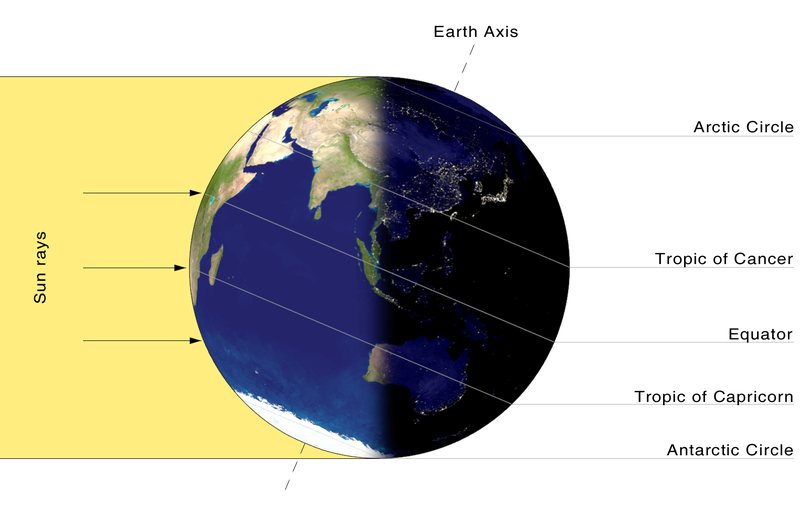
In RET, the Earth's rotation axis is tilted 23.5 degrees from the plane of its orbit around the sun which creates seasons while Earth is orbiting around the sun.


Below shows how Earth receives the sun's light on June and December solstices. in June, the northern hemisphere receives more sun light than the southern hemisphere creating summer time in the northern hemisphere and winter in the southern hemisphere. In December, it's the other way around. But regardless of the time of the year, one half of the spherical earth is in day time while the other half is in night time. Half earth is day and half earth is night. Half and half.

   

There are many sites that show day night map available on Internet. For example you can check what part of the world in in day time or and night time depending on the day of the year and the time of day in http://www.timeanddate.com/worldclock/sunearth.html

I tried to project day and night on a flat earth map depending on the month (March, June, September and December). The below sketches show the sun light (the yellow highlight) as perceived by a flat earth in function of the time of the year.


We can see than the shape of the sun light on earth is different depending on the month. In June, the sun is nearer to the north pole and shines in perfect circle on earth giving longer daytime to the northern part. This is probably what is referred to as "spotlight" by some FEers. But in March or September, the sun doesn't shine like a spotlight anymore. In December, it's getting worse. I cannot even find a word to describe how the sun can light the outermost of the disk while creating a dark spot in the middle.

Is this the death of the FE spotlight sun?

I used monopolar model for this work. When I get more time, I'll include the bipolar model too. I have the impression bipolar model will be even weirder than the monopolar one.
I think, therefore I am

?

rottingroom

  • 4785
  • +0/-0
  • Around the world.
Re: Day and night on a flat earth
« Reply #1 on: September 27, 2013, 06:55:34 AM »
Good work Cartesian. I had always thought about making a thread about exactly this but imagined it would be a pain.

?

SeekerOfTruth

  • 449
  • +0/-0
Re: Day and night on a flat earth
« Reply #2 on: September 27, 2013, 07:59:56 AM »
It is rather simply to explain this I believe. Check out James' post about the Details of the Sun's orbit (flat earth believers section of the forums). The Sun's orbit fluctuates vertically as well as horizontally, tracing a "potato chip" shape across the sky, which both causes the seasons and also changes the size of the spotlight on earth. However, in addition to vertical fluctuation, the sun must also fluctuate in SIZE, else the size of the sun in the sky would change (it appears to change when near the horizon, but this is likely due to atmospheric scattering). In your picture of the spotlight for Mar/Sept, the spotlight terminator would not be a perfect straight line, but slightly curved. This is the same effect as those shuttle pictures of the spotlighted earth which show a slight curvature, that some erroneous claim is "proof" fro a round earth. Good work!

?

11cookeaw1

Re: Day and night on a flat earth
« Reply #3 on: September 27, 2013, 08:18:37 AM »
It is rather simply to explain this I believe. Check out James' post about the Details of the Sun's orbit (flat earth believers section of the forums). The Sun's orbit fluctuates vertically as well as horizontally, tracing a "potato chip" shape across the sky, which both causes the seasons and also changes the size of the spotlight on earth. However, in addition to vertical fluctuation, the sun must also fluctuate in SIZE, else the size of the sun in the sky would change (it appears to change when near the horizon, but this is likely due to atmospheric scattering). In your picture of the spotlight for Mar/Sept, the spotlight terminator would not be a perfect straight line, but slightly curved. This is the same effect as those shuttle pictures of the spotlighted earth which show a slight curvature, that some erroneous claim is "proof" fro a round earth. Good work!
And yet it doesn't appear to change size at all. Any anyway the areas that is should light up would still be circular.

*

Cartesian

  • 1965
  • +0/-0
Re: Day and night on a flat earth
« Reply #4 on: September 27, 2013, 08:38:19 AM »
It is rather simply to explain this I believe. Check out James' post about the Details of the Sun's orbit (flat earth believers section of the forums). The Sun's orbit fluctuates vertically as well as horizontally, tracing a "potato chip" shape across the sky, which both causes the seasons and also changes the size of the spotlight on earth. However, in addition to vertical fluctuation, the sun must also fluctuate in SIZE, else the size of the sun in the sky would change (it appears to change when near the horizon, but this is likely due to atmospheric scattering). In your picture of the spotlight for Mar/Sept, the spotlight terminator would not be a perfect straight line, but slightly curved. This is the same effect as those shuttle pictures of the spotlighted earth which show a slight curvature, that some erroneous claim is "proof" fro a round earth. Good work!

Welcome to TFES. I appreciate that you decided to submit your first post to my thread less than 30 minutes after registering to this forum. I feel honoured :)

But frankly, you completely lost me with your explanation. I don't know how your "potato chip" looks like. Let's put aside about the change in size. Let's just concentrate on how the sun light can produce such shape on a flat earth. When you say it is really simply to explain it seems you understand very well how your model works. I am sure you would be to draw something similar to what rounders do to explain day/night/seasons. The equivalent of something like this in FE model would suffice. Simple and elegant and yet it can perfectly explain what we observe. A picture is worth a thousand words.

I think, therefore I am

*

Rama Set

  • 6875
  • +1/-0
  • I am also an engineer
Re: Day and night on a flat earth
« Reply #5 on: September 27, 2013, 08:41:41 AM »
Maybe he means the Sun's Analemma?

Aether is the  characteristic of action or inaction of charged  & noncharged particals.

*

Cartesian

  • 1965
  • +0/-0
Re: Day and night on a flat earth
« Reply #6 on: September 27, 2013, 08:55:51 AM »
Maybe he means the Sun's Analemma?

picture

I see. Then in that case SeekerOfTruth's explanation is completely irrelevant. I am not talking about the sun position in the sky, I am talking about  how the sun light can produce weird shapes of spotlight on a flat earth to produce day and night.
« Last Edit: September 27, 2013, 09:28:36 AM by Cartesian »
I think, therefore I am

*

Salviati

  • 147
  • +0/-0
  • What is my Personal Text?
Re: Day and night on a flat earth
« Reply #7 on: September 27, 2013, 09:12:32 AM »
It is rather simply to explain this I believe. Check out James' post about the Details of the Sun's orbit
Wait a moment, this guy James is that one in telepathic contact with the queen of the moonshrimps?
Q: Why do you think the Earth is round?
A: Look out the window!

?

SeekerOfTruth

  • 449
  • +0/-0
Re: Day and night on a flat earth
« Reply #8 on: September 27, 2013, 10:07:23 AM »
Maybe he means the Sun's Analemma?

picture

I see. Then in that case SeekerOfTruth's explanation is completely irrelevant. I am not talking about the sun position in the sky, I am talking about  how the sun light can produce weird shapes of spotlight on a flat earth to produce day and night.

Well, the position of the Sun in principle includes its orientation. This should probably have been made clear. Take a spotlight (or flashlight), shine it on the ground, and then change its angle. The light's circle on the ground moves (obviously), in accordance with the changed orientation of the spotlight. Now draw an earth on the ground, and play with the spotlight. Actually do this! Change its orientation, horizontal position, and elevation. You can produce the "weird" effects you need. This is not magic, it is just how light and shadows work. It is optics, but is NOT trivial to understand. To wit: there are still some who believe the moon landing was faked because the shadows on the pictures don't look right. They just don't have a good understanding of how shadows work.

*

Cartesian

  • 1965
  • +0/-0
Re: Day and night on a flat earth
« Reply #9 on: September 27, 2013, 10:11:46 AM »
Maybe he means the Sun's Analemma?

picture

I see. Then in that case SeekerOfTruth's explanation is completely irrelevant. I am not talking about the sun position in the sky, I am talking about  how the sun light can produce weird shapes of spotlight on a flat earth to produce day and night.

Well, the position of the Sun in principle includes its orientation. This should probably have been made clear. Take a spotlight (or flashlight), shine it on the ground, and then change its angle. The light's circle on the ground moves (obviously), in accordance with the changed orientation of the spotlight. Now draw an earth on the ground, and play with the spotlight. Actually do this! Change its orientation, horizontal position, and elevation. You can produce the "weird" effects you need. This is not magic, it is just how light and shadows work. It is optics, but is NOT trivial to understand. To wit: there are still some who believe the moon landing was faked because the shadows on the pictures don't look right. They just don't have a good understanding of how shadows work.

Then I am sure you can produce some photographic evidences to support your claim.
I think, therefore I am

?

rottingroom

  • 4785
  • +0/-0
  • Around the world.
Re: Day and night on a flat earth
« Reply #10 on: September 27, 2013, 10:14:10 AM »
So much complication in necessitates the idea of a flat earth. The sun moves like a potato chip and grows and produces strange optical effect at precise times every year. It's too ridiculous.

?

The Captain

  • 89
  • +0/-0
Re: Day and night on a flat earth
« Reply #11 on: September 27, 2013, 10:24:04 AM »
Maybe he means the Sun's Analemma?


Wait so Earth accepts pictures as evidence now? So Re wins then. You know space... satellites. The Round Earth. Theres pictures of them all disproving FE. So unless you accept them your little potato chip sun picture is meaningless.

?

rottingroom

  • 4785
  • +0/-0
  • Around the world.
Re: Day and night on a flat earth
« Reply #12 on: September 27, 2013, 10:26:33 AM »
Maybe he means the Sun's Analemma?


Wait so Earth accepts pictures as evidence now? So Re wins then. You know space... satellites. The Round Earth. Theres pictures of them all disproving FE. So unless you accept them your little potato chip sun picture is meaningless.

Not too mention that that potato chip sun effect is perfectly explained by elliptical orbits.

?

SeekerOfTruth

  • 449
  • +0/-0
Re: Day and night on a flat earth
« Reply #13 on: September 27, 2013, 10:37:19 AM »
Maybe he means the Sun's Analemma?


Wait so Earth accepts pictures as evidence now? So Re wins then. You know space... satellites. The Round Earth. Theres pictures of them all disproving FE. So unless you accept them your little potato chip sun picture is meaningless.

Oh dear, you are misreading the picture. Note the change in size of the Sun in these pictures, far from the horizon. Re fails here.

Not too mention that that potato chip sun effect is perfectly explained by elliptical orbits.

?

rottingroom

  • 4785
  • +0/-0
  • Around the world.
Re: Day and night on a flat earth
« Reply #14 on: September 27, 2013, 10:39:24 AM »
The change in size of the sun is because our distance to the sun varies in an elliptical orbit.

?

SeekerOfTruth

  • 449
  • +0/-0
Re: Day and night on a flat earth
« Reply #15 on: September 27, 2013, 10:40:48 AM »
Maybe he means the Sun's Analemma?

picture

I see. Then in that case SeekerOfTruth's explanation is completely irrelevant. I am not talking about the sun position in the sky, I am talking about  how the sun light can produce weird shapes of spotlight on a flat earth to produce day and night.

Well, the position of the Sun in principle includes its orientation. This should probably have been made clear. Take a spotlight (or flashlight), shine it on the ground, and then change its angle. The light's circle on the ground moves (obviously), in accordance with the changed orientation of the spotlight. Now draw an earth on the ground, and play with the spotlight. Actually do this! Change its orientation, horizontal position, and elevation. You can produce the "weird" effects you need. This is not magic, it is just how light and shadows work. It is optics, but is NOT trivial to understand. To wit: there are still some who believe the moon landing was faked because the shadows on the pictures don't look right. They just don't have a good understanding of how shadows work.

Then I am sure you can produce some photographic evidences to support your claim.

Do not trust my pictures! How long will we trust pictures? How do you know I didn't photoshop them? Fake them entirely with more than one light source? Go look for yourself!!!!! It is the only way you can be sure. I am not dodging your challenge, I am saying: collect your own data you can trust.

*

Cartesian

  • 1965
  • +0/-0
Re: Day and night on a flat earth
« Reply #16 on: September 27, 2013, 10:50:23 AM »
Do not trust my pictures! How long will we trust pictures? How do you know I didn't photoshop them? Fake them entirely with more than one light source? Go look for yourself!!!!! It is the only way you can be sure. I am not dodging your challenge, I am saying: collect your own data you can trust.

I don't care whether you took a picture of your proposed experiment, or photoshop it or make a sketch. I just want to understand how you model your sun to produce that weird illumination on a flat earth.
I think, therefore I am

?

SeekerOfTruth

  • 449
  • +0/-0
Re: Day and night on a flat earth
« Reply #17 on: September 27, 2013, 11:01:03 AM »
The change in size of the sun is because our distance to the sun varies in an elliptical orbit.

It shows that either the distance from the Sun or the Sun's size change. It agrees with an elliptical orbit model and well as a geo-centric model. This picture does not prove anything.

?

SeekerOfTruth

  • 449
  • +0/-0
Re: Day and night on a flat earth
« Reply #18 on: September 27, 2013, 11:04:00 AM »
Do not trust my pictures! How long will we trust pictures? How do you know I didn't photoshop them? Fake them entirely with more than one light source? Go look for yourself!!!!! It is the only way you can be sure. I am not dodging your challenge, I am saying: collect your own data you can trust.

I don't care whether you took a picture of your proposed experiment, or photoshop it or make a sketch. I just want to understand how you model your sun to produce that weird illumination on a flat earth.

Pick up a flashlight, point it at your desk. It makes a circle of light. Move the flashlight away, the circle get larger. Move the flashlight around, the circle moves around. Now take a piece of paper, draw a circle on it (the Earth). Put it on your desk, and use the flashlight. Can you make all the weird pictures? Try moving the flashlight further away, or closer. Seriously, this takes 5 minutes. 

*

Rama Set

  • 6875
  • +1/-0
  • I am also an engineer
Re: Day and night on a flat earth
« Reply #19 on: September 27, 2013, 11:08:46 AM »
The day-night terminator cannot always be represented as a circle or an ellipse on any FE map I have seen.
Aether is the  characteristic of action or inaction of charged  & noncharged particals.

?

rottingroom

  • 4785
  • +0/-0
  • Around the world.
Re: Day and night on a flat earth
« Reply #20 on: September 27, 2013, 11:09:18 AM »
The change in size of the sun is because our distance to the sun varies in an elliptical orbit.

It shows that either the distance from the Sun or the Sun's size change. It agrees with an elliptical orbit model and well as a geo-centric model. This picture does not prove anything.

Perhaps. So on this point, it's a stalemate. However, other statements in the RE vs FE arguments show an interlocked weave of proofs that suggest that RE is correct. Galileo did not manage to prove that the Earth revolves around the sun. What he was able to do was to show that not everything revolves around the Earth. Specifically, he argued that the phases and size variations of Venus demonstrated that it orbited the sun, and the moons of Jupiter orbited Jupiter, which is consistent with Jupiter and Earth each being planets with moons in orbit around them.

The first direct evidence of Earth's orbital motion was discovered in the first half of the 18th century where measurements showed a seasonal variation in the apparent positions of stars which he called the aberration of starlight, and later showed that it was the result of Earth's motion around the sun combined with a finite speed of light. Later astronomers were able to measure the parallax shift of nearby stars, which demonstrates both Earth's orbital motion and the distances to those stars.

Something like this growing sun is an example of a theory that stands on its own and works in this particular context.

*

Cartesian

  • 1965
  • +0/-0
Re: Day and night on a flat earth
« Reply #21 on: September 27, 2013, 11:13:58 AM »
Pick up a flashlight, point it at your desk. It makes a circle of light. Move the flashlight away, the circle get larger. Move the flashlight around, the circle moves around. Now take a piece of paper, draw a circle on it (the Earth). Put it on your desk, and use the flashlight. Can you make all the weird pictures? Try moving the flashlight further away, or closer. Seriously, this takes 5 minutes.

I am still waiting for any supporting evidence other than your words.
I think, therefore I am

?

rottingroom

  • 4785
  • +0/-0
  • Around the world.
Re: Day and night on a flat earth
« Reply #22 on: September 27, 2013, 11:17:25 AM »
Pick up a flashlight, point it at your desk. It makes a circle of light. Move the flashlight away, the circle get larger. Move the flashlight around, the circle moves around. Now take a piece of paper, draw a circle on it (the Earth). Put it on your desk, and use the flashlight. Can you make all the weird pictures? Try moving the flashlight further away, or closer. Seriously, this takes 5 minutes.

I am still waiting for any supporting evidence other than your words.

The things is that with that flashlight example it is apparent that the source of the light is changing shape and as far as I can tell that should be noticeable to the observer. If it's possible for us to be able to observe a changing size then certainly the changing shape should be observable as well.

*

Cartesian

  • 1965
  • +0/-0
Re: Day and night on a flat earth
« Reply #23 on: September 27, 2013, 11:22:45 AM »
I am not really interested in the apparent size changing sun in the sky in this thread, I am more interested in finding out how sun can shine this way on a flat earth over time.

I think, therefore I am

?

SeekerOfTruth

  • 449
  • +0/-0
Re: Day and night on a flat earth
« Reply #24 on: September 27, 2013, 11:27:41 AM »
The day-night terminator cannot always be represented as a circle or an ellipse on any FE map I have seen.

The terminator can be represented as an arc of a circle, appearing close to straight, if the Sun is farther away. The maps show this as a perfect straight line, but it obviously cannot be. The edges would be slightly curved, corresponding to an arc of a very large circle.

*

Cartesian

  • 1965
  • +0/-0
Re: Day and night on a flat earth
« Reply #25 on: September 27, 2013, 11:32:19 AM »
The day-night terminator cannot always be represented as a circle or an ellipse on any FE map I have seen.

The terminator can be represented as an arc of a circle, appearing close to straight, if the Sun is farther away. The maps show this as a perfect straight line, but it obviously cannot be. The edges would be slightly curved, corresponding to an arc of a very large circle.

Instead of dodging the real question by questioning the quality of my sketch, why don't you provide visual evidence of your claim. And btw this is the spherical earth during March and September

I think, therefore I am

?

SeekerOfTruth

  • 449
  • +0/-0
Re: Day and night on a flat earth
« Reply #26 on: September 27, 2013, 11:34:16 AM »
Pick up a flashlight, point it at your desk. It makes a circle of light. Move the flashlight away, the circle get larger. Move the flashlight around, the circle moves around. Now take a piece of paper, draw a circle on it (the Earth). Put it on your desk, and use the flashlight. Can you make all the weird pictures? Try moving the flashlight further away, or closer. Seriously, this takes 5 minutes.

I am still waiting for any supporting evidence other than your words.

The things is that with that flashlight example it is apparent that the source of the light is changing shape and as far as I can tell that should be noticeable to the observer. If it's possible for us to be able to observe a changing size then certainly the changing shape should be observable as well.

What do you mean "changing shape?" How does the flashlight change shape?

?

rottingroom

  • 4785
  • +0/-0
  • Around the world.
Re: Day and night on a flat earth
« Reply #27 on: September 27, 2013, 11:36:02 AM »
Pick up a flashlight, point it at your desk. It makes a circle of light. Move the flashlight away, the circle get larger. Move the flashlight around, the circle moves around. Now take a piece of paper, draw a circle on it (the Earth). Put it on your desk, and use the flashlight. Can you make all the weird pictures? Try moving the flashlight further away, or closer. Seriously, this takes 5 minutes.

I am still waiting for any supporting evidence other than your words.

The things is that with that flashlight example it is apparent that the source of the light is changing shape and as far as I can tell that should be noticeable to the observer. If it's possible for us to be able to observe a changing size then certainly the changing shape should be observable as well.

What do you mean "changing shape?" How does the flashlight change shape?

changes to ellipse of varying degrees instead of a circle.

?

SeekerOfTruth

  • 449
  • +0/-0
Re: Day and night on a flat earth
« Reply #28 on: September 27, 2013, 11:42:10 AM »
Pick up a flashlight, point it at your desk. It makes a circle of light. Move the flashlight away, the circle get larger. Move the flashlight around, the circle moves around. Now take a piece of paper, draw a circle on it (the Earth). Put it on your desk, and use the flashlight. Can you make all the weird pictures? Try moving the flashlight further away, or closer. Seriously, this takes 5 minutes.

I am still waiting for any supporting evidence other than your words.

The things is that with that flashlight example it is apparent that the source of the light is changing shape and as far as I can tell that should be noticeable to the observer. If it's possible for us to be able to observe a changing size then certainly the changing shape should be observable as well.

What do you mean "changing shape?" How does the flashlight change shape?

changes to ellipse of varying degrees instead of a circle.

Ah, I see now. The Sun could well be doing this too. If you scale things to much larger sizes than the toy model with a flashlight, the eccentricity of the ellipse does not need to be as great as it needs to be with the toy model...in other words, the change in the shape of the Sun could be small enough to escape our everyday detection.

?

SeekerOfTruth

  • 449
  • +0/-0
Re: Day and night on a flat earth
« Reply #29 on: September 27, 2013, 11:48:46 AM »
It is rather simply to explain this I believe. Check out James' post about the Details of the Sun's orbit (flat earth believers section of the forums). The Sun's orbit fluctuates vertically as well as horizontally, tracing a "potato chip" shape across the sky, which both causes the seasons and also changes the size of the spotlight on earth. However, in addition to vertical fluctuation, the sun must also fluctuate in SIZE, else the size of the sun in the sky would change (it appears to change when near the horizon, but this is likely due to atmospheric scattering). In your picture of the spotlight for Mar/Sept, the spotlight terminator would not be a perfect straight line, but slightly curved. This is the same effect as those shuttle pictures of the spotlighted earth which show a slight curvature, that some erroneous claim is "proof" fro a round earth. Good work!

Welcome to TFES. I appreciate that you decided to submit your first post to my thread less than 30 minutes after registering to this forum. I feel honoured :)

But frankly, you completely lost me with your explanation. I don't know how your "potato chip" looks like. Let's put aside about the change in size. Let's just concentrate on how the sun light can produce such shape on a flat earth. When you say it is really simply to explain it seems you understand very well how your model works. I am sure you would be to draw something similar to what rounders do to explain day/night/seasons. The equivalent of something like this in FE model would suffice. Simple and elegant and yet it can perfectly explain what we observe. A picture is worth a thousand words.


Go here:
http://www.theflatearthsociety.org/forum/index.php/topic,3136.msg28359.html#msg28359