Roberto:
You have the large balloon ' A' (top) with air inside it.
The large balloon is mimicking space so it has no air inside it from the start...only the small balloon (B) has air inside it.
Oh i thought they were the same balloon, in that case the small ballon doesn't move because it is attached by a tube to a heavy object and the air force is not enough to move it.
For instance, when you throw the medicine ball away from you at a slow pace, you will be lucky to move an inch, but if you throw it as hard as you can, you will move backwards, yet people believe it's the mass and nothing to do with the atmosphere , yet it's the weight of that ball against the atmosphere , plus the downward force of gravity that plays a part.
Firstly, if you throw it at speed, you are creating more friction against the air whilst the downward force acts upon you as you throw the ball. Both of these actions cause you to move in the opposite direction.
You are not understanding the logic of the ball and chair experiment.
In first place, the same friction against the air you mention as stopping the ball is also stopping you too from moving to the opposite direction, so you are not only pushing the ball against the air because there is also air behind you (all arround) that you need to be pushed against before moving, the same friction is stopping the ball is stopping you also. The reason you move is force, not friction (a force strong enough to overcome that friction), for every action there is a reaction, in vaccum too, so i made another drawing. This rocket throws a ball as propulsion.
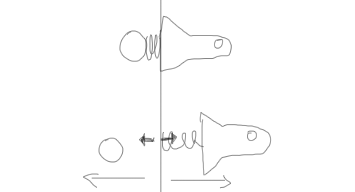
As the rocket pushes the ball in one direction, it is being pushed by the same force, caused by the spring, in the opposite direction.
The force in this case is the spring, in the chair and ball experiment, the force is your arms, the faster the spring stretches (stronger force), just the same as the fastest you push the ball with your arms (stronger force) will make the reaction also stronger, the reaction of the ball and rocket or chair moving faster (with more strength) in opposite directions.