TheJackel, I have warned you before about the perspicuity of your posts; if you err once more I shall ban you from these forums.
Now, to the matter at hand: the Moon is illumined by a vast, heaving swathe of bioluminescent matter which traverses its inferior surface with regularity and unity. The Moon is certainly flat, we can tell this simply by looking at it. In spheres, lit by external sources (as globularists claim the Moon is), we see a darker area around the edges, and a lighter one toward the centre of the sphere, generally in the direction of the light source, as seen in the diagram below:
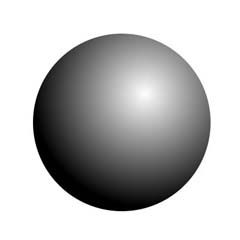
It so happens that tonight there is a full Moon. At great personal risk, I have been able to sneak a glance at it, taking care not to expose myself to its harmful rays, and, to my complete lack of surprise, it looks much as it always does: distinctly NOT like the sphere in the diagram. What I see, when I part the shutters and peer through a window at the fearful object, is what one might expect of a disc: a largely homogenous spread of tincture, with areas of white and light grey dispersed across its surface without discernable pattern, peering blankly back at me with flat and threatening radiance.

As you can see, I've created my own diagram using a 3D sphere model and attempted to duplicate a similar look between the RET "full moon" position of my model and the full moon with some success. As you can see, my model does bear significanly more resemblance to the moon than the diagram James Provided, plus the other phases shown of my model are quite similar in light distribution to those of the actual moon. Currently the the moon is in it's waning crescent phase, approaching first quarter. At first quarter, it will be highest tomorrow at around suppertime (indeed during the day, for Eastern Ontario, rising between 2 and 3 PM, and setting before midnight). I have observed the moon extensively today with no ill effects, and carefully noted how the visible side of the moon exactly faced the Sun. The light distribution can clearly be seen to match closely the diagram I have provided

Here I provide the exact material settings I used for the sphere, should anyone with experience with Blender 3D wish to duplicate my experiment. Perhaps someone with more experience may reproduce the actual light distribution of the moon.
