So you think that what was quoted does support the argument, but it might be misquoted. Interesting hypothesis. Another hypothesis is that the researchers mean what they say.
We aren't doubting the researchers just your interpretations of what they write.
Yeah, it's just a coincidence that I found multiple sources and examples to back up the argument, and it's only a coincidence that multiple researchers say that gravimeters are seismometers. Weak argument. You are better off calling the researchers are college dropouts who don't know what they are talking about, and who fell for an old science myth that caused them to write what they wrote. At least that wouldn't rely on unbelievable coincidence to maintain that your viewpoint is correct.
But what I am saying is that
absolute gravimeters are not seismometers. Try to debunk that.
In any case, while they are both accelerometers a seismometer must be connected firmly to the ground of bedrock if possible.
USGS: Seismometers, seismographs, seismograms - what's the difference? How do they work?
Seismographs are instruments used to record the motion of the ground during an earthquake. They are installed in the ground throughout the world and operated as part of a seismographic network. The earliest "seismoscope" was invented by the Chinese philosopher Chang Heng in A.D. 132. This did not, however, record earthquakes; it only indicated that an earthquake was occurring. The first seismograph was developed in 1890.
A seismograph is securely mounted onto the surface of the earth so that when the earth shakes, the entire unit shakes with it EXCEPT for the mass on the spring, which has inertia and remains in the same place. As the seismograph shakes under the mass, the recording device on the mass records the relative motion between itself and the rest of the instrument, thus recording the ground motion. In reality, these mechanisms are no longer manual, but instead work by measuring electronic changes produced by the motion of the ground with respect to the mass.
You might also read:
Site Selection, Preparation and Installation of Seismic Stations by Amadej Trnkoczy, Peter Bormann, Winfried Hanka, L. Gary Holcomb and Robert L. NigborWould you care to dispute any of that?
Gravity meters, on the other hand, must be
isolated from seismic events but because they of necessity have to be mounted on a stable platform they must include some type of seismic isolation.
The simplest is a super-spring arrangement but more advanced units include a seismic detector whose output can cancel any seismic effects on the gravity meter.
For example see:
NCBI: Gravity measurements below 10−9g with a transportable absolute quantum gravimeter
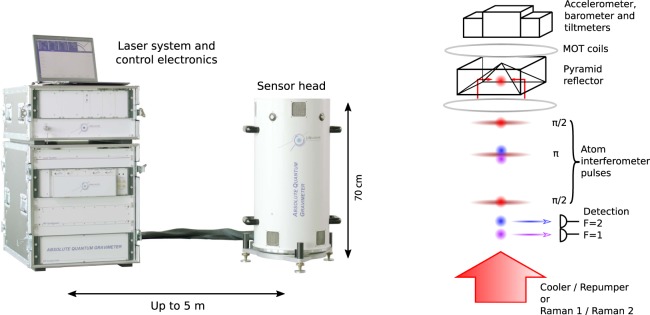
Figure 1.
A high-precision accelerometer is attached to the top of the vacuum chamber, as close as possible to the pyramidal reflector. Its signal is used to apply a real-time correction to the laser phase, in order to reject seismic noise. Two tiltmeters and a barometer are also attached to the sensor to ensure high accuracy and long-term stability of the gravity measurement.
Far from being a seismometer this
Absolute Quantum Gravimeter (AQG-A01) takes steps to "in order to reject
seismic noise".