Vanishing perspective relative to sun and moon

  • 25 Replies
  • 7331 Views
?

D. Seaver

  • 11
  • +0/-0
Vanishing perspective relative to sun and moon
« on: August 13, 2007, 09:53:02 AM »
Hello everyone.  I stumbled across this site yesterday and spent an hour or two poking around.  I believe that it is admirable that there are those who question the accepted world model rather than blindly accepting things as they are handed to them; however, I also believe that after a careful consideration of the facts, there is a point at which "questioning the accepted model" becomes "defending a preposterous argument".  Occam's Razor has rarely been more relevant than it is here; the "explanations" are vastly more convoluted and complex than the alternative- new apologies must be custom-made for the sole purpose of explaining how it could be possible, rather than explaining how it must be so.  Nevertheless, to each his own.

The main purpose for this post is to put forward one test which I have not seen addressed here (granted, I may have missed it as I haven't dug back very far into the archives). 

In the FAQs, the explanation for sunsets and sunrises is as follows;

Quote
Q: "Please explain sunrises/sunsets."

A: It's a perspective effect.  Really, the sun is just getting farther away; it looks like it disappears because everything gets smaller and eventually disappears as it gets farther away.

It is true that things appear smaller as they move further away.  What this doesn't explain, however, is why that the sun and moon do NOT appear to get smaller as they move down and off the horizon.  In fact, they appear exactly the same size.  If measured with a camera, there is absolutely no discernible change in relative size due to the change in distance from noon position and rise or set position. 

If they are, as argued, mere miles from the surface of the Earth, and if they are moving thousands of miles in a circular trajectory, then they would shrink like mountains in the distance as they move away from us to set and they would appear to grow larger as they rise to their full position in the sky. 

This is a test which anyone can perform at any time; the math to calculate this effect is not so complicated that only a NASA scientist can test it.  The effect of the sun setting on the horizon simply can't be explained by perspective unless the sun simply were to shrink away to a tiny speck and vanish among the stars at the edge of the sky, and anyone who has ever seen a sunset can attest that this is not the case.


*

Trekky0623

  • Official Member
  • 10045
  • +0/-0
Re: Vanishing perspective relative to sun and moon
« Reply #1 on: August 13, 2007, 09:56:34 AM »
Another RE victory!

I had something similar once, along the lines that in my location at noon the sun should only rise of the ground 20 or so degrees with the figures in FE.

?

Gulliver

  • 3804
  • +0/-0
Re: Vanishing perspective relative to sun and moon
« Reply #2 on: August 13, 2007, 11:12:41 AM »
Hello everyone. ...

This is a test which anyone can perform at any time; the math to calculate this effect is not so complicated that only a NASA scientist can test it.  The effect of the sun setting on the horizon simply can't be explained by perspective unless the sun simply were to shrink away to a tiny speck and vanish among the stars at the edge of the sky, and anyone who has ever seen a sunset can attest that this is not the case.

Welcome. Good first post. You'll find the math worked for some of your challenge in Experiment 0001 in the RE Primer.

?

The Communist

  • 1217
  • +0/-0
  • Paranoid Intellectual & Pedantic Twat
Re: Vanishing perspective relative to sun and moon
« Reply #3 on: August 13, 2007, 11:12:53 AM »
Samuel Rowbotham explains this as merely a Law of Perspective where the point of perspective exists beyond the horizon. And if you don't like that then the Earth must be slightly curved.
On FES, you attack a strawman. In Soviet Russia, the strawman attacks you
-JackASCII

Do you have any outlandish claims to back up your evidence?
-Raist

Quote from: GeneralGayer date=1190908626
Yeah I love gay porn.

*

Colonel Gaydafi

  • Spam Moderator
  • Planar Moderator
  • 65234
  • +17/-49
  • Queen of the gays!
Re: Vanishing perspective relative to sun and moon
« Reply #4 on: August 13, 2007, 11:14:23 AM »
Oi Gully I made a thread for you in general discussion, go have a look at it
Quote from: WardoggKC130FE
If Gayer doesn't remember you, you might as well do yourself a favor and become an hero.
Quote from: Raa
there is a difference between touching a muff and putting your hand into it isn't there?

?

D. Seaver

  • 11
  • +0/-0
Re: Vanishing perspective relative to sun and moon
« Reply #5 on: August 13, 2007, 12:46:04 PM »
Quote
Samuel Rowbotham explains this as merely a Law of Perspective where the point of perspective exists beyond the horizon.

Forgive me, but how does saying that something has been explained actually make it so?  This does not make any sense.  Perspective exists without any regard to the horizon.

*

Tom Bishop

  • Flat Earth Believer
  • 18033
  • +6/-9
Re: Vanishing perspective relative to sun and moon
« Reply #6 on: August 13, 2007, 01:25:30 PM »
To understand this aspect of the FE model, how the sun rises and lowers due to perspective, it is necessary to read Chapter 9 of Earth Not a Globe by Dr. Samuel Birley Rowbotham:

CAUSE OF SUNRISE AND SUNSET

ALTHOUGH the sun is at all times above the earth's surface, it appears in the morning to ascend from the north-east to the noonday position, and thence to descend and disappear, or set, in the north-west. This phenomenon arises from the operation of a simple and everywhere visible law of perspective. A flock of birds, when passing over a flat or marshy country, always appears to descend is it recedes; and if the flock is extensive, the first bird appears lower or nearer to the horizon than the last, although they are at the same actual altitude above the earth immediately beneath them. When a balloon sails away from an observer, without increasing or decreasing its altitude, it appears to gradually approach the horizon. In a long row of lamps, the second--supposing the observer to stand at the beginning of the series---will appear lower than the first; the third lower than the .second; and so on to the end of the row; the farthest away always appearing the lowest, although each one has the same altitude; and if such a straight line of lamps could be continued far enough, the lights would at length descend, apparently, to the horizon, or to a level with the eye of the observer, as shown in the following diagram, fig. 63.
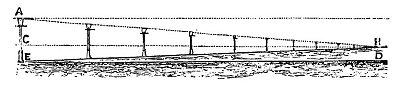

FIG. 63.

Let A, B, represent the altitude throughout of a long row of lamps, standing on the horizontal ground E, D; and C, H, the line of sight of an observer at C. The ordinary principles of perspective will cause an apparent rising of the ground E, D, to the eye-line C, H, meeting it at H; and an apparent descent of each subsequent lamp, from A, to H, towards the same eye-line, also meeting at H. The point H, is the horizon, or the true "vanishing point," at which the last visible lamp, although it has really the altitude D, B, will disappear.

Bearing in mind the above phenomena it will easily be seen how the sun, although always above and parallel to the earth's surface, must appear to ascend from the morning horizon to the noonday or meridian position; and thence to descend to the evening horizon.

In the diagram, fig. 64, let the line E, D, represent the
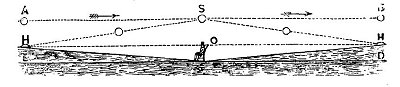

FIG. 64.

surface of the earth; H, H, the morning and evening horizon; and A, S, B, a portion of the true path of the sun. An observer at 0, looking to the east, will first see the sun in the morning, not at A, its true position, but in its apparent position, H, just emerging from the "vanishing point," or the morning horizon. At nine o'clock, the sun will have the apparent position, 1, gradually appearing to ascend the line H, 1, S; the point S, being the meridian or noonday position. From S, the sun will be seen to gradually descend the line S, 2, H, until he reaches the horizon, H, and entering the "vanishing point," disappears, to an observer in England, in the west, beyond the continent of North America, as in the morning he is seen to rise from the direction of Northern Asia. An excellent illustration of this "rising" and "setting" of the sun may be seen in a long tunnel, as shown in diagram, fig. 65. The top of the tunnel,
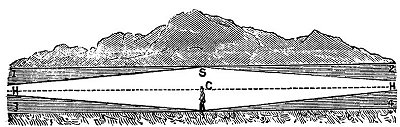

FIG. 65.

[paragraph continues] 1, 2, and, the bottom, 3, 4, although really equi-distant throughout the whole length, would, to an observer in the centre, C, appear to approach each other, and converge at the points, H, H; and a lamp, or light of any kind, brought in, and carried along the top, close to the upper surface 1, 2, would, when really going along the line, 1, S, 2, appear to ascend the inclined plane H, S, to the centre, S, and after passing the centre, to descend the plane S, H; and if the tunnel were sufficiently long, the phenomena of sunrise and of sunset would be perfectly imitated.

A very striking illustration of the convergence of the top and bottom, as well as the sides, of a long tunnel, has been observed in that of Mont Cenis. M. de Porville, when in the centre of the tunnel, noticed that the entrance had apparently become so small that the daylight beyond it seemed like a bright star. "Before us, at an apparently prodigious distance, we beheld a small star at the entrance of the gallery. Its vivid light contrasted strangely with the red glare of the lamps. Its brightness increased as the horses dashed on the way. In a short time its proportions were more clearly defined, and its volume increased. The illusion was quickly dispelled as we got over some kilometres. This soft white light is the extremity of the gallery."

We have seen that "sunrise" and "sunset" are phenomena dependent entirely upon the fact that horizontal lines, parallel to each other, appear to approach or converge in the distance. The surface of the earth being horizontal, and the line of sight of the observer and the sun's path being over and parallel with it, the rising and setting of the moving sun over the immovable earth are simply phenomena arising necessarily from the laws of perspective.
« Last Edit: August 13, 2007, 01:29:59 PM by Tom Bishop »

*

Tom Bishop

  • Flat Earth Believer
  • 18033
  • +6/-9
Re: Vanishing perspective relative to sun and moon
« Reply #7 on: August 13, 2007, 01:27:15 PM »
Secondly, to address issues regarding the size of the sun at its setting, it is necessary to read Chapter 10 of Earth Not a Globe:

CAUSE OF SUN APPEARING LARGER WHEN RISING AND SETTING THAN AT NOONDAY

IT is well known that when a light of any kind shines through a dense medium it appears larger, or rather gives a greater "glare," at a given distance than when it is seen through a lighter medium. This is more remarkable when the medium holds aqueous particles or vapour in solution, as in a damp or foggy atmosphere. Anyone may be satisfied of this by standing within a few yards of an ordinary street lamp, and noticing the size of the flame; on going away to many times the distance, the light or "glare" upon the atmosphere will appear considerably larger. This phenomenon may be noticed, to a greater or less degree, at all times; but when the air is moist and vapoury it is more intense. It is evident that at sunrise, and at sunset, the sun's light must shine through a greater length of atmospheric air than at mid-day; besides which, the air near the earth is both more dense, and holds more watery particles in solution, than the higher strata through which the sun shines at noonday; and hence the light must be dilated or magnified, as well as modified in colour. The following diagram, fig. 66, will show also that, as the sun recedes from the meridian, over a plane surface, the light, as it strikes the atmosphere, must give a larger disc.


FIG. 66.

Let A, B, represent the upper stratum of the atmosphere; C, D, the surface of the earth; and 1, 2, 3, 4, 5, the sun, in his morning, forenoon, noon, afternoon, and evening positions. It is evident that when he is in the position 1, the disc of light projected upon the atmosphere at 6, is considerably larger than the disc projected from the forenoon position, 2, upon the atmosphere at 7; and the disc at 7 is larger than that formed at 8, when the sun, at 3, is on the meridian; when at 4, the disc at 9 is again larger; and when at 5, or in the evening, the disc at 10 is again as large as at 6, or the morning position. It is evident that the above results are what must of necessity occur if the sun's path, the line of atmosphere, and the earth's surface, are parallel and horizontal lines. That such results do constantly occur is a matter of everyday observation; and we may logically deduce front it a striking argument against the rotundity of the earth, and in favour of the contrary conclusion, that it is horizontal. The atmosphere surrounding a globe would not permit of anything like the same degree of enlargement of the sun when rising and setting, as we daily see in nature.
« Last Edit: August 13, 2007, 01:29:26 PM by Tom Bishop »

*

sokarul

  • 19303
  • +1/-1
  • Extra Racist
Re: Vanishing perspective relative to sun and moon
« Reply #8 on: August 13, 2007, 01:32:56 PM »
The earth is round, no need to copy paste anything. 
ANNIHILATOR OF  SHIFTER

It's no slur if it's fact.

?

Gulliver

  • 3804
  • +0/-0
Re: Vanishing perspective relative to sun and moon
« Reply #9 on: August 13, 2007, 01:37:13 PM »
You can quickly prove TomB wrong by a few simple observations. This evening watch the setting Sun. You'll see that it moves as a circular disc over the horizon. The Sun's shape and size do not vary as Parallax would have you believe. Be sure to use a standard measuring technique to avoid being fooled by an optical illusion. I recommend holding your thumb upright with your arm extended such that your thumbnail is near the line of sight to the Sun. You'll notice that regardless of the time of day the Sun and the Moon both always appear to be circular and about the size of your thumbnail.

Parallax would also have you believe, incorrectly, that the Sun appears taller as it sets. It does not.

Parallax would also have you believe, incorrectly, that the Sun through its glare maintains unexplained size. You can tell the difference between the glare around the Sun and the disc of the Sun.

Also you'll find many rebuttals to Parallax's perspective argument.

?

Brennan

  • 144
  • +0/-0
Re: Vanishing perspective relative to sun and moon
« Reply #10 on: August 13, 2007, 01:44:26 PM »
In terms of the image size the observer's view of the sun is determined by the angle it occupies in the sky, not by a random ellipse the light forms as it passes through a plane at an arbitrary distance.
Quote from: Tom Bishop
tell me how your model explains why deep-dripping Russian geologists found an impenetrable layer of turtle shell when attempting to breach the crust of the earth.

*

Tom Bishop

  • Flat Earth Believer
  • 18033
  • +6/-9
Re: Vanishing perspective relative to sun and moon
« Reply #11 on: August 13, 2007, 01:56:17 PM »
Quote
You can quickly prove TomB wrong by a few simple observations. This evening watch the setting Sun. You'll see that it moves as a circular disc over the horizon. The Sun's shape and size do not vary as Parallax would have you believe. Be sure to use a standard measuring technique to avoid being fooled by an optical illusion. I recommend holding your thumb upright with your arm extended such that your thumbnail is near the line of sight to the Sun. You'll notice that regardless of the time of day the Sun and the Moon both always appear to be circular and about the size of your thumbnail.

Nope. The illusion is not psychological. The little thumb trick may convince a person that the illusion is apparent rather than real; but the conviction will not cause the illusion to disappear. Ergo, the illusion is not psychological.

See The Mystery of the Moon Illusion. The mystery sits wholly unsolved to this very day. As a celestial body approaches the horizon it becomes magnified - this applies to the Sun, Moon and Stars.

Here is an unzoomed photograph I took a while ago demonstrating this phenomena:


As we can see the moon is large at the horizon and discolored; exactly as Dr. Rowbotham predicts.

Quote
Parallax would also have you believe, incorrectly, that the Sun appears taller as it sets. It does not.

The diagram is a two dimensional side view. Rowbotham does not specify tallness or wideness. Rowbotham predicts an equal resizing of both x and y dimensions of the moon.
« Last Edit: August 13, 2007, 02:03:38 PM by Tom Bishop »

?

Lorcan

  • 163
  • +0/-0
  • FE is nothing but an exercise in doublethink.
Re: Vanishing perspective relative to sun and moon
« Reply #12 on: August 13, 2007, 01:57:45 PM »
Tom has shared some examples of why a flat earth theory is impossible to be taken seriously. This is the kind of shoddy science that flat earth theory is based on.


?

Brennan

  • 144
  • +0/-0
Re: Vanishing perspective relative to sun and moon
« Reply #13 on: August 13, 2007, 02:01:00 PM »
The sun and moon simply appears larger. The diagram is a two dimensional side view. Rowbotham does not specify tallness or wideness.
What Rowbotham specifies is irrelevant. The 'discs' described at 6,7,8,9,10 would be ellipses if seen from directly below. They do not in any way represent what the viewer is seeing.
« Last Edit: August 13, 2007, 02:03:02 PM by Brennan »
Quote from: Tom Bishop
tell me how your model explains why deep-dripping Russian geologists found an impenetrable layer of turtle shell when attempting to breach the crust of the earth.

*

Roundy the Truthinessist

  • Flat Earth TheFLAMETHROWER!
  • The Elder Ones
  • 26966
  • +0/-0
  • I'm the boss.
Re: Vanishing perspective relative to sun and moon
« Reply #14 on: August 13, 2007, 02:01:30 PM »
Quote
You can quickly prove TomB wrong by a few simple observations. This evening watch the setting Sun. You'll see that it moves as a circular disc over the horizon. The Sun's shape and size do not vary as Parallax would have you believe. Be sure to use a standard measuring technique to avoid being fooled by an optical illusion. I recommend holding your thumb upright with your arm extended such that your thumbnail is near the line of sight to the Sun. You'll notice that regardless of the time of day the Sun and the Moon both always appear to be circular and about the size of your thumbnail.

Nope. The illusion is not psychological. The little thumb trick may convince a person that the illusion is apparent rather than real; but the conviction will not cause the illusion to disappear.

See The Mystery of the Moon Illusion. Te mystery is wholly unsolved to this very day. As a celestial body approaches the horizon it becomes magnified - This applies to the Sun, Moon and Stars.

Here is an unzoomed photograph I took a while ago demonstrating this phenomena:


As we can see the moon is large at the horizon and discolored; exactly as Dr. Rowbotham predicts.

Quote
Parallax would also have you believe, incorrectly, that the Sun appears taller as it sets. It does not.

The sun and moon simply appears larger. The diagram is a two dimensional side view. Rowbotham does not specify tallness or wideness.

So what exactly is there in that photograph that confirms the moon is any larger than it is straight overhead?   ???

You know that out of all your arguments this is the one that makes you look the most mentally challenged, right?
Where did you educate the biology, in toulet?

?

Lorcan

  • 163
  • +0/-0
  • FE is nothing but an exercise in doublethink.
Re: Vanishing perspective relative to sun and moon
« Reply #15 on: August 13, 2007, 02:02:26 PM »
Amusingly, that diagram has the sun as a sphere.

?

Brennan

  • 144
  • +0/-0
Re: Vanishing perspective relative to sun and moon
« Reply #16 on: August 13, 2007, 02:07:18 PM »
Oh, lemme guess... the sun is actually a horizontally aligned disc... in which case as it disappears 'over the horizen' it should tend to appear more of a flattened ellipse, then a horizontal line?
Quote from: Tom Bishop
tell me how your model explains why deep-dripping Russian geologists found an impenetrable layer of turtle shell when attempting to breach the crust of the earth.

*

Tom Bishop

  • Flat Earth Believer
  • 18033
  • +6/-9
Re: Vanishing perspective relative to sun and moon
« Reply #17 on: August 13, 2007, 02:07:56 PM »
Quote
Tom has shared some examples of why a flat earth theory is impossible to be taken seriously. This is the kind of shoddy science that flat earth theory is based on.

If you are not familiar with the Moon Illusion I encourage you to go out tonight and watch the moon as it nears the horizon. You will find that it is magnified four to five times the size it should be.

No amount of conviction or size comparing will restore the moon to its normal size. Therefore the illusion cannot be psychological.

Quote
So what exactly is there in that photograph that confirms the moon is any larger than it is straight overhead?

The image perfectly illustrates the enormous resizing of the moon as it approaches the horizon. If you believe the size discrepancy to be a psychological illusion, then I must ask why this psychological resizing applies to cameras?

Quote
Amusingly, that diagram has the sun as a sphere.

The sun is a sphere in Flat Earth Theory.
« Last Edit: August 13, 2007, 02:10:09 PM by Tom Bishop »

?

Brennan

  • 144
  • +0/-0
Re: Vanishing perspective relative to sun and moon
« Reply #18 on: August 13, 2007, 02:11:16 PM »
The 'moon illusion' is an optical illusion IIRC. If you actually measure the size of the moon at the horizon it is exactly the same as normal.
Quote from: Tom Bishop
tell me how your model explains why deep-dripping Russian geologists found an impenetrable layer of turtle shell when attempting to breach the crust of the earth.

?

D. Seaver

  • 11
  • +0/-0
Re: Vanishing perspective relative to sun and moon
« Reply #19 on: August 13, 2007, 02:12:32 PM »
Posting a photograph of the moon does not show anything about it's apparent size.  It looks larger because it is near the horizon where it can be compared to physical objects whose size is known, thus it looks larger relative to those objects than it does when it is lost in the vast open sky.  Nothing more than an optical illusion. 

The fact has not yet been disputed, however, that the size of the sun and moon do not vary in the least in size as they move across the sky despite the fact that according to FE theory they are moving thousands of miles away from any given point.  Even an enormous mountain range will grow quite small after moving a mere 50 miles away from it, despite atmospheric conditions.   If "glare" is the only reason why they seem to be larger as they move further, then they would have a large, fuzzy halo but the change in size would still remain.  The moon would be blurred until the features are unrecognizable.  They would also not suddenly dip below the horizon at exactly the same size as they were in the noonday sky, but would blur and grow dimmer and dimmer as their descent appears slower and slower until they were too dim to be seen clearly before slowly moving across the horizon and then growing brighter once again.  But all this seems to be moot, as your "answer" has not in fact answered anything. 
No matter how complex your apologies get, they raise only more questions rather than answers.  The simplest answer always remains the most likely.

?

Gulliver

  • 3804
  • +0/-0
Re: Vanishing perspective relative to sun and moon
« Reply #20 on: August 13, 2007, 02:14:25 PM »
Quote
You can quickly prove TomB wrong by a few simple observations. This evening watch the setting Sun. You'll see that it moves as a circular disc over the horizon. The Sun's shape and size do not vary as Parallax would have you believe. Be sure to use a standard measuring technique to avoid being fooled by an optical illusion. I recommend holding your thumb upright with your arm extended such that your thumbnail is near the line of sight to the Sun. You'll notice that regardless of the time of day the Sun and the Moon both always appear to be circular and about the size of your thumbnail.

Nope. The illusion is not psychological. The little thumb trick may convince a person that the illusion is apparent rather than real; but the conviction will not cause the illusion to disappear. Ergo, the illusion is not psychological.

See The Mystery of the Moon Illusion. The mystery is wholly unsolved to this very day. As a celestial body approaches the horizon it becomes magnified - this applies to the Sun, Moon and Stars.

Here is an unzoomed photograph I took a while ago demonstrating this phenomena:


As we can see the moon is large at the horizon and discolored; exactly as Dr. Rowbotham predicts.

Quote
Parallax would also have you believe, incorrectly, that the Sun appears taller as it sets. It does not.

The sun and moon simply appears larger. The diagram is a two dimensional side view. Rowbotham does not specify tallness or wideness. Rowbotham predicts an equal resizing of both x and y dimensions of the moon.
I call shenanigans on the photo. There are zooming artifacts. There is nothing to set context. You could have done a much better job of documenting the phenomenon.

The reference supports the RE position. Thanks.

You fail to explain Parallax's mistake. The diagram shows the elongation. You need to show us a corrected diagram or accept defeat.

*

narcberry

  • 5623
  • +0/-0
  • Official Flat Earth Society Spokesman/min
Re: Vanishing perspective relative to sun and moon
« Reply #21 on: August 13, 2007, 02:15:49 PM »
This is untrue. Many observations have shown otherwise.

?

D. Seaver

  • 11
  • +0/-0
Re: Vanishing perspective relative to sun and moon
« Reply #22 on: August 13, 2007, 02:18:11 PM »
Quote
I call shenanigans on the photo. There are zooming artifacts.
I quite agree.  I have also photographed the moon on the horizon with a camera that had no zoom, and it was a tiny speck in the photo.  Also, at the perspective of ground if there was no zoom, then the photographer would be immediately next to the fence and the diminishing lines of perspective on the fence posts and wires would be greatly exaggerated, whereas with a zoom they are virtually nonexistent (as in this photo).

*

narcberry

  • 5623
  • +0/-0
  • Official Flat Earth Society Spokesman/min
Re: Vanishing perspective relative to sun and moon
« Reply #23 on: August 13, 2007, 02:19:59 PM »
Then how do you explain this:


*

Roundy the Truthinessist

  • Flat Earth TheFLAMETHROWER!
  • The Elder Ones
  • 26966
  • +0/-0
  • I'm the boss.
Re: Vanishing perspective relative to sun and moon
« Reply #24 on: August 13, 2007, 02:20:34 PM »
Quote
So what exactly is there in that photograph that confirms the moon is any larger than it is straight overhead?

The image perfectly illustrates the enormous resizing of the moon as it approaches the horizon. If you believe the size discrepancy to be a psychological illusion, then I must ask why this psychological resizing applies to cameras?


You fuckwit.   :D

You might learn something here.  Take a look at this picture:


Notice how the center circle on the right is much larger than the center circle on the left.  Oh wait, it's not.  It's an illusion based on the circle's appearance relative to what's around it.

The same basic idea applies to the moon photograph you so desperately want us to believe you think is proof that the moon actually gets larger when close to the horizon.  The moon appears larger because of its appearance relative to what's around it.

And come on.  You can't judge the size of something, unaided, by a photograph!  ::)  Back up your worthless contention that the moon in that picture is larger than it is high up in the sky.  And do it without referring to ENaG for once, please, it's getting tiresome.

You're a fucking moron.  ;D
Where did you educate the biology, in toulet?

*

Roundy the Truthinessist

  • Flat Earth TheFLAMETHROWER!
  • The Elder Ones
  • 26966
  • +0/-0
  • I'm the boss.
Re: Vanishing perspective relative to sun and moon
« Reply #25 on: August 13, 2007, 02:22:01 PM »
Then how do you explain this:


 ;D I always think of this scene when I read Tom's stupid arguments about the moon changing size when it's closer to the horizon.  You brought a smile to my face, narc.
Where did you educate the biology, in toulet?