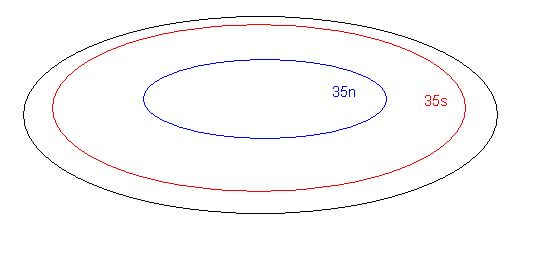
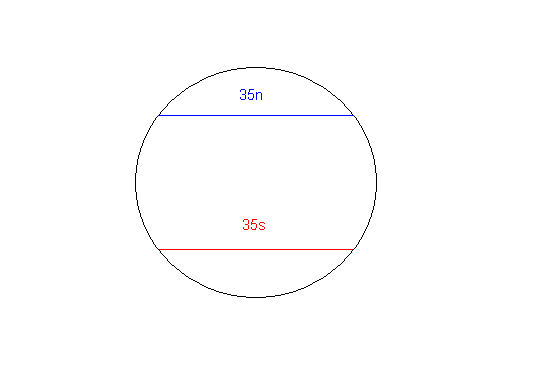
As a newly self-appointed flat-earther, I feel obligated to point out the inherent flaw in this idea. See, you think the airline is unbiased, when there is, in fact, a conspiracy.
The reason it takes you the same amount of time is simple, the airplane flies more slowly to your hypothetical "35 n", and flies faster to "35 s". Making it equal the same amount of time to fly the two distances.
I would think this would be clear, by you are obviously blinded by your zeal to defend a lie.
Ok, so any contradictory point to your idea is an attempt by some government or corporation from keeping you from knowing the truth? :roll:
Now lets see why this idea is absloutely asinine using simple math. The distance from the north pole to the south pole is about 12,500 miles. Since there are 180 lines of latitude, divide 12,500 by 180 to get the distance between two lines. This comes out to be about 70 miles. Now, the 35 n line of latitude is 55 degrees away from the north pole. That means that the distance from the north pole to the 35 n line is 3,820 miles. To figure out the distance that this trip is, we need the distance around the equator, which is about 25,000 miles. The equator is located 6,250 miles away from the north pole. To get the distance of the 35 n trip, set up a ratio:
25,000/6,250=X/3,820
3,820*(25,000/6,250)=X
X=15,280
As for the 35 s line, the steps are essentially the same. The only difference is that the calculations are based on a flat earth model.
Distance from the north pole to the 35 s line=8,750
25,000/6,250=X/8,750
X=35,000
For a plane to fly 35,000 mph in 48 hours (approximation based on the fact that initial assumptions were done with places halfway across the globe) means that it was going:
730 mph, which is substantially faster than the maximum speed of a standard Boeing 747-400. It is impossible for the plane to make the trip in 48 hours, because the Boeings are also not able to sustain maximum speed for very long without overheating. The trip is impossible with the flat earth model.
 Show Posts