Show Posts

This section allows you to view all posts made by this member. Note that you can only see posts made in areas you currently have access to.


Messages - WesternDuval

Pages: [1]
1
Flat Earth General / Re: What about a telescope aimed at the horizon?
« on: March 07, 2014, 07:55:14 PM »

Or, maybe they just did it like they do it with modern artillery.  A couple of Forward Observes with binoculars are close to where the target is and tell the artillery people how far off their calculations are so they can adjust their guns?

Are you being serious with this claim? Exactly how did these "forward observers" survive in the first place, and even assuming they did, how did they "tell" the gunners what corrections to make to their trajectories?  And this a century ago?  You obviously also have no idea at all about modern artillery fire procedures do you?  We certainly don't use forward observers to direct artillery fire—computers do it for us.  Or for visual target locking, we use radio-controlled drones operated from a rear base.

You also have very little idea about non-ballistic missile launching and trajectory plotting either.  Ever been in the army?  I have.

Quote
What?  A hundred years later, and we can not make accurate calculations for artillery shells from 10 miles away, yet, they could calculate this with any amount of accuracy from 75 miles back then?

We can't accurately drop shells from a mere 10 miles distance?  Have they moved April 1 forward a couple of weeks?   ;D


Forward observers were used to report how far off the artillery shell missed because the people running the artillery battery would not have line of sight. Before computers were used, forward observers would watch the shell impact from afar with binoculars, then report how far off the shells missed and in what direction by radio or something of the sort, so that the shot could be recalculated. This would go on until they hit the target.

2
Flat Earth Q&A / Re: Curvature for a Rounder
« on: March 07, 2014, 03:52:36 PM »
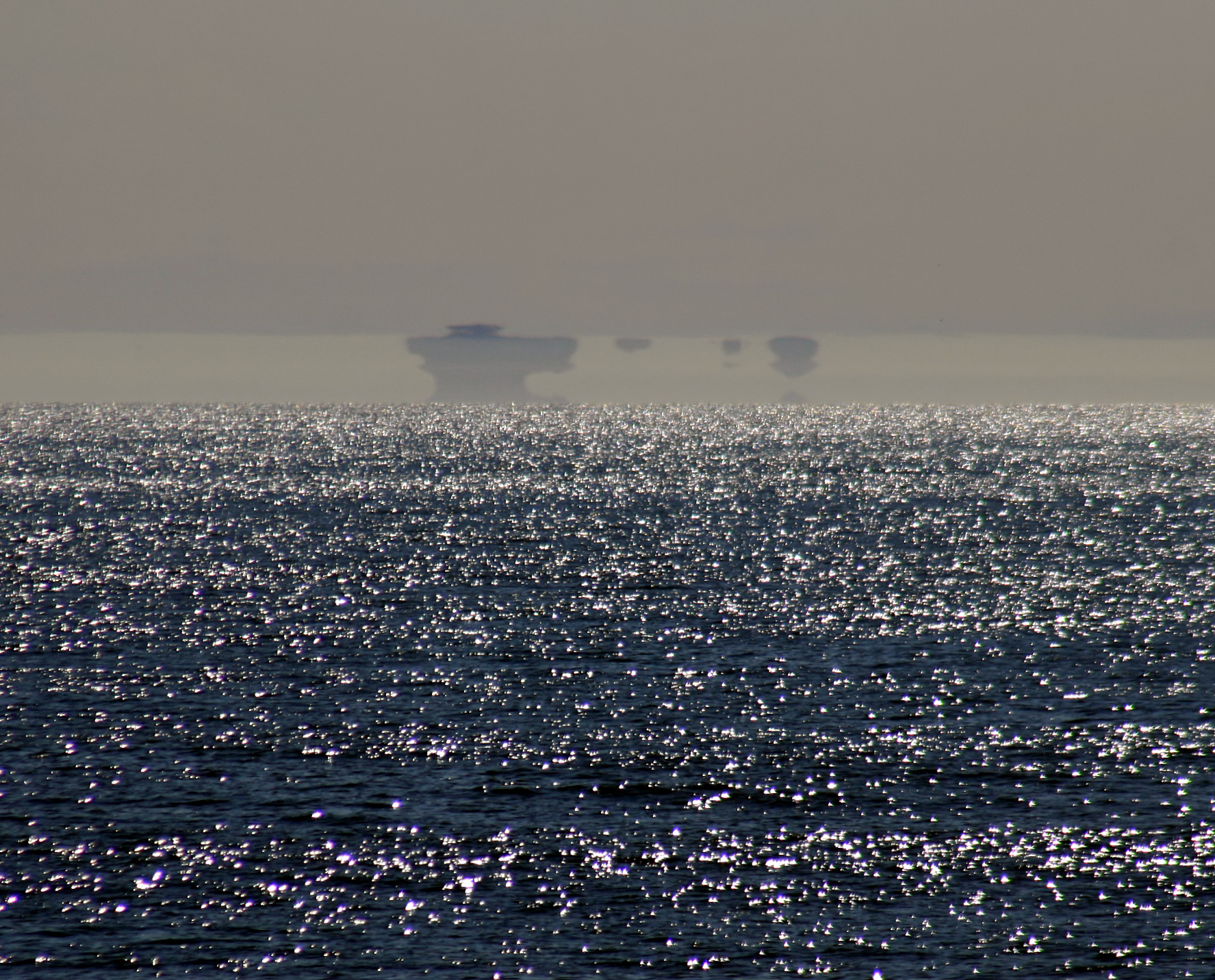
You can, in a way, see the curvature of the earth, with the help of refraction. In certain rare cases, where the temperature gradient in the atmosphere is flipped near the ground, as in, cold air on the bottom, and warm air up higher, which results in dramatic ducting of the light, so that one at sea level could view something above the horizon. These are called superior mirages. Here are a series of images demonstrating this. The object seen above the horizon is a series of islands, which are too far away to be seen at sea level.


"Superior mirages can have a striking effect due to the Earth's curvature. Were the Earth flat, light rays that bend down would soon hit the ground and only nearby objects would be affected. Since Earth is round, if their downward bending curve is about the same as the curvature of the Earth, light rays can travel large distances, perhaps from beyond the horizon."


3
Flat Earth Q&A / Re: Weight at Poles and weight at Equator
« on: March 07, 2014, 01:28:10 PM »
It's too bad Scept was the only one with an "answer", or better yet, a response.

4
The Lounge / Re: Is this real?
« on: March 07, 2014, 01:15:15 PM »
I'd assume that there are a fair number of people, mostly in the under-developed world, who've never heard anything about the earth being flat or round. I'd assume a good portion of them would guess that it is flat. Excuse my extensive levels of assumptions. Did you know that on average, people who eat pizza live longer than people who don't?

5
I would probably do that with any rouge drawing that was meant to be directed towards a group of people. It keeps the people who have no idea from cluttering up the place. I'm really curious how this would function on a flat earth without the beam ducting and hitting the ground. Also here's a cool atmospheric duct showing light from over the horizon.


Also how does one modify the size of the image? thanks.

6
Flat Earth Q&A / Re: Throwing a ball in the air.
« on: March 07, 2014, 12:42:35 PM »
To be fair, what is everyone comparing the speed to? You can only determine speed from a relative position. If an object were accelerating at the same rate, but was constantly 20 m/s slower, than the flat earth would be traveling at 20 m/s relative to that object. How can one deduce the speed at any given time without a relative point?

The speed of an object is defined as  the magnitude of its velocity.  Speed is a scalar property, and doesn't require any fixed point in order to define it.  Speed is usually measured in m/sec or km/hr.


Granted yes. But my point is how anyone would measure the speed at any given time, besides the fact that we know that v=at+y where v is the current speed, a is acceleration, t is time, and y is the initial speed.  It should take about 1.9 years then, for the earth to reach the speed of light, assuming that the starting speed was -c+1. So something weird would have to happen. I haven't taken physics yet, sadly, so i'm not too keen on relativity and the effects of approaching the speed of light on time for someone approaching that speed, or exactly all the weird things will occur when approaching that speed.

7
Flat Earth Debate / How does Doppler Radar function on a Flat Earth?
« on: March 06, 2014, 08:14:49 PM »
The atmosphere refracts light downwards, towards the surface of Earth, when using Doppler radar. For radar not to strike the ground when searching for storms every time it is used, it requires curvature of the earth. Here is a little diagram I drew to demonstrate the issue.


How does FE allow radar to detect storms long distance without striking the ground? Please note that the image is a rough drawing, for example, the radar tower is no as high as the clouds.

jroa: Edit: I shrank your picture so it can be viewed more easily. 

8
Flat Earth Q&A / Re: Throwing a ball in the air.
« on: March 06, 2014, 05:31:53 PM »
To be fair, what is everyone comparing the speed to? You can only determine speed from a relative position. If an object were accelerating at the same rate, but was constantly 20 m/s slower, than the flat earth would be traveling at 20 m/s relative to that object. How can one deduce the speed at any given time without a relative point?

9
Flat Earth Q&A / Re: Weight at Poles and weight at Equator
« on: March 06, 2014, 05:12:29 PM »
Village idiot? Hahah, man, you'd think that there would be more "round-earther" trolls here than FE's.

10
Man I thought this was a post on Star Trek.

11
Flat Earth Q&A / Re: Weight at Poles and weight at Equator
« on: March 06, 2014, 04:34:42 PM »
Quote
You're not exactly pushing a strong point here, are you. No disrespect but have a think about what you're saying.
Can you please provide evidence that states
Can you cite scientific sources that states that acceleration from gravity (or whatever you want to call it) is 0.5% higher at the poles than the equator due to barometric pressure?

12
Flat Earth Q&A / Re: Weight at Poles and weight at Equator
« on: March 06, 2014, 01:00:21 PM »
http://www.soest.hawaii.edu/GG/ASK/weight.html

You would actually weigh slightly (ever so slightly) less where there is higher atmospheric pressure.

13
Flat Earth Q&A / Re: Weight at Poles and weight at Equator
« on: March 06, 2014, 12:41:37 PM »
Air pressure pushes on you from all sides, including the bottom, which would not increase acceleration. That's why an object won't really sink faster towards the bottom of the ocean rather than the top.

14
Flat Earth Q&A / Re: Weight at Poles and weight at Equator
« on: March 06, 2014, 12:07:19 PM »
"The acceleration of gravity varies from 9.780 m/s2
 at the equator to 9.832
m/s2
 at the poles (a difference of 0.53%)."

http://www.space-electronics.com/Literature/Precise_Measurement_of_Mass.PDF

"Taking into account both of the above effects, the gravitational acceleration is 9.78 m/s2 at the equator and 9.83 m/s2 at the poles, so you weigh about 0.5% more at the poles than at the equator.

http://curious.astro.cornell.edu/question.php?number=310

15
Flat Earth Q&A / Re: Weight at Poles and weight at Equator
« on: March 06, 2014, 11:54:21 AM »
Aye, and I apologize, I left out two factors in weight at the poles vs. weight at the equator. Centripetal force causes you to weigh less at the equator, and also being farther away from the center of mass. All of these factors lead to a net INCREASE in weight at the poles, not a decrease. The centripetal(which is from the rotation of the earth) can be calculated out to give you a cleaner look. However, you'd still likely weigh more at the pole, regardless of the extra mass, due to the denser core.

16
Flat Earth Q&A / Weight at Poles and weight at Equator
« on: March 06, 2014, 11:36:15 AM »
At the equator, you weigh more than you would at the poles. This is because due to the earth's roundness (my perspective, not FE perspective) and it's rotation, and due to centripetal force, the Earth is not a perfect sphere. It is an elongated sphere. It bulges at the equator. The equator is about 22km from the core than the poles are. It is shown that the pull of gravity is stronger at the equator than at the equator. If the Earth were flat and continuously accelerating upwards with a constant function, then why would the poles have lower "gravity" than the equator?

Pages: [1]