Show Posts

This section allows you to view all posts made by this member. Note that you can only see posts made in areas you currently have access to.


Messages - Justatruthseeker

Pages: [1]
1
Flat Earth Debate / Re: "south star" not visible from northern hemisphere
« on: February 27, 2016, 02:01:54 PM »
A simple thought experiment.

Since the earth revolves once on its axis every 24 hours. Will it point to the same spot in the sky (roughly) once every 24 hours?

2
Flat Earth Debate / Re: "south star" not visible from northern hemisphere
« on: February 05, 2016, 01:34:31 PM »


Not true. Place the North pole on one end and the south pole on the opposite end and it fits all observations.

The RET/heliocentric model fails to explain why the south polar stars are not visible regardless of location on the same latitude while the north ones are. Since the same situation is supposed to apply on a globe regardless of north or south pole, then like the north pole constellations that are visible regardless of position on the same latitude, so should the south pole constellations be visible regardless of position on the same latitude. But this is not the case.

In fact the only model that does work is a disk with the north pole "near" the edge and a south pole "on" the edge directly opposite one another on a flat disk spinning end over end. If the RET/heliocentric model was correct as advertised - you would see the south pole constellations from all positions on the same latitude just as you see the north pole constellations from any location on the same latitude.

Now understand I am not advocating FE, just showing that the RET/heliocentric model does not fit all observations as advertised and claimed. No more that the current FE model does.

But to get into a more scientific explanation one has to understand aberration of starlight to understand the flaws with our current cosmology.
Do you have a source of information that you are using for your claim that 'all northern constellations are visible from the northern hemisphere while all southern constellations are not visible from the southern hemisphere'?

Can you provide a layout of continents on this 'end over end' disk that allows for alignment with the north and south celestial poles while also allowing the north and south celestial poles to be 180 degrees apart from each other from any given point?

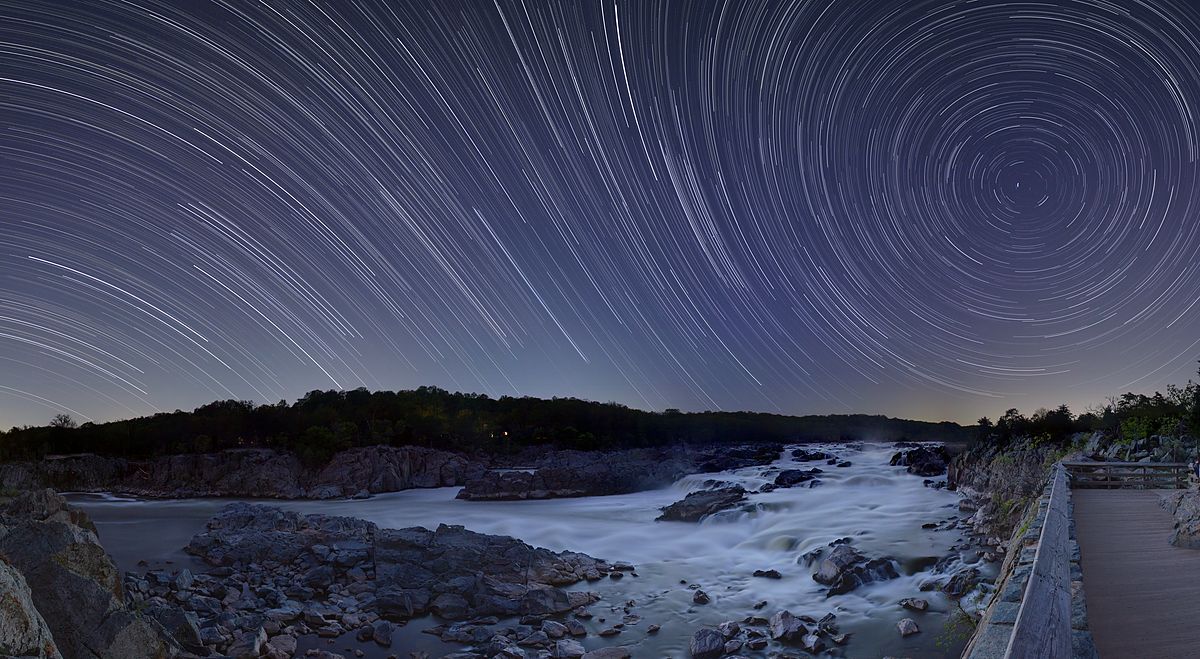
And not all those star trails are like they like to show you.


Nice wide-angle (or fisheye) lens photograph there.  It does not accurately show what is seen with the naked eye however.

Good try at some excuse

No fish eye lens used


"Canon 6D camera, 14mm f/4 lens, ISO 1600, 3600-second exposure"

With fisheye lens


"Canon 70D camera, Samyang 8mm f/5.6 fisheye lens, ISO 400-1600"

Now what were you saying??????

3
Technology, Science & Alt Science / Re: Telescope Distances
« on: February 01, 2016, 08:43:55 AM »
A cat has better night vison because it's cones are made for that purpose. CCD's are made to capture what the human eye sees to reproduce pictures faithfully as to what we observe. Go ahead, take your camera outside and take a picture - see if it shows things better than you can see without night vision attachments. In fact they have less resolution than the human eye.

http://www.cambridgeincolour.com/tutorials/cameras-vs-human-eye.htm

"Most current digital cameras have 5-20 megapixels, which is often cited as falling far short of our own visual system. This is based on the fact that at 20/20 vision, the human eye is able to resolve the equivalent of a 52 megapixel camera (assuming a 60° angle of view)."

We are not talking about regular cameras. The fact that Hubble can take pictures in infrared alone, proves that its simply not correct that the CCDs used in telescopes are made to reproduce what we see as accurately as possible. Why on earth would you want that?

Which has nothing to do with the amount of light it gathers - which is determined only by aperture size. A one hour exposure on Sunday gathers no more light than a one hour exposure on Tuesday. The two overlaid only increase the detail or resolution - not the amount of light collected on each exposure. You can make what is within range appear brighter and more detailed, but putting one exposure on top of another does not increase the distance except by a very slight amount.

But a one hour exposure gathers more light than a 1 second exposure. So no, when you take puctures, the light gathered does not only depend on aperture, it depens on exposure too. You just said it yourself. It also matters how much of the gathered light is actually detected, and recorded on the image, and that is way more than the eye is capable of. You seem to be under the impression that aperture determines the distance you can see. It is simply not so when you dont use the naked eye.

A CCD again is not made to see in the dark - but to reproduce the colors that the human eye sees faithfully. Only with infrared lights can a camera see better than you in the dark, IF the CCD is equipped to see in the infrared. But again, seeing in infrared does not increase distance nor the louight gatheing power, it remains the same as light is all frequencies combined.

Thats simply incorrect. Go to the following link and read the part about intensity range. It specifically says that CCDs can be used to enhance intensity range.

https://en.wikipedia.org/wiki/Night_vision

And again, if it can see infrared, then you are wrong when you say that its made to reproduce what the human eye sees.

"A telescope's most important attribute is its aperture, which determines the brightness and sharpness of everything you see through your scope. Technically, this is the diameter of the main lens or mirror and as the aperture increases so does the details of the image you see. Depending on the aperture you will either see an open or a restricted field of view. For example a good 10" aperture scope shows sharper images than even a well-made 6" aperture telescope."

How does that contradict what i say?

Apparently you need to read some books on how telescopes work.

https://starizona.com/acb/basics/equip_whichisbest.aspx

"Aperture

The diameter of the lens or mirror in a telescope--the aperture--is the single most important factor for stargazing.  The bigger the aperture, the more light the telescope gathers.  Ultimately this is the main purpose of a telescope:  to gather as much light as possible and funnel it into your eye.  Since the light-gathering ability of a telescope is determined by the area of the lens or mirror, doubling the aperture quadruples the light-gathering ability.  A small difference in aperture makes a big difference in what you see.  A look at the picture below shows the difference between the area of an 8" telescope mirror and the typical 7mm opening of the human eye.  An 8" telescope gathers more than 800 times as much light as the unaided eye."

I know how telescopes work, i have used many. You on the other hand need to read something that is NOT about naked eye observations, because that is simply not what Hubble is used for.

The CCD in Hubble is far less than your eye.

https://answers.yahoo.com/question/index?qid=20090207234120AAvedWz

"The Wide Field Camera 3 (WFC3), which is to be installed during the servicing mission in 2009, will also have 2 CCD chips each of 2048 x 4096 pixels for a total of 16 mega-pixels. "

http://www.cambridgeincolour.com/tutorials/cameras-vs-human-eye.htm

"Most current digital cameras have 5-20 megapixels, which is often cited as falling far short of our own visual system. This is based on the fact that at 20/20 vision, the human eye is able to resolve the equivalent of a 52 megapixel camera (assuming a 60° angle of view)."

So even someone with less than 20/20 vision (52 megapixels) has more resolution that Hubble which only amounts to 16 megapixels.

And we have not even started to talk about light extinction due to dust, the amount of which has been sadly underestimated.

https://en.wikipedia.org/wiki/Ulysses_%28spacecraft%29

"Ulysses discovered that dust coming into the Solar System from deep space was 30 times more abundant than previously expected."

Is far less what? Less resolution? What does that have to do with collecting light and distance?

Your spiel about Hubble and infrared is way off base since it used its infrared camera to take infrared pictures - which is completely separate from its normal ccd as are the other functions built into it.

http://hubblesite.org/the_telescope/nuts_.and._bolts/instruments/nicmos/

You are confusing other devices built into it with it's light gathering ability.

You were the one claiming that its CCD allowed us to see further, and now when you find out its CCD is less than half that of a human's, you suddenly want to know what it has to do with distance and light gathering power. Absolutely nothing - which is what I tried to tell you from the start, but you were insisting it did, now you are taking the exact opposite stance suddenly for some reason?????

4
Technology, Science & Alt Science / Re: Telescope Distances
« on: February 01, 2016, 08:34:36 AM »
The Keck telescope with a mirror diameter of 10 meters can only see 1,111 times further than the human eye.

http://www.astronomynotes.com/telescop/s6.htm

And you all want people to believe that the Hubble with a mirror diameter of 2.4 meters can see 6,500 times further than the human eye???????

The only math so far that doesn't add up is those that believe it can.

5
Technology, Science & Alt Science / Re: Telescope Distances
« on: February 01, 2016, 08:30:02 AM »
Btw, the longest distance you can see with the naked eye, was what is thought to have been a gamma-burts observed in 2008, and estimated to be 7.5 billion lightyears away. Multiply that with whatever the maths you did gave you for Hubble and tell me that 13-14 billion lightyears will be a problem.

http://www.universetoday.com/13280/biggest-ever-cosmic-explosion-observed-75-billion-light-years-away/

And its not even the telescopes that limit the range of how far we can see...its the fact that we look back in time due to the speed of light. There is a reason the term "visible universe" was coined.

Distance calculated by the false assumption of redshift???????

http://www.newtonphysics.on.ca/hubble/

Because that dust and plasma blocks out what we can see and is the sole factor of redshift.

https://en.wikipedia.org/wiki/Ulysses_%28spacecraft%29

"Ulysses discovered that dust coming into the Solar System from deep space was 30 times more abundant than previously expected."

https://www.nasa.gov/mission_pages/chandra/news/H-12-331.html#.Vq-HYVJRZdg

https://www.nasa.gov/feature/goddard/nasa-s-hubble-finds-giant-halo-around-the-andromeda-galaxy

I mean please. It is 30 times more dense than what we used to believe, yet they don't calculate it in their calculations for extinction at all. Not to mention all those plasma halos around every galaxy.

There is an answer, but first you must give up the Fairie Dust of cosmological redshift being expansion of the universe.

And gamma ray bursts are supposed to be the most energetic event in the universe.

https://en.wikipedia.org/wiki/Gamma-ray_burst

Are you claiming those newly forming galaxies at the edge of the universe just beginning star formation are brighter than gamma ray bursts?

6
Flat Earth Debate / Re: "south star" not visible from northern hemisphere
« on: February 01, 2016, 08:12:36 AM »
Simply put, you can probably take a disk and do strange and wonderful things to it (ad hoc explanations) to create an effect, like in this case. You can have a map with the N.Pole in the middle to take care of many things north of the equator. You can have another with the S.Pole in the middle to take care of the southern stuff. You can ...

But each model is different. There is no single FE model/map that handles everything. Just ad hoc explanations that MAY work for one situation but cause problems in all the other situations.

The RET/heliocentric one handles these situations without changing models - naturally, elegantly.

Not true. Place the North pole on one end and the south pole on the opposite end and it fits all observations.

The RET/heliocentric model fails to explain why the south polar stars are not visible regardless of location on the same latitude while the north ones are. Since the same situation is supposed to apply on a globe regardless of north or south pole, then like the north pole constellations that are visible regardless of position on the same latitude, so should the south pole constellations be visible regardless of position on the same latitude. But this is not the case.

In fact the only model that does work is a disk with the north pole "near" the edge and a south pole "on" the edge directly opposite one another on a flat disk spinning end over end. If the RET/heliocentric model was correct as advertised - you would see the south pole constellations from all positions on the same latitude just as you see the north pole constellations from any location on the same latitude.

Now understand I am not advocating FE, just showing that the RET/heliocentric model does not fit all observations as advertised and claimed. No more that the current FE model does.

But to get into a more scientific explanation one has to understand aberration of starlight to understand the flaws with our current cosmology.
Yes, if you flip a disk horizontally (like flipping a coin), you will see a North and South Celestial Pole (NCP/SCP). This would imply that the N.Pole and S.Pole are on the EDGE of the disk. Since motion is relative, if the Earth was stationary, the half the sky would be above the disk (seen everywhere on earth) and the other half below the disk (seen nowhere on Earth). This does not happen. There is NO WAY to make the sky look/act right with a disk.

The RET/heliocentric model is symmetrical around the equator. What you see north of the equator (e.g. NCP with stars spinning around it) you will see south of the equator (e.g. SCP with stars spinning around it) - by definition (symmetry).

A disk with the N.Pole (or S.Pole) in the middle, definitely does NOT work. The stars circle the NCP (like Polaris) and their arcs/circles continue to grow all the way to the edge with the stars near/above Antarctica (barely above ground) making 50,000+ mile circles.

Furthermore for example, at S. Georgia Island (54° S), the SCP would be 54° up looking due south. This only works with a spherical Earth. It is impossible on a FE. The SCP is up in the sky based on your latitude getting higher and higher the farther south you go.


On a Flat Earth, the SCP would be on the ground south of the Antarctica "wall". Using the pictures/stamps above, ALL the stars above the SCP would be located between YOU and the edge. ALL the stars below the SCP would be located between the edge and equator on the OPPOSITE side of the disk! How do you see them when they are WAY WAY BEHIND YOU (on the other side of the world)?

The Celestial SPHERE (not plane), corresponds EXACTLY to the spherical Earth's latitudes (declination). What this means is EVERY day/night, the stars in the sky as viewed from a latitude will always be at the same declination:
  • Polaris (89° N declination) will ALWAYS circle the Earth above 89° N latitude.
  • Rigel (Orion, 8° S declination) will ALWAYS circle the Earth above 8° S latitude.
  • Sigma Octantis (Octans, 89° S declination) will ALWAYS circle the Earth above 89° S latitude.
... and so on. THAT means on an Earth disk, Sigma Octantis will circle 50,000+ MILES! - not be a single point (very small circle actually) in the sky.

Sorry, but you don't understand astronomy and the geometry of objects.

Oh I understand the FE model fails on several accounts.

And I also understand astronomy enough to know that out current beliefs require 96% ad-hoc explanations. In current belief everything is accelerating away from us in a 360 degree sphere placing us at the center of the universe, because they simply do not want to admit their belief about cosmological redshift is wrong. Cosmological redshift is nothing but the interaction of light quanta with plasma in space.

http://www.newtonphysics.on.ca/hubble/

They still uphold their dark matter beliefs despite 12 null results in experiments and also discovering huge halos of plasma right where the dark matter was supposed to be. But because they treat plasma like solids, liquids and gasses - they always get incorrect answers and cant figure out why.

https://www.nasa.gov/mission_pages/chandra/news/H-12-331.html#.Vq-CzFJRZdg
https://www.nasa.gov/feature/goddard/nasa-s-hubble-finds-giant-halo-around-the-andromeda-galaxy
http://science.nasa.gov/science-news/science-at-nasa/2008/10apr_moondustinthewind/

""We've had some surprising results," says Abbas "We're finding that individual dust grains do not act the same as larger amounts of moon dust put together. Existing theories based on calculations of the charge of a large amount of moondust don't apply to the moondust at the single particle level.""

But precisely because they do treat the behavior and charge of those single particles like clumps of particles - they have to add all that Fairie Dust into their calculations.

The belief in the CMB is another flawed assumption like redshift and dark matter. The CMB is nothing but the solar wind being decelerated to an almost complete stop at the heliosphere as voyager detected. All charged particles emit radiation when accelerated or decelerated.

But like I said, FE is the least of their problems.

And not all those star trails are like they like to show you.


7
Technology, Science & Alt Science / Re: Telescope Distances
« on: January 28, 2016, 05:54:11 PM »
Not to mention your spiel about cats is way off base. Cats have 6 to 8 times more rod cells than humans do. But the CCD inboard the Hubble has less resolution than the average sighted person as those with 20/20 vision have about 52 megapixel resolution while Hubble has 16. Basically the Hubble is a half blind human gazing at the stars as far as resolution goes.

Those images all look pretty because they undergo computerized processing before your eyes ever see them.

8
Technology, Science & Alt Science / Re: Telescope Distances
« on: January 28, 2016, 05:42:09 PM »
And the eyes determines what you eventually see.

No, its not that simple. The CCD-chip that gathers the light instead of your eye, is waaaay more sensitive than a human eye. It simply sees better in the dark. Just like a cat has better nightvision than a human.

A cat has better night vison because it's cones are made for that purpose. CCD's are made to capture what the human eye sees to reproduce pictures faithfully as to what we observe. Go ahead, take your camera outside and take a picture - see if it shows things better than you can see without night vision attachments. In fact they have less resolution than the human eye.

http://www.cambridgeincolour.com/tutorials/cameras-vs-human-eye.htm

"Most current digital cameras have 5-20 megapixels, which is often cited as falling far short of our own visual system. This is based on the fact that at 20/20 vision, the human eye is able to resolve the equivalent of a 52 megapixel camera (assuming a 60° angle of view)."

Quote
Yes. But it is more sensitive, can collect light over long periods of time, and combine pictures taken at different wavelengths. Your eye cant do that.

Which has nothing to do with the amount of light it gathers - which is determined only by aperture size. A one hour exposure on Sunday gathers no more light than a one hour exposure on Tuesday. The two overlaid only increase the detail or resolution - not the amount of light collected on each exposure. You can make what is within range appear brighter and more detailed, but putting one exposure on top of another does not increase the distance except by a very slight amount.


Quote
Would a cat see the same thing as you if it looked in the telescope, or would it see things you cant see since its eyes are more sensitive to light? Now imagine using a CCD that is thousands of times more sensitive than the cat of an eye, and combining the light recieved over an hour into one picture. How good your eyesight is, is irrelevant.

A CCD again is not made to see in the dark - but to reproduce the colors that the human eye sees faithfully. Only with infrared lights can a camera see better than you in the dark, IF the CCD is equipped to see in the infrared. But again, seeing in infrared does not increase distance nor the louight gatheing power, it remains the same as light is all frequencies combined.

Quote
This is simply untrue. The distance is not determined solely by the aperture. Put a blind man in front of the telescope and say that again. Or a person that has sightly worse eyesight than you, or better for that matter.

Since you want to be ridiculous put a cap over the telescope. Same results as putting a blind man.

http://www.telescopes.com/blogs/helpful-information/18966596-understanding-telescopes

"A telescope's most important attribute is its aperture, which determines the brightness and sharpness of everything you see through your scope. Technically, this is the diameter of the main lens or mirror and as the aperture increases so does the details of the image you see. Depending on the aperture you will either see an open or a restricted field of view. For example a good 10" aperture scope shows sharper images than even a well-made 6" aperture telescope."


Quote
You seem to focus only on how much light is collected. You need to factor in the CCDs ability to sum that light over time, and its ability to see stuff that is way beyond the capabilities of your eyes.

Apparently you need to read some books on how telescopes work.

https://starizona.com/acb/basics/equip_whichisbest.aspx

"Aperture

The diameter of the lens or mirror in a telescope--the aperture--is the single most important factor for stargazing.  The bigger the aperture, the more light the telescope gathers.  Ultimately this is the main purpose of a telescope:  to gather as much light as possible and funnel it into your eye.  Since the light-gathering ability of a telescope is determined by the area of the lens or mirror, doubling the aperture quadruples the light-gathering ability.  A small difference in aperture makes a big difference in what you see.  A look at the picture below shows the difference between the area of an 8" telescope mirror and the typical 7mm opening of the human eye.  An 8" telescope gathers more than 800 times as much light as the unaided eye."


Quote
Random image pulled of the internet, just to give you an idea...the CCD in Hubble is probably vastly superior to the ones used to make that chart btw.
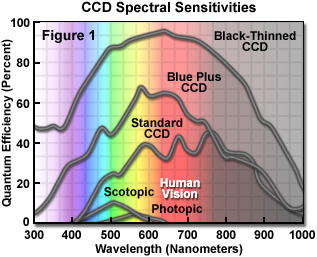


The CCD in Hubble is far less than your eye.

https://answers.yahoo.com/question/index?qid=20090207234120AAvedWz

"The Wide Field Camera 3 (WFC3), which is to be installed during the servicing mission in 2009, will also have 2 CCD chips each of 2048 x 4096 pixels for a total of 16 mega-pixels. "

http://www.cambridgeincolour.com/tutorials/cameras-vs-human-eye.htm

"Most current digital cameras have 5-20 megapixels, which is often cited as falling far short of our own visual system. This is based on the fact that at 20/20 vision, the human eye is able to resolve the equivalent of a 52 megapixel camera (assuming a 60° angle of view)."

So even someone with less than 20/20 vision (52 megapixels) has more resolution that Hubble which only amounts to 16 megapixels.

And we have not even started to talk about light extinction due to dust, the amount of which has been sadly underestimated.

https://en.wikipedia.org/wiki/Ulysses_%28spacecraft%29

"Ulysses discovered that dust coming into the Solar System from deep space was 30 times more abundant than previously expected."

9
Flat Earth Debate / Re: "south star" not visible from northern hemisphere
« on: January 28, 2016, 04:53:40 PM »
Here's an article with a great time-lapse photo taken of the night sky near the equator. The Flat Earth Model cannot explain why the stars closer to directly overhead are traveling in a straight line across the sky, while their paths become more and more circular around two separate points as you look farther to the north and south. The Flat Earth Model insists that all stars are rotating around a single point in the "center", but this photo would be impossible if that were true.
You are assuming the flat disk is spinning like a record player, and not spinning end over end which would produce the exact same results you see in that picture, would it not????

Be honest.

Not an advocate of FE, but that claim wont stand as it first assumes the disk must be spinning as if on a record player, not if you tumbled the record end for end along a center axis.

And asnswers the north and south pole star problems as well.


Well no!  On the (supposed) flat earth:
The north pole is in the centre of the disk (and the North Celestial Pole is above that) and
the south pole is, err, well there isn't one! and so where is the South Celestial Pole?
That is the whole question, the flat earth has no place for a single point South Celestial Pole.
And yet unlike the north celestial pole stars that are visible from the same latitude everywhere, the south pole stars are not visible from the same latitude everywhere. This defeats that argument on its face. If it is applicable to the North pole stars - it should be applicable to the south pole stars - under the theory of a globe.

You are assuming that FE'rs are correct in their interpretation in the first place of locations and spins in order to argue against their interpretation, yes? But if you place the North pole near the edge, just as they place the south pole on the edge - then all problems are resolved. All interpretations then match exactly what we see. I am not arguing they are correct in their interpretation of the placement of the poles and map - just that a correct placement could make the theory match exactly with what we observe.

And as I stated - am not a supporter of FE, just playing Devil's Advocate and showing there are many other interpretations available but that of standard theory.
I know you are "just playing Devil's Advocate", but I don't follow "You are assuming that FE'rs are correct in their interpretation in the first place of locations and spins in order to argue against their interpretation, yes?"
  • I certainly don't "assuming that FE'rs are correct" in anything about theor flat earth model.
  • In my interpretation of their model, the flat earth is not rotating at all, but the "heavens" are rotating above it centred on the North Celestial Pole.
I guess it's just a way of putting, and in there end on any FE model I have seen there is no way the southern hemisphere stars could rotate about South Celestial Pole.

Of course, it is the earth rotating and the North Celestial and South Celestial Poles are just extensions of the asix of rotation.

They can not if you refuse to place the north pole at one edge and the south pole directly opposite to it. Then spin the disk end over end and you get the same results you would see now.

To understand the flaws in modern cosmology you must first understand aberration of starlight. Only then can you begin to see the problems associated with modern astronomy.

Imagine that picture of the star trails as a flat disk. Then place one pole on one edge and the other pole near the other edge. Spin it end over end and that is exactly what you see, just as in the picture.

But really I don't hold to FE - the flaws in modern cosmology are too numerous to even begin which is why 96% of cosmology is ad-hoc explanations and FE is the least of their problems.

10
Flat Earth Debate / Re: "south star" not visible from northern hemisphere
« on: January 28, 2016, 04:50:09 PM »
Simply put, you can probably take a disk and do strange and wonderful things to it (ad hoc explanations) to create an effect, like in this case. You can have a map with the N.Pole in the middle to take care of many things north of the equator. You can have another with the S.Pole in the middle to take care of the southern stuff. You can ...

But each model is different. There is no single FE model/map that handles everything. Just ad hoc explanations that MAY work for one situation but cause problems in all the other situations.

The RET/heliocentric one handles these situations without changing models - naturally, elegantly.

Not true. Place the North pole on one end and the south pole on the opposite end and it fits all observations.

The RET/heliocentric model fails to explain why the south polar stars are not visible regardless of location on the same latitude while the north ones are. Since the same situation is supposed to apply on a globe regardless of north or south pole, then like the north pole constellations that are visible regardless of position on the same latitude, so should the south pole constellations be visible regardless of position on the same latitude. But this is not the case.

In fact the only model that does work is a disk with the north pole "near" the edge and a south pole "on" the edge directly opposite one another on a flat disk spinning end over end. If the RET/heliocentric model was correct as advertised - you would see the south pole constellations from all positions on the same latitude just as you see the north pole constellations from any location on the same latitude.

Now understand I am not advocating FE, just showing that the RET/heliocentric model does not fit all observations as advertised and claimed. No more that the current FE model does.

But to get into a more scientific explanation one has to understand aberration of starlight to understand the flaws with our current cosmology.

11
Technology, Science & Alt Science / Re: Telescope Distances
« on: January 28, 2016, 10:04:32 AM »
The short answer: the CCD's used in telescopes and cameras are much more sensitive than the human eye. And you mention yourself that prolonged exposures pushes that difference even further. On top of that it has the ability to detect infrared and other frequencies that the human eye cant see at all. I dont really see how the sensitivity of the human eye is relevant to begin with to be honest...noone is actually looking through these telescopes with their eyes, they are watching a screen.

And the eyes determines what you eventually see. But the ability to see other spectrum's has nothing to do with the telescopes ability to gather light. Only the size of the aperture determines that. The Hubble's aperture enables it to gather 127,551 times more light - regardless of which spectrum it looks in. If it looks in the infrared spectrum it sees no more light than it's aperture allows - and then does not see in the visible spectrum.

https://starizona.com/acb/basics/observing_theory.aspx

"How much more light a telescope gathers compared to the unaided eye is determined by the ratio between the light-gathering area of the telescope and the light-gathering area of the eye. "

What spectrum it looks in has nothing to do with the distance it can see. The distance is determined solely by its aperture size. It receives all wavelengths, just as your eye does. It's ability to focus on a different wavelength has nothing to do with the distance it can see, which again is solely determined by the aperture size. It would see no further in infrared then it would in the visible spectrum, the same amount of light is gathered regardless of which spectrum it looks in.

Resolution may be increased - but distance is unaffected.

12
Flat Earth Debate / Re: "south star" not visible from northern hemisphere
« on: January 28, 2016, 09:53:34 AM »
Here's an article with a great time-lapse photo taken of the night sky near the equator. The Flat Earth Model cannot explain why the stars closer to directly overhead are traveling in a straight line across the sky, while their paths become more and more circular around two separate points as you look farther to the north and south. The Flat Earth Model insists that all stars are rotating around a single point in the "center", but this photo would be impossible if that were true.
You are assuming the flat disk is spinning like a record player, and not spinning end over end which would produce the exact same results you see in that picture, would it not????

Be honest.

Not an advocate of FE, but that claim wont stand as it first assumes the disk must be spinning as if on a record player, not if you tumbled the record end for end along a center axis.

And asnswers the north and south pole star problems as well.


Well no!  On the (supposed) flat earth:
The north pole is in the centre of the disk (and the North Celestial Pole is above that) and
the south pole is, err, well there isn't one! and so where is the South Celestial Pole?

That is the whole question, the flat earth has no place for a single point South Celestial Pole.

And yet unlike the north celestial pole stars that are visible from the same latitude everywhere, the south pole stars are not visible from the same latitude everywhere. This defeats that argument on its face. If it is applicable to the North pole stars - it should be applicable to the south pole stars - under the theory of a globe.

You are assuming that FE'rs are correct in their interpretation in the first place of locations and spins in order to argue against their interpretation, yes? But if you place the North pole near the edge, just as they place the south pole on the edge - then all problems are resolved. All interpretations then match exactly what we see. I am not arguing they are correct in their interpretation of the placement of the poles and map - just that a correct placement could make the theory match exactly with what we observe.

And as I stated - am not a supporter of FE, just playing Devil's Advocate and showing there are many other interpretations available but that of standard theory.

13
Technology, Science & Alt Science / Re: Evolution debate in detail
« on: January 27, 2016, 08:24:29 PM »
Here's a link.

http://www.truthingenesis.com/2013/01/03/carbon-dating-flaws-doesnt-carbon-dating-disprove-the-bible/

What they don't like to mention is that radiocarbon dating was based upon Enrico Fermi's theory of beta decay. His theory was found to violate parity and was later revised, but radiocarbon dating never was.

Also they don't like to mention that it varies with solar output and radioactive decay is not even constant from one solar flare to the next.

http://news.stanford.edu/news/2010/august/sun-082310.html

14
Technology, Science & Alt Science / Re: Evolution debate in detail
« on: January 27, 2016, 07:57:27 PM »
It's pretty simple really when you do not ignore observational data.

Asian mates with Asian and produces only Asian. African mates with African and produces only African. Only when Asian and African mate is a new infraspecific taxa entered into the record (Afro-Asian).

Husky mates with Husky and produces only Husky. Mastiff mates with Mastiff and produces only Mastiff. Only when Husky and Mastiff mate is a new infraspecific taxa entered into the record (Chinook).

The Asian remains Asian, the African remains African. Neither evolved into the Afro-Asian and no missing links are missing.

The Husky remains Husky, the Mastiff remains Mastiff. Neither evolved into the Chinook and no missing links are missing.

Just as T-Rex remained T-Rex and Triceratops remained Triceratops - as each and every one of them did from the oldest fossil found to the youngest one found.

Fossils have simply been misconstrued as belonging to separate species, when as per empirical observations they are simply different infraspecific taxa of the same species.

These:


Are in reality no different than these:


Just different infraspecific taxa of the species to which they belong.

If evolutionists had never seen a dog before and found fossils of the Husky and Mastiff, and then later in the strata found fossils of the Chinook, they would insist the Husky or the Mastiff evolved into the Chinook. And would be wrong of course.

The fossil record is simply the result of ignoring empirical observations of how life actually propagates. Ignoring the variation they see right before their eyes while postulating something not once observed.

15
Technology, Science & Alt Science / Telescope Distances
« on: January 27, 2016, 07:34:34 PM »
How far do you believe the Hubble allows us to see?

It's mirror has a surface area of 49,062.5 cm^2 the average human eye has a surface area of  0.38465 cm^2.

In comparison with the lens of the eye it has an objective diameter of 357.14 times larger than the human eye. It's surface area is 127,551 times that of the human eye.
This means Hubble collects 127,551 times more light than the human eye, so can make objects appear 127,551 times brighter than with the human eye.

Now, being the inverse square law of light says that the apparent intensity of the light of a point source is inversely proportional to the square of its distance to the observer. This means that if the distance of a star is doubled its apparent light is reduced four times. If its distance is increased three times its apparent luminosity is reduced nine times.

https://en.wikipedia.org/wiki/Inverse-square_law

Assuming that a star is so far away that it is barely visible to the naked eye, we know that the Hubble telescope can make the star appear 127,551 times brighter. Does this mean that the  Hubble telescope enables an observer to see the star if it were 127,551 times farther away? The answer is no. The Inverse Square Law says that the light that we receive from a star is  inversely proportional to the square of its distance. According to this law, at that distance, the light of the star becomes 127,551^2 or 16,269,262,700  times dimmer, far too dim for us to see with the telescope.

This raises the question: What is the maximum distance an object can be seen through the Hubble telescope? The  answer is 357.14 times the distance that the naked eye can see. The  reason is that an object 357.14 times farther away, its light  becomes 127,551 times dimmer. Since the Hubble telescope can make a star appear 127,551 times brighter, then looking through the telescope the star would be barely visible.

Of course this does not take into account long exposures to film or digital media which would increase the distance several times.

So would someone taking the inverse square law of light into effect show me how we can see galaxies a claimed 13.7 billion light years away? Remember - magnification spreads out the light received and so does not make a star appear brighter, but actually dimmer. Because this would mean the human eye can see 38,360,306 million light years?????

http://www.physics.ucla.edu/~huffman/m31.html

16
Flat Earth Debate / Re: "south star" not visible from northern hemisphere
« on: January 27, 2016, 07:17:49 PM »
Here's an article with a great time-lapse photo taken of the night sky near the equator. The Flat Earth Model cannot explain why the stars closer to directly overhead are traveling in a straight line across the sky, while their paths become more and more circular around two separate points as you look farther to the north and south. The Flat Earth Model insists that all stars are rotating around a single point in the "center", but this photo would be impossible if that were true.


You are assuming the flat disk is spinning like a record player, and not spinning end over end which would produce the exact same results you see in that picture, would it not????

Be honest.

Not an advocate of FE, but that claim wont stand as it first assumes the disk must be spinning as if on a record player, not if you tumbled the record end for end along a center axis.

And asnswers the north and south pole star problems as well.

Pages: [1]